
TL;DR:
- Yes, you can rent a car in Saudi Arabia as a resident or visitor, but you need a licence that's actually valid here — a Saudi licence, a GCC licence, or a foreign licence paired with an International Driving Permit (IDP) in many cases — plus matching ID and a credit card in your own name.
- Minimum age is commonly 21, often 23–25 for SUVs and luxury categories — this is set by each company, not a single national rule, so confirm before you book.
- The quoted daily rate is rarely the final price. Insurance level, fuel policy, one-way drop fees, cross-border cover and any traffic fines earned during the rental all move the total.
- Saher camera fines don't disappear when you return the car. They get billed to your card after the fact, usually with an added administration fee.
- Renting wins for short stays. Once you're past roughly three to four weeks, it's worth totalling the numbers — buying a used car locally and reselling it later is often cheaper than months of rental payments.
Quick answer: Renting a car in Saudi Arabia requires a minimum age (commonly 21+), a valid licence — Saudi, GCC, or a foreign licence plus an International Driving Permit in many cases — matching ID, and a credit card for the security deposit. The final cost depends on the car category, insurance level, season and duration, and fuel, fines, cross-border cover and one-way fees can all add to the quoted rate. For trips of a few weeks, renting is usually simplest; for stays of several months, buying a car locally is often the cheaper route.
Do you actually need a rental car?
Before comparing rental companies, it's worth a five-second gut check, because the right answer isn't the same for every visitor. If you're in the Kingdom for Umrah, Hajj, a short business trip, or a family visit measured in days or a couple of weeks, renting is almost always the right call — it's fast, flexible, and you walk away with zero commitment when you fly home.
If you're relocating for work, starting a longer assignment, or you already know you'll be here for several months, the calculation changes. A rental car is priced for short-term convenience, and that convenience has a cost that compounds the longer you keep the car. We'll come back to the actual breakeven logic later in this guide, but keep the question in the back of your mind as you read: is this a trip, or the start of a longer stay?
There's also a narrower, practical case: your own car is in for repairs or a Fahes inspection, and you need something to drive for a few days. A short rental is the obvious bridge — no need to read any further than the requirements below.
Who can rent a car in Saudi Arabia
Every rental company sets its own policy, but the requirements converge on the same core checklist. Meet all of it and booking is straightforward; miss one item and you can be turned away at the counter with a confirmed reservation in hand.
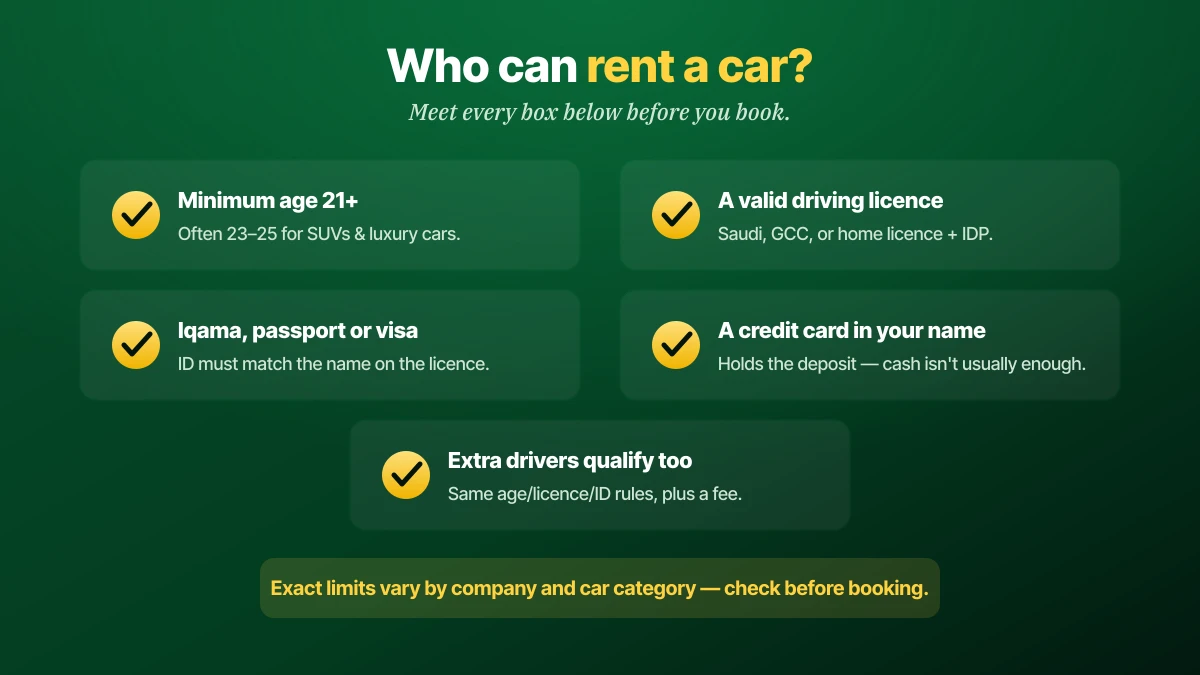
- Minimum age. Commonly 21, but many companies raise this to 23–25 for SUVs, larger vehicles or premium categories — and some also charge a young-driver surcharge below a certain age.
- A valid driving licence. A Saudi licence or a recognized GCC licence is straightforward. With a foreign licence, many companies also want an International Driving Permit (IDP) alongside your home licence, and the exact rule can depend on your nationality and how long you'll be driving. If you're a resident converting or applying for a local licence, our Saudi driving licence guide covers that process.
- Matching ID. Residents show an Iqama; visitors show a passport (with entry visa where applicable). The name on your ID must match the name on the licence and the booking.
- A credit card in your own name. This is how the security deposit is held. Debit cards and cash are frequently refused for the deposit, even if you can pay the rental fee itself that way — ask before you arrive at the counter if you're not sure.
- Any additional driver must qualify independently. If someone else will also be driving, they need to meet the same age, licence and ID requirements — and adding them is usually a paid extra, not a formality.
None of this is standardized by a single national rule; it's set company by company and can change, so the safest approach is to confirm your specific documents against your specific rental company before you fly or drive to the counter.
Documents you'll need
What counts as valid ID and licensing depends on who you are when you show up to collect the car. This quick reference covers the three common cases.
| You are… | Licence needed | Also bring |
|---|---|---|
| Saudi citizen or resident | Saudi driving licence | National ID or Iqama, credit card |
| GCC national | Valid GCC-country licence | National ID/passport, credit card |
| International visitor | Home licence, plus an IDP in many cases | Passport, entry visa, credit card |
Two habits save real trouble later. First, sort out your IDP (if you'll need one) in your home country before you travel — it typically can't be arranged after arrival. Second, photograph every document you bring, plus the rental agreement itself, and keep copies on your phone; if a question comes up mid-rental, having everything on hand resolves it faster than trying to re-source paperwork from abroad.
What's your car worth?
Get a free instant estimate based on real Saudi market data — then sell it on KSAplate with direct WhatsApp contact.
Value My Car — FreeRental categories & terms
Rental fleets in Saudi Arabia are overwhelmingly built around GCC-spec vehicles — the same regionally-tuned cars covered in our GCC spec vs American spec guide — so you're generally getting a car designed for the climate rather than an import. Beyond the car itself, three things define the rest of the booking: category, rental term, and pickup location.
| Category | Typical use case | Usual minimum age | Relative daily cost |
|---|---|---|---|
| Economy / compact | City driving, solo or couple travel | 21+ | Lowest |
| Mid-size sedan | Family trips, longer highway drives | 21–23+ | Low–medium |
| SUV / 7-seater | Groups, luggage, desert or rural roads | 23–25+ | Medium–high |
| Luxury / premium | Business travel, special occasions | 25+ | Highest |
On terms: most companies offer daily, weekly and monthly rates, and the per-day cost typically drops as the commitment lengthens — a monthly rate is almost always cheaper per day than booking the same month in daily blocks. Mileage may be unlimited or capped with a per-kilometre charge beyond the limit, so check this if you're planning a long intercity drive. Pickup location matters too: airport branches are convenient but often carry a location surcharge that a city-center branch doesn't.
Insurance: what's actually covered
Every rental comes with some level of insurance bundled into the price, but "included" and "fully covered" are not the same thing. Basic coverage typically handles third-party liability and standard collision damage up to a point, usually with an excess (deductible) you're responsible for if the car is damaged.
Comprehensive or "zero-excess" upgrades reduce or remove that deductible, usually for an extra daily fee, and are worth considering if you're unfamiliar with local roads or driving conditions you don't normally deal with. What's commonly excluded regardless of level: damage to tyres, windscreens and the underbody, driving on unpaved or off-road terrain, and anything that happens while the agreement itself was violated (an unlisted driver, for instance). Before you pay for an upgrade, check whether your credit card or travel insurance already includes rental car cover — it sometimes overlaps, and paying twice for the same protection is an easy way to overspend. For how insurance works once you own a car outright, see our car insurance in Saudi Arabia guide.
What actually drives the price
There's no single national rental rate — prices are set by each company and move with several factors, which is why two people can rent an identical car for very different amounts.
- Season. Peak periods — Hajj, Umrah high season, national holidays and school breaks — push demand and prices up; booking outside these windows tends to be noticeably cheaper.
- Category and duration. Larger, newer or premium cars cost more per day, and weekly/monthly commitments lower the effective daily rate versus booking day by day.
- Insurance level. Comprehensive or zero-excess cover adds a daily amount on top of the base rate.
- Pickup location. Airport counters commonly add a location or facility fee that a city branch doesn't charge.
- Extras. Additional drivers, child seats, GPS units and similar add-ons are usually priced per day, not as one-time fees.
The way to compare offers fairly is the same discipline used when thinking about the real cost of owning a car: total everything — base rate, insurance upgrade, extras, and any fees you can anticipate — rather than comparing bare daily prices across companies.
Fees & gotchas that catch renters out
Most rental disputes trace back to a handful of recurring surprises. None of them are hidden exactly — they're written into the agreement — but few people read that agreement closely before signing.
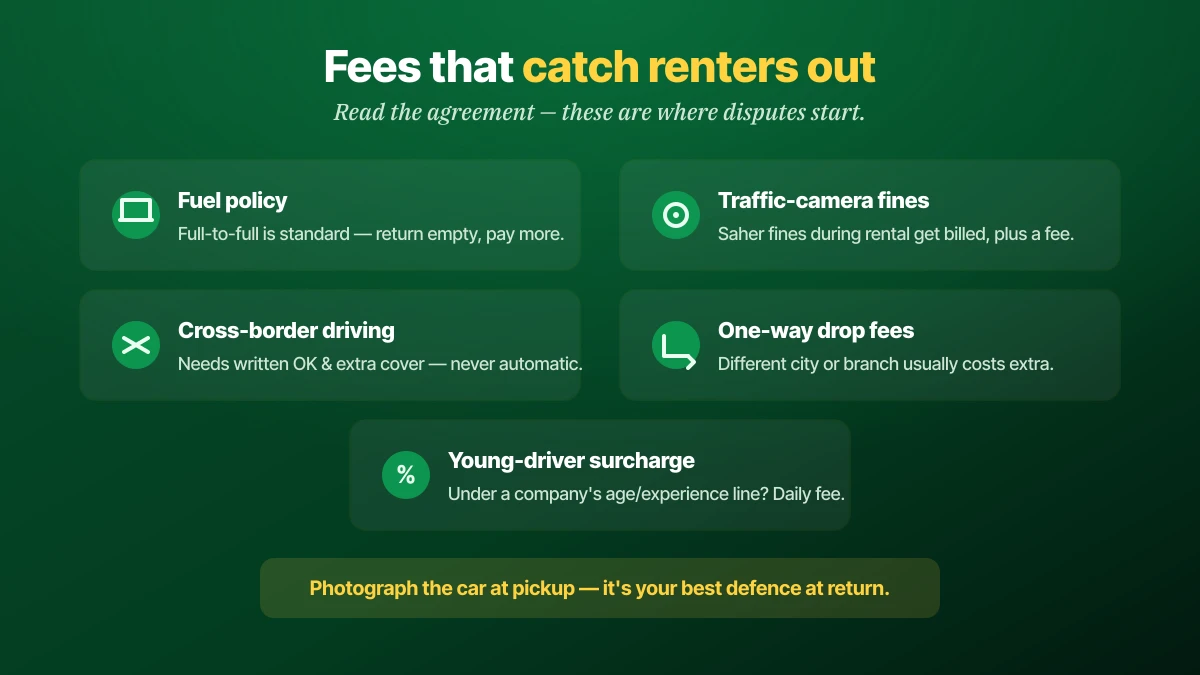
- Fuel policy. Full-to-full is the standard arrangement: you receive the car full and return it full. Bring it back with less and you'll typically pay for the missing fuel at a marked-up rate, not the pump price.
- Traffic-camera (Saher) fines. Speeding or other camera-detected violations during your rental are tied to the car, not you directly — the rental company receives the fine, then bills it to your card after you've returned the car, usually with an administration fee added. Handing back the keys doesn't close this out. See our guides on checking and paying traffic fines and Saher cameras and speed limits for how the system works.
- Cross-border driving. Taking a rental car into another GCC country is not automatic — it needs the company's written approval in advance and usually extra insurance. Crossing a border without it can void your cover entirely.
- One-way drop fees. Returning the car to a different city or branch than where you picked it up usually triggers a separate fee, sometimes a substantial one on longer routes.
- Young or inexperienced-driver surcharge. Fall under the company's age or licence-experience threshold and expect a daily surcharge on top of the base rate, even if you otherwise qualify to rent.
The deposit itself is its own small gotcha: the hold on your card is typically released some days after you return the car, not instantly, so don't plan on that balance being available again immediately.
Rent or buy: which wins for you
This is the honest question most rental guides skip, because a rental company's answer is obviously going to be "rent." The real answer depends entirely on how long you actually need a car.
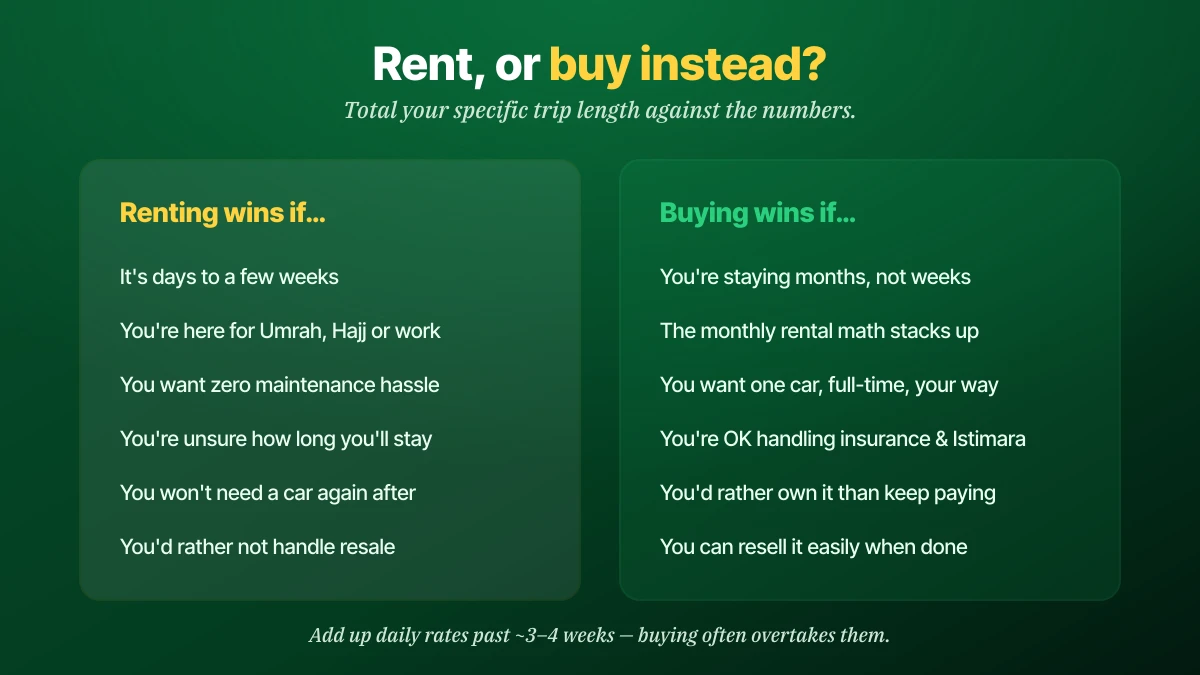
Renting wins if your trip is measured in days to a few weeks, you're here for Umrah, Hajj or a defined work trip, you want zero maintenance or insurance-shopping hassle, you're genuinely unsure how long you're staying, or you simply won't need a car again once this visit ends.
Buying wins if you're staying for months rather than weeks, the running total of daily or weekly rental payments is starting to rival a monthly car payment, you want one car full-time without repeated paperwork, and you're comfortable handling insurance and an annual Istimara renewal like any other owner. A practical rule of thumb: once you're past roughly three to four weeks, start adding up what you've already paid in rental fees against what a modest, well-inspected used car bought locally would cost you over the same period — including the fact that you can resell it later rather than simply handing back the keys with nothing to show for it. Our guides to valuing a car, comparing new vs used, and car finance options can help you run the actual numbers. When you're ready to compare, you can browse the KSAplate marketplace for a car near you, and when it's time to move on, list it for sale instead of returning it to a counter.
Picking up & returning without a dispute
Almost every rental dispute comes down to one side saying "that damage was already there" and the other disagreeing. You can close that gap entirely with a few minutes of effort at both ends of the rental.
- At pickup: walk around the entire car and photograph or film every panel, the wheels, the windscreen and the interior, including the fuel gauge and odometer reading. Do this before you drive off, not after.
- Cross-check the paperwork. Make sure any existing scratches or marks noted by staff on the handover sheet match what you can actually see — get anything missed added to the form on the spot.
- At return: repeat the same photos, ideally with staff present, and get written or digital confirmation that the car was accepted with no new damage noted.
- Keep everything. Hold on to the agreement, your photos and any confirmation until well after your card statement shows the deposit released — that's your evidence if a disputed charge appears later.
Mistakes to avoid
Most rental problems are avoidable with a little preparation before you book.
- Assuming any foreign licence works everywhere. Confirm whether you need an IDP before you travel — it's usually not something you can arrange after landing.
- Skipping the fine print on insurance. Know your excess and what's excluded before you need to make a claim, not after.
- Ignoring the fuel policy. Returning the car with less fuel than you received it with is one of the most common — and easily avoided — extra charges.
- Driving across a border without written permission. This can void your insurance entirely, leaving you fully exposed if anything happens.
- Not photographing the car. Skipping pickup and return photos removes your best evidence if a damage dispute comes up later.
- Never revisiting the rent-vs-buy question. A "short trip" that quietly becomes months of repeated rentals is often the most expensive way to have a car in Saudi Arabia.
Frequently asked questions
Can tourists rent a car in Saudi Arabia?
Do I need an International Driving Permit (IDP) to rent a car in Saudi Arabia?
What is the minimum age to rent a car in Saudi Arabia?
Can I pay a cash deposit instead of using a credit card?
Am I responsible for traffic fines during my rental?
Can I drive a rental car from Saudi Arabia into another GCC country?
What insurance is included with a rental car?
Is it cheaper to rent or buy a car in Saudi Arabia?
What happens if I return the rental car with less fuel than I picked it up with?
Can I extend my car rental in Saudi Arabia?
What should I do if I have an accident in a rental car?
Conclusion & next steps
Renting a car in Saudi Arabia is straightforward once you know what's actually being checked at the counter: age, a licence that's genuinely valid here, matching ID, and a credit card for the deposit. From there, the real cost isn't the daily rate on the booking page — it's that rate plus your insurance choice, the fuel policy, any cross-border or one-way fees, and the traffic fines that follow you home if you're not careful on the road. Photograph the car at pickup and return, read the agreement's fee schedule, and you'll avoid nearly every dispute renters run into.
The question worth revisiting honestly is how long you actually need the car. For a trip measured in days or a couple of weeks, renting wins on convenience every time. For a stay of several months, run the numbers against buying — start with valuing a car and comparing new vs used, then browse the KSAplate marketplace for something that fits, or list your current car when it's time to move on. Either way, you'll make the call with the real numbers in front of you instead of guessing.