TL;DR:
- A Saudi driving licence is the official permit from the General Department of Traffic (Muroor) that lets you legally drive on Saudi roads. Everything runs through your Absher account.
- Hold a licence from an approved country (about 47, including the UK, USA, EU, Canada, Australia and every GCC state)? You convert it — translation, medical check and a fee, no driving test.
- First-time or unlicensed driver? You take the full path: medical exam, theory test, then 6–30 hours of practical training and a road test at an approved school.
- Fees are low: SAR 40 per year for a private licence — SAR 200 for 5 years, SAR 400 for 10. The real cost is the medical, translation and school hours.
- An international or foreign licence is valid for only 1 year in Saudi Arabia. Let your Saudi licence expire and you face fines from SAR 240 and possible impoundment.
Quick answer: To get a Saudi driving licence, register on Absher, pass a medical exam, then either convert an existing licence from an approved country (no test) or complete a theory test plus practical training and a road test. A private licence costs from SAR 40 per year, and the whole process usually takes one to three weeks.
What a Saudi driving licence is
A Saudi driving licence is the official document, issued by the General Department of Traffic (Muroor) under the Ministry of Interior, that authorises a person to drive a specific class of vehicle in the Kingdom. It is tied to your national ID or Iqama, recorded digitally in Absher, and checked at every traffic stop, registration and insurance step.
The most common class is the private (light vehicle) licence for cars and small SUVs. Separate classes exist for motorcycles, heavy vehicles and public-transport vehicles. The minimum age to hold a private licence is 18. Women have held full driving rights since 2018 and follow exactly the same process as men.
Two facts decide your entire journey: your age and whether you already hold a valid licence from a recognised country. The second one is the fork in the road.
Classes of Saudi driving licence
A Saudi driving licence is issued by class, and each class covers a defined group of vehicles. Choosing the right class matters, because a licence for one type does not legally cover another.
- Private (light vehicle): cars, small SUVs and light pickups. This is the licence most residents need and the focus of this guide.
- Motorcycle: a separate class for two-wheelers, with its own test and fee.
- Heavy vehicle: trucks and large vehicles. Fees are higher — SAR 50 per year — and it generally requires holding a private licence first.
- Public transport: buses and taxis, which carry additional requirements beyond the standard private class.
For the vast majority of expats and new drivers, the private light-vehicle licence is the one to apply for. Upgrades to heavy or public-transport classes are handled as separate applications once you already hold a private licence.
Two routes: convert or take the full test
There are exactly two ways to end up with a Saudi licence. You either convert an existing foreign licence, or you earn one from scratch through a driving school. Which route you take is not a choice — it is set by the licence you already hold.
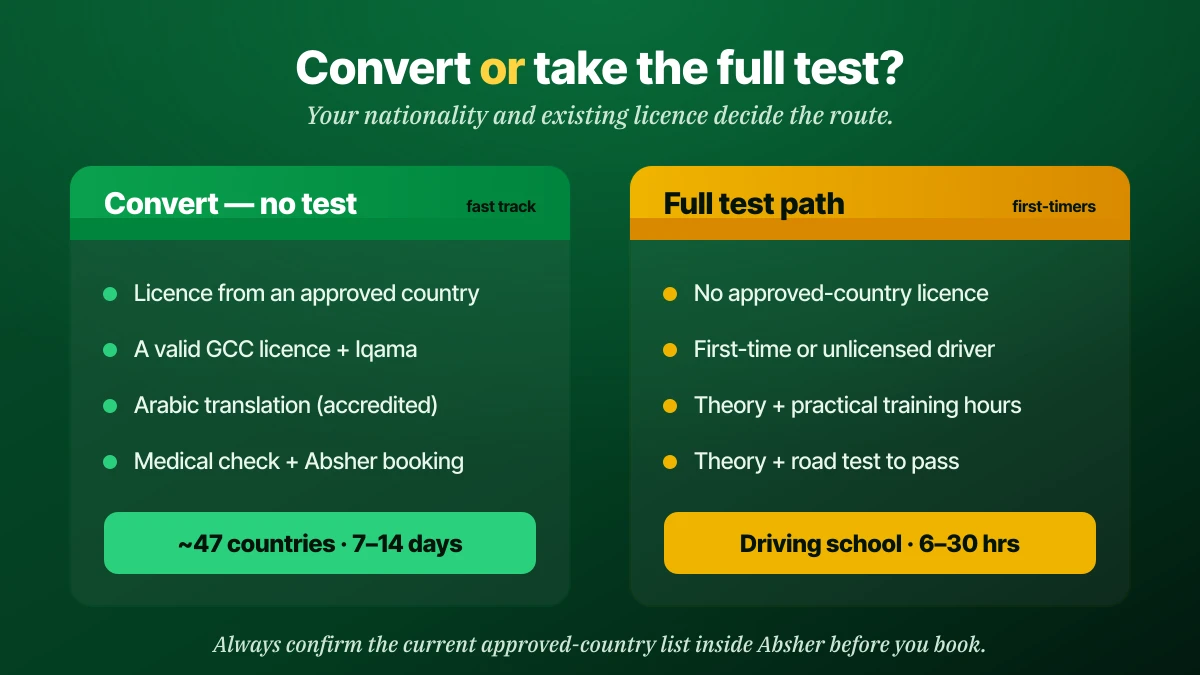
If your licence comes from one of roughly 47 approved countries, you skip the tests entirely. If it does not — or you have never held a licence — you go through the school. Here is the side-by-side.
| Factor | Convert (no test) | Full test path |
|---|---|---|
| Who it is for | Holders of an approved-country or GCC licence | First-time drivers, or licences from non-approved countries |
| Driving test | None | Theory + practical road test |
| Training hours | None required | 6–30 hours by evaluation |
| Medical exam | Required | Required |
| Translation | Foreign licence must be translated to Arabic | Not applicable |
| Typical timeline | 7–14 days | 2–6 weeks |
| Typical total cost | Lower (no school fees) | Higher (school + test fees) |
The single question that decides your route: "Do I hold a valid licence from an approved country?" If yes, you convert. If no, you train and test.
What's your car worth?
Get a free instant estimate based on real Saudi market data — then sell it on KSAplate with direct WhatsApp contact.
Value My Car — FreeConverting a foreign licence
Converting a foreign driving licence is the process of exchanging a valid licence from a recognised country for a Saudi one without sitting a driving test. It is the fastest route and the one most professionals and skilled expats use.
Approved countries. The General Department of Traffic maintains a list of roughly 47 approved countries whose licences can be converted without a test. It includes the United Kingdom, the United States, Canada, Australia, New Zealand, the EU member states and every Gulf Cooperation Council (GCC) country. The list is updated periodically, so confirm yours inside Absher or with Muroor before you book.
GCC licences. If you hold a valid licence and residency from a GCC state — the UAE, Kuwait, Bahrain, Qatar or Oman — your licence transfers to a Saudi one without a driving test. This is the smoothest conversion of all.
Translation. Any non-Arabic licence must be translated into Arabic by an accredited translation office. Approved offices sit close to the Muroor centres in Riyadh, Jeddah and Dammam, and a certified translation is what the traffic department accepts.
The conversion itself is short: translate the licence, pass the medical check, book the appointment on Absher, submit the original licence with your documents, pay the fee, and collect the Saudi licence. Start to finish, expect 7 to 14 days, most of it waiting on the translation and the appointment slot.
Getting a licence from scratch: 5 steps
If you have no convertible licence, you earn a Saudi licence through an approved driving school. The process is standardised across the Kingdom and runs through Absher from start to finish.
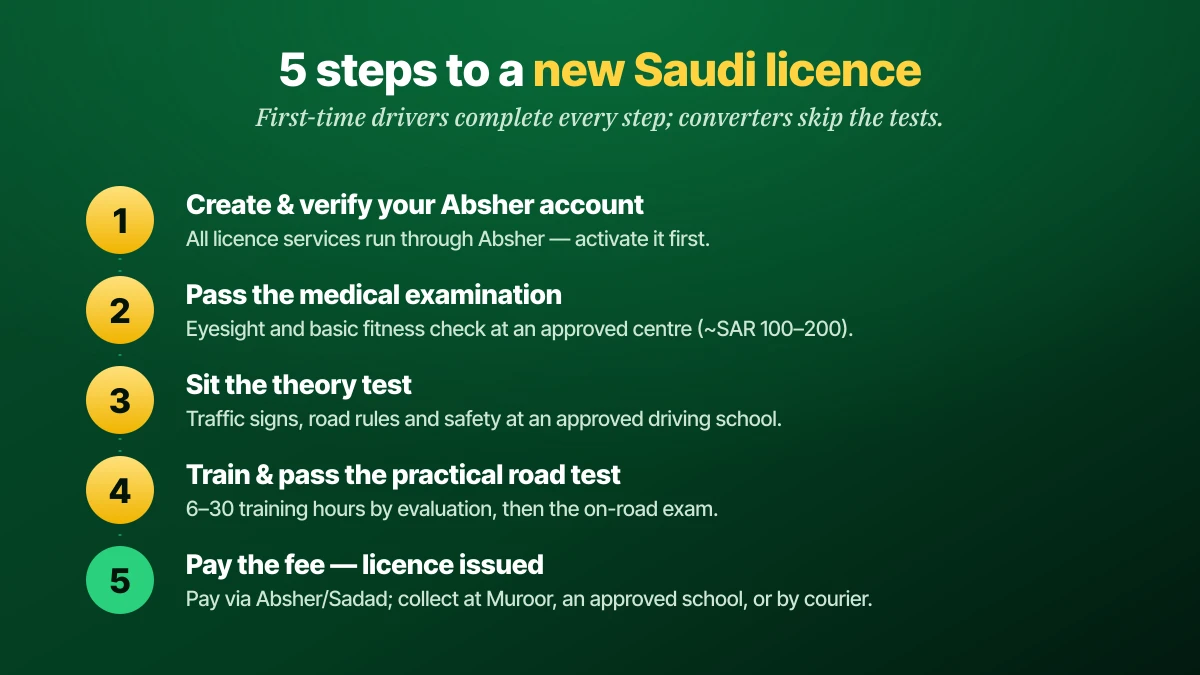
- Create and verify your Absher account. Every licence service — booking, payment, status — runs through Absher. Activate it and make sure your Iqama and contact details are current.
- Pass the medical examination. Visit an approved medical centre for an eyesight and basic fitness check. It costs roughly SAR 100–200 and the result is sent to your file electronically.
- Sit the theory test. Book through an approved driving school and study traffic signs, road rules and safe-driving principles. The test confirms you understand Saudi traffic law before you touch the road.
- Train and pass the practical road test. After an initial evaluation, the school assigns a training band — commonly 6, 15 or 30 hours depending on your skill. You then sit the on-road practical exam.
- Pay the fee and collect your licence. Pay through Absher via the Sadad system. Collect the licence at a Muroor office, at the school, or have it couriered to you.
Experienced drivers without a convertible licence are not automatically forced into 30 hours of lessons. The school evaluates you first — pass the assessment and you may be placed in the shortest training band.
Documents you need
Whether you convert or test, the document set is broadly the same. Have these ready before you book your Absher appointment:
- An active, verified Absher account linked to your Iqama.
- Original Iqama (residence permit) and passport.
- A completed medical examination from an approved centre.
- Four passport-sized photos (4×6 cm).
- Your original foreign licence plus a certified Arabic translation, if converting.
- Sponsor or employer identification, where required.
- A copy of your appointment confirmation.
The most common reason an application stalls is a mismatch between your Iqama details and your Absher record. Fix that first — it saves a wasted trip.
Fees: what you really pay
The headline fee for a Saudi private driving licence is SAR 40 per year, and you choose how many years to pay up front. Paying for ten years at once is the same flat rate — there is no penalty for the longer term, and it spares you the renewal admin.
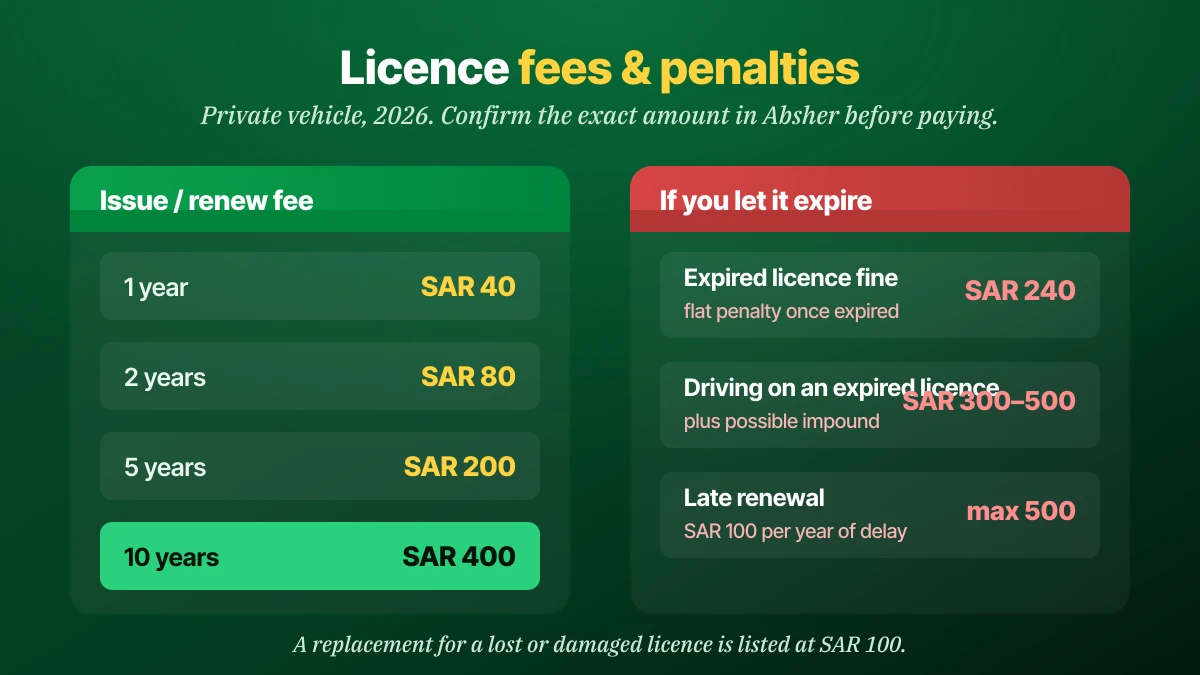
| Validity | Private licence | Heavy-vehicle licence |
|---|---|---|
| 1 year | SAR 40 | SAR 50 |
| 2 years | SAR 80 | SAR 100 |
| 5 years | SAR 200 | SAR 250 |
| 10 years | SAR 400 | SAR 500 |
| Lost / damaged replacement | SAR 100 | |
The government fee is the cheap part. Your real outlay is everything around it: the medical exam (SAR 100–200), the certified Arabic translation if you convert, and — on the test path — the driving-school training hours, which are the biggest single cost. Budget for the school, not the licence sticker.
Renewing your Saudi licence
Renewing a Saudi driving licence is a fully online task done through Absher — no office visit needed in most cases. The renewal periods mirror the issue fees: 2, 5 or 10 years.
Inside Absher, open My Services → Traffic → Renew Driving Licence, confirm your details, choose the renewal period, and pay through Sadad. A fresh medical check (around SAR 100) is usually required, and it links to your file automatically. The new validity is applied immediately.
Set a reminder for a month before expiry. Renewing early costs the same as renewing on time — and far less than renewing late.
The one-year foreign-licence trap
A foreign or international driving licence is valid in Saudi Arabia for a maximum of one year. After that, it is no longer accepted, and continuing to drive on it is the same as driving with no licence at all.
This catches new residents constantly. They arrive on a valid home licence or an International Driving Permit, assume it lasts as long as their stay, and let the twelve months slide by. The moment it lapses, every traffic stop, insurance claim and accident report becomes a problem.
Treat your first year as a countdown. If your licence is convertible, convert it early; if it is not, start driving school within the first few months. Do not wait for the one-year mark.
Penalties for an expired or invalid licence
Driving on an expired Saudi licence is a traffic violation with escalating costs. The penalties are designed to make renewal the obviously cheaper choice:
- Expired licence fine: a flat penalty of around SAR 240 once the licence has lapsed.
- Driving on an expired licence: roughly SAR 300–500, and the vehicle can be impounded at the roadside.
- Late renewal surcharge: about SAR 100 for each year of delay, capped at SAR 500.
Beyond the fines, an invalid licence can void an insurance payout after a crash — turning a minor accident into a major financial loss. Keeping the licence current is the cheapest insurance you will ever buy.
After the licence: the rest of car ownership
The licence is step one. Once you can legally drive, the rest of Saudi car ownership opens up — and each stage has its own process. A valid licence is the foundation that every other step sits on.
- Ready to buy? Our guide to buying a used car in Saudi Arabia walks through inspection and transfer.
- You will need to renew the vehicle registration (Istimara) and arrange car insurance before driving.
- Keep an eye on the rules for checking and paying traffic fines, and know how to report an accident with Najm.
And when you choose your car, the number on it matters too. A distinctive plate holds and grows in value — value any Saudi plate on our calculator before you buy or sell.
Frequently asked questions
Can expats get a Saudi driving licence?
How much does a Saudi driving licence cost?
Which countries' licences can be converted without a test?
Can I drive in Saudi Arabia on my foreign or international licence?
How long does it take to get a Saudi driving licence?
How do I renew my Saudi driving licence?
What happens if my licence expires?
Do women follow a different process?
Do I need a Saudi licence to register or insure a car?
Conclusion & next steps
Getting a Saudi driving licence comes down to one fork and one habit. The fork: if you hold a licence from an approved country, convert it — translate, take the medical, pay the fee, skip the test. If you do not, go through an approved school for the theory and practical path. The habit: never let the licence — or your first-year foreign licence — quietly expire, because that is where the real costs and risks begin. Sort the licence early, then build the rest of your car ownership on top of it. And when you pick the car, pick the number too — value any plate on our calculator and make it part of the deal.