
TL;DR:
- A used car is usually the smarter financial buy in Saudi Arabia — a 3–5 year-old car typically costs 35–45% less than new while skipping the steepest depreciation, which hits hardest in the first three years.
- A new car wins on certainty: a full 3–5 year warranty, the latest safety tech, no hidden history, and predictable costs — but you pay a premium plus 15% VAT and absorb the fastest value loss.
- Total cost, not sticker price, decides it. Add depreciation, finance profit, insurance and maintenance for the years you'll keep the car — used almost always wins on this number.
- Used only wins if you verify the car. Run a history check, inspect it, and confirm a fair price before you commit — a cheap car with a bad past is no saving.
- Pick a model that holds value. Toyota and Nissan retain value best in the Kingdom, which protects you whether you buy new or used.
Quick answer: For most buyers in Saudi Arabia, a used car is the better value — a 3–5 year-old vehicle costs roughly 35–45% less than new, avoids the steepest depreciation, and carries a lower insurance premium. Buy new only if you keep cars long-term and want full warranty, the latest tech, and zero history risk. Whichever you choose, decide on total cost of ownership, not the sticker price, and always check a used car's history and value first.
The short answer
If you are buying purely on value, a used car wins in Saudi Arabia. A well-kept vehicle that is three to five years old typically sells for 35–45% below its original new price, yet it has already absorbed the harshest part of depreciation — the steep drop that happens in the first three years. You let the first owner pay for that loss.
A new car is not a mistake, though. It buys certainty: a full factory warranty (commonly three to five years in the Kingdom), the newest safety and technology, a clean and known history, and stable, predictable costs. The trade-off is that you pay the highest price, add 15% VAT, and lose value fastest in the early years.
So the honest answer is: used for value, new for peace of mind. The rest of this guide gives you the numbers and the framework to know which side you fall on — and how to buy safely once you decide.
New vs used: side by side
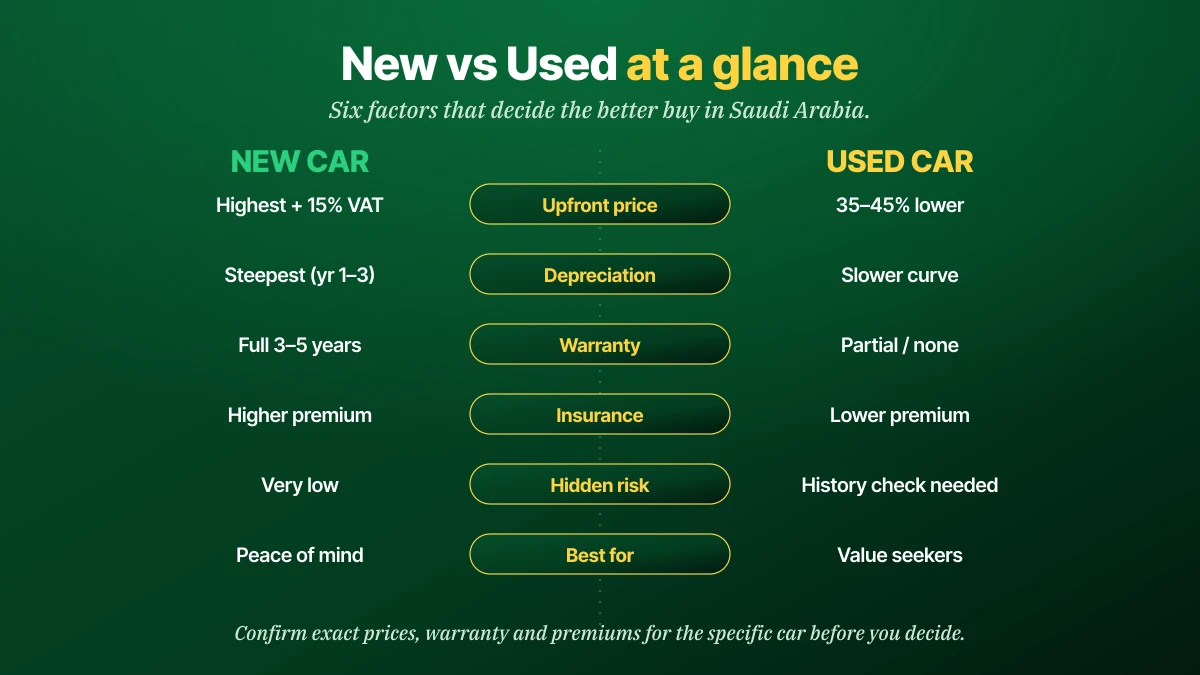
Before the detail, here is the whole decision on one screen. Each factor below is where new and used genuinely differ for a Saudi buyer.
| Factor | New car | Used car |
|---|---|---|
| Upfront price | Highest, plus 15% VAT | 35–45% lower (3–5 yrs old) |
| Depreciation | Steepest in years 1–3 | Slower, flatter curve |
| Warranty | Full 3–5 years | Partial or none |
| Insurance premium | Higher (higher value) | Lower |
| Hidden history risk | Effectively none | Real — must verify |
| Latest tech & safety | Yes | One or more generations behind |
| Best for | Long-term keepers, peace of mind | Value seekers, shorter holds |
Notice the pattern: new wins every certainty row, used wins every cost row. Your decision is really a question of how much you will pay for certainty — and that price is the depreciation gap we break down next.
Depreciation: the hidden cost
Depreciation is the single biggest cost of owning a car, and it is invisible until you sell. It is the gap between what you paid and what the car is worth later — and on a new car, most of that gap opens in the first three years.
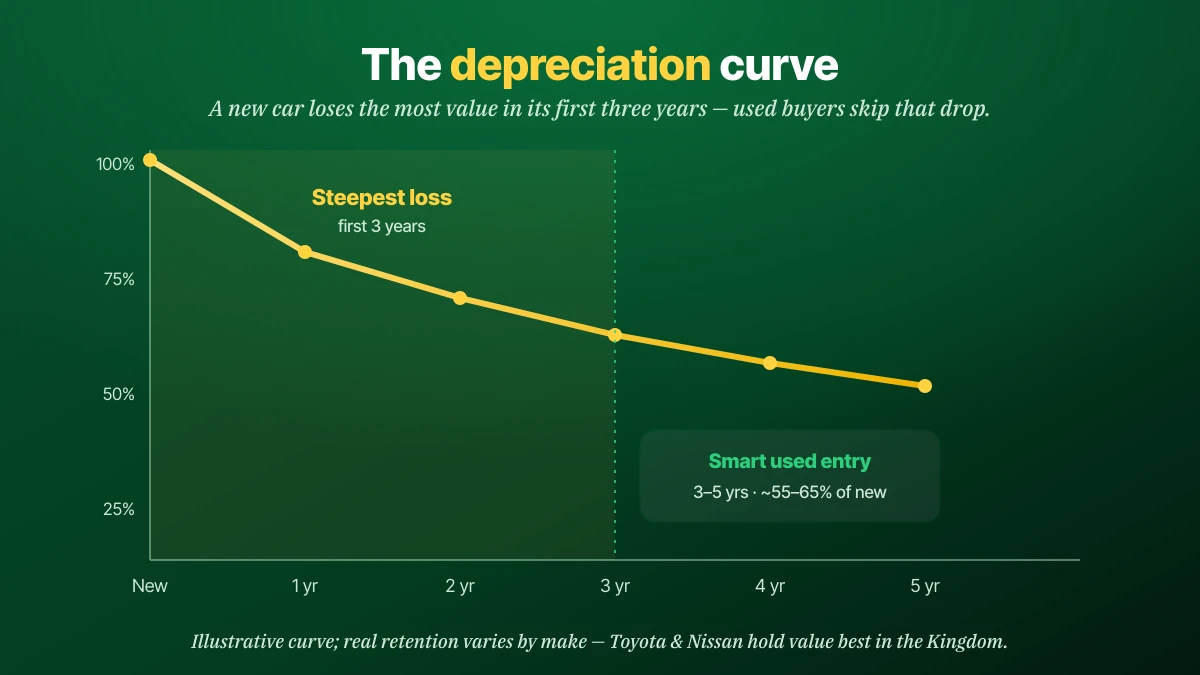
A typical car keeps only around 55–65% of its value after five years, and the slope is steepest at the start — a meaningful share of value can disappear in year one alone. This is exactly why a lightly used car is such good value: the first owner already absorbed the steep early loss, and you step onto the flatter part of the curve where each year costs you far less.
It also explains why "best resale value" matters whichever way you buy. A model that holds value protects a new buyer (smaller loss) and rewards a used buyer (the car stays sellable). In the Kingdom, Toyota and Nissan are the benchmark here — some models retain well over 70–80% after five years, far better than the market average.
The cheapest car to own is rarely the cheapest to buy. It is the one that loses the least value while you own it. Always check resale strength before you sign — use our used-car value guide to see what a model is really worth.
What's your car worth?
Get a free instant estimate based on real Saudi market data — then sell it on KSAplate with direct WhatsApp contact.
Value My Car — FreeTotal cost of ownership
The right way to compare new and used is total cost of ownership (TCO): everything the car costs you across the years you keep it, not just the price on the windscreen. Five things make up TCO, and depreciation usually dwarfs the rest.
- Depreciation — the value lost between buying and selling. Biggest cost on a new car, smallest on a used one.
- Finance profit — the markup or rent you pay if you finance rather than pay cash. See our car finance guide.
- Insurance — higher on a more valuable (newer) car. Comprehensive cover is required while financed.
- Maintenance & repairs — low and often warranty-covered on new; rising but still modest on a well-chosen used car.
- Fuel & registration — broadly similar for the same model, new or used.
When you add these up over, say, five years, the used car's lower depreciation and lower insurance usually outweigh its slightly higher maintenance. That is why a used car almost always wins on TCO — provided you picked a reliable example and a value-holding model.
A worked SAR example
Numbers make this concrete. Compare two versions of the same popular sedan: brand new, and the same model three years old. Figures are illustrative, but the shape of the result is what matters.
Option A — buy new
New price SAR 100,000 (VAT included). After three years it might be worth around SAR 62,000. That is roughly SAR 38,000 of depreciation in three years — your single largest cost — before insurance, finance profit and maintenance are added. Insurance on a higher value is higher too.
Option B — buy the 3-year-old version
You buy the same car used for about SAR 62,000. Over the next three years it might fall to around SAR 45,000 — roughly SAR 17,000 of depreciation. You also pay a lower insurance premium on the lower value. Maintenance is a little higher and the factory warranty may be partial, but the gap nowhere near closes the depreciation difference.
On depreciation alone the used buyer is roughly SAR 21,000 better off over three years for the same car and the same daily experience. Add lower insurance and the case strengthens further. The new buyer's extra spend bought warranty, the latest tech, and certainty — which is exactly what you are weighing.
Run this same comparison on the actual car you want before deciding. Get a realistic used price from our value guide, then browse live listings on KSAplate to see what that money buys today.
When new is the right call
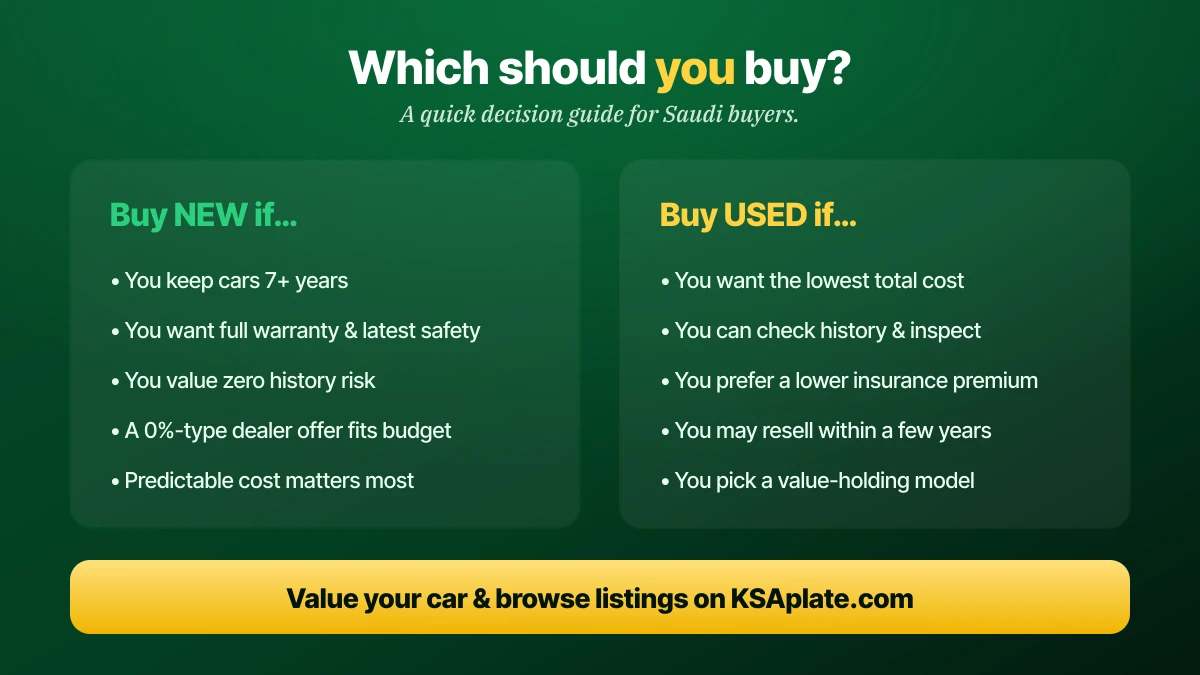
New makes sense when certainty and long ownership outweigh the depreciation premium. Choose new if most of these describe you:
- You keep cars for seven years or more. Holding long spreads the steep early depreciation across many years, softening its yearly bite.
- You want full warranty and the latest safety. A 3–5 year factory warranty and current driver-assist tech remove both repair worry and risk.
- You want zero history risk. A new car has no accidents, no odometer doubt, no previous-owner neglect.
- A strong dealer offer fits your budget. Promotional rates or low/zero-down deals can narrow the cost gap — read the all-in total, not the monthly figure.
- Predictable cost matters most. Known service intervals and warranty cover make budgeting simple.
When used is the right call
Used makes sense when value is your priority and you are willing to verify the car. Choose used if most of these fit:
- You want the lowest total cost. Lower price, lower depreciation and lower insurance compound into real savings.
- You can check history and inspect. A history check and a workshop inspection turn the main risk into a managed one.
- You prefer a lower premium. A lower insured value means a smaller comprehensive premium each year.
- You may resell within a few years. Starting on the flat part of the curve means you lose less when you sell.
- You choose a value-holding model. A reliable, in-demand car is easy to insure, cheap to run, and quick to sell.
Most working families and value-focused buyers — locals and expats alike — land here. The savings are real, and the only condition is doing your homework before you pay.
Financing new vs used
Financing is available for both, but the terms differ. New-car finance is usually simpler and cheaper, with lower or promotional profit rates and easy dealer approval. Used-car finance is also widely available, but the profit rate is typically higher and lenders impose limits on the car's age (often up to around 10–12 years at loan maturity) and mileage.
Either way, judge the deal on the total amount payable, not the monthly instalment, and remember SAMA caps your debt-burden ratio and the admin fee. Our car finance guide walks through Murabaha, Ijara and Tawarruq, down payments, tenor and your rights. A useful rule for the new-vs-used decision: if a new-car promotional rate is much cheaper than used finance, it can shrink — though rarely erase — the depreciation advantage of buying used.
Insurance & running costs
Insurance is cheaper on a used car because the premium follows the car's value. A lower insured value means a lower comprehensive premium every year — a small but recurring win for the used buyer. Third-party cover is the legal minimum, while comprehensive is required while financed and strongly advised for any newer or valuable car.
Running costs tilt the other way, modestly. A new car sits under warranty with predictable servicing, while a used car may need more frequent maintenance as it ages. The key is choosing a reliable model with available, affordable parts — pick well and the maintenance gap stays small. See our car insurance guide to estimate premiums for each option before you commit.
Models that hold value
Resale strength should shape your shortlist whether you buy new or used, because it decides how much you lose. The principle is simple: cars in high, steady demand depreciate slowly, so they cost less to own and sell faster when you need to move on.
- Toyota — Camry, Corolla and Land Cruiser are the value-retention benchmark; some hold well above market average after five years.
- Nissan — the Patrol is famous for holding value strongly in the Kingdom; family models stay in demand.
- Hyundai — popular, well-priced models like the Elantra retain value better than their price suggests.
Whatever badge you choose, confirm the specific car's worth before you buy or sell. Our value guide shows how to price any model against the real market so you neither overpay nor under-sell.
Buying used and selling within a few years? Resale strength is your most important filter — it can matter more than the purchase price itself.
Buy used the safe way
A used car only beats new if it is a good used car. Follow this sequence and you turn the main risk of buying used into a controlled, manageable step.
- Set your budget on total cost. Include the price, expected insurance, and likely depreciation — not just what you can borrow per month.
- Value the model first. Use our value guide so you know a fair price before you negotiate, then browse cars on KSAplate.
- Run a history check. Confirm mileage, accident and service history with a car history check before you view.
- Inspect properly. Get an independent workshop inspection — our used-car buying guide lists exactly what to check.
- Avoid the scams. Know the warning signs from our used-car scams guide before you pay a deposit.
- Transfer ownership correctly. Finalise the deal and registration through Absher ownership transfer with insurance in place.
Do these and the used car's price advantage becomes a real, risk-free saving rather than a gamble. Ready to sell your current car first? List it on KSAplate and put the proceeds toward your next one.
Mistakes to avoid
The new-vs-used decision goes wrong in predictable ways. Avoid these and you protect both your budget and your peace of mind.
- Comparing sticker prices, not total cost. A cheaper new deal can still cost more to own once depreciation and insurance are counted. Compare TCO.
- Underestimating new-car depreciation. The biggest cost of a new car is the value it loses in years one to three — budget for it, don't ignore it.
- Buying used without a history check. Skipping verification is how a "bargain" becomes an accident-damaged or odometer-rolled liability.
- Choosing a poor-resale model. A car that depreciates fast is expensive to own new and hard to sell used. Resale strength first.
- Judging finance by the monthly figure. A low instalment can hide a long term and a high total. Ask for the total amount payable.
- Over-buying. Stretching to a bigger or newer car than you need raises every cost at once — price, finance, insurance and depreciation.
Frequently asked questions
Is it better to buy a new or used car in Saudi Arabia?
How much cheaper is a used car than a new one?
Why do new cars lose value so fast?
What is total cost of ownership?
Can I finance a used car in Saudi Arabia?
Does buying new or used protect resale value better?
Is a used car reliable enough?
Do I pay VAT on a used car?
How many kilometres is too many for a used car?
Conclusion & next steps
New versus used comes down to one trade: certainty against cost. A new car buys a full warranty, the latest tech and a clean history, but you pay the most and lose value fastest. A used car — three to five years old, verified and value-holding — costs far less to buy and own, which is why it is the smarter choice for most Saudi buyers. Decide on total cost of ownership, not the sticker price, and let the car lead the decision: pick a reliable, in-demand model, confirm a fair price, and only then choose how to pay. Start now — value the model you want, browse cars on KSAplate, and when you're ready, list your current car to fund the upgrade.