
Last updated: 13 August 2026 · 12 min read
A new car in Saudi Arabia typically loses 15–25% of its value in the first year and 50–60% over five years — but the model you choose changes that number more than anything else. A Toyota Land Cruiser or Hilux can hold 60–70% after five years, while a discounted sedan or an early electric car can shed more than half in three. Depreciation is the single biggest cost of owning a car, larger than fuel, insurance and servicing combined — and it is the one cost you can plan around before you buy.
Depreciation is a silent expense. You never write a cheque for it, yet it quietly takes more from your pocket than the petrol pump ever will.
- Year one is the cliff. A typical new car drops 15–25% the moment it is registered and driven; by year five it retains roughly 40–50% of the sticker price.
- Body-on-frame Toyotas and Nissans win. Land Cruiser, Hilux, Patrol and Prado are the Kingdom's strongest value holders, often keeping 60–70% after five years.
- Fast losers: heavily discounted new sedans, first-generation EVs, low-demand European luxury out of warranty, and anything with a gap in its service history.
- The Saudi customs rule deducts 10% per year (capped at 50%) from a car's value — a useful government-anchored benchmark for a "fair" resale figure.
- Your car depreciates; a distinctive plate can appreciate. It is the one car-linked asset in Saudi Arabia that can be worth more when you sell than when you bought it.
What car depreciation actually means
Car depreciation is the difference between what you pay for a vehicle and what you can sell it for later. It is not a fee or a tax — it is the market re-pricing your car every day it ages, gains kilometres and slips a model year behind the showroom.
In Saudi Arabia the effect is easy to see on Syarah, Haraj and dealer lots: two identical trims, one a year apart, can sit SAR 15,000–30,000 apart on price with barely 20,000 km between them. That gap is depreciation made visible. Because it is baked into the resale price rather than a line on a bill, most buyers underestimate it — and then feel it all at once on the day they sell.
Key takeaway: depreciation is the largest single cost of car ownership in the Kingdom. Choosing a slow-depreciating model is the most powerful money decision you make about a car — bigger than haggling over the purchase price or shopping for cheaper insurance.
How fast cars lose value in Saudi Arabia
Depreciation is fastest early and slows with age. A new car in Saudi Arabia usually loses 15–25% in year one, then roughly 10–15% of the original price each year until about year three, after which the curve flattens to 5–8% a year. By the end of five years a mainstream car retains around 40–50% of what it cost new; the strongest holders keep far more.
This is why the used market is where the value is. The steepest part of the curve — the first-year "cliff" — is paid entirely by the first owner. Buy a well-kept two-year-old car and you let someone else absorb the drop, which is the core argument in our guide to buying new versus used in Saudi Arabia.
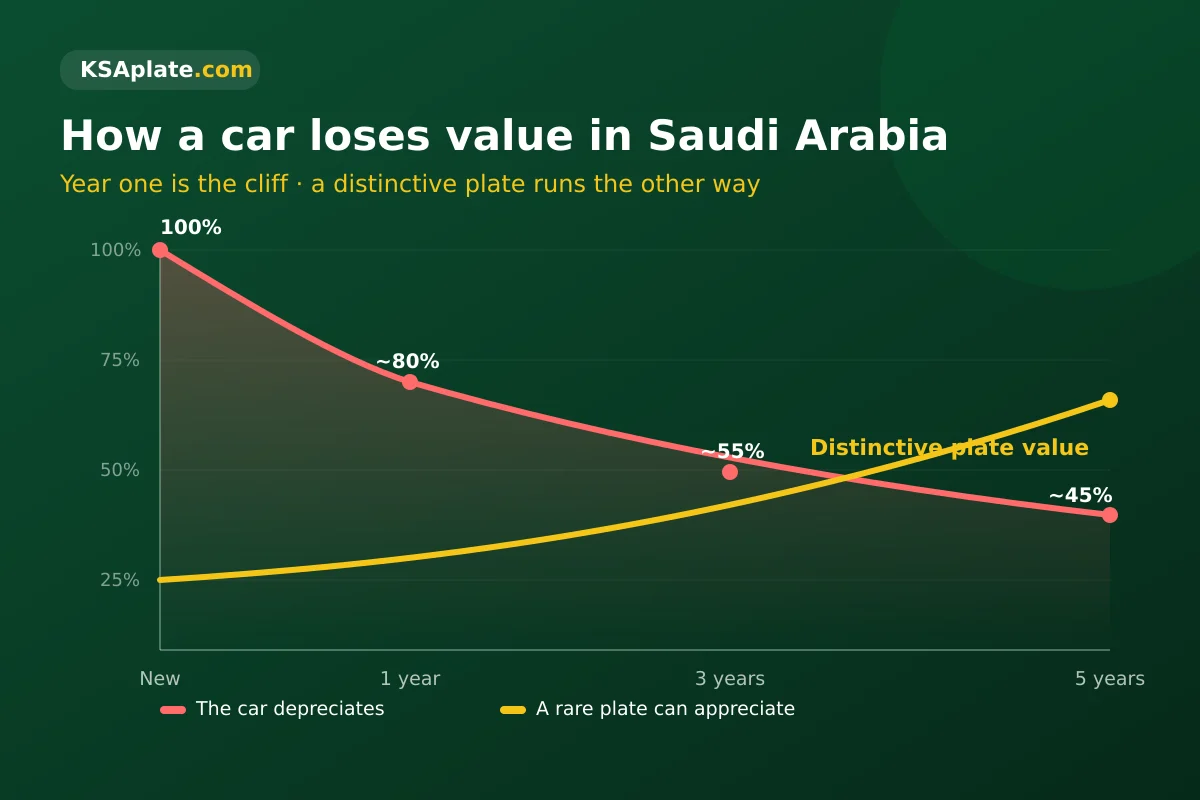
| Age of car | Typical value retained | Annual drop |
|---|---|---|
| New (day one) | 100% | — |
| 1 year | 75–85% | 15–25% |
| 3 years | 55–65% | ~12% / year |
| 5 years | 40–50% | ~6–8% / year |
| 8 years | 25–35% | ~5% / year |
Indicative ranges for a mainstream petrol car in Saudi Arabia; strong holders (below) sit well above these figures. Confirm any specific car against live listings and a valuation.
The first owner pays for the newness. The second owner pays for the car. In depreciation terms, year two is the smartest seat in the house.
The 5-year value-retention matrix (by model)
Value retention is the share of a car's original price it still commands after a set number of years — the mirror image of depreciation. In Saudi Arabia, retention is driven by reliability in heat, spare-parts availability, dealer network depth and plain resale reputation. The table below is the KSAplate retention matrix: a Saudi-specific read built from GCC resale data, the ZATCA customs depreciation schedule, and patterns we see in first-party plate-and-car listings.
| Model / segment | ~5-year value retained | Depreciation tier |
|---|---|---|
| Toyota Land Cruiser | 62–70% | ★★★★★ Elite holder |
| Toyota Hilux | 60–68% | ★★★★★ Elite holder |
| Nissan Patrol | 58–66% | ★★★★★ Elite holder |
| Toyota Prado / Fortuner | 55–63% | ★★★★☆ Very strong |
| Toyota Camry / Corolla | 52–60% | ★★★★☆ Very strong |
| Honda Accord / Civic | 48–56% | ★★★★☆ Strong |
| Hyundai / Kia (mainstream) | 42–50% | ★★★☆☆ Average |
| MG / leading Chinese SUVs | 38–48% | ★★★☆☆ Improving fast |
| European luxury (out of warranty) | 30–40% | ★★☆☆☆ Weak |
| First-generation EVs | 30–42% | ★★☆☆☆ Weak but rising |
The pattern is consistent: a reliable body-on-frame Toyota or Nissan that thrives in desert heat and has spare parts in every town holds value best. A Land Cruiser bought for SAR 300,000 that still fetches SAR 195,000 after five years has "cost" about SAR 21,000 a year in depreciation; a European saloon that halves in the same period costs double that from depreciation alone. When you are ready to check a specific car against the market, our how much is my car worth guide walks through the valuation step by step.
Key takeaway: in the Kingdom, "reliable + parts everywhere + strong reputation" beats "cheap sticker price" every time you sell. Retention, not the discount at purchase, decides your real cost.
Pickups sit at the opposite end of this curve: a Hilux or Land Cruiser pickup holds value in a way sedans do not, which is why they dominate resale lists. We break the segment down in our guide to pickup trucks in Saudi Arabia.
What's your car worth?
Get a free instant estimate based on real Saudi market data — then sell it on KSAplate with direct WhatsApp contact.
Value My Car — FreeWhy Saudi depreciation is different from the West
Saudi depreciation is shaped by local forces that do not exist in Europe or the US, and on balance they are kind to the right cars. The Kingdom's heat, distances and buyer preferences reward rugged, proven vehicles and punish fragile ones — so a Land Cruiser can depreciate noticeably slower here than the same model in a cooler market.
Four Saudi-specific factors move the curve:
- Heat and distance. Cars that survive 50°C summers and long highway runs — and whose parts are cheap and everywhere — keep demand high. Fragile electronics and rare imports lose buyers fast.
- The customs benchmark. For imported used cars, ZATCA applies a 10%-per-year depreciation deduction, capped at 50%. Buyers quietly use this as a "fair value" yardstick even for locally bought cars.
- GCC-spec premium. A GCC-specification car with a clean local history resells more easily than an American- or European-spec import, which is why GCC spec versus American spec matters to your future resale.
- Seasonal demand. Used-car demand swells before summer travel and around bonus periods, then cools — a rhythm we map in the best time to buy a car guide.
In a cooler country a reputation for reliability is nice to have. In Saudi Arabia, where a breakdown can mean the hard shoulder at midday in July, it is worth thousands of riyals at resale.
The fastest-depreciating cars to avoid
The fastest-depreciating cars in Saudi Arabia are the ones with weak resale demand relative to their new price. If you plan to sell within five years, these categories cost the most in silent depreciation, even when the monthly finance looks attractive.
- Heavily discounted new sedans. A big showroom discount is really tomorrow's depreciation brought forward — the used market prices off the discounted street price, not the brochure.
- European luxury out of warranty. Strong badge, steep drop: high parts and repair costs scare second-hand buyers once the agency warranty ends.
- Low-demand or rare imports. Thin buyer pools and awkward spare parts mean long sale times and deep discounts.
- Cars with a broken paper trail. A missing service record or an unclear history flags risk. A clean history and valuation can be worth thousands at sale.
Key takeaway: a low purchase price is not the same as a low cost of ownership. The cheapest car to buy is often the most expensive to own once depreciation is counted.
Do electric cars depreciate faster?
Electric cars have historically depreciated faster than petrol cars, but the gap is closing in 2026. Early EVs lost value quickly — worries about battery life, fast-moving technology and thin used demand pushed first-generation models to keep only 30–42% after five years, versus 45–55% for a comparable petrol car.
That picture is shifting. As charging spreads and used-EV demand matures, resale values are stabilising, and the strongest EV nameplates now track much closer to petrol. For a buyer, the practical rule is simple: a used EV can be a bargain precisely because someone else absorbed the steep early drop — provided you check battery health the way you would check a Saudi EV's charging and warranty details before buying.
| Powertrain | ~3-year value retained | Trend in 2026 |
|---|---|---|
| Reliable petrol SUV/sedan | 55–65% | Stable |
| Hybrid (mainstream) | 50–60% | Improving |
| Electric (strong nameplate) | 45–55% | Rising toward petrol |
| Electric (first generation) | 35–45% | Recovering slowly |
5 levers that slow your car's depreciation
You cannot stop depreciation, but you can bend the curve. These five levers routinely add thousands of riyals to a resale price in Saudi Arabia, and none of them require luck — only discipline.
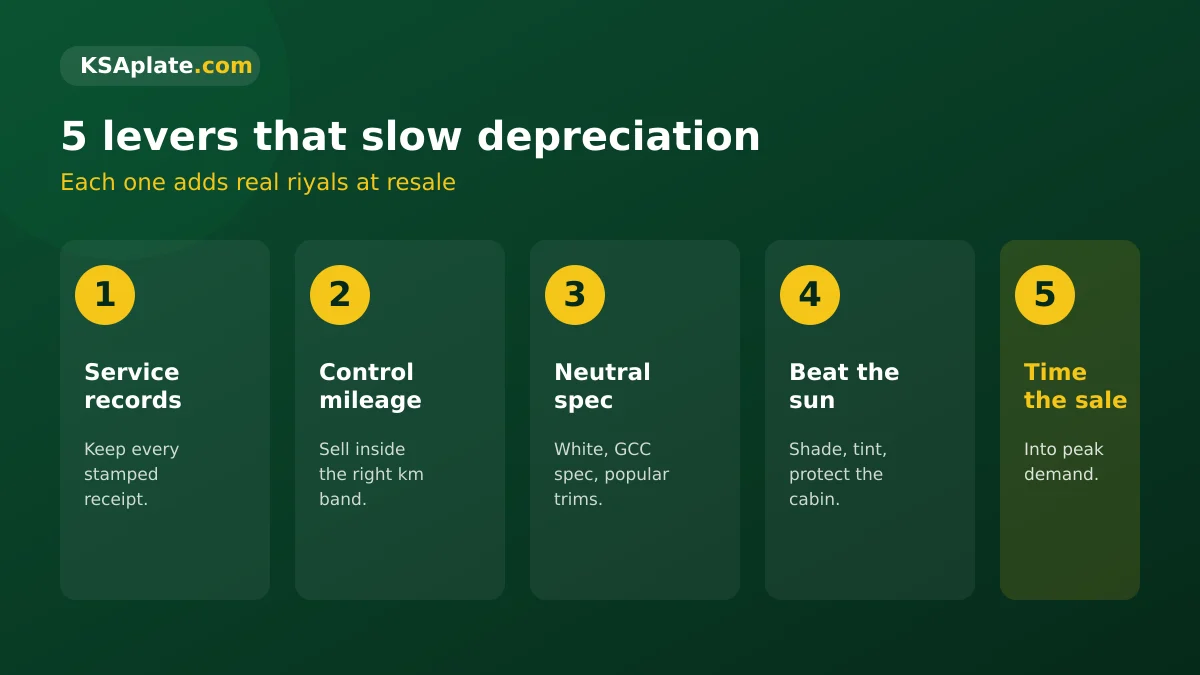
- Keep every service record. A complete, stamped service history is the cheapest value insurance you can buy. Buyers pay for proof, not promises.
- Watch the odometer. Mileage is priced in bands. Selling at 95,000 km rather than 105,000 km can keep you on the right side of a psychological threshold.
- Choose resale-friendly specs and colours. White and neutral tones, popular trims and GCC spec sell faster and higher than niche colours or grey imports.
- Protect the paint and interior from the sun. Sun-faded dashboards and cracked trim scream neglect. Shade, tint within the legal limits and simple care preserve the cabin that buyers judge first.
- Time the sale. Sell before a major service or tyre change is due, and into strong seasonal demand, using our how to sell a car in Saudi Arabia playbook rather than waiting for the car to age into the next price band.
The market does not pay for how well you looked after your car. It pays for how well you can prove it. Records, receipts and photos are worth real riyals.
Depreciation-adjusted cost of ownership
The real monthly cost of a car is its running costs plus depreciation, divided by how long you keep it. Most owners track fuel, insurance and servicing but forget the biggest number — the value quietly draining away — which is why a "cheap" car can turn out to be the expensive one.
Here is the simple method we use:
Depreciation-adjusted monthly cost = ( Purchase price − Expected resale value ) ÷ Months owned + monthly running costs
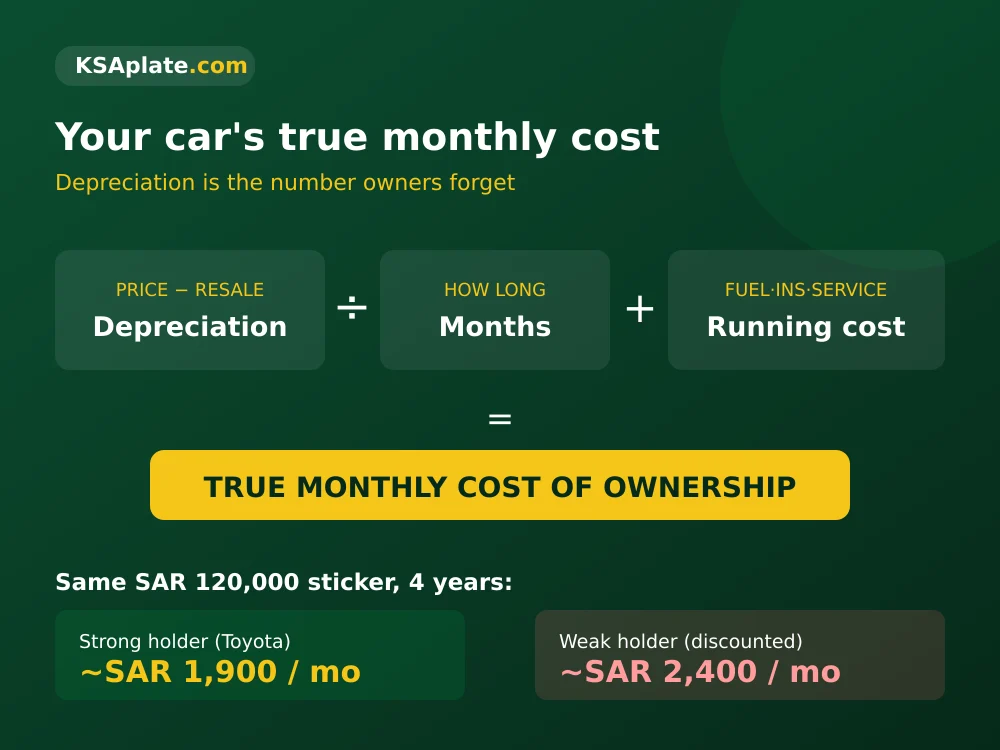
Worked example, two SAR 120,000 cars kept four years (48 months):
| Cost element | Strong holder (Toyota) | Weak holder (discounted saloon) |
|---|---|---|
| Purchase price | SAR 120,000 | SAR 120,000 |
| Resale value after 4 years | SAR 72,000 (60%) | SAR 48,000 (40%) |
| Total depreciation | SAR 48,000 | SAR 72,000 |
| Depreciation per month | SAR 1,000 | SAR 1,500 |
| Running costs / month | ~SAR 900 | ~SAR 900 |
| True monthly cost | ~SAR 1,900 | ~SAR 2,400 |
Same purchase price, same fuel, but the weak holder costs about SAR 500 more every month — SAR 24,000 over four years — purely through depreciation. Fold this into the full picture in our real cost of owning a car in Saudi Arabia breakdown, and revisit the trade-in versus private sale decision when it is time to exit.
The plate that appreciates while your car falls
A distinctive Saudi licence plate is the one car-linked asset that can appreciate while the car it sits on depreciates. The car follows the curve above; a rare number — a single digit, a repeating pattern, a meaningful combination — follows demand for scarcity, and scarcity in the Kingdom has been rising, not falling.
This is unique to Saudi Arabia's system, where a plate is a transferable asset you can keep when you change cars. Sell a five-year-old car for 45% of its price, but the distinctive plate you paid SAR 20,000 for might be worth SAR 28,000 today — because, unlike the car, they are not making more of it. You can read the full case on plates as an investment, but the mechanics are straightforward: when you sell the car, keep the plate, move it to the next vehicle through Absher, or sell it separately at its own market price.
Key takeaway: think of your driveway as two assets, not one. The metal depreciates; the right number can hold or grow. Check what your plate is worth before you assume it should leave with the car.
See both numbers before you sell
Value your plate in seconds, then list your car where the plate market lives too — the only Saudi marketplace built for both.
Value my plate List my carFrequently asked questions
How much does a car depreciate per year in Saudi Arabia?
Which cars hold their value best in Saudi Arabia?
Why do cars depreciate slower in Saudi Arabia than in the West?
Do electric cars lose value faster than petrol cars?
What is the Saudi customs depreciation rate?
Is it cheaper to buy new or used given depreciation?
How do I reduce how much my car depreciates?
Does keeping my licence plate affect the car's resale value?
How do I calculate my car's real monthly cost?
When is the best time to sell to minimise depreciation loss?
Reviewed by Khalid Al-Rashid, Saudi License Plate & Car Market Expert. Figures are indicative market ranges for 2026 and vary by model, mileage and condition — confirm any specific car against live listings and an official valuation.
Sources: ZATCA (zatca.gov.sa) customs valuation schedule; Absher / Moroor (absher.sa) plate and ownership transfer; GCC resale-market data and first-party KSAplate listing observations, 2026.