


TL;DR:
- Pickups are Saudi Arabia's value-retention champions. Our live market curves put a 2017 Hilux around SAR 51,000 today — while a same-age, same-mileage mid-size sedan sits near SAR 34,000. Same years, very different endings.
- The market splits into two worlds: mid-size workhorses (the Hilux class) that prize durability and resale, and full-size American trucks (the Sierra/F-150 class) that prize power, towing and highway comfort — cross-shopping them is the most common buyer mistake.
- Diesel vs petrol is a usage question, not a status question: heavy loads and long desert distances favor diesel torque and range; city-driven lifestyle trucks are usually better served by petrol.
- Used-truck inspection is its own discipline. Frame rust is rare here, but frame damage from off-road abuse, sagging rear leaf springs, sand-eaten 4x4 components and a hammered bed tell the real story — the checklist below covers all of it.
- Buy the truck for the work it will actually do. An empty full-size bed commuting solo through Riyadh traffic is the most expensive lifestyle accessory in the Kingdom; a mid-size doing real farm duty is some of the cheapest transport per year of service.
Quick answer: For most Saudi buyers, a mid-size pickup — Hilux, and its rivals like Navara, D-Max or L200 — is the rational choice: proven against heat and sand, cheap to run, and the strongest resale value in the market. Full-size American trucks (Sierra, Silverado, F-150, Tundra, Ram) earn their extra cost when you genuinely tow, haul heavy or live on the highway. Buy used at 2–4 years old for the best value, inspect the frame and 4x4 hardware before the paint, and check the exact model's market value before negotiating.
Why the Kingdom runs on pickups
No vehicle type is woven deeper into Saudi life than the pickup. It is the farm's lifeline, the contractor's office, the camping convoy's pack mule and — in its full-size American form — a highway statement all at once. That cultural depth has practical consequences for buyers: parts are everywhere, every mechanic knows the common engines by heart, and the used market is deep enough that fair prices are discoverable rather than negotiable folklore.
It also has a financial consequence that surprises newcomers: demand keeps residual values high. A working truck is bought for what it does, not what it promises, and machines that keep doing it — reliably, in heat, on bad roads — hold their price in a way lifestyle vehicles rarely match. The numbers in the resale section make that concrete.
The two truck worlds
Saudi pickup shopping goes wrong most often at the first fork: treating all trucks as one category. They are two, with different jobs, costs and buyers.
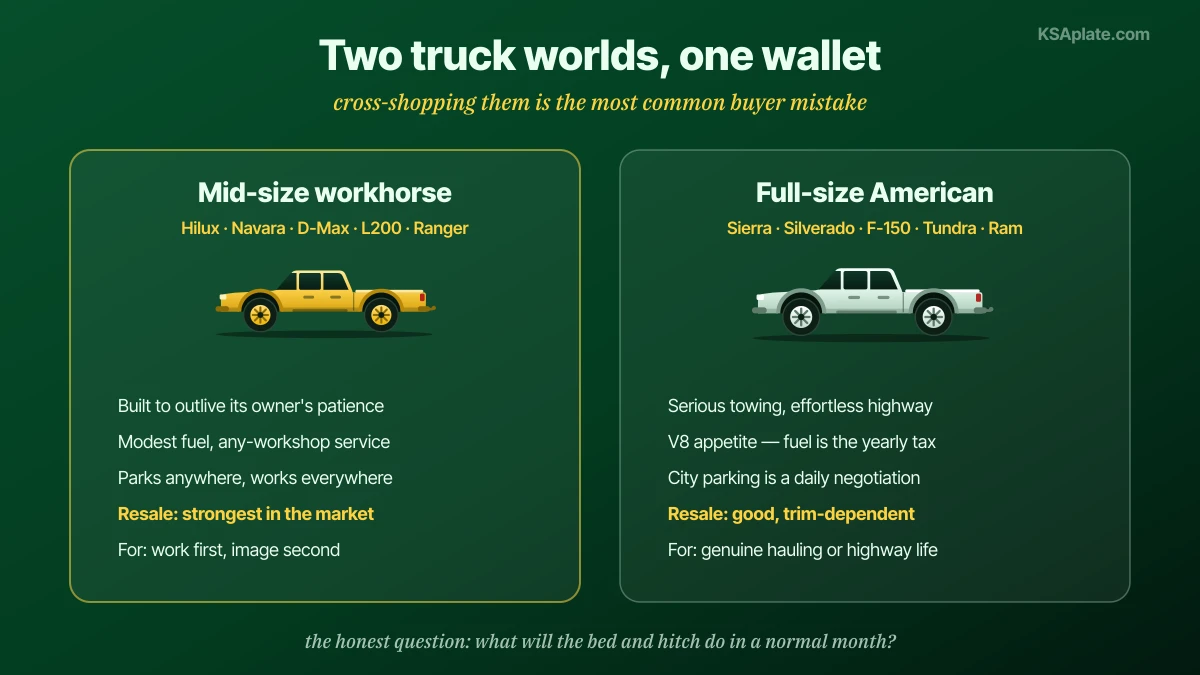
| Mid-size workhorse | Full-size American | |
|---|---|---|
| Typical names | Hilux, Navara, D-Max, L200, Ranger | Sierra, Silverado, F-150, Tundra, Ram |
| Built for | Durability, farm/site duty, fleets | Towing, hauling, highway comfort |
| Fuel appetite | Modest (often diesel option) | Large petrol V6/V8 territory |
| City usability | Parks almost anywhere | A daily negotiation |
| Resale behavior | Strongest in the market | Good for the class, model-dependent |
| Right buyer | Work first, image second | Genuine towing/hauling or highway life |
The honest question before any showroom visit: what will the bed and the hitch actually do in a normal month? If the answer is "carry things sometimes, go to the desert in winter," the mid-size class does everything required and costs meaningfully less at every line of the budget.
Mid-size workhorses: the Hilux class
The Hilux is the reference point — not because alternatives are weak, but because its reputation for surviving abuse defines the segment's expectations. Around it sits a competent field: the Navara brings a more car-like cabin, the D-Max undercuts on price with honest mechanicals, the L200 has a long fleet history, and the Ranger pushes the segment's comfort and tech ceiling.
What to weigh inside the class:
- Cab and bed configuration first. Single cab maximizes bed and price-efficiency for pure work; double cab is the family-plus-work compromise that dominates the used market and resells easiest.
- Diesel or petrol — covered properly in the running-costs section, but the short version: loads and distance argue diesel; city commuting argues petrol.
- 4x2 vs 4x4. A genuine on-road-only truck saves real money in purchase and maintenance as a 4x2 — but 4x4 dominates resale demand here, and a two-wheel-drive truck can be slower to sell later. Buy 4x2 for economics only if you will keep the truck long.
- The Land Cruiser pickup deserves its own mention: the utilitarian single-cab legend sits price-wise above the class — our curves put a 2020 example around SAR 101,000 — because institutional and desert demand for it never sleeps.
What's your car worth?
Get a free instant estimate based on real Saudi market data — then sell it on KSAplate with direct WhatsApp contact.
Value My Car — FreeFull-size Americans: the Sierra class
Full-size trucks are a different ownership proposition, and the Kingdom is one of their best markets outside North America. The Sierra and Silverado twins, the F-150, the Tundra and Ram all offer what no mid-size can: serious towing capacity, effortless V8 (or strong turbo V6) highway performance, and cabins that embarrass luxury sedans.
The candid trade-offs:
- Fuel is the recurring tax. Even at Saudi prices, a full-size petrol truck consumes roughly half again to double what a mid-size diesel does; over 25,000 km a year the difference is real money every single year.
- Everything costs in proportion — tires in large sizes, brakes moving heavy metal, insurance on higher values.
- Parking and city agility are daily realities, not one-time complaints.
- Model-year and trim matter more than in the workhorse class: the spread between a base work trim and a loaded off-road or luxury trim of the same truck can exceed the entire price of a mid-size — and the used market prices those trims very differently.
None of that is an argument against the class — it is the price list of capabilities. The mistake is paying it for capabilities that never get used.
What our market data says about resale
KSAplate's valuation engine is fitted on real Saudi listings, so instead of folklore ("trucks hold value") we can show numbers. Same age, comparable mileage, live from our curves:
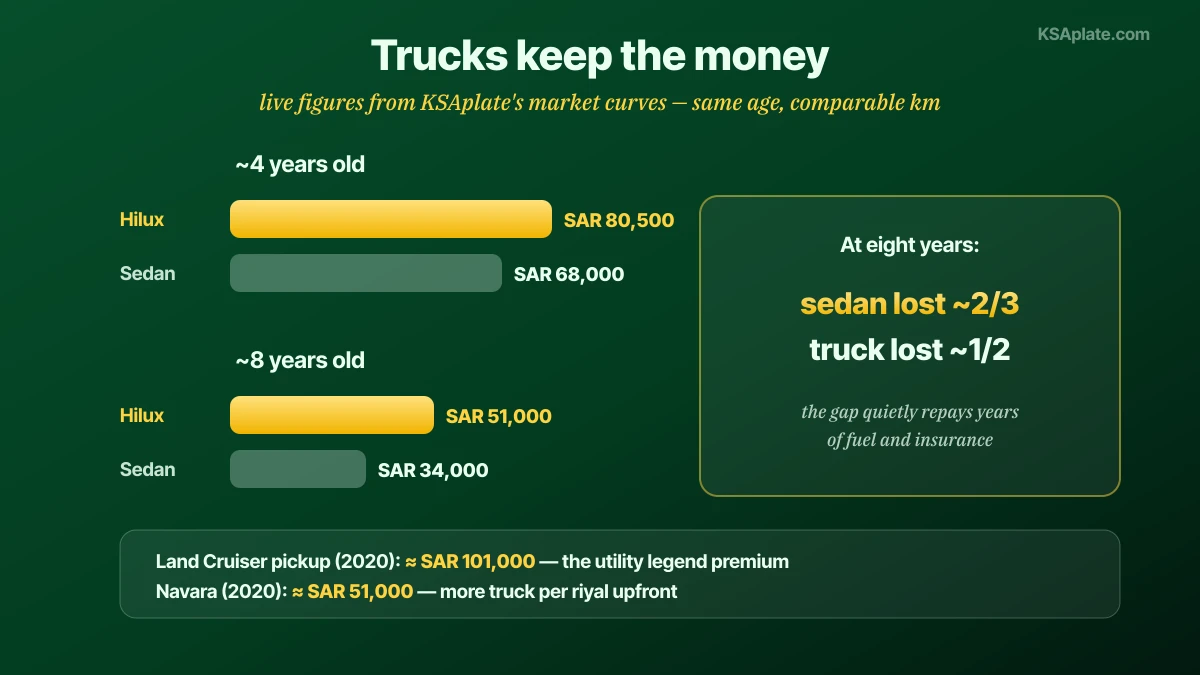
| Vehicle (semi-full, typical km) | ~4 years old | ~8 years old |
|---|---|---|
| Hilux (mid-size pickup) | ≈ SAR 80,500 | ≈ SAR 51,000 |
| Comparable mid-size sedan | ≈ SAR 68,000 | ≈ SAR 34,000 |
| Land Cruiser pickup (2020) | ≈ SAR 101,000 — the utility legend premium | |
| Navara (value alternative, 2020) | ≈ SAR 51,000 — more truck per riyal upfront | |
Read the eight-year column twice: the sedan surrendered roughly two-thirds of its value; the Hilux barely half. That difference quietly repays years of fuel and insurance, and it is the single strongest financial argument for the workhorse class. Every figure updates with the market — run any exact truck, year and mileage through the free car value calculator before you negotiate either side of a deal.
New vs used: the truck math
Because trucks depreciate slowly, the usual "buy at 2–4 years, skip the cliff" logic works differently here — the cliff is smaller, so the used discount is smaller too. The decision framework:
- Heavy planned use → lean new(er). A truck bought for real work earns its warranty; abuse history on a used workhorse is the one thing you cannot inspect away.
- Light or lifestyle use → the 3–5 year sweet spot. Someone else paid the (modest) first drop; the machine has decades left.
- Budget-first → older Hilux-class beats newer sedan-class for many buyers: an eight-year workhorse with honest history is a known quantity with parts everywhere, and its remaining depreciation is famously flat.
- Whatever the age, price it before you shop: browse what comparable trucks actually ask on current listings across Saudi Arabia and anchor on the calculator's range rather than the seller's opening number.
GCC-spec vs imported trucks
Trucks are the most import-heavy corner of the Saudi market — American-spec full-sizes especially. The differences are the same ones covered in our GCC-vs-imported guide, but three deserve truck-specific emphasis:
- Cooling packages. GCC-spec trucks carry radiators, fans and AC systems sized for 50°C summers with a load on. An import that never expected Gulf heat can run hot exactly when worked hard — ask for the spec, not assumptions.
- Fuel calibration. Many US-spec engines assume higher octane than the local 91; check the flap and manual logic from our fuel guide before assuming cheap running.
- Warranty and parts routing. Gray imports may sit outside local dealer warranty networks; on a working machine, that is a bigger deal than on a weekend car.
None of this makes imports wrong — much of the full-size fleet arrived that way — but the discount on an import should reflect the spec gaps, and the import guide walks the full checklist if you are bringing one in yourself.
Desert duty: what actually matters
Marketing sells lockers and decals; the desert rewards simpler things. If winter camping and dune weekends are part of the plan, weigh these in order:
- Low-range gearing and recovery points — the non-negotiables. Everything else can be improvised; these cannot.
- Tires with sidewall to sacrifice. Sand work at low pressure is a tire-sidewall sport; low-profile street rubber is the wrong uniform.
- Cooling reserve — sand at 45°C is the hardest thing you will ever ask of a drivetrain. This is where the GCC-spec point stops being theoretical.
- Weight discipline. Every accessory bolted on is capability subtracted in soft sand. The half-empty truck climbs the dune that the overloaded one summits on a tow rope.
- A partner vehicle. The oldest desert rule outranks any equipment list: one truck is a stranded truck. Our breakdown and emergency guide covers the remote-road protocol in full.
Running costs, honestly
Annualized for a typical 25,000 km year — the point is the shape of the difference, not riyal-perfect accounting:
- Fuel. A mid-size diesel doing site-and-city duty is among the cheapest per-kilometer machines in the Kingdom. A petrol V8 full-size roughly doubles the annual fuel line; on 91-spec engines at least the grade is the cheap one.
- Maintenance. Workhorse-class servicing is famously inexpensive and any-workshop-friendly. Full-size trucks are not fragile — but everything is bigger, and dealer-network parts for imports can add waiting time as well as cost.
- Tires. The forgotten line: full-size and off-road sizes cost multiples of sedan rubber, and desert use shortens their life. Budget it, don't discover it.
- Insurance. Priced on value and driver profile like any car — the full-size premium follows the higher value, not the body style. The market mechanics are in the insurance guide.
- Depreciation — the invisible refund. As the data section showed, the workhorse class hands a large share of its cost back at resale. On a total-cost basis, a hard-working Hilux may be the cheapest vehicle-per-year-of-service money buys here.
The used-truck inspection checklist
A used truck carries its biography in metal. The standard used-car discipline applies — and then trucks add their own chapters:
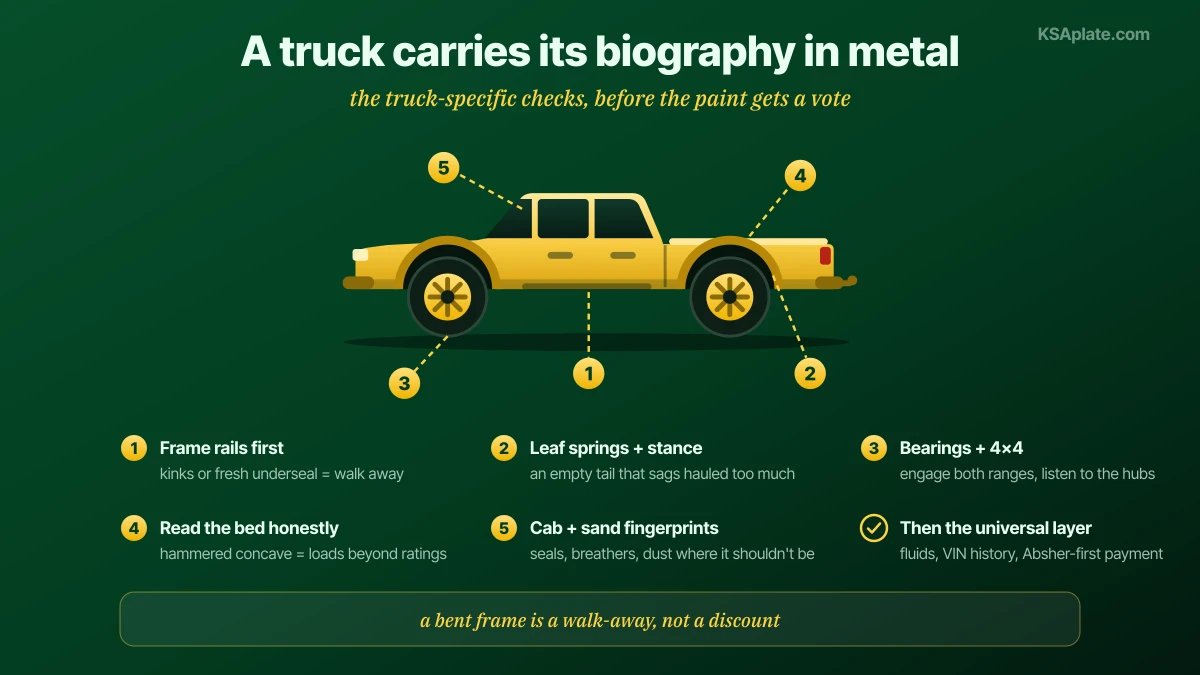
- Frame before paint. Sight along the chassis rails: kinks, wrinkles, or suspiciously fresh underseal are off-road damage talking. A bent frame is a walk-away, not a discount.
- Leaf springs and rear stance. A tail that sags empty has hauled chronically overloaded — expect tired springs, bushings and shocks as a package.
- Engage the 4x4 — actually. High range, low range, on dirt if possible. Transfer-case surprises are five-figure surprises, and "it worked last winter" is not a test.
- Read the bed honestly. Scars are fine — this is a truck — but a bed hammered concave whispers loads far beyond ratings, and what the bed suffered the drivetrain shared.
- Sand's fingerprints. Grinding wheel bearings, weeping axle seals, dust-caked breathers: desert life is legitimate, unserviced desert life is expensive.
- Then the universal layer: fluids, panel evidence and the VIN history pull from the history-check guide, and the full process discipline from the used-car buying guide — payment only after the Absher transfer is real.
And on the selling side, everything mirrors: document the service life, photograph the frame and bed honestly, price from the calculator's range, and list it for free — serious truck buyers respond to serious listings, directly on WhatsApp.
FAQ
What is the best pickup truck in Saudi Arabia?
Do pickups really hold their value better than sedans?
Should I buy a diesel or petrol pickup?
Is a 4x2 pickup worth buying in Saudi Arabia?
Single cab or double cab?
Are American full-size trucks expensive to run here?
What should I inspect first on a used pickup?
Is the Land Cruiser pickup worth its premium?
Do imported trucks have problems in Saudi Arabia?
When is the best age to buy a used truck?
How do I price a pickup fairly when buying or selling?
Conclusion
Pickup shopping in Saudi Arabia rewards one discipline above all: buy the job, not the silhouette. Decide honestly what the bed, the hitch and the low-range lever will do in a real month, and the market sorts itself — the Hilux class for work and wealth-preservation, the full-size Americans for genuine towing and highway life, diesel for loads and distance, double cab for the family compromise the used market loves.
Then let data close the deal. The resale numbers in this guide came from the same engine you can use tonight: value any truck on the free calculator, compare it against what the market actually asks, and when it is your bed and hitch changing hands, list for free and let the Kingdom's deepest vehicle demand come to you on WhatsApp.