
TL;DR:
- GCC-spec cars are built or adapted for the Gulf — stronger cooling for extreme heat, an official agency warranty, local service, and the highest resale value in Saudi Arabia.
- American-spec (US-spec) cars are imported from the United States — usually cheaper to buy, but often without agency warranty, with lower resale, and a real risk of a salvage or accident history.
- Both are legal to own and drive in Saudi Arabia provided the car meets standards and is properly registered — the choice is about value and risk, not legality.
- For most buyers, GCC spec is the safer long-term choice; American spec can make sense only when the discount is large, the history is verified clean, and you have a trusted independent mechanic.
- Whichever you pick, verify the spec and the history with a report and an inspection before you pay — and value the car first.
Quick answer: In Saudi Arabia, a GCC-spec car is one made or certified for the Gulf market — engineered for high heat, sold through the official dealer, and carrying an agency warranty and strong resale. An American-spec car is imported from the US, typically cheaper but often without agency cover, with weaker resale and a higher chance of a salvage-title past. For long-term ownership and easy resale, GCC spec usually wins; American spec only pays off when the savings clearly outweigh the added risk and you've verified a clean history.
What "GCC spec" and "American spec" mean
When you shop for a used car in Saudi Arabia, almost every listing is described as either GCC spec or American spec (sometimes "imported" or "US spec"). Understanding that label is the single biggest factor in whether a car is a smart buy — so it's worth getting right before anything else.
GCC spec means the car was manufactured or certified for the Gulf Cooperation Council market (Saudi Arabia, UAE, Kuwait, Qatar, Bahrain, Oman). These cars are sold new through the brand's official local dealer — the "agency" — and are built with the region's climate in mind. American spec means the car was originally built for the United States market and later imported into the Kingdom, usually through auctions or specialist importers rather than the official dealer.
You'll also occasionally see Canadian, European, or Japanese spec imports, but in Saudi Arabia the practical decision is almost always GCC versus American. The two can look identical on the outside and even share the same engine — the differences are in how they're built, supported, and valued. If you're new to the used-car process overall, start with our complete guide to buying a used car in Saudi Arabia, then come back here to choose a spec.
The differences that matter (at a glance)
Six factors separate the two, and they're what every Saudi buyer should weigh before deciding. Here's the comparison in one view.
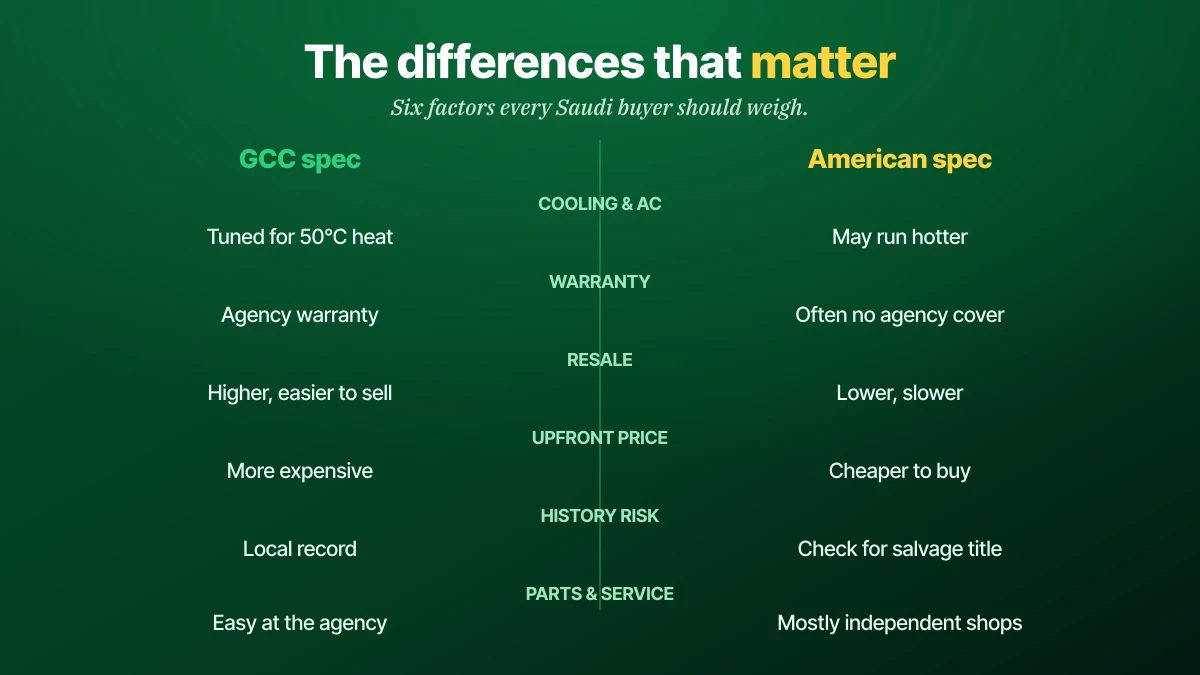
| Factor | GCC spec | American spec |
|---|---|---|
| Cooling & AC | Tuned for 50°C heat | May run hotter |
| Warranty | Official agency warranty | Often no agency cover |
| Resale value | Higher, easier to sell | Lower, slower to sell |
| Upfront price | More expensive | Cheaper to buy |
| History risk | Local, traceable record | Check for salvage title |
| Parts & service | Easy at the agency | Mostly independent shops |
The pattern is clear: GCC spec costs more upfront but is lower-risk and easier to live with and resell, while American spec saves money at purchase in exchange for more uncertainty. The rest of this guide unpacks each factor so you can judge whether that trade-off works for your situation.
Heat & AC: built for the Gulf
The original reason "GCC spec" exists is the climate. Summers in much of Saudi Arabia push past 45–50°C, and cars sold officially for the region were historically set up to cope: larger or higher-capacity cooling systems, air-conditioning calibrated for extreme heat, and protection tuned for dust and sun.
An American-spec car was engineered for a milder, more varied climate. In practice many modern cars are mechanically similar worldwide, so the gap is smaller than it once was — but it can still show up in the things that matter most in a Saudi summer: how quickly the cabin cools, how hard the AC has to work in traffic, and how the cooling system holds up over years of heat. For a car you'll drive through Gulf summers, the GCC setup remains a genuine advantage, especially on older models where the regional differences were larger.
The Gulf climate is the whole reason the GCC spec exists. If a car will spend its life in Saudi heat, that engineering was designed for exactly this.
What's your car worth?
Get a free instant estimate based on real Saudi market data — then sell it on KSAplate with direct WhatsApp contact.
Value My Car — FreeWarranty & agency service
This is often the deciding factor. A GCC-spec car bought new comes with the manufacturer's official agency warranty, and the local dealer network will service it, honour recalls, and supply genuine parts without question. If the car is still within its warranty period, that protection can transfer to you as the next owner and is worth real money.
American-spec cars typically sit outside the official agency system. Because they weren't sold through the local dealer, agencies often decline warranty work on them, and some may be reluctant to service them at all. That's not a legal barrier — you can still maintain the car — but it usually means relying on independent workshops rather than the agency. For a newer car where warranty and dealer support matter, this gap is significant; for an older car that's already out of warranty, it matters far less, because every car of that age is serviced independently anyway.
Resale value in Saudi Arabia
Saudi buyers strongly prefer GCC-spec cars, and the used market reflects that. A GCC-spec car holds its value better and sells faster, because the next buyer wants the same reassurances you do: agency history, regional engineering, and no import question marks. An American-spec car of the same model, year and mileage will typically command a lower price and take longer to sell.
This matters even if you're buying, because today's purchase is tomorrow's sale. The cheaper American-spec car can give back much of its upfront saving when you come to resell — the discount you enjoyed buying it is the same discount the next buyer will demand. Before you commit either way, it pays to know the real number: our guide on how much your car is worth in Saudi Arabia explains how spec, history and condition combine, and you can weigh the bigger decision in our new vs used car guide.
Price: why American spec is cheaper
American-spec cars are cheaper for understandable reasons, and knowing them helps you judge whether a given deal is a bargain or a trap. The lower price reflects:
- Cheaper sourcing — many US-market cars come through American auctions, where prices can be low.
- No agency premium — you're not paying for the official dealer channel, warranty or regional certification.
- Lower local demand — fewer Saudi buyers want them, which pushes prices down.
- History discount — some imported cars carry accident or salvage records that legitimately reduce value.
The first three are fair savings you can pocket. The fourth is the catch: a portion of "cheap" American-spec cars are inexpensive because they were rebuilt after a serious accident, flood or write-off in the US. That's not always disclosed, which is exactly why verifying the history is non-negotiable — covered next. A genuinely clean, well-kept American-spec car can be a smart buy; a hidden salvage car at a tempting price is the most expensive mistake on this list.
Verifying an American-spec car's history
Because American-spec cars are imported, their past happened somewhere you can't easily see — so checking it is the most important step in the whole purchase. Skipping it is how buyers end up with a rebuilt salvage car wearing a clean coat of paint.
- Pull the US history first. For an imported car, a US history report (by VIN) can reveal salvage/flood titles, auction records and reported accidents from before it arrived.
- Then check the Saudi record. A local car history check (Mojaz) shows mileage, accidents and finance status recorded in the Kingdom.
- Get an independent inspection. A professional pre-purchase inspection catches structural repairs and hidden damage a report can miss.
This is also where most scams live, so it's worth reading our guide to used-car scams in Saudi Arabia before you hand over any money. A clean history report plus a hands-on inspection turns an uncertain import into a known quantity — and gives you real leverage to negotiate or walk away.
With an American-spec car, the history report isn't optional — it's the difference between a bargain and a buried problem.
How to tell which spec a car is
Never take "it's GCC spec" on trust — confirm it yourself. Five checks will tell you what a car really is.
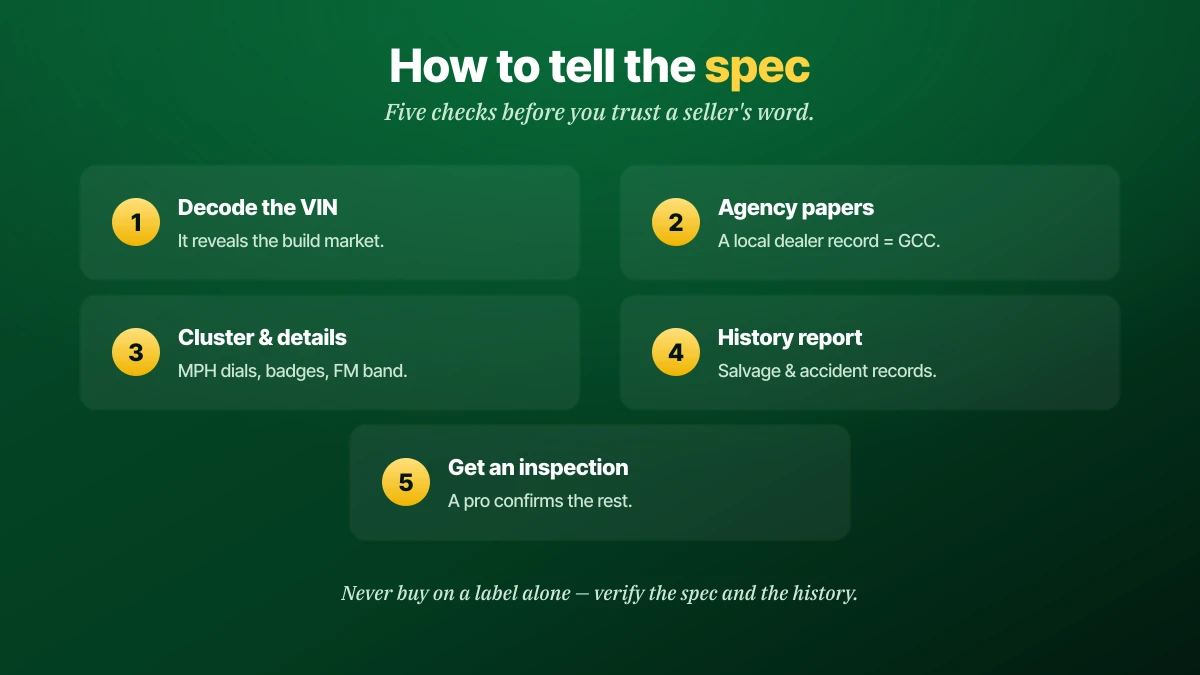
- Decode the VIN. The vehicle identification number encodes the market the car was built for; a US-built VIN points to American spec.
- Ask for agency papers. A service record or purchase document from the official local dealer is strong evidence of GCC spec.
- Check the details. Tell-tale signs of a US car include a speedometer reading primarily in MPH, certain badge or lighting differences, and a radio tuned to the US FM band.
- Pull a history report. Beyond confirming origin, it surfaces the salvage and accident records that matter most.
- Get an inspection. A professional can confirm the spec and the condition together, which is the surest check of all.
If a seller can't or won't help you verify the spec, treat that as a warning sign in itself. A straightforward seller of a clean car has nothing to hide.
Which should you buy?
There's no universal answer — the right spec depends on how you'll own the car. Match it to your situation.
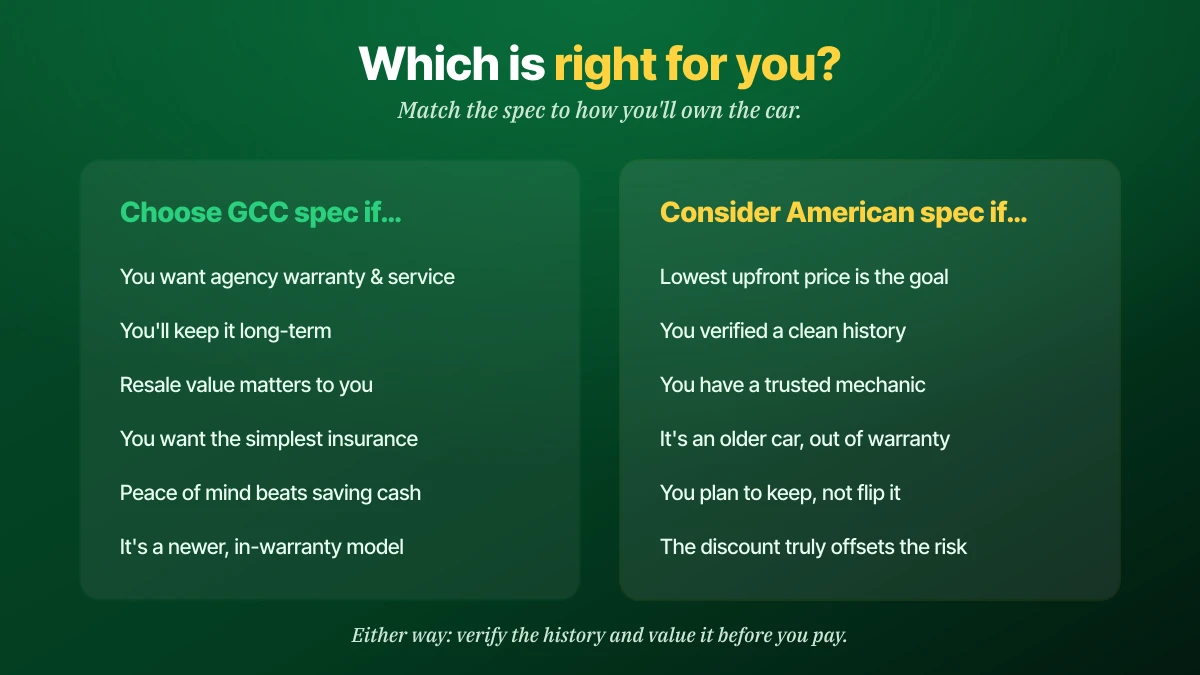
Choose GCC spec if you want the official agency warranty and service, you'll keep the car long-term, resale value matters to you, you want the simplest insurance, or you're buying a newer model still under warranty. For most buyers — especially first-time or risk-averse ones — this is the safer, lower-stress choice.
Consider American spec if the lowest upfront price is your priority, you've verified a genuinely clean history, you have a trusted independent mechanic, the car is older and already out of warranty, and the discount truly offsets the added risk and weaker resale. In that specific combination, a clean American-spec car can be a savvy buy. Whatever you decide, value the car first, then browse real listings on the KSAplate cars marketplace — or sell your current car to fund the upgrade.
Mistakes to avoid
The same few errors catch buyers on both sides of this decision. Steer clear of them:
- Buying American spec on price alone. A low sticker means nothing until the history is verified clean.
- Skipping the history report. On an imported car this is the one check you can't afford to miss.
- Forgetting resale. The cheaper spec is also the cheaper resale — factor in what you'll get back.
- Assuming the agency will service any car. Confirm warranty and service eligibility before you rely on it.
- Trusting the label. "GCC spec" on an advert isn't proof — verify the VIN and papers yourself.
- Ignoring insurance. Check how the spec affects your premium and cover with our car insurance guide before buying.
Frequently asked questions
What is the difference between GCC spec and American spec cars?
Is it legal to buy and drive an American-spec car in Saudi Arabia?
Is GCC spec better than American spec?
Why are American-spec cars cheaper in Saudi Arabia?
Do American-spec cars have worse air conditioning in the Gulf?
Can I get an American-spec car serviced at the agency?
Do American-spec cars hold their value in Saudi Arabia?
How do I check if a used car is GCC or American spec?
Should a first-time buyer choose GCC or American spec?
Conclusion & next steps
GCC spec versus American spec comes down to a single trade-off: pay more upfront for lower risk, agency support and stronger resale, or pay less for an imported car that demands careful checking and gives back less when you sell. For most Saudi buyers — especially anyone keeping a car long-term or buying their first — GCC spec is the safer, simpler choice. American spec earns its place only when the savings are real, the history is verified clean, and you have the mechanic and the patience to manage it. Either way, the rules are the same: confirm the spec, pull the history, get an inspection, and know the value before you pay. Start by valuing the car, read up on buying a used car the right way, then browse the KSAplate marketplace or list your car when you're ready.