
TL;DR:
- Electric cars are a Vision 2030 priority in Saudi Arabia, backed by the Public Investment Fund (PIF) through Lucid's local factory, the homegrown brand Ceer, and the EVIQ charging network.
- You can already buy EVs here — Tesla, Lucid and a growing range of other brands — while hybrids remain the easy middle step.
- Home charging is the single biggest factor: if you can charge overnight where you park, EV ownership is easy; if you can't, think twice for now.
- Be honest about two Saudi realities: extreme summer heat cuts range and stresses the battery, and cheap local petrol means the fuel-saving case is smaller than in high-fuel-cost countries.
- The economics still work for many drivers, especially city commuters with home charging — but plan long desert drives around fast chargers while the network fills in.
Quick answer: Yes, you can buy and own an electric car in Saudi Arabia today. The Kingdom is pushing EVs hard under Vision 2030 — with PIF-backed manufacturing (Lucid), a national brand (Ceer) and a growing fast-charging network (EVIQ). For most buyers the decision comes down to three things: whether you can charge at home, whether the public network covers your routes, and whether the sums add up given Saudi Arabia's low petrol prices. City drivers with home charging benefit most; long-distance desert drivers need to plan around chargers for now.
The EV moment in Saudi Arabia
For years, electric cars felt like something that happened somewhere else. In Saudi Arabia — a land of cheap petrol, long distances and extreme heat — the EV looked like an awkward fit. That has changed fast. The Kingdom is now one of the most ambitious EV backers in the region, and for the first time, buying an electric car here is a genuine, practical option rather than a novelty.
The shift is being driven from the top. Electric mobility is a flagship part of Vision 2030, the national plan to diversify the economy away from oil, and it's being funded on a scale few countries can match. If you're weighing an EV as your next car, the important thing to understand is that this isn't a passing trend — it's national infrastructure being built deliberately, which changes the calculation for buyers today.
This guide gives you the honest picture: what's driving the push, what you can actually buy, how charging really works, and the two Saudi-specific realities — heat and cheap fuel — that every buyer should weigh before switching.
Why the Kingdom is going electric
Saudi Arabia's EV push is a coordinated, state-backed project rather than a market that grew on its own. The Public Investment Fund (PIF), the country's sovereign wealth fund, sits behind the major pieces of the ecosystem — and they're moving at once.
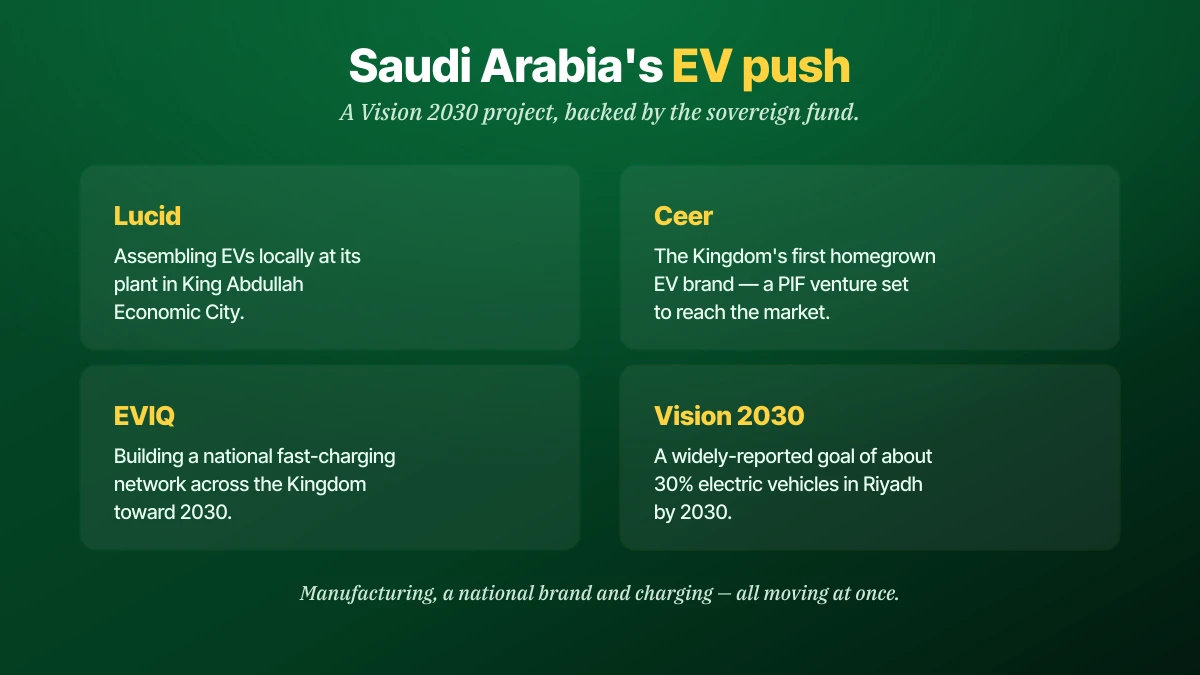
- Lucid — the US EV maker in which PIF is the major shareholder — has established local manufacturing in Saudi Arabia, assembling electric cars at a plant in King Abdullah Economic City. It's the Kingdom's first EV factory.
- Ceer is Saudi Arabia's first homegrown electric-vehicle brand, a PIF venture created to design and build EVs domestically and bring them to market.
- EVIQ — a joint venture involving PIF and the Saudi Electricity Company — is rolling out a national fast-charging network, with the goal of covering cities and major highways across the Kingdom.
- The 2030 target: a widely-reported ambition is for roughly 30% of vehicles in Riyadh to be electric by 2030, signalling how seriously the transition is being pursued.
For a buyer, the takeaway is confidence: manufacturing, a national brand and charging infrastructure are all being built together. That reduces the classic EV risks of "will there be anywhere to charge?" and "will this brand still be supported?" — the whole system is being stood up on purpose.
This isn't a grassroots trend catching on slowly. It's national infrastructure being built on a deadline — which is exactly what makes an EV a reasonable choice in Saudi Arabia now.
What you can buy right now
The choice of electric cars in Saudi Arabia has widened quickly, from premium models to more affordable options, alongside the hybrids that remain a popular halfway house. Availability depends on which brands have an official agent in the Kingdom, so always confirm local support before buying.
| Option | What it is | Best for |
|---|---|---|
| Tesla | Global EV brand, now officially in KSA | Buyers wanting a proven EV & charging |
| Lucid | Premium EVs, locally assembled | Luxury EV buyers backing local build |
| Ceer | Saudi national EV brand (reaching market) | Supporting a homegrown brand |
| Other global & Chinese EVs | A widening range via local agents | Value and choice across price points |
| Hybrids (HEV / PHEV) | Petrol-electric, no charging anxiety | Drivers not ready for full EV |
If you're not sure a full EV fits your life yet, a hybrid is the sensible middle step: you get better efficiency without depending on charging infrastructure, which matters if you can't charge at home. When you're comparing any of these against a conventional car, the same buying fundamentals apply — value it properly and check the paperwork. Start with our new vs used car guide and, when you're ready, browse cars on KSAplate.
What's your car worth?
Get a free instant estimate based on real Saudi market data — then sell it on KSAplate with direct WhatsApp contact.
Value My Car — FreeCharging in Saudi Arabia
Charging is where EV ownership is won or lost, and in Saudi Arabia it comes down to three options — with one of them mattering far more than the others.
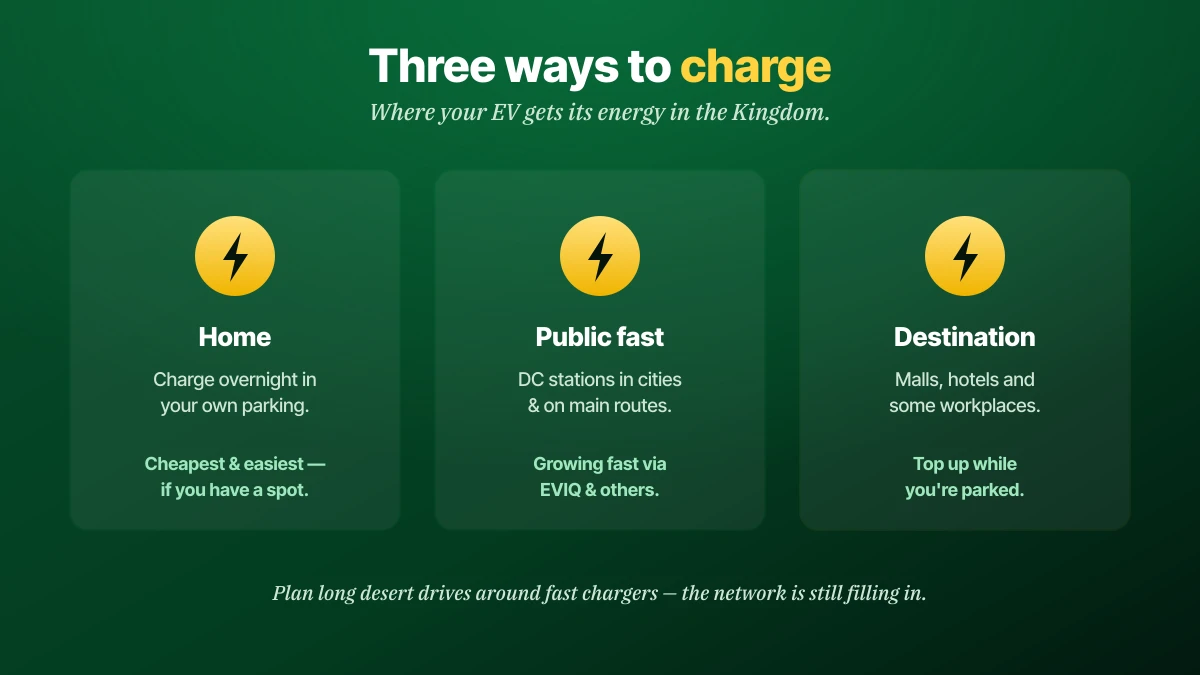
- Home charging is the foundation of easy EV ownership. If you have a private parking spot where you can install a charger, you plug in overnight and wake up "full" every day — the cheapest and most convenient way to run an EV. This single factor decides whether an EV will suit you.
- Public fast charging — DC stations that add a lot of range quickly — is expanding across cities and main highways, led by EVIQ and other operators. It's what you use on longer trips and when you can't charge at home.
- Destination charging at malls, hotels and some workplaces lets you top up while you're parked anyway, which quietly covers a lot of daily needs.
The honest caveat is that the public network, while growing fast, is still filling in — it's strongest in Riyadh, Jeddah and the Eastern Province and thinner on remote desert routes. For city driving this is rarely an issue; for regular long-distance journeys, plan your stops around known fast chargers until coverage deepens.
Range, heat & the desert
Two things about Saudi Arabia genuinely affect an EV, and a good guide won't gloss over them. The first is heat. Summer temperatures that push past 45–50°C are hard on any battery: extreme heat can accelerate battery ageing over time, and — more noticeably day to day — running the air-conditioning hard to cool the cabin draws energy that would otherwise be range.
In practice this means the real-world range you get in a Saudi summer is lower than the headline figure on the brochure, which is measured in milder conditions. Modern EVs manage heat with active battery cooling and are far better than early models, but you should still plan around a realistic range, not the best-case number. The second factor is distance: the Kingdom's long inter-city drives across open desert put a premium on charging availability, which is exactly why home charging plus route planning matters so much.
Judge an EV by its real summer range with the AC on — not the brochure figure. In Saudi heat, the gap is real, and planning around it is the difference between relaxed and anxious.
The real cost picture
This is where a Saudi EV guide has to be more honest than most. In many countries the headline reason to go electric is slashing your fuel bill. In Saudi Arabia, petrol is cheap, so the fuel-saving argument — while still real — is smaller than it would be in Europe or elsewhere.
Here's the balanced view:
- Running costs — Electricity in the Kingdom is also relatively low-cost, so charging (especially at home overnight) is cheaper per kilometre than petrol, but the gap is narrower than in high-fuel-price markets. The savings are real, just not dramatic.
- Maintenance — EVs have far fewer moving parts: no oil changes, fewer wear components, and regenerative braking that spares the brakes. This can meaningfully lower servicing costs over years of ownership.
- Upfront price — EVs often cost more to buy than a comparable petrol car, though the range of prices is widening. Factor the purchase premium against the running-cost savings over how long you'll keep it.
- Resale & battery — EV resale in a young market is still settling; a strong battery warranty (below) protects the car's biggest-value component.
The upshot: an EV in Saudi Arabia is often chosen for the driving experience, the technology, lower maintenance and alignment with Vision 2030 — with fuel savings as a bonus rather than the headline. To run the numbers for your situation, weigh it against our breakdown of the real cost of owning a car in Saudi Arabia.
EV vs hybrid vs petrol
For most Saudi buyers the practical question isn't "EV or nothing" — it's where you sit on a spectrum from full electric to hybrid to conventional petrol. Here's how they compare on what matters locally.
| Factor | Full EV | Hybrid | Petrol |
|---|---|---|---|
| Home charging needed | Strongly recommended | Optional (PHEV benefits) | No |
| Long desert drives | Plan around chargers | Easy | Easy |
| Running cost | Lowest per km | Low | Higher, but cheap fuel |
| Maintenance | Lowest | Moderate | Highest |
| Upfront price | Often highest | Middle | Often lowest |
| Best for | City drivers who charge at home | The cautious middle step | Heavy long-distance use |
In short: if you can charge at home and mostly drive in and around a city, a full EV makes strong sense today. If you can't charge at home yet, or you regularly cross the country, a hybrid captures much of the efficiency without the charging dependence. A conventional petrol car still suits the highest-mileage, most remote drivers — for now.
Buying an EV: what to check
Buying an electric car adds a few checks on top of the usual car-buying discipline. Run these honest questions first, then get the details right to avoid the common first-EV regrets.
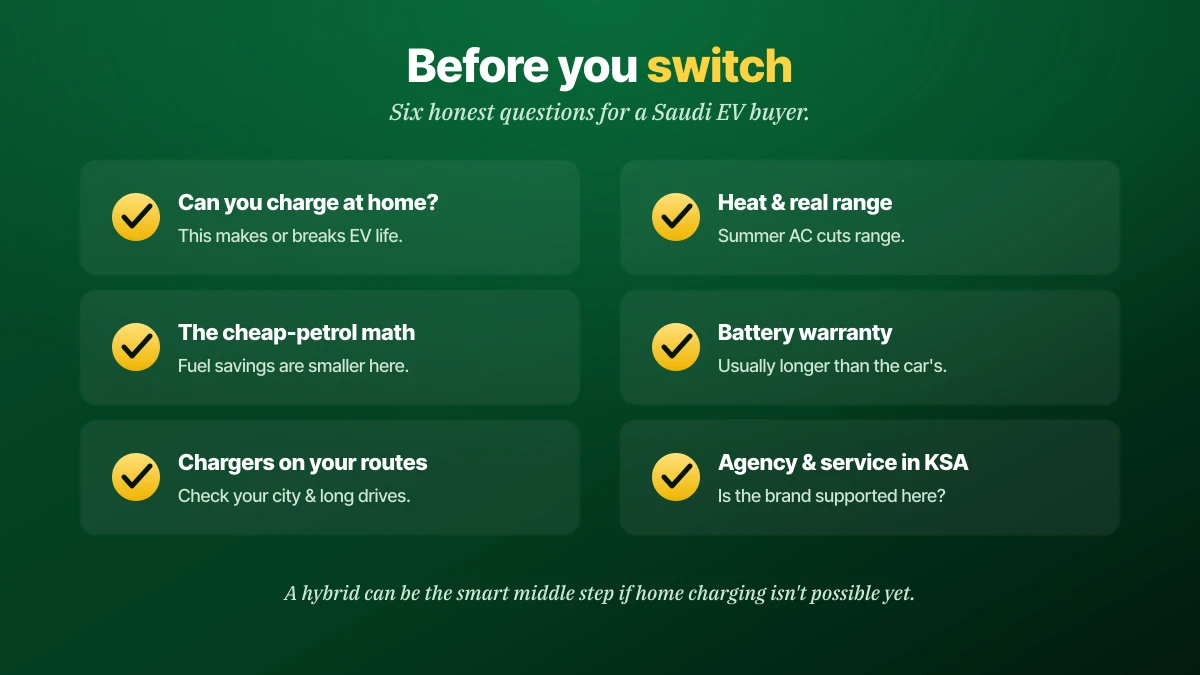
- Confirm home-charging access first. Before anything else, be sure you can install and use a charger where you park — this is the make-or-break factor.
- Check the battery warranty. The battery is the most expensive component, and it usually carries its own, longer warranty than the rest of the car. Confirm the years and mileage — our car warranty guide explains how cover and transfers work.
- Confirm local agency & service. Make sure the brand is officially supported in the Kingdom, so you have warranty service and parts — the same GCC-spec logic that applies to any car, covered in our GCC vs American spec guide.
- Match the range to your real driving. Look at realistic summer range, not the brochure, against your actual daily and long-trip needs.
- For a used EV, check battery health. Battery condition and remaining warranty matter as much as mileage — combine it with a normal car history check.
Everything else — valuation, insurance, paperwork — is the same as any car. Value it with our used-car value guide, sort cover via the car insurance guide, and if you're switching, sell your current car to help fund it.
Where it's heading
The direction of travel is clear, and it's worth factoring into a purchase you'll keep for years. With local manufacturing ramping up, a national brand in Ceer reaching the market, and the EVIQ charging network expanding toward the 2030 goals, the practical barriers to EV ownership in Saudi Arabia are falling year on year.
That has two implications for buyers. First, the charging and service situation you'll live with over the next few years should be better than today, not worse — which de-risks buying now. Second, as the market matures, choice widens and prices become more competitive across segments. If an EV nearly fits your life today, the trajectory is firmly in your favour; if it doesn't quite fit yet, a hybrid now and an EV next time is a perfectly rational plan.
Mistakes to avoid
The first-time EV buyers who end up frustrated usually made one of a short list of avoidable mistakes. Steer clear of these.
- Buying an EV with no home charging plan. Relying solely on public chargers is doable but far less convenient — sort charging first.
- Trusting the brochure range. Plan around real summer range with the AC running, not the best-case figure.
- Expecting huge fuel savings. They're real but modest given cheap local petrol — buy for the whole package, not just fuel.
- Ignoring the battery warranty. It protects the priciest part; confirm its terms before you sign.
- Not checking local service support. An unsupported brand means hard-to-service problems later.
- Overbuying range you'll never use. If you charge at home and drive in the city, a giant battery may be money better spent elsewhere.
Frequently asked questions
Are electric cars available in Saudi Arabia?
Is it worth buying an electric car in Saudi Arabia?
Where can I charge an electric car in Saudi Arabia?
How does the heat affect electric cars in Saudi Arabia?
Do electric cars save money in Saudi Arabia?
What is Saudi Arabia doing to support electric vehicles?
Can I drive an electric car long distances in Saudi Arabia?
Is a hybrid better than an EV in Saudi Arabia?
How long does an electric car battery last, and is it covered?
Conclusion & next steps
Electric cars in Saudi Arabia have crossed from novelty to a genuine choice, and the momentum is only building: PIF-backed manufacturing with Lucid, the national brand Ceer, and the EVIQ charging network are turning Vision 2030's ambition into real infrastructure. The smart way to decide is honest and specific to you — can you charge at home, do the public chargers cover your routes, and do the sums work given cheap local petrol and the heat's effect on range? For city drivers with home charging, an EV already makes strong sense; for long-distance or no-home-charging drivers, a hybrid is a rational bridge. Whatever you choose, treat it like any car purchase: value it first, check the warranty, then browse the KSAplate marketplace or sell your current car to make the switch.