
TL;DR:
- Saher is Saudi Arabia's automated traffic-enforcement system — a network of fixed and mobile cameras run by the General Department of Traffic (Moroor) that records violations 24/7 and sends them to your Absher account by SMS.
- Newer Saher cameras measure your average speed between two points, not just your speed at the camera. Braking only as you pass a camera does not work.
- Speed limits: ~40 km/h near schools, 60–80 on city streets, 120 on highways, and 140 on signed smart corridors.
- Speeding fines: SAR 300–500 for up to 25 km/h over, SAR 500–900 above that. Red-light and wrong-way violations run SAR 3,000–6,000.
- Pay within 30 days for a 25% discount. Unpaid fines block your registration renewal and any plate transfer — and 24 black points suspend your licence.
Quick answer: Saher is Saudi Arabia's automated camera system that enforces traffic rules 24/7 and logs violations to Absher. Speed limits are about 40 km/h near schools, 60–80 in cities, 120 on highways and 140 on smart corridors. Speeding fines start at SAR 300 and rise with speed. Pay within 30 days to get a 25% discount, or object on Absher within 30 days.
What Saher is
Saher is Saudi Arabia's automated traffic monitoring and enforcement system. It is operated by the General Department of Traffic (Moroor) under the Ministry of Interior and was launched in Riyadh in April 2010 before expanding across the Kingdom.
The system combines a network of fixed cameras on streets, highways and intersections with mobile camera units that move between locations. It runs 24 hours a day, records each violation automatically, and pushes it to your Absher account with an SMS alert — usually within minutes.
In plain terms: Saher replaces the roadside officer with a camera. There is no warning, no discussion, and no discretion. The camera sees the violation, the system issues the fine, and it appears on your phone.
How Saher works
Saher catches violations in two ways, and the second one surprises most drivers. The first is spot speed — a camera measures how fast you are going at that exact point. The second, used by newer units, is average speed.
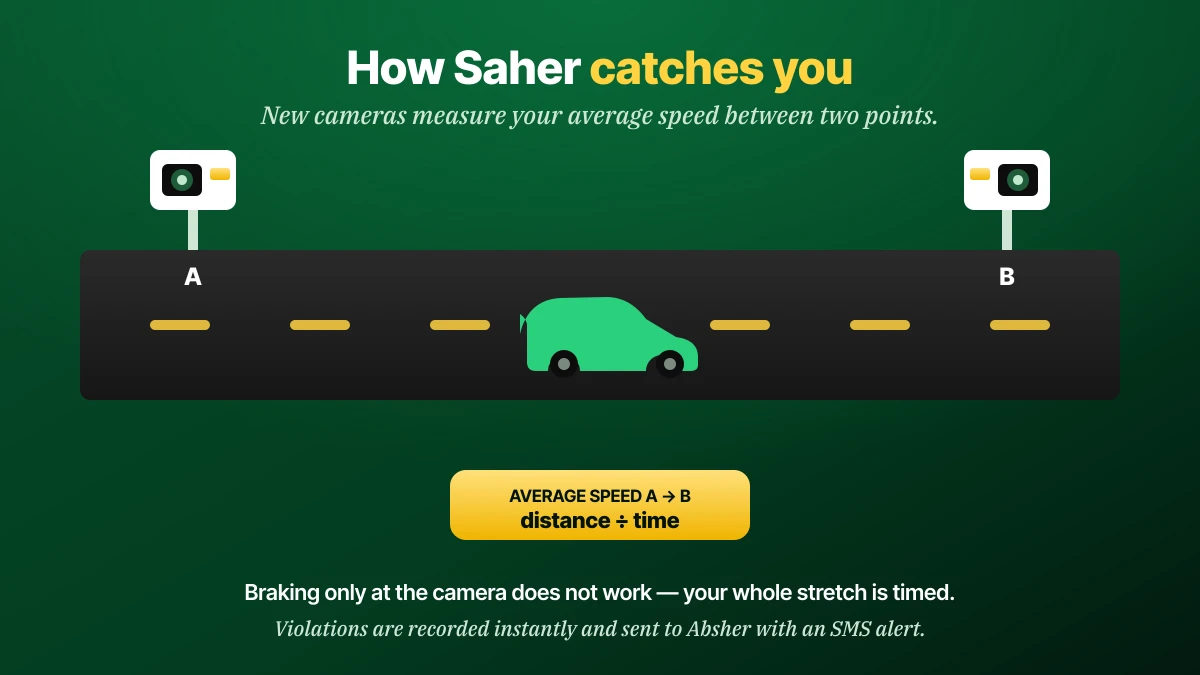
Average-speed enforcement uses two cameras a known distance apart. The system records when you pass camera A and when you pass camera B, divides the distance by the time, and calculates your average speed for the whole stretch. If that average is over the limit, you are fined — even if you were under the limit at each camera.
Slamming the brakes only at the camera is useless against average-speed enforcement. The system times your entire run between two points, so the only safe speed is the limit, the whole way.
Saher also uses AI image analysis to detect mobile phone use and missing seatbelts, not just speed. Every capture is time-stamped, plate-matched, and logged to the vehicle's record automatically.
Each capture records the date, exact location, vehicle plate, the measured speed against the posted limit, and a photograph. Because the violation is tied to the plate, it is matched to the vehicle rather than to whoever was driving — which is why buyers check for outstanding fines before a purchase. Sellers should still pay them, although fines do not block the ownership transfer while the istimara and periodic inspection are valid. The record is generated by the system, so there is no officer to talk your way past at the roadside.
Where the cameras are
Saher cameras fall into two types, and knowing the difference explains why there is no safe place to speed. Fixed cameras are permanently mounted on poles and gantries at known high-risk spots. Mobile cameras are portable units — often in unmarked vehicles or temporary tripods — that move between locations without notice.
The highest concentration sits where violations are most dangerous:
- Intersections — to catch red-light running and lane violations.
- School zones — where the limit drops to around 40 km/h.
- Highway entry and exit points — and along average-speed corridors.
- City arterial roads — the busy 60–80 km/h streets where speeding is common.
Because mobile units relocate daily and average-speed zones cover long stretches, the practical takeaway is simple: assume a camera is always within range. There is no "clear road" where speeding is safe, and apps or signs that claim to map every camera are never complete.
What's your car worth?
Get a free instant estimate based on real Saudi market data — then sell it on KSAplate with direct WhatsApp contact.
Value My Car — FreeSpeed limits by road type
A speed limit in Saudi Arabia is the maximum legal speed for a specific road, shown on a round red-bordered sign. Limits change by zone, and the posted sign always overrides your assumption.
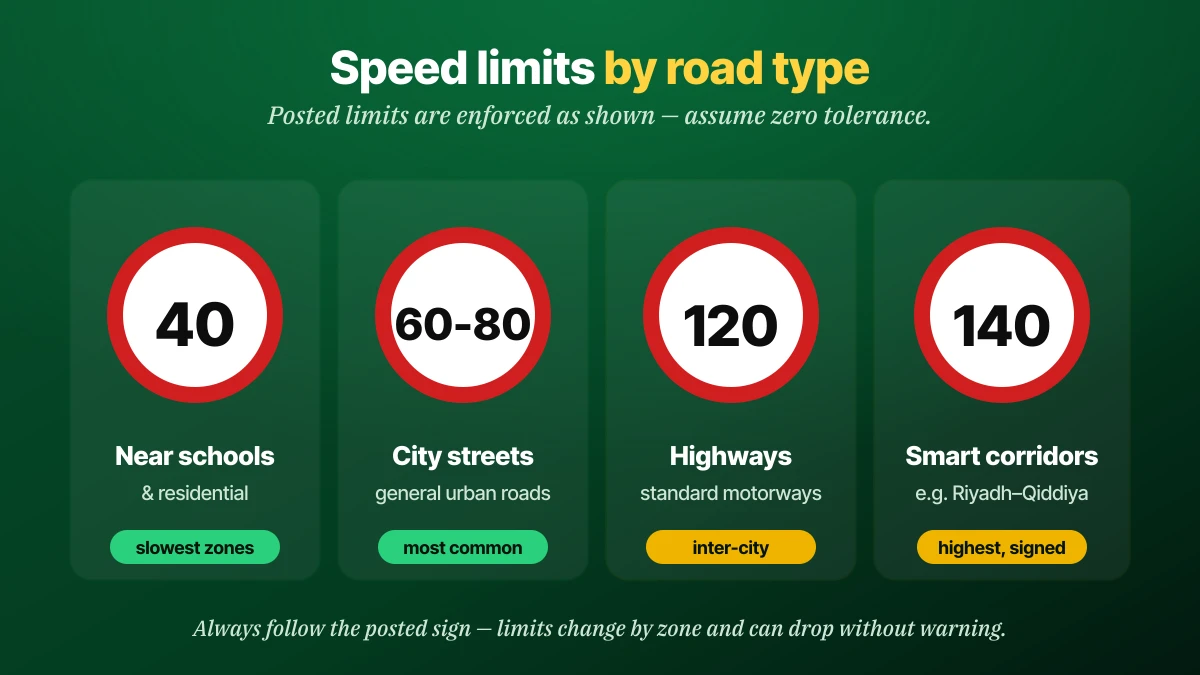
| Road type | Typical limit | Notes |
|---|---|---|
| Near schools & residential | ~40 km/h | Slowest zones, heavily monitored |
| General city streets | 60–80 km/h | Most common urban limit |
| Highways / motorways | 120 km/h | Standard inter-city roads |
| Smart corridors | 140 km/h | Signed routes, e.g. Riyadh–Qiddiya |
Treat the posted number as a hard ceiling, not a target with a buffer. Saudi Arabia has tightened tolerance over the years, and average-speed zones leave no room to "make up time" between cameras. When a limit drops near a school zone, junction or roadworks, it drops immediately.
Speeding fines
Speeding fines in Saudi Arabia scale with how far over the limit you are. The faster you go, the higher the band — and the most serious speeds add black points on top of the cash fine.
| How far over | Fine | Severity |
|---|---|---|
| Up to 25 km/h over | SAR 300–500 | Minor |
| More than 25 km/h over | SAR 500–900 | Serious |
| Above 145 km/h | SAR 900 + black points | Severe |
Do not rely on a "tolerance buffer." Drivers often assume a few km/h over is ignored, and on some roads a small margin has historically existed. But that margin is not guaranteed, it varies by road, and it does not apply across average-speed corridors where your whole journey is timed. The only reliable assumption is that the posted number is the limit and anything above it can be captured.
These are the indicative ranges; the exact amount for your specific violation appears on Absher. The key point is that a single high-speed capture can cost close to SAR 900 and add points that move you toward a licence suspension. For the full process of viewing and settling these, see our guide to checking and paying traffic fines in Saudi Arabia.
Other major violations
Saher enforces far more than speed. The most expensive violations are the ones that endanger others, and the fines reflect that.
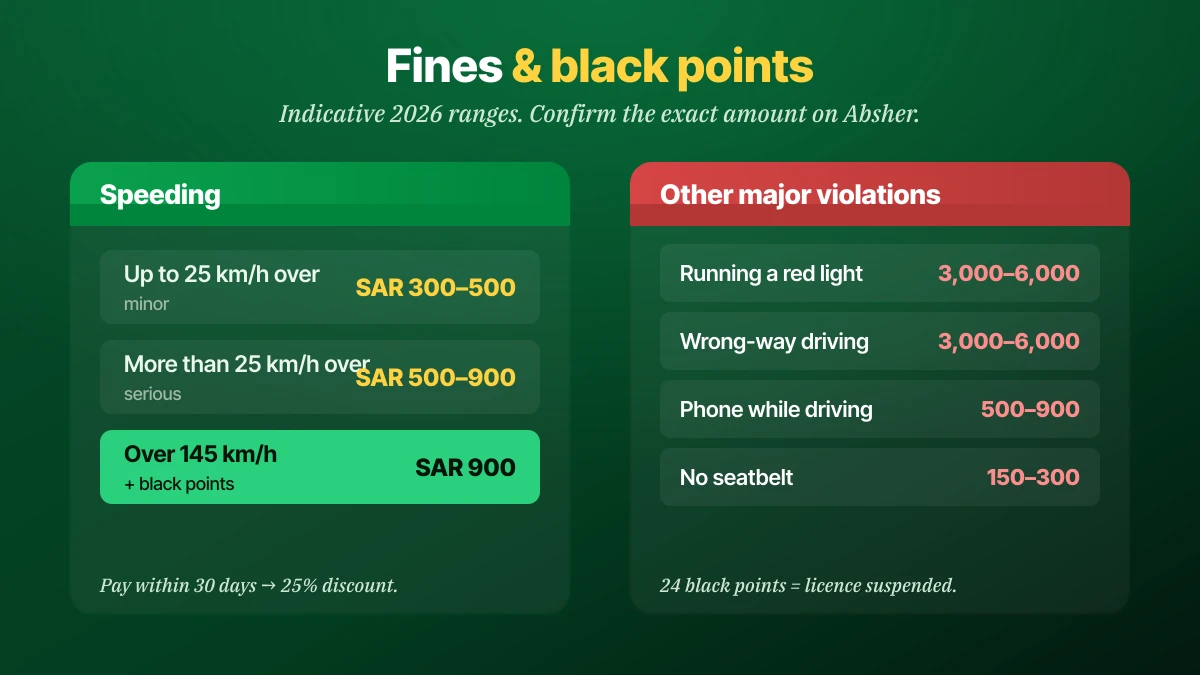
- Running a red light: SAR 3,000–6,000.
- Driving the wrong way: SAR 3,000–6,000.
- Using a mobile phone while driving: SAR 500–900.
- Not wearing a seatbelt: SAR 150–300.
- No child safety seat: SAR 150–300.
- Driving in a non-designated lane: SAR 150–300.
A red-light or wrong-way capture can cost more than a month's rent. These are the violations Saher cameras at intersections are built to catch, and they carry the heaviest fines on the schedule.
The black points system
The black points system is a penalty record attached to your driving licence, separate from the cash fine. Serious violations add points, and the points accumulate over time.
The threshold that matters is 24 points: reaching it triggers a licence suspension. Speeds above 145 km/h, for example, add points on top of the SAR 900 fine. A driver who treats fines as just a cost can still lose the right to drive once the points stack up. Keeping your Saudi driving licence valid means keeping your points low, not just paying the fines.
Points are not permanent — they decay over time if you avoid further violations, and a first suspension is shorter than repeat ones. But the system is designed to escalate: the more often you offend, the faster you approach the limit and the longer the consequences last. Paying a fine clears the money owed; it does not erase the point on your record. That distinction is what catches habitual speeders who assume a settled fine means a clean slate.
Discount & payment deadlines
Saudi Arabia rewards fast payment. Any newly issued violation qualifies for a 25% discount if you pay within 30 days of the notification. Miss that window and you pay the full amount.
If you need more time, you can request a payment extension — generally up to 90 days — but the request must be made early, within the first part of the period, and the discount no longer applies after the early window closes. For larger fines, Saudi Arabia has also allowed payment in installments in some cases, easing the burden of a heavy violation. The government additionally runs occasional Kingdom-wide discount campaigns of up to 50%, announced publicly — worth waiting for only if your fine is not about to expire.
- Open Absher and sign in to your account.
- Go to the traffic violations section to see every fine on your record.
- Review the details — date, location, type and amount — for each violation.
- Pay through Sadad within 30 days to lock in the 25% discount.
- Keep the receipt so the violation clears from your vehicle record.
How to object to a fine
If you believe a Saher fine is wrong, you have the right to object — but the clock is short. You get 30 days from the notification date to either pay or file an objection.
- Act within 30 days. After the window closes, an unchallenged fine becomes final.
- Open the violation on Absher and select the objection option.
- State your case clearly and attach any evidence — photos, timestamps, or proof the car was elsewhere.
- Submit and track the objection through the platform.
- Await the decision. If the objection is accepted, the fine is cancelled or adjusted; if rejected, the original fine stands.
An objection is only worth filing with real evidence. "I wasn't speeding" is not enough — average-speed and time-stamped captures are hard to dispute without proof the system made an error.
Why unpaid fines cost more than the fine
An unpaid Saher fine is not just a number sitting on your phone — it can hold up key parts of your vehicle admin. Here is how outstanding violations affect routine processes.
- Registration renewal: you cannot renew your Istimara while fines are outstanding.
- Selling or transferring: Saudi traffic police (Muroor) confirm that unpaid fines do not block the ownership transfer when you sell your car, provided the istimara and periodic inspection are valid — but the fines stay on your record until paid.
- Insurance: a poor violation record can raise your premium when you renew car insurance, on top of the fines themselves.
The cheapest path is always to clear fines quickly. A SAR 300 speeding ticket left unpaid can block your istimara renewal and cost you the 25% discount — the fine itself is only part of the cost.
How to avoid Saher fines
Avoiding Saher fines comes down to driving as if a camera is always watching, because one usually is. A few habits remove almost all risk:
- Drive the limit the whole way, not just at the cameras — average-speed zones time the full stretch.
- Watch for zone changes near schools, junctions and roadworks, where limits drop sharply.
- Phone down, belt on — AI cameras catch both, and the fines are steep.
- Keep your Absher notifications on so you see a fine in time to claim the 25% discount.
- Clear fines monthly so nothing blocks a future renewal.
- Use cruise control on highways to hold a steady legal speed through average-speed corridors, where small lapses add up across the whole stretch.
- Check fines before you buy a used car, and confirm its istimara and periodic inspection are valid — the ownership transfer depends on them.
Frequently asked questions
What is Saher in Saudi Arabia?
What are the speed limits in Saudi Arabia?
How much is a speeding fine in Saudi Arabia?
Do Saher cameras measure average speed?
How do I get the 25% discount on a traffic fine?
How do I object to a Saher fine?
What happens if I do not pay a traffic fine?
How many black points do Saher violations carry?
Does a traffic violation affect my car insurance?
Conclusion & next steps
Saher makes Saudi roads predictable: the limit is the limit, a camera is always watching, and the fine lands on your phone within minutes. Drive the posted speed the whole way, keep your phone down and belt on, and treat every road as an average-speed zone. When a fine does arrive, pay within 30 days for the 25% discount or object on Absher with real evidence — and never let fines sit, because they quietly block your registration and push up your premium. Staying clean keeps your licence, your record and your car's value intact. And when that car is worth selling, the number on it has value too — check what your plate is worth on the KSAplate calculator.