


TL;DR:
- Saudi Arabia is one of the world's great road-trip countries hiding in plain sight — 950 km from Riyadh to Jeddah on smooth divided highway, AlUla and Abha within a day's drive, fuel among the cheapest anywhere. What the distances demand in return is preparation and rhythm.
- The trip is won before departure: tires and coolant checked, the half-tank rule adopted, water loaded at four liters per person, departure timed so no one drives drowsy through the 3 p.m. heat or hits open range at dusk.
- The four killers of the Saudi highway are boredom-fatigue, camels at dusk, sand on asphalt, and heat-stressed tires — every one of them predictable, every one of them manageable with the habits in this guide.
- Families run on a different clock: a stop every two hours, the midday oven parked out, child seats staying buckled for every kilometer — the boring routine is exactly what makes eight hours with children feasible.
- The long drive is also the most honest test your car will ever take. Many families come home knowing the AC, the third row, or the whole car is wrong — which is a solvable problem, with numbers, not a showroom impulse.
Quick answer: Road-tripping Saudi Arabia by car is straightforward on the main corridors — Riyadh to Jeddah (~950 km, 8–9 hours), Riyadh to Dammam (~400 km, 4 hours), Jeddah to AlUla (~680 km) — provided you prepare for distance and heat: check tires and coolant before leaving, refuel at half a tank rather than near empty, carry at least four liters of water per person, stop every two hours against fatigue, and avoid open-range driving at dawn and dusk when camels cross. Speed limits run up to 140 km/h under Saher camera enforcement, and the summer midday hours are for resting, not driving.
The kingdom as a road-trip country
Ask where the world's great driving countries are and nobody says Saudi Arabia — which is exactly why the people who live here have the roads largely to themselves. The raw material is exceptional: thousands of kilometers of modern divided highway, fuel that costs less than bottled water per liter, and destinations that have gone from rumor to bucket-list in a decade — AlUla's rock tombs, the Edge of the World an hour from Riyadh, the green terraces of Abha, the Red Sea coast, Taif's mountain air above Jeddah.
What makes Saudi road-tripping its own discipline is scale and climate. Distances here are continental: the Riyadh–Jeddah run crosses nine hundred kilometers of mostly empty country, and "empty" is meant literally — stretches where the next fuel station is an act of planning, not an exit sign. The sun sets the schedule, the terrain sets the hazards, and a car that is merely fine for the school run needs a checkup before it becomes a long-distance machine. This guide is the whole discipline in one place: routes, preparation, packing, timing, the specific craft of the Saudi highway, and the family logistics that make it work with children aboard.
The classic routes, honestly measured
The corridors every Saudi road-tripper eventually drives, with honest numbers — times assume legal speeds, normal stops and no convoy of roadworks:
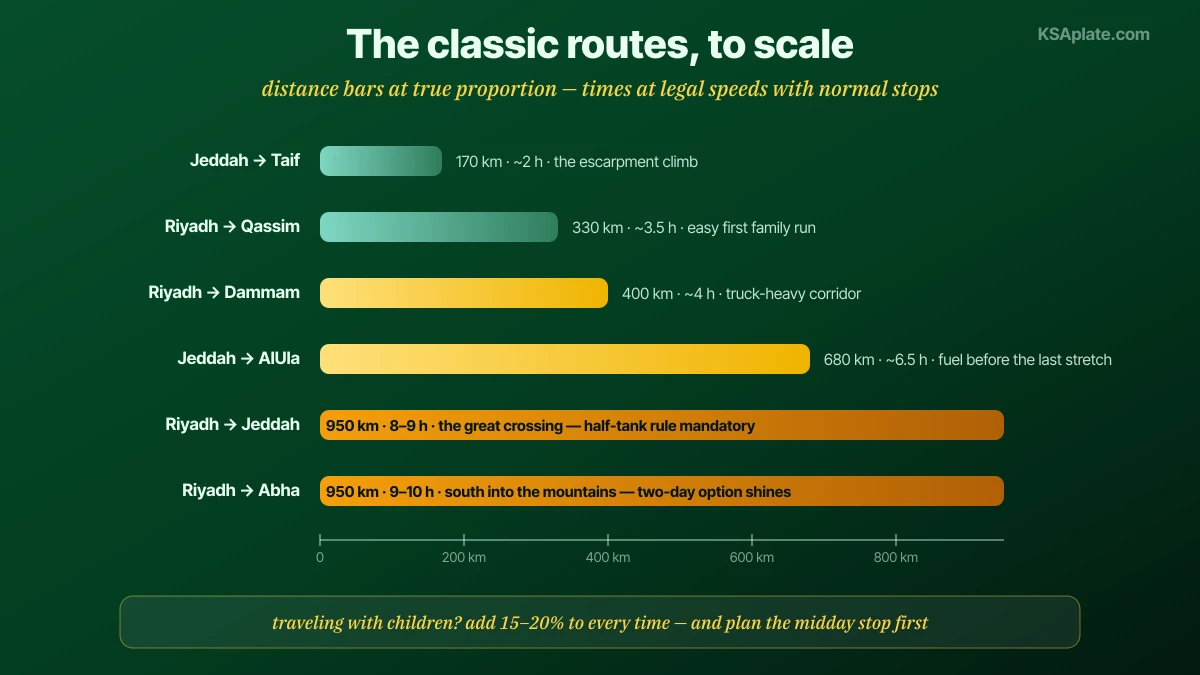
| Route | Distance / time | Character | Planning note |
|---|---|---|---|
| Riyadh → Dammam | ~400 km · ~4 h | Flat, fast, busy — the kingdom's commuter corridor | Heavy truck traffic; overtake decisively, then return right |
| Riyadh → Qassim | ~330 km · ~3.5 h | Easy first family trip northbound | Good station density the whole way |
| Jeddah → Taif | ~170 km · ~2 h | The escarpment climb — engines and brakes work hard | Check coolant before, use engine braking down |
| Riyadh → Jeddah | ~950 km · 8–9 h | The great crossing — long empty stretches mid-route | Half-tank rule mandatory; plan the midday stop |
| Jeddah → AlUla | ~680 km · ~6.5 h | Coast then desert north — the heritage run | Fuel up before the final stretch; arrive before dark |
| Riyadh → Abha | ~950 km · 9–10 h | South into real mountains — weather actually changes | Two-day option via Al Baha is the scenic answer |
Two honest notes on the table. First, add 15–20% to any time estimate when traveling with children — the arithmetic is in the family section. Second, the times assume the car cruises comfortably at the limit; an overloaded car with heat-soft tires should not be driven at 140 km/h, whatever the sign allows.
Getting the car trip-ready
A week before departure, not the night before:
- Tires first, always. Tread depth, sidewall cracks, and the date code — desert heat ages rubber faster than mileage does, and a highway blowout at speed is the single failure most worth preventing. Check pressures cold, set to the loaded-vehicle figure on the door jamb, and do not forget the spare.
- Cooling system and AC. Coolant level and condition, radiator face clear of sand cake, AC blowing genuinely cold — the cooling margin that survives city driving disappears at 130 km/h in August. The full maintenance logic lives in our maintenance guide.
- Fluids, battery, brakes, lights. Oil level and service due-date, battery age (two Saudi summers is midlife, three is borrowed time), brake feel, and every light working — you will drive at night at least once, planned or not.
- Documents and coverage. Registration valid, insurance current and understood — comprehensive vs third-party matters more away from home; the details are in the insurance guide. Save your insurer's roadside number in the phone before you need it.
- The honest question. If this checkup reveals a car that is marginal for the mission — cooling tired, tires due, family outgrown — fix it or face it. A long trip on a marginal car is how the breakdown guide becomes required reading at the roadside; and if the real answer is a more capable car, the family SUV guide and the current listings across Saudi Arabia are the calmer place to solve it than a desert shoulder.
What's your car worth?
Get a free instant estimate based on real Saudi market data — then sell it on KSAplate with direct WhatsApp contact.
Value My Car — FreeWhat to pack beyond the breakdown kit
The emergency kit — triangle, cables, torch, first aid — is covered in the breakdown guide and is assumed. Road-trip packing is the layer above it:
- Water at expedition scale: four liters per person minimum, in several containers, in the cabin rather than the boot (a boot in the sun cooks the supply you may one day need cold). It is the one item where over-packing has no downside.
- The cool box — powered or ice-packed — turns fuel-station stops into real meals and keeps children negotiable. Freeze half the water bottles the night before: they cool the box, then become drinking water in sequence.
- Offline maps and a charged power bank. Coverage on the main corridors is good but not continuous; download the route region before leaving. The power bank matters most on the day the car's electrics are the problem.
- Sun management: windscreen shade for every stop, light blankets to throw over child seats and buckles (metal hardware burns small skin — the physics are in the child seats guide), sunglasses for the driver against eight hours of glare.
- Cash in small notes. Cards work almost everywhere; "almost" is the operative word at the smallest stations on the emptiest stretches.
Planning the day: heat, light and timing
On a Saudi summer trip, the schedule is a safety system:
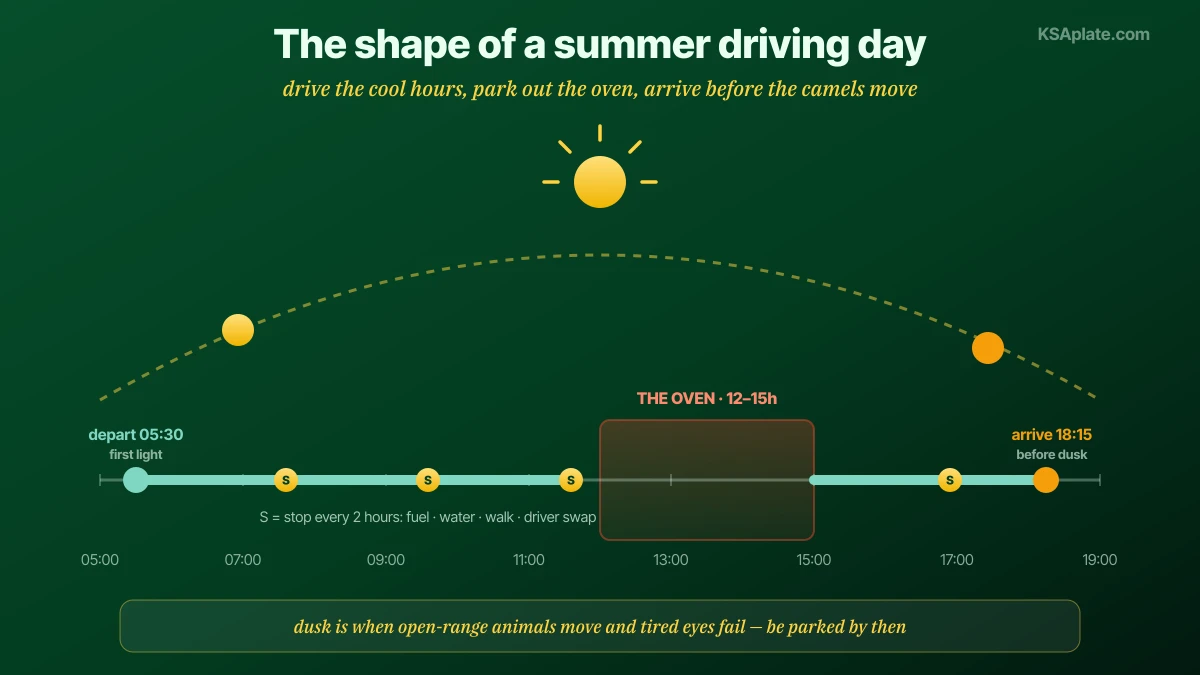
- Leave at first light. A 05:30 departure buys five or six cool hours — the best driving of the day — and puts distance behind you while children sleep through the first stretch.
- Park out the oven. Noon to three is for a long stop: food, prayer, shade, rest. Fighting the hottest hours costs concentration, fuel and AC margin for the worst kilometers per hour of the day.
- Arrive before dusk. This is not aesthetic advice. Twilight is when open-range animals move and when tired eyes fail — the two deadliest features of the Saudi highway share the same hour. Plan backwards from a pre-sunset arrival, and if the schedule slips, stop for the night rather than pushing into darkness on rural roads.
- Respect the two-hour rule. Every two hours or 200 km, whichever first: fuel, water, walk, driver swap if you have one. Fatigue on an empty, straight, unchanging highway is not weakness; it is physiology — the road hypnotizes precisely because nothing happens.
Highway craft: the four killers
The Saudi highway is engineered for calm speed; what remains dangerous is specific and learnable:
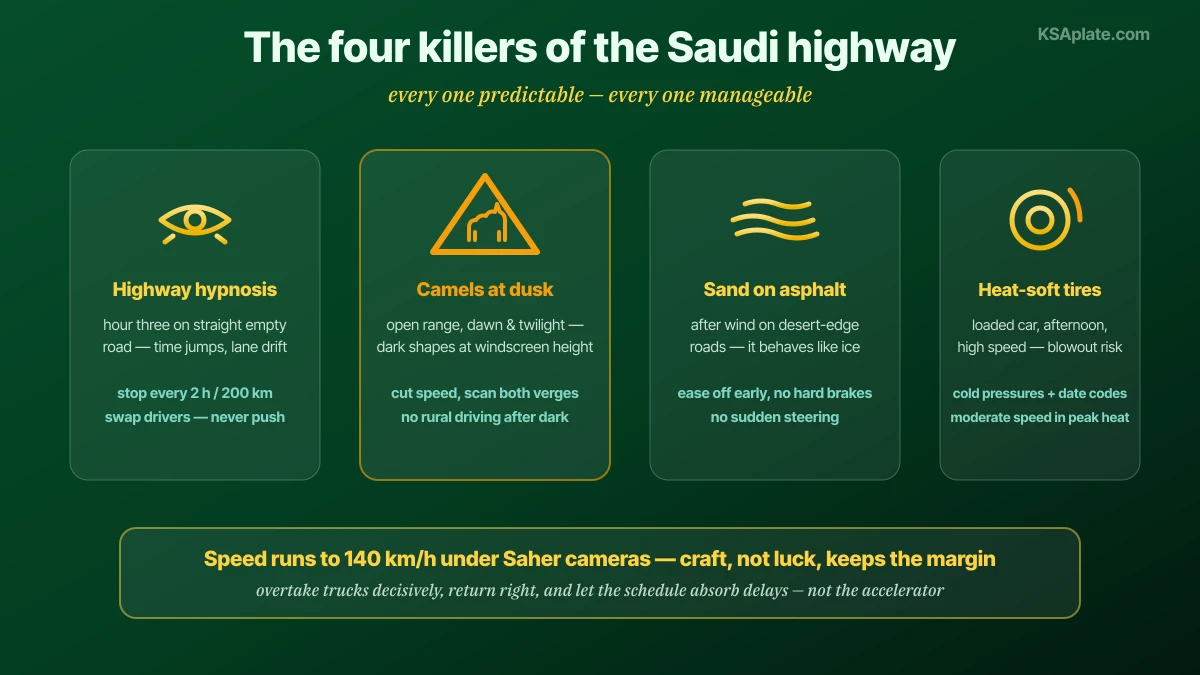
| Hazard | When it strikes | The tell | The answer |
|---|---|---|---|
| Highway hypnosis | Hours 3+ on straight empty road | Time jumps, lane drift, heavy eyes | Two-hour stops, cold air, driver swap — never "push through" |
| Camels & livestock | Dawn and dusk, open-range stretches | Warning signs, herds visible off-road, dark shapes at the verge | Cut speed sharply, scan both verges, never drive open range at night |
| Sand on asphalt | After wind, on desert-edge roads | Pale tongues across the lane, hazy air ahead | Ease off early, no hard braking, no sudden steering — sand is ice at speed |
| Heat-stressed tires | Afternoon, loaded car, high speed | Thump rhythm change, pull, TPMS warning | Correct cold pressures, moderate speed in peak heat, respect the date code |
Add the human layer: speed is camera-enforced at up to 140 km/h on the main corridors — the limits and Saher mechanics are in our speed guide — and truck traffic on the eastern corridor rewards decisive, complete overtakes rather than lingering alongside. If the worst happens despite everything, the accident procedure through Najm is its own process — documented in the accident guide — and knowing it beforehand is worth more than reading it at the roadside.
Fuel strategy and the half-tank rule
Fuel is the cheapest part of a Saudi road trip and the easiest to mismanage:
- The half-tank rule: on any route with empty stretches, refuel when the gauge touches half. The rule costs a few extra stops and removes the entire category of range anxiety, detour risk and "is that station open?" arithmetic. On Riyadh–Jeddah and the AlUla approaches it is not a tip; it is the difference between a trip and a story.
- Know your octane before you leave. Most stations everywhere carry 91; 95 is universal on main corridors but thinner off them. If your engine genuinely requires 95, plan around it — and if you are not sure what it requires, settle it once with the 91 vs 95 guide instead of paying premium out of caution at every stop.
- Fuel the car when you stop the car. Combine the two-hour human stop with the fuel stop — one rhythm, fewer decisions, and the tank never surprises you.
- Consumption honesty: a loaded SUV at 140 km/h with AC at maximum drinks 20–30% more than its city figure. Budget range accordingly — the trip computer's optimism was calibrated on neither August nor a full boot.
Road-tripping with children
Eight hundred kilometers with children is entirely feasible — Saudi families do it every Eid — but it runs on rhythm, not endurance:
- The seat rules do not relax on holiday. Every child, every kilometer, in the correct restraint — the highway is precisely where the seat earns its existence. Long-trip specifics: thin clothing under the harness despite the AC, shade cloth over hardware at stops, and a hand-check of buckles after every stop in the sun. The complete discipline is in the child car seats guide.
- Plan stops as destinations, not pauses. A fuel station forecourt entertains no one. Aim the two-hour stops at something — a rest area with space to run, a town with a park, the scenic viewpoint — and the day becomes a chain of small trips instead of one long sentence.
- Feed the schedule, not the appetite. Eat light and often from the cool box rather than one heavy restaurant meal that puts the driver into the 3 p.m. dip with 300 km to go.
- Screens are trip equipment. Loaded tablets with downloaded content and headphones are not a parenting failure at hour six; they are why hour seven happens peacefully. Balance with window games in the interesting stretches.
- The trip is a test drive in disguise. Nothing audits a family car like a long haul: third-row comfort, boot honesty, rear AC reach. If the audit fails, treat it as data — the family SUV guide covers the upgrade decision, and the free car value calculator prices the current car for the swap.
Leaving the asphalt
The dunes and wadi tracks are half the reason to own an SUV here, and the rules compress hard:
- Never alone. Off-asphalt travel is a two-vehicle activity, full stop. One stuck car with a second car present is an anecdote; alone it is an emergency in 45-degree heat.
- Air down, tell someone, carry double water. Lower tire pressures for sand (and re-inflate at the first station back), leave your route and return time with someone in town, and double the water calculation the moment wheels leave tarmac.
- Know your machine's reality. All-wheel-drive crossovers are not dune cars; low-range and recovery points define what the vehicle can attempt. Recovery gear without training digs deeper holes — go with experienced company the first times.
- The escalation path, if it goes wrong anyway — shade discipline, staying with the vehicle, who to call — is written in the breakdown guide's desert chapter; read it before the trip that needs it.
When something goes wrong anyway
The short version, because the long versions have their own guides: move the car fully off the road and get everyone behind the barrier — the shoulder of a 140 km/h highway is the most dangerous place on the trip. Triangle out, hazards on, shade and water rationed calmly. Your insurer's roadside line is the first call for a breakdown (the full protocol); accidents run through the Najm process (documented here); and comprehensive coverage — worth confirming before a long trip, per the insurance guide — is what turns a bad afternoon far from home into logistics instead of loss.
Frequently asked questions
How long is the drive from Riyadh to Jeddah?
Is a road trip across Saudi Arabia safe?
Do I need an SUV for a Saudi road trip?
How much water should I carry driving in Saudi Arabia?
What is the biggest danger driving at night in Saudi Arabia?
When should I refuel on a long Saudi drive?
How do I avoid fatigue on long empty highways?
Can I drive off-road into the desert on my own?
What should I check on my car before a long trip?
Are speed limits enforced on Saudi highways?
Is fuel expensive for a long Saudi road trip?
Conclusion
The Saudi road trip rewards the same temperament as everything else in this market: preparation over improvisation, rhythm over endurance, respect for the specific local physics — heat, distance, dusk — over generic advice. Check the car a week out, load water like you mean it, leave at first light, stop every two hours, refuel at half, and be parked somewhere pleasant when the camels start moving. Do that and the kingdom opens up: the escarpment down into Taif, the first sight of AlUla's rocks, the temperature falling as the road climbs into Abha.
And if the long haul teaches you that the car itself is the weak point — cooling marginal, third row punitive, boot dishonest — treat it as the trip's most valuable souvenir. Price the current car honestly on the free value calculator, browse what the live listings across Saudi Arabia actually offer for the next one, and list the outgrown car for free with its service history up front. The best road-trip cars in the kingdom are bought by people who just came back from one — and selling before the next school year puts the calendar on your side too.