TL;DR:
- In Saudi Arabia, heat is what kills a car battery — not cold. The Kingdom's extreme summers evaporate the fluid inside the battery and accelerate the corrosion that wears out its plates, which is why a battery here typically lasts 2 to 3 years instead of the 4 to 5 you'd expect in a mild climate.
- Your battery gives warnings before it dies. Slow, sluggish cranking on the first start of the day, a battery light on the dash, dim lights at idle, a single click with no start, or a swollen case — any of these means test it now, before it strands you in a car park in July.
- A replacement costs roughly SAR 180–1,200 depending on size and type. A standard sedan battery is around SAR 300–550 fitted; large SUVs and modern start-stop cars needing an AGM battery run higher. Street battery shops and mobile replacement services are cheaper than dealerships.
- Buy a battery built for heat, not just a cheap one. For the Saudi climate, reserve capacity and high-temperature durability matter more than the cold-cranking figure printed on the label — and any car with automatic start-stop needs an AGM or EFB battery, not a plain one.
- A car that eats batteries and needs constant help is sending a financial signal. A healthy car deserves a fresh battery and years more service; a car stacking up repairs is telling you to check its value and move it on while it still starts every time.
Quick answer: A car battery in Saudi Arabia lasts about 2 to 3 years because the extreme heat — not cold — evaporates the electrolyte and speeds up internal corrosion. Replace it when you notice slow cranking, a dashboard battery light, dim lights at idle, or if the battery is more than three years old. A replacement typically costs SAR 180–1,200 fitted depending on size and type, with street battery shops and mobile services cheaper than dealerships. For the Saudi climate, choose a battery rated for high temperatures, and use an AGM battery if your car has automatic start-stop.
Why heat is a battery's worst enemy in Saudi Arabia
Most drivers grow up hearing that cold weather kills car batteries. That's true in Europe and North America — but in the Gulf the opposite problem does the damage. A standard car battery is happiest at around 25°C. In Riyadh, Jeddah or Dammam, summer air routinely hits 45–48°C, and the engine bay where the battery sits can climb past 70–80°C once the car has been running or parked in the sun. That heat attacks the battery in three ways at once.
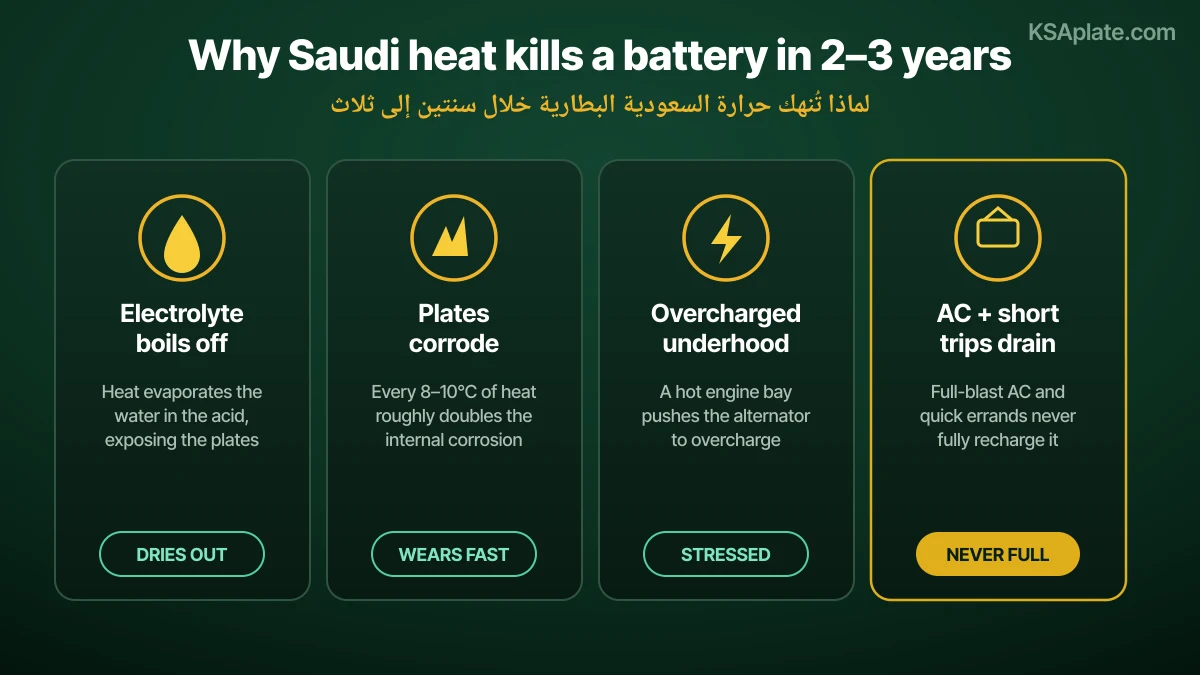
It boils off the fluid. A conventional battery is filled with an electrolyte of sulfuric acid and water. Extreme heat evaporates that water, dropping the fluid level and exposing the lead plates to air. Once the plates aren't fully submerged, the battery loses capacity permanently — and a sealed "maintenance-free" battery can't simply be topped up.
It accelerates corrosion. Chemical reactions speed up as temperature rises. As a rough rule, every 8–10°C of extra heat roughly doubles the rate at which the battery's internal plates and grids corrode. A battery that would age slowly in Germany effectively ages at double or triple speed through a Saudi summer.
It encourages overcharging. Your car's voltage regulator sets charging voltage partly by temperature. In a scorching engine bay, the alternator can push a little too much voltage into an already-hot battery, which drives more evaporation — a vicious circle. Add the constant heavy load of running the air conditioning at full blast, often on short city trips that never fully recharge the battery, and the cell is worked hard and rested little.
How long does a car battery last in Saudi Arabia?
Plan for 2 to 3 years. In a temperate climate a good battery lasts 4 to 5 years. In the Gulf, heat roughly halves that. Many drivers in Saudi Arabia find their battery starts struggling in its third summer, and a battery that survives four years here has done exceptionally well. The table below shows why the number is so much lower than the figure quoted on most global spec sheets.
| Climate / condition | Typical battery life |
|---|---|
| Mild climate (≈25°C average) | 4–5 years |
| Saudi Arabia, garaged & driven daily | 3–4 years |
| Saudi Arabia, parked outdoors in the sun | 2–3 years |
| Short city trips + heavy AC use | 2 years or less |
| Car left standing for weeks in summer | Can fail in a single season |
The single biggest thing you control is where you park. A battery in a car that lives in a shaded or basement car park will comfortably outlast the identical battery in a car baking on an open lot every day. Everything else — the brand, the price, the technology — matters less than keeping the heat off it.
5 signs your battery is about to fail
A battery rarely dies without warning. Learn to read these five signs and you can replace it on your own schedule — in the shop, at a fair price — instead of at 2pm in a mall car park waiting for a roadside rescue.
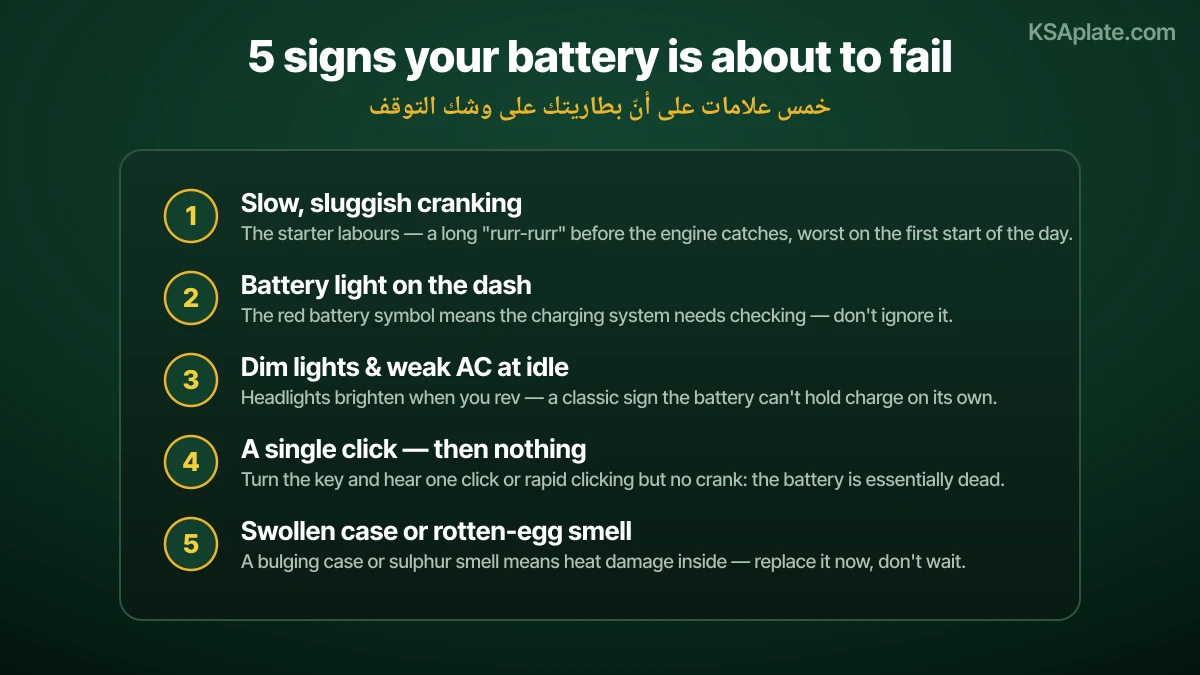
- Slow, sluggish cranking. The starter labours — a longer "rurr-rurr" than usual before the engine catches. It's often worst on the very first start of the day, before the heat has warmed the chemistry up.
- A battery light on the dash. The red battery symbol means the charging system needs checking. It doesn't always mean the battery itself, but never ignore it.
- Dim lights and weak AC at idle. If the headlights or dashboard dim at a standstill and brighten when you rev, the battery can no longer hold charge well on its own.
- A single click, then nothing. Turn the key and hear one loud click or a rapid clicking, but the engine won't crank — the battery is essentially flat.
- A swollen case or rotten-egg smell. A bulging battery case or a sulphur (rotten-egg) smell means heat has damaged the cells inside. Replace it immediately; a swollen battery can leak or fail completely without notice.
What's your car worth?
Get a free instant estimate based on real Saudi market data — then sell it on KSAplate with direct WhatsApp contact.
Value My Car — FreeHow to test a battery and read the voltage
You don't have to guess. Two quick checks tell you almost everything.
The voltage check. With the engine off, a cheap multimeter across the terminals reads the battery's resting state of charge:
| Resting voltage (engine off) | State of charge |
|---|---|
| 12.6 V or higher | Fully charged & healthy |
| 12.4 V | About 75% — still fine |
| 12.2 V | About 50% — recharge soon |
| 12.0 V | About 25% — weak |
| Below 11.8 V | Discharged / failing |
With the engine running, you should see roughly 13.7–14.7 V at the terminals — that's the alternator charging. A reading far below or above that range points to a charging-system problem rather than the battery itself.
The load test. Voltage alone can lie: a dying battery can show 12.5 V at rest and still collapse the moment the starter draws current. That's why any battery shop, dealership, or fast-fit centre will do a free load test that measures how the battery holds up under a real electrical load. If your battery is over two years old, ask for a load test at your next service — it takes two minutes and turns "it feels a bit slow" into a clear yes or no. It fits naturally alongside routine car maintenance.
Which battery type is best for the Saudi heat
Not all batteries cope with heat equally. When you replace yours, match it to your car and — just as importantly — to the climate.
| Type | Best for | Heat & price notes |
|---|---|---|
| Standard flooded (lead-acid) | Older or basic cars with no start-stop | Cheapest; shortest life in heat. Fine if you replace on schedule. |
| EFB (Enhanced Flooded) | Cars with basic start-stop | More durable than standard; mid-price. A sensible upgrade for the Gulf. |
| AGM (Absorbent Glass Mat) | Modern cars with start-stop, big SUVs, lots of electronics | Sealed, most heat- and vibration-tolerant, longest life; most expensive. |
Two rules matter more than brand loyalty in Saudi Arabia:
- Fit the technology your car was designed for. If your car has automatic engine start-stop, it needs an AGM or EFB battery. Fitting a cheap standard battery in a start-stop car will kill it within months and can confuse the car's electronics.
- Prioritise heat durability over cold-cranking amps (CCA). CCA measures cold-start power — critical in Canada, close to irrelevant in Riyadh. Here you want strong reserve capacity and a battery marketed for high-temperature or GCC conditions. Look for a battery designed and warranted for hot climates rather than the highest CCA on the shelf.
What a replacement costs and where to buy
Budget SAR 180 to SAR 1,200, fitted. The exact figure depends on the battery's size (its Ah rating), its technology, and where you buy it. As a guide for 2026:
| Car type | Typical battery | Approx. fitted price (SAR) |
|---|---|---|
| Small sedan / hatchback | 40–50 Ah standard | 180–320 |
| Family sedan (Camry, Accord) | 60–80 Ah standard/EFB | 300–550 |
| Large SUV / pickup | 80–100 Ah | 450–800 |
| Start-stop car / premium (AGM) | 70–105 Ah AGM | 600–1,200 |
Where to buy, cheapest to most expensive:
- Street battery shops. Every neighbourhood has specialist battery shops that will test, sell, and fit a battery on the spot, often for the best price. They usually take your old battery in part-exchange (there's a small scrap value in the lead).
- Mobile replacement services. Apps and roadside services (for example Morni and similar providers) will come to you, test the battery, and swap it wherever you're parked — for a modest call-out fee on top of the battery. Ideal when the car won't start at all.
- Auto-parts retailers & fast-fit centres. Chains and hypermarket auto sections carry known brands with clear warranties; convenient and reliable, mid-price.
- Dealership service centres. The most expensive route, but the safe choice for a complex AGM/start-stop car that needs the battery "registered" to the car's computer.
Common brands you'll see in the Kingdom include AC Delco, Varta, Bosch, Amaron and various regional makes. Whatever you choose, check the manufacture date stamped on the battery — a battery that has itself been sitting in a hot warehouse for a year has already lost life before you fit it. And keep the receipt: most carry a warranty of 1–2 years, which matters when heat can cause an early failure.
Jump-starting and mobile replacement
If the car is already dead, you have two quick options. A jump-start — from another car's battery with jumper cables, or from a portable lithium jump pack kept in the boot — will get you moving in minutes. Connect red to the dead positive, red to the good positive, black to the good negative, and the last black to a bare metal point on the dead car (not its battery), start the good car, then the dead one.
But understand what a jump-start is: a rescue, not a repair. A battery flat enough to need jumping in the Saudi heat is usually near the end of its life. Drive straight to a battery shop for a load test, or call a mobile replacement service to swap it on the spot. A portable jump pack is one of the smartest SAR 150–300 you can spend before summer — it turns a stranding into a two-minute inconvenience, and it's a natural companion to a proper roadside emergency kit.
How to make your battery last longer in the heat
You can't beat the Saudi summer, but you can buy your battery an extra year with a few habits:
- Park in the shade. The single most effective step. Shade, a basement car park, or even a car cover keeps the underhood temperature down and slows evaporation.
- Drive it enough to recharge. A run of short trips with the AC blasting drains a battery faster than it refills. An occasional longer drive lets the alternator fully recharge it.
- Turn off electronics before switching off. Kill the AC, lights and sound system a moment before you stop the engine so the next start isn't fighting a load.
- Keep the terminals clean and tight. Corroded or loose terminals waste charge and cause hard starts. A quick clean of any white/green powder and a firm connection helps.
- Don't let the car sit for weeks. A car standing unused in summer can flatten its battery in one holiday. If you travel, have someone start and run it, disconnect the negative terminal, or use a smart trickle charger.
- Replace proactively at year three. Once a battery is three summers old, replacing it before it fails is cheaper than the tow, the wasted morning, and the mall-car-park stress that a surprise failure brings.
Do hybrids and EVs have the same problem?
Partly — and it surprises people. A hybrid or electric car still has an ordinary 12-volt battery that runs the computers, lights and locks, and that small battery suffers in the heat exactly like a normal one; a dead 12V battery can leave an EV unable to power up even with a full traction pack. The large high-voltage traction battery in an EV or hybrid is a different technology with its own liquid or air cooling, and it's managed carefully by the car — but sustained extreme heat is still its enemy, which is why shade and thermal management matter even more for electric cars in the Gulf. In short: every car on Saudi roads has at least one battery that the heat is working against.
When a dying battery is a sell signal
A flat battery is almost always a cheap, easy fix — arguably the best value repair in all of motoring. On a sound car, spending SAR 300–600 on a fresh battery buys years more reliable service, and you should do it without a second thought. A battery, by itself, is never a reason to sell a car.
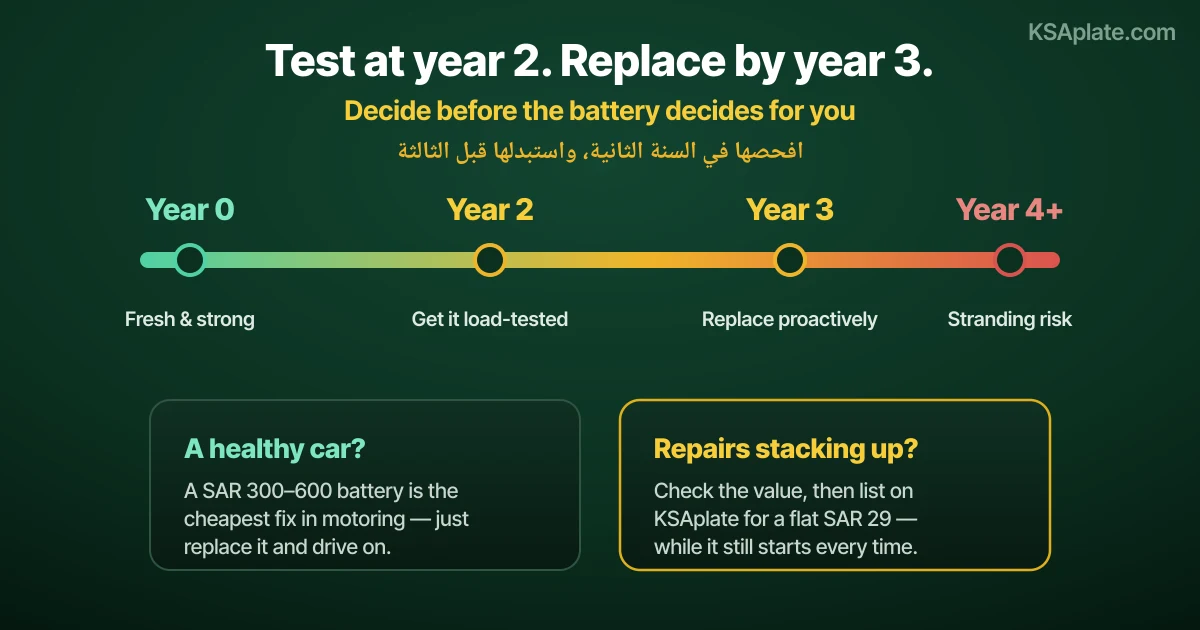
The picture changes when the battery is the latest in a run of problems. If this year has already brought an AC repair, a string of maintenance bills, and now a car that needs jumping or towing more than once, the battery isn't really the issue — it's the messenger. That's the moment to run the numbers honestly: add up what you've spent and are about to spend, and weigh it against what the car is actually worth today.
Do it in two minutes: check your car's current market value in the free car value calculator, and look at what similar cars are selling for on the live KSAplate marketplace. If a year of repairs is starting to rival the resale price, keeping the car is the expensive choice. And the best time to sell is now — while a fresh battery means the car starts on the first turn for every buyer who comes to see it. A car that starts cleanly sells for far more, and far faster, than one that needs an apology and a jump pack. When you're ready, you can list your car on KSAplate for free, no commission — see the full playbook in our guide to selling a car in Saudi Arabia.
Frequently asked questions
How long does a car battery last in Saudi Arabia?
Why do car batteries die faster in hot weather than cold?
What are the signs my car battery is dying?
How much does a car battery cost in Saudi Arabia?
Where can I buy and fit a car battery in Saudi Arabia?
What voltage should a healthy car battery read?
Which battery type is best for the Saudi climate?
Can I put any battery in a start-stop car?
How do I jump-start a car in Saudi Arabia?
Does using the air conditioning drain the battery?
Can expats and Iqama holders buy and fit a battery the same way?
How can I make my car battery last longer in the heat?
My car keeps needing jump-starts and repairs — should I fix it or sell it?
Conclusion
A car battery in Saudi Arabia lives a hard life. The same sun that makes a black steering wheel untouchable at noon is quietly boiling the fluid and corroding the plates inside your battery, which is why two or three years is a normal lifespan here, not a defect. But a battery is also the most predictable part on your car: it warns you before it quits, it's cheap to test, and it's cheaper still to replace on your own terms. Read the signs — slow cranking, a dashboard light, dim lights at idle — get a free load test once you're past two years, park in the shade, and swap the battery proactively at year three. Do that, and you'll never meet the version of this problem that strikes at 2pm in a mall car park.
And when the battery is the third thing to go wrong this year, listen to what it's really telling you. Handle the small stuff — a fresh battery, a jump pack in the boot — and then ask the bigger question the roadside keeps raising. Check what the car is worth in the value calculator, look at the live market, and if the repairs are starting to rival the resale, list it on KSAplate for free while it still starts on the first turn — because the best battery problem is the one you replaced before it ever left you stranded.