
Last updated: 27 August 2026
TL;DR:
- Digit count is the single strongest demand signal on a Saudi plate. Across 10,103 live listings, a one-digit plate draws 12.2 views a day and a four-digit plate draws 1.7 — a 7.1x gap that no other listing feature comes close to.
- Three-digit plates are the widest mispricing in the market. They are asked at almost the same money as two-digit plates (SAR 44,876 against SAR 55,247 on average) while attracting 43% less buyer attention.
- Only repeating digits behave like a premium pattern. Among four-digit plates, 7777-style numbers pull 8.89 views a day against 1.28 for a plate with no pattern. Mirrors and ladders barely beat an ordinary number.
- Double-pair numbers such as 1122 perform below the baseline — 1.21 views a day, less than a plate with no pattern at all, despite being sold as a pattern.
- Hiding your price suppresses attention. Two-digit plates showing a number average 12.60 views a day; those marked "call for price" average 1.05.
- Where you live is close to irrelevant. Hold digit count constant and the best and worst Saudi cities differ by 18%, against a 615% gap between digit lengths.
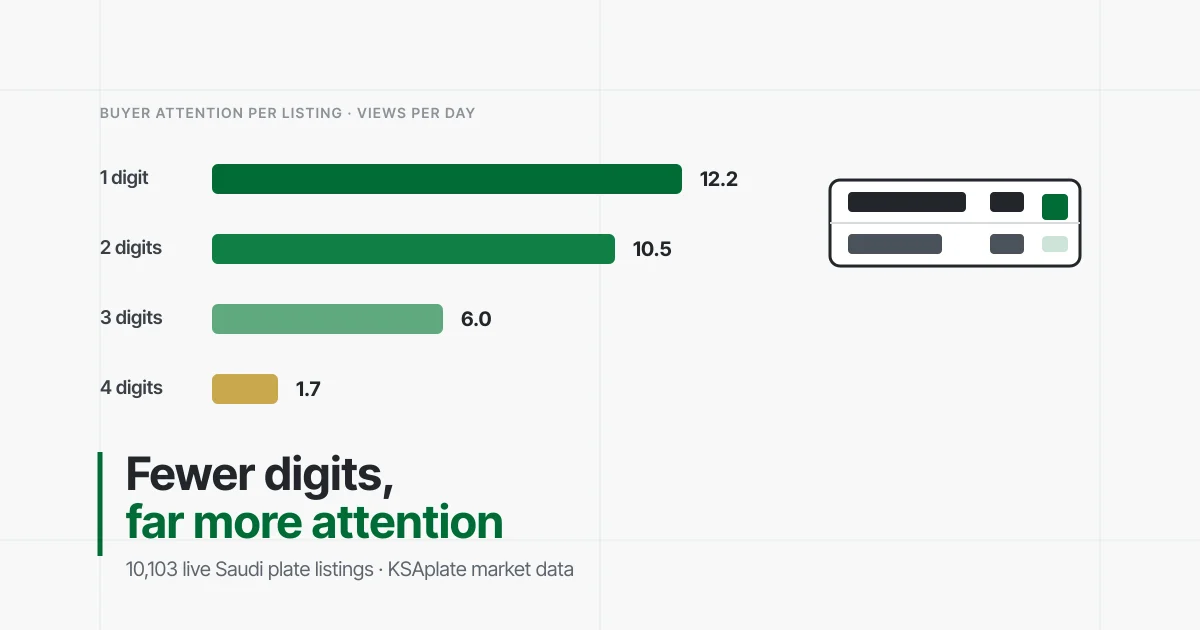
Quick answer: Saudi plate buyers concentrate almost entirely on short numbers. Measured across 10,103 active listings on KSAplate, a one-digit plate receives 12.2 page views per day live, a two-digit plate 10.5, a three-digit plate 6.0 and a four-digit plate 1.7. Digit count predicts buyer attention more strongly than pattern, letters, price or city combined.
What the attention index measures
The attention index is the average number of times a plate listing is opened per day it has been live. It is a demand measure, not a price measure. Every figure in this article comes from one dataset: the 10,103 active private-plate listings on KSAplate as of 27 August 2026, which between them have been opened 4,503,724 times and have been live for an average of 176 days.
Raw view totals are misleading because an older listing has had more time to collect them. Dividing each listing's views by the number of days it has been live removes that bias, so a plate posted in March and a plate posted in July can be compared directly. Every comparison below is made on that per-day basis.
Most published writing about Saudi plates describes what sellers ask. Asking prices are easy to gather and tell you what owners hope for. They say nothing about whether anyone wants the plate. Attention is the other half of the picture, and it is the half that decides whether a listing sits for a year.
Key takeaway: Asking price is a claim made by a seller. Attention is a behaviour recorded from buyers. When the two disagree, the buyers are the ones holding the money.
Digit count beats everything else
Digit count is the strongest single predictor of buyer interest in the Saudi plate market. A one-digit plate averages 12.22 views per day live. A four-digit plate averages 1.71. That is a 7.1x difference, and it dwarfs every other variable measured here.
The ranking is clean and it does not wobble:
| Digit count | Live listings | Attention index (views/day) | Mean asking price | Median asking price |
|---|---|---|---|---|
| 1 digit | 157 | 12.22 | SAR 337,635 | SAR 140,000 |
| 2 digits | 515 | 10.47 | SAR 55,247 | SAR 36,000 |
| 3 digits | 1,466 | 6.01 | SAR 44,876 | SAR 26,500 |
| 4 digits | 7,965 | 1.71 | SAR 19,700 | SAR 3,300 |
Two structural facts sit behind those numbers. Short plates are genuinely scarce — one-digit plates are 1.6% of the listings on the site while four-digit plates are 78.8% — and scarcity is visible to a browsing buyer in a way that letter rarity is not. A buyer scrolling a results page reads the number length instantly and everything else second.
The practical consequence for a seller is uncomfortable but useful. If you hold a four-digit plate, you are competing with roughly 8,000 others for a pool of attention that is an order of magnitude smaller than the pool chasing short numbers. Nothing in your listing changes that. What you control is where you sit inside that group, which is what the rest of this article is about. If you have not yet established a starting figure, the method in our guide to calculating a Saudi plate's value is the right first step.
Key takeaway: Removing one digit from a plate is worth more demand than any pattern, letter combination or listing improvement available to a seller.
The price–attention gap
The price–attention gap is the distance between what a segment of the market asks and how much buyer interest that segment actually attracts. Where the gap is wide, plates sit unsold. In this dataset the widest gap by a clear margin belongs to three-digit plates.
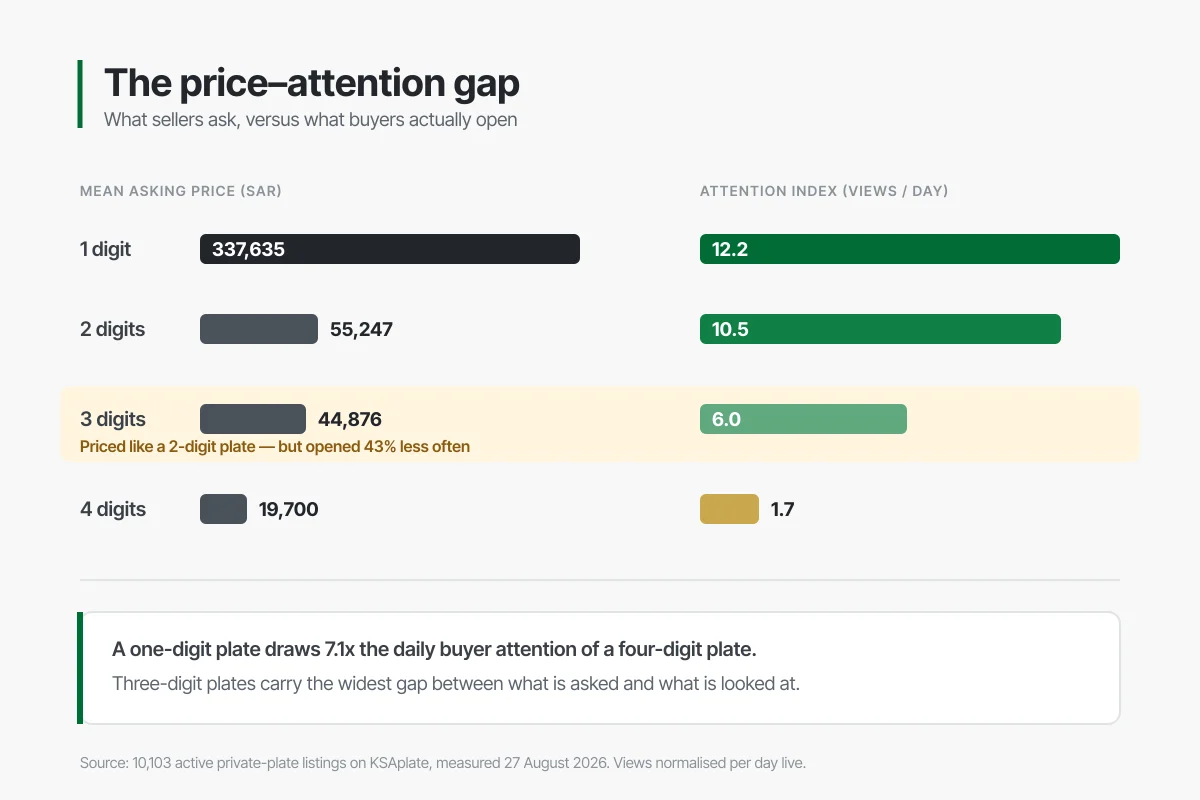
Look at the two middle rows. Three-digit plates are asked at SAR 44,876 on average against SAR 55,247 for two-digit plates — a discount of only 19%. Yet three-digit plates attract 6.01 views per day against 10.47, which is 43% less interest. Sellers of three-digit plates are pricing themselves as near-substitutes for two-digit plates while the market treats them as something meaningfully further down the ladder.
The same comparison run the other way makes the point sharper. Going from three digits to four costs a seller 56% of the asking price but 72% of the attention. Every step down the digit ladder loses more demand than it loses money, which is precisely why the shortest plates hold their value through slow markets. Our three-digit plate guide sets out where inside that band the stronger numbers sit.
Key takeaway: If you own a three-digit plate priced within 20% of comparable two-digit plates, you are asking two-digit money for roughly half the buyer interest.
What's your plate worth?
Get an instant, free estimate with our plate value calculator.
Calculate My Plate's ValueOnly one pattern actually moves buyers
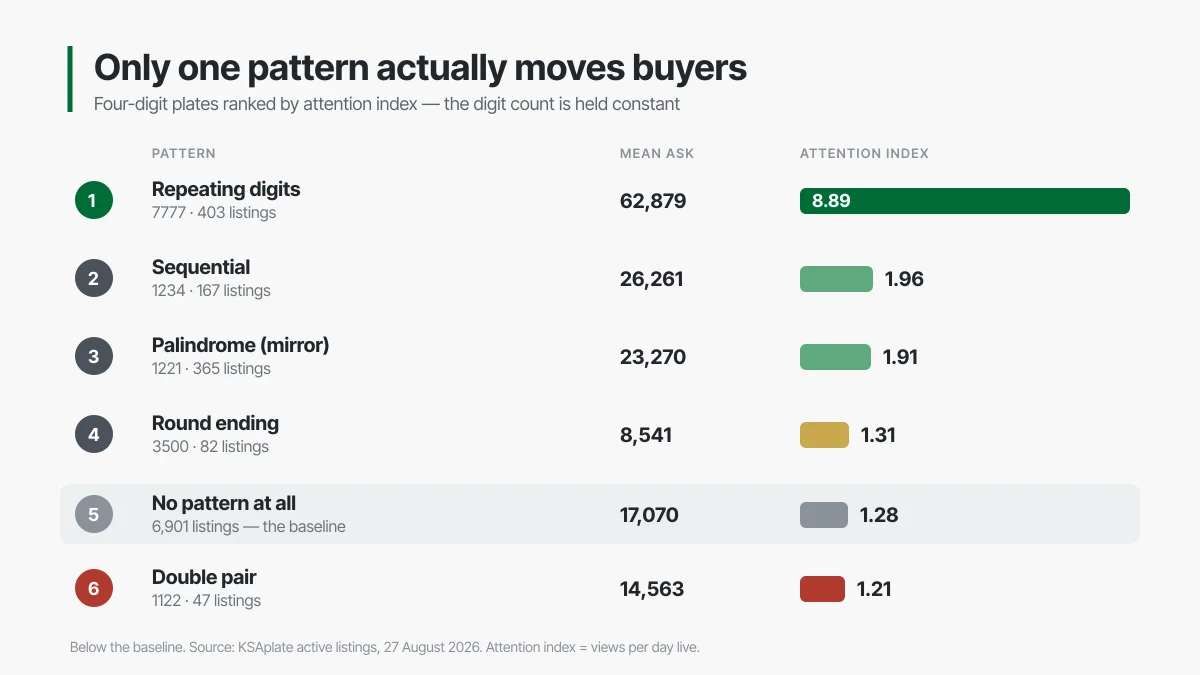
Among four-digit plates, repeating digits are the only pattern that produces a large demand premium. Holding digit count constant removes the effect described above and isolates the pattern itself. The result contradicts a good deal of what the market believes.
| Pattern | Example | Listings | Mean ask | Attention index | Against baseline |
|---|---|---|---|---|---|
| Repeating digits | 7777 | 403 | SAR 62,879 | 8.89 | +595% |
| Sequential | 1234 | 167 | SAR 26,261 | 1.96 | +53% |
| Palindrome | 1221 | 365 | SAR 23,270 | 1.91 | +49% |
| Round ending | 3500 | 82 | SAR 8,541 | 1.31 | +2% |
| No pattern | 6284 | 6,901 | SAR 17,070 | 1.28 | baseline |
| Double pair | 1122 | 47 | SAR 14,563 | 1.21 | −5% |
Repeating digits are in a category of their own. At 8.89 views a day they draw almost seven times the interest of an ordinary four-digit number, and the market has priced that correctly: the mean ask of SAR 62,879 is 3.7x the baseline. This is the one place in the dataset where the asking price and the demand agree.
Everything below it is softer than its reputation. Palindromes carry a 36% price premium over an ordinary plate for a 49% attention premium — roughly fair, but nowhere near the step-change sellers often expect. Sequential numbers carry a 54% price premium for a 53% attention premium. Both are respectable and neither is transformative. Our plate pattern value guide describes the full taxonomy; this data adds the demand column that the taxonomy alone cannot supply.
The double-pair result is the one that should change expectations. Numbers like 1122 and 3344 are marketed as pattern plates, yet they attract 1.21 views a day — slightly below a plate with no pattern at all. The market has already worked this out and prices them accordingly, at SAR 14,563 against SAR 17,070 for an ordinary number. The sample is the smallest in the table at 47 listings, so treat the exact figure with care, but the direction is clear: buyers do not read a double pair as a pattern, and a seller expecting a pattern premium for one will be disappointed.
Key takeaway: A repeat is a pattern buyers chase. A mirror or a ladder is a mild bonus. A double pair is, to the market, an ordinary number with a story attached.
Matching letters, and what they add
Plates whose three Arabic letters are identical attract 47% more attention than plates with mixed letters. Among four-digit plates, triple-same letter combinations average 2.45 views a day across 408 listings, against 1.67 for the 7,557 mixed-letter plates.
The pricing reflects it, and then some. Triple-same plates are asked at SAR 43,205 on average against SAR 18,431 for mixed — a 134% premium for a 47% demand premium. That is the second-widest price–attention gap in the dataset after three-digit plates, and it suggests letter symmetry is somewhat overbought relative to how buyers actually behave.
This is a smaller effect than digit count by an order of magnitude, which is the useful thing to know. A seller weighing whether matching letters can rescue a long number should expect a lift of roughly half again on attention, not a transformation. The guide to the 17 Arabic letters covers which individual letters are scarce and why the Latin transliterations look the way they do.
Key takeaway: Matching letters are real but secondary. They lift a long plate; they do not turn one into a short plate.
Do expensive plates get ignored?
No — within a fixed digit count, more expensive plates attract more attention, not less. This is the most counter-intuitive result in the dataset and it needs care in the reading.
| Asking price band (4-digit plates) | Listings | Attention index |
|---|---|---|
| Under SAR 5,000 | 5,183 | 1.22 |
| SAR 5,000–10,000 | 787 | 1.64 |
| SAR 10,000–20,000 | 826 | 2.59 |
| SAR 20,000–50,000 | 675 | 2.42 |
| SAR 50,000–100,000 | 171 | 4.78 |
| Over SAR 100,000 | 323 | 4.41 |
A four-digit plate asked above SAR 50,000 draws 3.9 times the attention of one asked below SAR 5,000. The obvious reading — that raising your price raises your visibility — is wrong, and acting on it would be an expensive mistake. The causation runs the other way. Plates that are genuinely desirable get priced high because they are desirable, and the same qualities that justify the price are what buyers respond to. Price is a symptom here, not a cause.
What the table does establish is that there is no evidence of buyers avoiding expensive plates. A common seller fear — that a high number scares people off before they click — does not appear in this data at any price point up to and beyond SAR 100,000. Sellers of strong plates can price with confidence, which is consistent with what our analysis of plates as an investment found on the returns side.
Key takeaway: Buyers are not deterred by high asking prices. But do not read this backwards: raising the price on a weak plate buys nothing.
The cost of hiding your price
Listings marked "call for price" attract dramatically less attention than listings showing a number. Among two-digit plates, those with a visible price average 12.60 views a day while those without average 1.05. Among three-digit plates the split is 6.29 against 1.06.
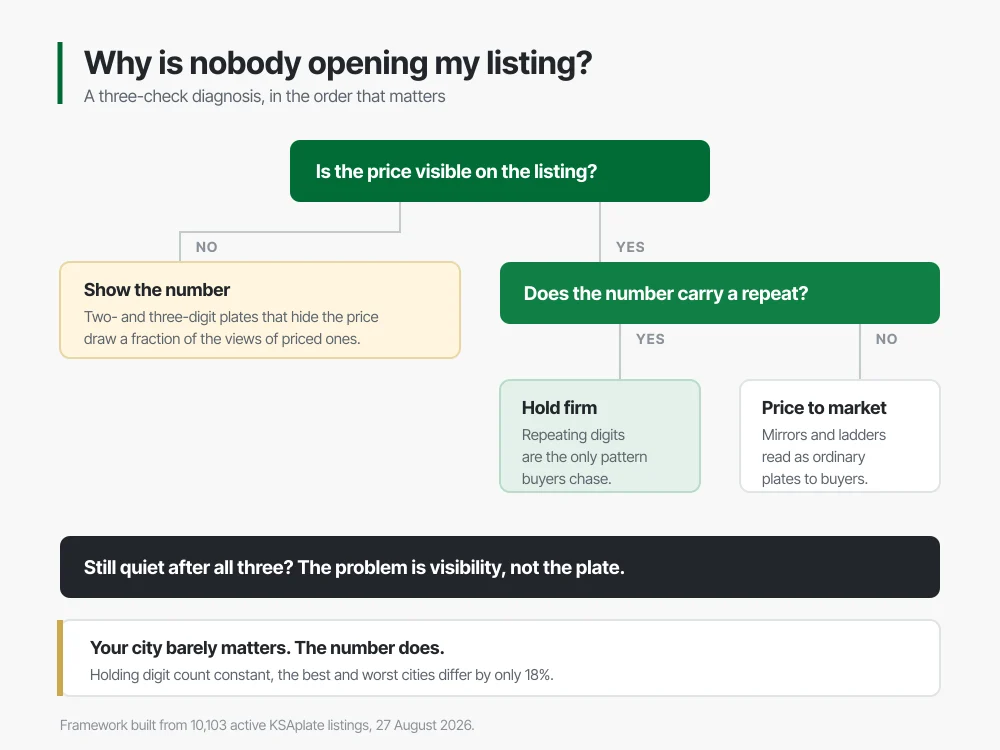
Withholding the price is common at the top of the market. Half of all one-digit listings — 50.3% — carry no price, against 18.4% of two-digit, 5.3% of three-digit and 0.4% of four-digit listings. The logic sellers give is that a serious buyer will call, and that naming a figure caps the negotiation. The measured behaviour does not support it for two- and three-digit plates.
Two honest caveats. First, this is an association, not proof of cause: sellers who hide prices may differ from those who do not in ways this data cannot see. Second, the pattern reverses among four-digit plates, where the 35 no-price listings average 4.78 views a day against 1.69 for priced ones. With a sample that small, and given those 35 are likely unusual plates, we do not treat the reversal as a finding. The two- and three-digit result rests on 95 and 77 no-price listings respectively and points firmly one way.
Key takeaway: On a two- or three-digit plate, a visible price is associated with roughly six to twelve times the buyer attention. Name a figure.
Does your city matter? Barely
Once digit count is held constant, the city recorded on a listing explains very little. Across four-digit plates, the best-performing city averages 1.86 views a day and the weakest 1.57 — a spread of 18%, against the 615% spread between one-digit and four-digit plates.
This corrects an impression the raw numbers create. Uncontrolled, Buraydah appears to outperform Riyadh by 24%. Control for digit count and Riyadh sits mid-table at 1.69 against Buraydah's 1.77. The apparent city effect was mostly a difference in what each city has listed, not in how buyers treat it. Our guide to the Riyadh, Jeddah and Dammam regional markets covers the pricing differences that do persist between them.
For a seller this is liberating. Buyers on a national marketplace browse by number, not by province. You are not disadvantaged by listing from Tabuk or Najran, and you gain nothing by claiming a Riyadh address.
Key takeaway: There is no meaningful geographic penalty on a Saudi plate listing. The number carries the demand.
What this data cannot tell you
An attention index measures interest, not transactions. Stating the boundaries matters more here than usual, because plate valuation is an area where confident numbers circulate with no method behind them.
Four limits apply to everything above:
- Views are not sales. A listing opened 5,000 times and never sold is common. This dataset shows which plates buyers investigate, which is a leading indicator of demand and not a record of completed deals. Confirmed sale prices, where we have them with sources, are published separately on the market data page.
- Views are not deduplicated per visitor. The counter increments each time a listing page loads, so repeat visits and automated crawlers are included. That inflates every figure, but it inflates them in the same way across every segment, which is why comparisons between segments hold and absolute values should not be read as unique buyers.
- This is one marketplace. Plates also change hands through government auctions, dealers, and private WhatsApp networks. Behaviour on those channels may differ. The comparison of selling channels sets out how they work.
- Some samples are small. The one-digit group is 157 listings and the double-pair group is 47. Wide segments such as four-digit plates rest on thousands of observations and are stable; narrow ones move with a handful of listings and are flagged as such above.
This is marketplace behaviour, not a national census. Registration and vehicle totals for the Kingdom are published by the General Authority for Statistics; nothing here should be read as a count of plates in circulation.
Where a result was fragile, we have said so rather than rounding it into a headline. The city finding in particular changed once we controlled for digit count, and the corrected version is the one reported here.
Pricing to demand: a six-step method
Pricing to demand means setting your asking figure against the attention your plate's segment actually receives, rather than against the most optimistic comparable listing you can find. The sequence below applies the findings in order of how much each one is worth.
- Establish your segment first. Count the digits. That fixes the demand pool you are competing in before any other consideration. A four-digit plate is in the 1.71-views-a-day world regardless of its letters.
- Check for a repeat. If your number repeats a digit throughout, you hold the one pattern with a large, market-confirmed premium — 8.89 views a day against a 1.28 baseline. Price it accordingly and expect to wait for the right buyer rather than discounting.
- Discount mirrors and ladders honestly. A palindrome or a sequential run earns roughly a 50% attention premium, not a multiple. If your asking price assumes more than that, it is above what buyer behaviour supports.
- Show the price. On two- and three-digit plates especially, a visible figure is associated with many times the attention of a "call for price" listing. If you want negotiating room, build it into the number rather than hiding the number.
- Sanity-check three-digit asks against two-digit reality. If comparable two-digit plates are listed at SAR 55,000 and you are asking SAR 48,000 for three digits, you are pricing into the widest demand gap in the market.
- Fix the listing itself last. Clear photographs and an accurate description matter, but they operate inside your segment, not across segments. The eight-shot photography method covers what a good plate listing looks like.
Two of these steps cost nothing and take a minute: showing your price, and checking your ask against the segment above you. Between them they address the two widest gaps this dataset found.
Listing a plate on KSAplate is free, with no commission on the sale. List your plate free →
Frequently asked questions
What is the most in-demand type of Saudi licence plate?
How many views should my plate listing be getting?
Why is my plate getting views but no offers?
Should I put a price on my listing or write "call for price"?
Are mirror plates and sequential numbers worth a premium?
Is a number like 1122 a pattern plate?
Do matching Arabic letters increase demand?
Does it matter which Saudi city I list my plate from?
Do expensive plates get fewer views because of the price?
How was this data collected?
What to do next
If you own a plate and have been guessing at a figure, the sequence is short. Count the digits to find your segment, check whether your number carries a repeat, then compare your ask against the segment above you rather than against the boldest listing you can find. The free plate value calculator gives you a starting range from the letters and number alone.
If your plate is already listed elsewhere and quiet, the two changes worth making today are showing your price and correcting an ask that assumes a mirror or ladder is worth a multiple. Both are free.
Listing on KSAplate costs nothing and there is no commission on the sale. List your plate free →
Written by Khalid Al-Rashid, who has covered the Saudi distinctive-plate market for KSAplate since 2026. The figures in this article were computed directly from KSAplate's live listing database on 27 August 2026 and are described with their sample sizes and limits in the methodology section. Documented auction results, with sources, are published on the market data page.
Last reviewed on 27 August 2026 by the KSAplate editorial team. Plate transfer rules and fees are set by the General Directorate of Traffic (Muroor) — confirm current requirements on Absher before acting.