Last updated: May 2026 | 16 min read
Saudi Arabia has one of the world's most active markets for distinctive license plates. The Ministry of Interior releases hundreds of plates weekly through Absher electronic auctions, and millions of SAR change hands on private marketplaces like KSAplate.com every month.
But here is the fact that most buyers miss: Saudi plates are not city-specific. A plate numbered 7 ABJ purchased in Riyadh is equally valid in Jeddah, Dammam, Mecca, or NEOM. The physical plate has no regional code. Yet anyone who has spent time in the Saudi plate market knows that where you buy — and who you're buying from — matters enormously to the price you pay and the return you can expect.
This guide breaks down Saudi Arabia's three major plate markets by city, explaining the cultural drivers, price dynamics, buyer psychology, and investment strategies that operate differently in Riyadh, Jeddah, and Dammam.
1. Why Cities Matter in a Nationwide Market
Saudi Arabia is a nation where wasta — social standing and who you know — shapes everything from business deals to marriage prospects. License plates are one of the most visible signals of status in the Kingdom. Your plate is seen by everyone on the road, in valet queues, and outside government buildings. This is why the plate market is so deeply cultural, and why culture differs meaningfully between Saudi cities.
The three largest cities — Riyadh, Jeddah, and Dammam — are not just geographically distinct. They represent three different versions of Saudi identity:
- Riyadh is the political and administrative heart of the Kingdom. It is Nejdi in culture — deeply tribal, conservative, and status-conscious at the highest levels. The old money of Saudi Arabia flows through Riyadh.
- Jeddah is the commercial port and cultural melting pot. Its Hijazi culture is more cosmopolitan, more merchant-oriented, and more open to the outside world. Jeddah has historically been Saudi Arabia's most commercially sophisticated city.
- Dammam and the Eastern Province is the petroleum heartland. The presence of Saudi Aramco has created a unique economic culture: high salaries, corporate spending, and proximity to Bahrain make the Eastern Province a distinct third market.
These cultural differences create measurable differences in what plates sell, at what prices, and who is buying.
2. Riyadh: The Dominant Plate Market
Riyadh is the Kingdom's biggest plate market by listing volume, and our own data supports that much: it carries more active listings than any other city. What we cannot give you is its share of national transactions. No public transaction record exists for Saudi plates — private sales settle through Absher with no price attached — so any percentage of "all distinctive plate transactions" is an estimate presented as a measurement. This section previously carried one; it has been removed.
2.1 Who Buys Plates in Riyadh
The Riyadh buyer pool is the deepest in Saudi Arabia. It includes:
- Royal family members and senior government officials — who pay essentially any price for single-digit plates and plates that carry their tribal initials
- Saudi businessmen from major Najdi tribes — for whom a plate displaying the initials of a prominent tribe is both a status symbol and a cultural identity marker
- Institutional investors — including family offices that treat top-tier plates as alternative assets
- Car dealerships and showroom operators — who buy premium plates for display vehicles
2.2 What Riyadh Buyers Prefer
Riyadh buyers consistently dominate bidding on:
- Single and two-digit plates — The most prized assets in the entire Saudi market. The 2025 record sale of SAR 21,000,000 for a single-digit plate was achieved by a Riyadh buyer.
- Tribal letter combinations — specific three-letter combinations that spell or abbreviate names of major Najdi tribes are sought after, and sellers price them accordingly. We cannot put a multiplier on it: our listings are not classified by tribal significance, so any figure would be invented. The letter أ (Alef) is particularly prestigious in Riyadh.
- Presidential and government-adjacent numbers — Plates that could theoretically be confused with VIP motorcades carry unofficial premiums.
2.3 Riyadh Price Premium
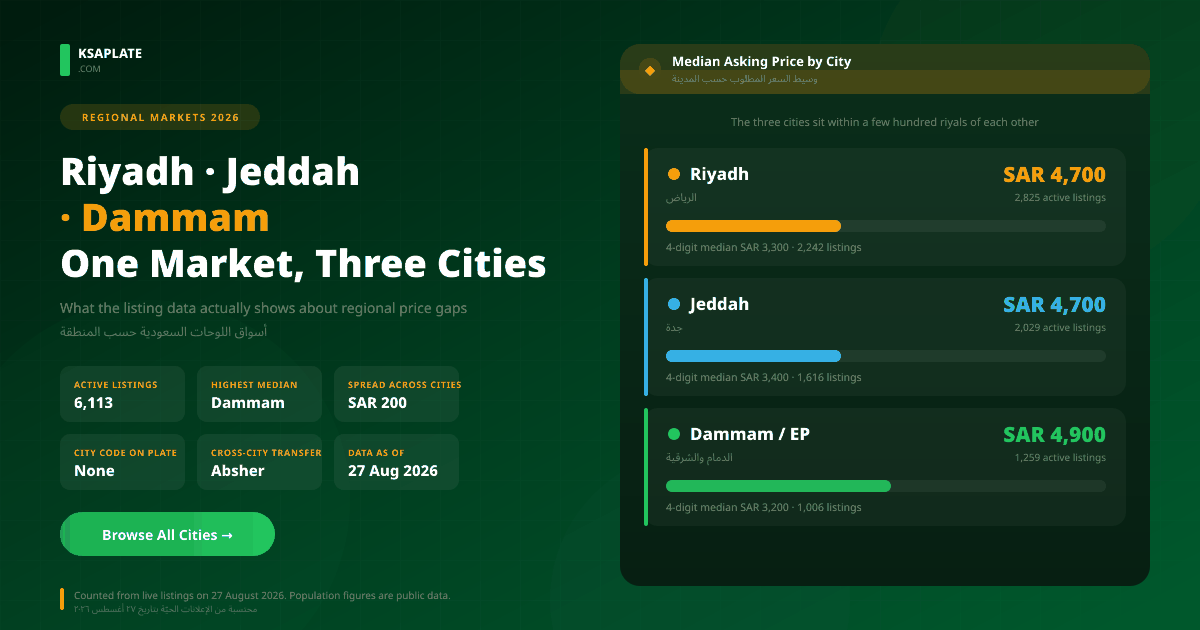
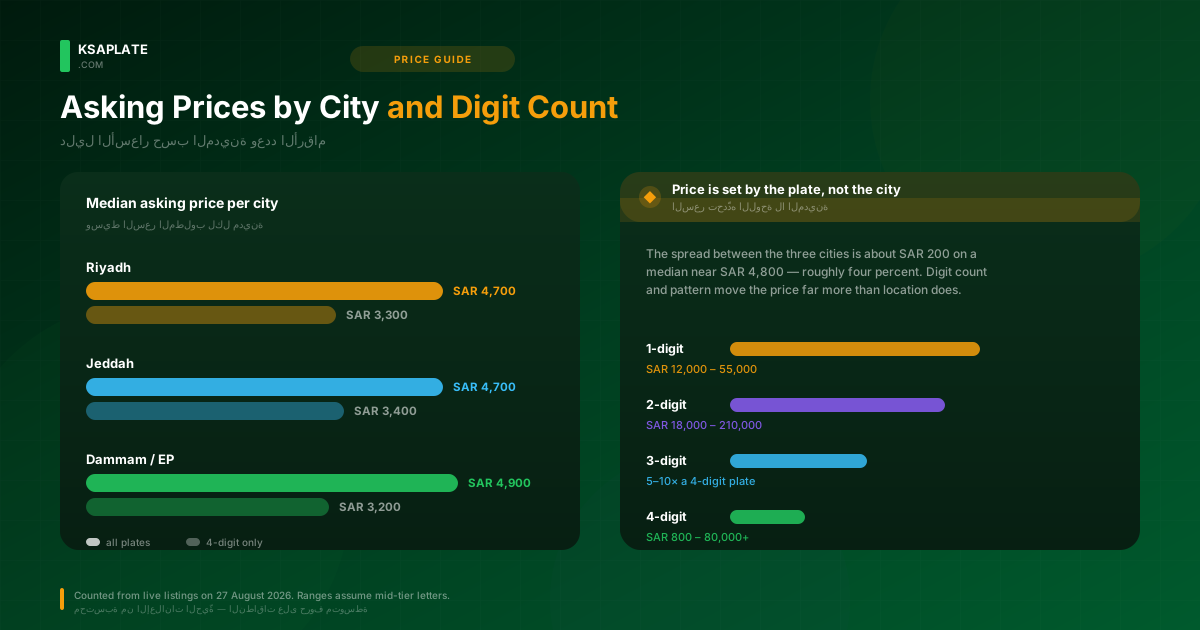
A Riyadh price premium is widely assumed, and our own listings do not show one. Comparing like with like — four-digit plates only — the median asking price is SAR 3,300 in Riyadh against SAR 3,400 in Jeddah. Whether a particular plate fetches more in one city is a question about that plate and that buyer, not a rule you can price against.
We cannot give you an average transaction price for Riyadh, or for any Saudi city: private sales settle through Absher with no public price attached. What we can count is what sellers ask here. Across active Riyadh listings the median asking price is SAR 4,700, and for four-digit plates specifically SAR 3,300 from 2,243 listings. Single-digit plates are a different world — the highest publicly reported Saudi result is SAR 21 million, documented on our market data page.
3. Jeddah: The Cosmopolitan Challenger
Jeddah is Saudi Arabia's commercial, financial, and cultural gateway. With direct access to the Red Sea, an international port, and King Abdulaziz International Airport — one of the region's busiest hubs — Jeddah has always been more outward-facing than Riyadh.
3.1 Jeddah's Unique Plate Culture
Jeddah's Hijazi culture values aesthetics, commerce, and cosmopolitanism in ways that produce different plate preferences:
- Palindromes and mirror plates — symmetric numbers are a visible part of Jeddah's plate culture. The often-repeated claim that they fetch more in Jeddah than in Riyadh is the wrong way round in our listings: 136 four-digit palindromes listed in Jeddah sit at a median asking price of SAR 4,750 against SAR 7,500 for the 198 listed in Riyadh. Taste and price are not the same thing.
- Lucky and spiritually significant numbers — 786 (the numerical value of "Bismillah ar-Rahman ar-Rahim"), 777, and 99 (names of Allah) are intensely sought in Jeddah's trading community.
- Foreign buyer participation — Jeddah's foreign resident community (Lebanese, Egyptian, Yemeni traders who have built generational businesses) is more active in the plate market than in other cities.
3.2 The Tourism Factor
Saudi Arabia's Vision 2030 has turned Jeddah into one of the Middle East's fastest-growing tourism destinations. The Red Sea Project, Diriyah Gate, and the NEOM marketing have all increased Jeddah's global profile. This creates a new buyer segment: wealthy international visitors who purchase a Saudi plate as a luxury collectible — not for use on a vehicle, but as an investment or status item in their home country.
3.3 Jeddah Price Profile
Jeddah's median asking price across active listings is SAR 4,700 — the same as Riyadh's — and for four-digit plates SAR 3,400 from 1,617 listings, marginally above Riyadh. The range is wide at both ends. Claims that one city is systematically cheaper than the other are not supported by what is listed here.
What's your plate worth?
Get an instant, free estimate with our plate value calculator.
Calculate My Plate's Value4. Dammam & Eastern Province: The Rising Force
The Eastern Province — centered on Dammam, Al Khobar, and Dhahran — has an active and long-established trading community. Year-on-year growth figures circulate for it, but there is no transaction record from which growth could be measured, so we do not quote one.
4.1 The Aramco Effect
Saudi Aramco is headquartered in Dhahran, and its presence shapes everything about the Eastern Province economy. Senior Aramco executives and contractors receive compensation packages that put them among Saudi Arabia's highest earners. This concentrated wealth, combined with a culture of corporate prestige signaling, creates intense demand for distinctive plates.
The typical Eastern Province premium buyer is different from Riyadh or Jeddah:
- More likely to be a technical professional or engineer rather than a merchant or government official
- More likely to be interested in four-digit plates with memorable patterns (sequential, repeating) rather than single/two-digit ultra-premium plates
- More likely to make faster purchase decisions — the Aramco culture values efficiency over negotiation
4.2 The Bahrain Causeway Advantage
The Eastern Province's proximity to Bahrain — connected via the King Fahd Causeway — creates a unique cross-border dynamic. Saudi plates are frequently bought in the Eastern Province by Bahraini residents for use on Saudi-registered vehicles. This cross-border demand adds a buyer pool unavailable to Riyadh or Jeddah sellers.
4.3 Eastern Province Price Profile
Dammam's median asking price across all active listings is SAR 4,900 — the highest of the three cities, not the lowest. For four-digit plates specifically it is SAR 3,200 from 1,006 listings, marginally below Riyadh and Jeddah. The idea that the Eastern Province is systematically the cheapest market is not what our listings show.
5. Other Cities: Mecca, Medina & Emerging Markets
Beyond the big three, Saudi Arabia has 13 administrative regions with active plate markets of varying sizes.
Mecca and Medina
The holy cities present a paradox: enormous wealth (royal family, religious scholars, Hajj-related businesses) but relatively low plate market activity in the private sector. Much of the wealth here is institutional or religious in nature, and ostentatious plate displays are culturally less appropriate near the Haramain. However, the small number of very high-status plates that do trade in Mecca and Medina often reach exceptional prices precisely because the buyer pool is so exclusive.
Riyadh Satellite Cities
Al Kharj, Diriyah, and the newer NEOM-adjacent developments are emerging micro-markets. The Diriyah development — being transformed into a cultural and luxury destination as part of Vision 2030 — has already created new wealth flowing into the plate market.
Tabuk and NEOM
NEOM's construction is creating a new class of millionaires among Saudi contractors, engineers, and land-related deals. Tabuk currently carries 509 active listings on KSAplate.com. A growth figure was previously quoted here against a 2023 baseline; our listing data only begins in mid-2024, so that comparison was not possible and has been removed. Watch this space for 2027–2028.
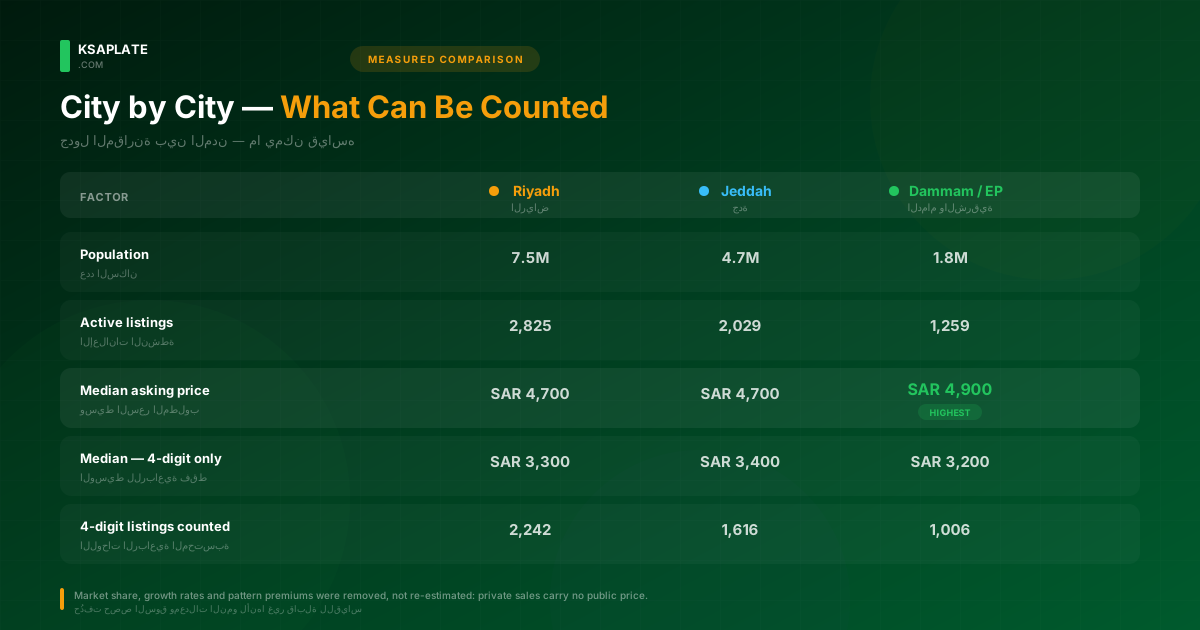
6. City-by-City Comparison Table
| Factor | 🏛 Riyadh | 🌊 Jeddah | ⚡ Dammam / EP |
|---|---|---|---|
| Population (approx.) | 7.5M | 4.7M | 1.8M |
| Active listings on KSAplate | 2,825 | 2,029 | 1,259 |
| Median asking price (all plates) | SAR 4,700 | SAR 4,700 | SAR 4,900 |
| Median asking price (4-digit only) | SAR 3,300 | SAR 3,400 | SAR 3,200 |
| 4-digit listings counted | 2,242 | 1,616 | 1,006 |
Every figure above is counted from live listings on this site on 27 August 2026, except population, which is public data. The previous version of this table also carried market share, year-on-year growth, buyer profiles, pattern premium multipliers and an "investment score" out of ten. None of those could be measured: private Saudi plate sales settle through Absher with no public price, so there is no transaction record to compute a share, a growth rate or a premium from. They have been removed rather than re-estimated.
Note what the measured numbers show: the three cities sit within a few hundred riyals of each other, and Dammam has the highest overall median of the three — the opposite of the ranking the old table asserted.
7. Regional Arbitrage: Does Buying in One City and Selling in Another Work?
Regional arbitrage means buying a plate in a lower-priced market and reselling it in a higher-priced one. A plate is valid nationwide, so nothing stops you — the question is whether the price gap the strategy depends on actually exists. Judged against our own listings, mostly it does not.
Three Arbitrage Paths, and What Holds Up
-
Dammam → Riyadh (Most Common)
Buy specific plate patterns in the Eastern Province (where competition is lower) and sell to Riyadh's deeper buyer pool. The premise is that the Eastern Province is systematically cheaper. Our listings do not support it: Dammam's median asking price across all active plates is SAR 4,900, the highest of the three cities. No expected margin can be quoted. -
Jeddah → Riyadh (Palindrome Play)
The premise is that Jeddah sellers list palindromes below Riyadh prices. Our listings do not show that gap either: across 817 four-digit palindromes the median asking price is SAR 6,000, and the 136 listed in Jeddah sit at a median of SAR 4,750 — lower, but on a small sample and with an enormous spread behind it (SAR 550 to over SAR 2 million). A specific underpriced plate is a real opportunity; a systematic city discount is not something you can price against. -
Private sale → Absher auction (does not work as described)
This path used to be described here as buying privately, holding, then letting the plate enter the Absher auction pool. That is not how the auctions work: Absher auctions release newly issued government plates that have never been in private hands. A plate you already own cannot be fed into them. If you buy privately you resell privately.
The key risk in regional arbitrage is liquidity: if you cannot find the right Riyadh buyer at the right price within 6–12 months, holding costs and opportunity cost erode your margin. Always calculate your break-even carefully before committing.
8. Seasonal Demand Patterns by City
Every Saudi city has predictable seasonal demand cycles. Understanding these cycles lets buyers time their purchases for maximum savings and sellers time their listings for maximum returns.
Riyadh Seasonal Pattern
- Peak (September–November): Post-summer return and National Day (September 23) drive demand for patriotic numbers. How much sellers actually get in that window is not something anyone measures — private sales carry no published price.
- Trough (Ramadan → Eid al-Fitr): Activity is visibly quieter through Ramadan and picks up after Eid. We cannot quantify the drop: we see listings, not completed transactions.
- Secondary Peak (February–March): Pre-National Day premium vehicles get new plates in Q1. Active buyer period.
Jeddah Seasonal Pattern
- Peak (October–January): Cooler weather, tourism season, Jeddah Season entertainment events drive luxury consumption including plates.
- Trough (July–August): Mass departure of Jeddah's business class for summer holidays creates the best buying window. Sellers become motivated.
- Secondary: Hajj Season: Paradoxically, Hajj creates temporary demand for plates from pilgrimage business operators.
Dammam / Eastern Province Seasonal Pattern
- Peak (Q4: October–December): Year-end bonuses at Aramco and major companies fuel discretionary spending, including plates.
- Trough (August): Similar to Jeddah — summer travel creates motivated sellers.
- Local factor: Aramco pay cycles: Aramco and the large Eastern Province employers pay bonuses and dividends on a quarterly rhythm, and discretionary spending in the region follows it. We have not measured a plate-demand effect and do not claim one.
9. Step-by-Step: How to Buy the Right Plate in Any Saudi City
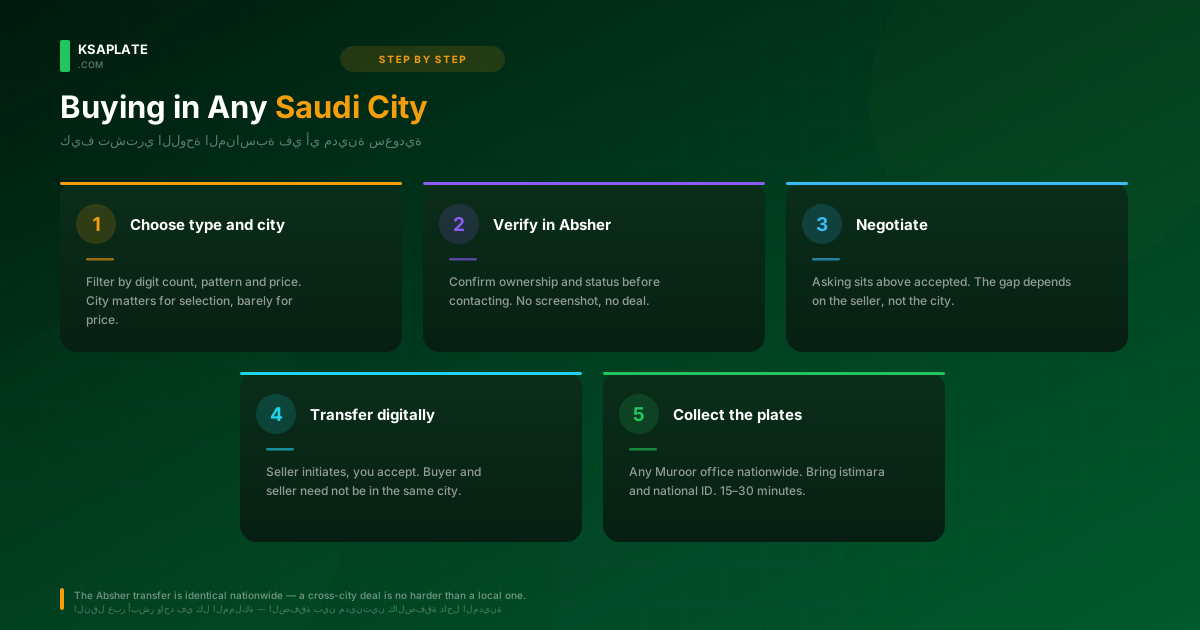
Regardless of which city you target, the plate acquisition process is standardized through the Saudi government's Absher platform. Here is the complete process:
- Choose your plate type and city target. Use KSAplate.com to filter by city where the seller is located, digit count, pattern type, and price range. Apply the regional context from this guide: if you want a palindrome, Jeddah sellers offer the widest selection. If you need single or two-digit plates, Riyadh is the only deep market.
- Verify the plate's status via Absher. Before contacting a seller, confirm the plate's ownership and status at absher.sa. A genuine distinctive plate will show clearly in Absher's traffic services portal. Any seller who cannot show this verification should be considered suspect.
- Apply regional negotiation norms. Sellers everywhere list above the price they will accept, and how much varies by person, not by city. We can see asking prices, not settled prices, so we cannot tell you the typical gap in any city. Adjust your opening offer accordingly.
- Complete the Absher digital transfer. The seller initiates the transfer in Absher, you accept. Both parties need verified Absher accounts. This step is completely digital — you and the seller do not need to be in the same city. See our complete Absher transfer guide for the exact steps.
- Collect physical plates from any Muroor office. Once the plate shows in your name on Absher, visit any traffic department (Muroor) office nationwide to get the physical plates made. Bring your vehicle registration (استمارة) and national ID. Takes 15–30 minutes, costs approximately SAR 100–150.
10. Investment Strategy by Region
The right regional strategy depends on your budget and time horizon. The figures below are asking prices in the private market, not projected returns.
Riyadh: The Deepest Market for Short Numbers
Riyadh is the only market with real depth in single- and two-digit plates, which means the highest chance of finding a buyer when you come to resell. The trade-off is that entry prices are the highest of the three cities. Two-digit asking prices today run from SAR 12,000 for ordinary combinations up to SAR 315,000 for the strongest letter groups.
Jeddah: Palindrome and Lucky-Number Specialist
Jeddah offers the clearest opportunities in palindromes and culturally significant numbers. Across 817 four-digit palindromes listed nationwide the median asking price is SAR 6,000, with a long tail above it; three-digit palindromes sit higher again.
Dammam / Eastern Province: Smaller-Budget Entry
For budgets between SAR 10,000 and SAR 100,000, the Eastern Province is where patterned four-digit plates — repeating, sequential and round numbers — have a median asking price of SAR 4,300 across 331 active listings.
A note on method: we cannot confirm that any region is growing faster than another, and we do not quote expected returns. Private plate sales settle through Absher with no published price, so there is no public transaction record from which a growth rate or a return could be computed. What is measurable is asking prices on live listings — and as the comparison table above shows, those sit within a few hundred riyals of each other across all three cities.
For a full analysis of plate investment considerations and risk factors, see our complete Saudi plate investment guide.
11. Frequently Asked Questions
Can I buy a Saudi plate in Riyadh and use it in Jeddah?
Yes. Saudi license plates are completely nationwide — there is no regional restriction on use. A plate purchased from a seller in Riyadh works on any vehicle registered anywhere in Saudi Arabia, from Tabuk to Najran. The plate's registration is to the vehicle and owner, not to a city. This is what makes regional arbitrage possible: buy in Dammam, drive in Riyadh, sell to anyone in the Kingdom.
Do Saudi plates have a city code on them?
No. Saudi distinctive license plates show only the letter combination (right side) and number (left side), with the Saudi emblem in the center and the Kingdom name at the bottom. There is no city code, region indicator, or any location-specific marking on Saudi plates. A plate from Riyadh looks identical to one from Jeddah — because they are part of the same national registration system.
Why are Riyadh plates more expensive than Jeddah plates?
Riyadh plates are more expensive for three reasons: (1) Riyadh has more high-net-worth individuals than any other Saudi city, creating a deeper buyer pool and more competitive bidding; (2) the tribal culture of Nejd places higher cultural value on prestige plates; and (3) proximity to government and royalty creates demand for plates that signal political proximity. Our own listings do not show Riyadh asking more than Jeddah for like-for-like plates: the four-digit medians are SAR 3,300 and SAR 3,400 respectively.
Is it legal to buy a plate in Dammam and sell it to someone in Riyadh?
Completely legal. The Absher transfer system does not restrict plate transfers by geography. Both parties just need verified Absher accounts. The seller can be anywhere in Saudi Arabia, and so can the buyer. The physical transfer of the plate (Muroor office) can happen in any city the buyer chooses. Regional plate trading is not only legal but is actively facilitated by the government's digital Absher platform.
Which city has the most Absher plate auctions?
Absher plate auctions are national — they release plates to all eligible bidders simultaneously, regardless of their city. Any Saudi citizen or resident with a verified Absher account can bid from any city. However, auction competition for premium plates is more intense in Riyadh simply because there are more premium buyers there.
Are there plates that only sell well in specific cities?
Yes — tribal letter combinations. Certain Arabic letter combinations correspond to the initials or names of major Saudi tribes that are concentrated in specific regions. A letter combination that represents a major Qahtani tribal name sells at a premium among Qahtani buyers (concentrated in southern regions and Jeddah). A Shammar tribal initial combination commands premiums in Riyadh and Ha'il. These micro-market premiums are known to experienced brokers and tribal community members.
What's the best city to sell my plate quickly?
Riyadh offers the fastest liquidity for plates priced above SAR 100,000 because it has the deepest buyer pool. For plates in the SAR 5,000–50,000 range, KSAplate.com's national marketplace is more efficient than targeting any specific city — you are accessible to buyers from all 13 regions simultaneously. List on KSAplate.com with good photos and a fair market price, and you will typically receive serious inquiries within 72 hours regardless of your city.
Does Vision 2030 affect plate prices differently in each city?
Yes. Vision 2030 is creating wealth unevenly across the Kingdom. Riyadh benefits from government spending and the new financial district. Jeddah benefits from tourism investment and the Red Sea Project. The Eastern Province benefits from Aramco IPO-related wealth and energy transition investment. NEOM/Tabuk benefits from the megaproject construction boom. Each of these creates regional demand surges at different times. As a plate investor, tracking Vision 2030 project milestones by city gives you advance warning of regional demand spikes.
12. Conclusion & Next Steps
Saudi Arabia's distinctive plate market is one asset class with three regional personalities. Riyadh is the deepest market for short numbers and the centre of status buying. Jeddah leads on cosmopolitan taste and palindrome premiums. The Eastern Province is a market of its own, driven by the spending cycle of the oil sector.
What the measured numbers show is straightforward: median asking prices across the three cities sit within a few hundred riyals of each other, and Dammam posts the highest overall median of the three. The city effect is considerably smaller than it is commonly claimed to be.
For buyers there is one practical takeaway: do not limit your search to your own city. The right plate for your needs and budget may well be listed by a seller in Dammam or Jeddah, and the Absher transfer system makes a cross-city deal exactly as simple as a same-city one.
Ready to browse plates from all three markets in one place? Browse all plates on KSAplate.com →
Want to understand what makes any specific plate valuable, regardless of city? Use our free plate value calculator →