
TL;DR:
- You buy and sell number plates in the GCC through two routes everywhere: a private marketplace/classifieds or a government auction.
- Plates are country-bound. A Saudi plate cannot go on a UAE car and vice versa — each plate is tied to its own country's vehicle registration.
- UAE has the region's biggest distinctive-plate market, split between dedicated plate platforms and official RTA auctions; Saudi Arabia uses dedicated marketplaces like KSAplate plus the Absher auction.
- To buy, shop in the country where the car is registered; to sell, list where that country's buyers actually look.
- Ownership always transfers through the country's official system (Saudi = Absher) after payment clears.
Quick answer: The best place to buy or sell a car number plate in the Middle East is a dedicated plate marketplace or your country's government auction. Plates are tied to the country where the vehicle is registered, so buy and sell within that country. In Saudi Arabia use a plate marketplace plus the Absher auction; in the UAE use a dedicated plate platform or the official RTA auction.
Where to buy and sell number plates: the short answer
The best place to buy or sell a number plate in the GCC is either a dedicated plate marketplace or your country's government auction. Every Gulf country offers both routes: private platforms where individuals trade plates, and official auctions run by the traffic authority for premium numbers. The right channel depends on the country you are in and whether you want speed, the best price, or a specific number.
This guide maps the market country by country — Saudi Arabia, the UAE, Qatar, Kuwait, Bahrain and Oman — and explains the one rule that catches out cross-border buyers. For the fundamentals of how a plate works and what it is worth, start with our complete guide to Saudi license plates.
Plates are country-bound — the rule that matters
A number plate in the GCC is tied to the country where the vehicle is registered, and it cannot be moved across a border. A Saudi plate cannot be fitted to a UAE car, and a Dubai plate cannot be transferred onto a vehicle registered in Riyadh. Each plate lives inside one national registration system, so the market in each country is effectively separate.
The practical consequence is simple: buy and sell within the country where the car is, or will be, registered. If you live in Saudi Arabia, you trade Saudi plates; if you are in the UAE, you trade Emirates plates. Regional classifieds may list plates from several countries, but a transaction only completes inside the relevant national system.
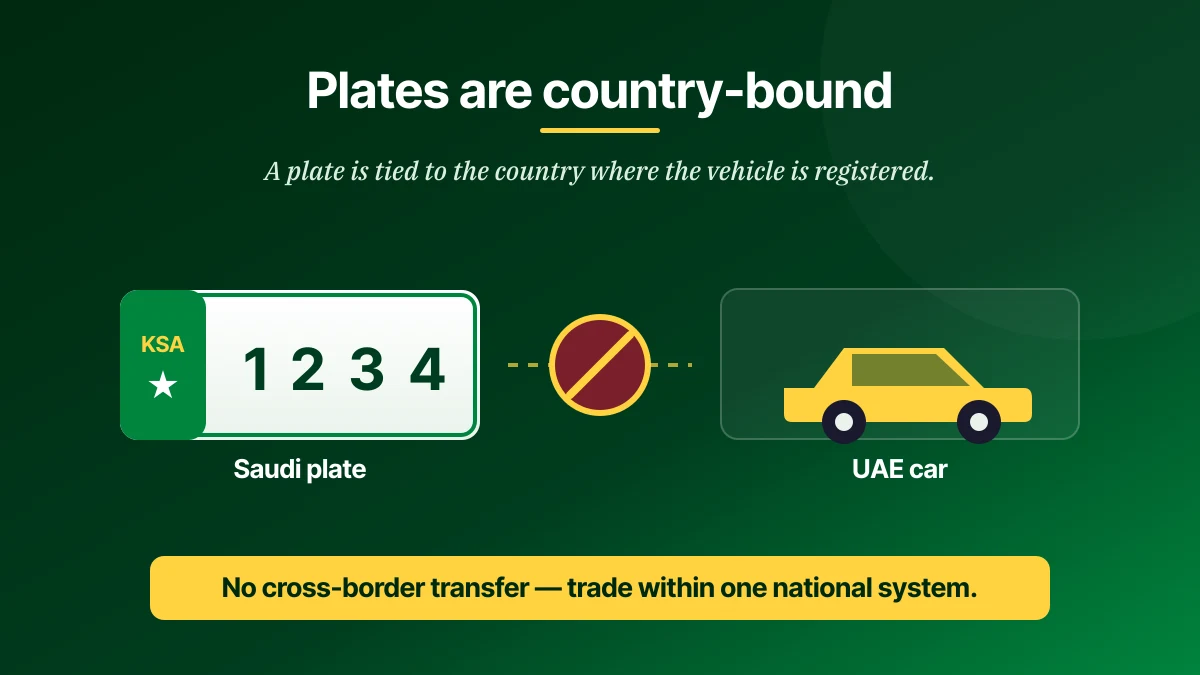
The single most common mistake is assuming a Gulf plate is portable. It is not — a plate belongs to its country's registry, full stop.
This is why there is no single "Middle East" plate exchange. What looks like a regional market is really six national markets that happen to share a language and a love of distinctive numbers. Knowing which market you are in is the first decision; everything else — platform, price, transfer — follows from it.
Marketplace vs government auction
There are two ways to acquire a plate anywhere in the GCC, and they suit different buyers.
| Route | What it is | Best for |
|---|---|---|
| Plate marketplace | Private platform built for plates | A specific number, fair price, speed |
| General classifieds | Plates as one category among many | Casual buyers & sellers |
| Government auction | Traffic authority sells premium plates | Brand-new distinctive numbers |
| Dealer / broker | Handles the deal for a commission | Hands-off, high-value plates |
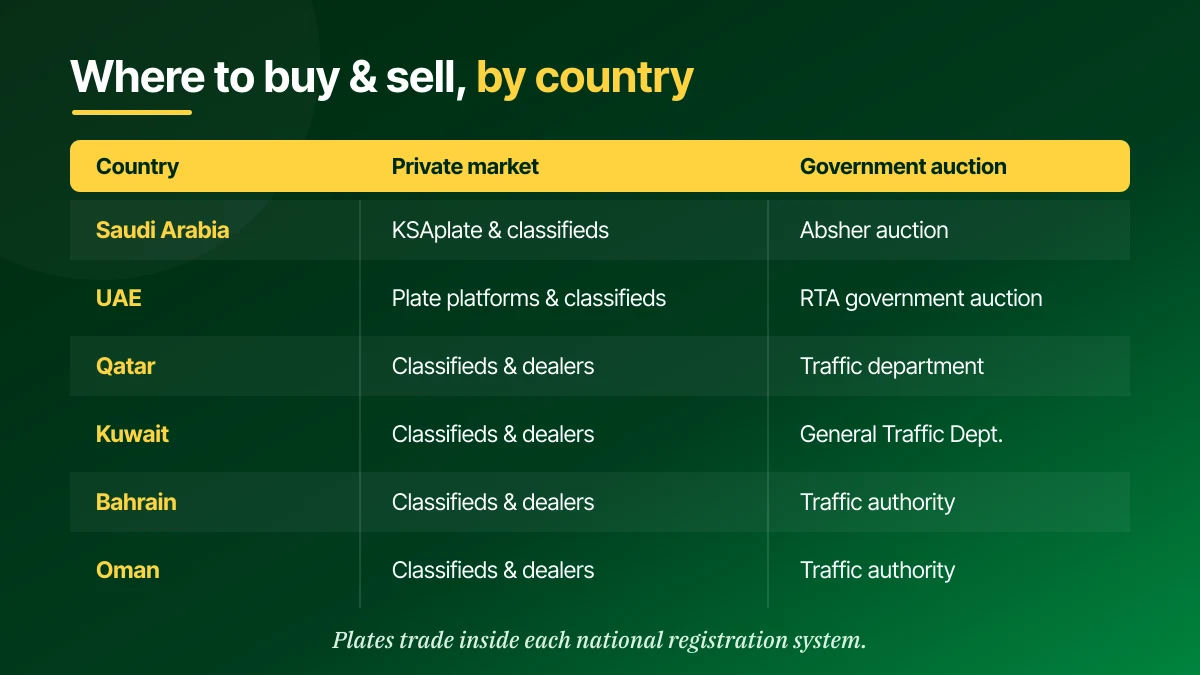
The government auction is where the headline-grabbing prices happen — the region's record plates are sold by official auction houses. For everyday buying and selling, a dedicated marketplace gives the best mix of reach, price, and safety. The table below shows the main places to trade in each Gulf country.
| Country | Main private platforms | Official auction |
|---|---|---|
| Saudi Arabia | KSAplate & general classifieds | Absher auction |
| UAE | Dedicated plate platforms & classifieds | RTA government auction |
| Qatar | Regional classifieds, dealers | Traffic department |
| Kuwait | Classifieds, dealer networks | General Traffic Dept. |
| Bahrain & Oman | Classifieds, dealers | Traffic authority |
What's your plate worth?
Get an instant, free estimate with our plate value calculator.
Calculate My Plate's ValueSaudi Arabia: where to buy and sell
In Saudi Arabia, the main routes are a dedicated plate marketplace and the official Absher auction. A dedicated marketplace such as KSAplate lists private plates with the number, letters, city and price, and charges a flat listing fee rather than a commission. General classifieds platforms also carry plates as one category among many, though without the plate-specific search and pricing tools. The Absher electronic auction, run by the General Directorate of Traffic, sells distinctive plates directly from the government.
To sell your own Saudi plate, list it where buyers shop and transfer it on Absher once paid — our guide on where to sell your Saudi license plate compares every channel. To buy, follow the Saudi buyer's guide, or browse the KSAplate marketplace.
United Arab Emirates: the region's biggest market
The UAE has the largest and most active distinctive-plate market in the Gulf. Private trading runs through dedicated plate platforms and general classifieds, where tens of thousands of numbers change hands across Dubai and Abu Dhabi. Above that sits the official RTA government auction, where single-digit and ultra-rare plates have sold for tens of millions of dirhams, setting world records.
If you are trading in the UAE, a specialist plate platform is the fastest route for a private sale, while the government auction is the source for brand-new premium numbers. UAE plates, like all Gulf plates, stay within the Emirates registration system.
One quirk of the UAE worth knowing: plates are issued per emirate, so a Dubai plate and an Abu Dhabi plate sit in different sub-registries even within the same country. The premium also runs higher than anywhere else in the region, which is why UAE auctions regularly make global headlines. For most buyers, though, the everyday market on the private platforms is where real deals are done.
Qatar
Qatar's plate market is smaller but real, centred on classifieds and the traffic department's own releases. Buyers and sellers use regional classifieds platforms and local dealer networks, while premium and low-number plates are issued and auctioned through official channels. As elsewhere, a Qatari plate is registered in Qatar and traded there; cross-border movement is not possible.
Kuwait
Kuwait trades plates mainly through classifieds and dealer networks, with distinctive numbers carrying a strong premium in a market that values short, clean combinations. The General Traffic Department controls issuance and any official auctions. Private sales follow the same logic as the rest of the Gulf: agree a price, verify the plate, pay, and transfer through the national system.
Bahrain & Oman
Bahrain and Oman have the smallest GCC plate markets, but the structure is identical: classifieds and dealers for private sales, and the traffic authority for issuance and auctions. In both countries, demand concentrates on low digit counts and meaningful numbers, and every transaction completes inside the national registration system. For a side-by-side look at how prices and demand differ across the Gulf, see our GCC plate market comparison.
How to buy or sell a plate, step by step
The process is the same across the GCC once you know which country's market you are in. Follow this order to protect your money and your plate.
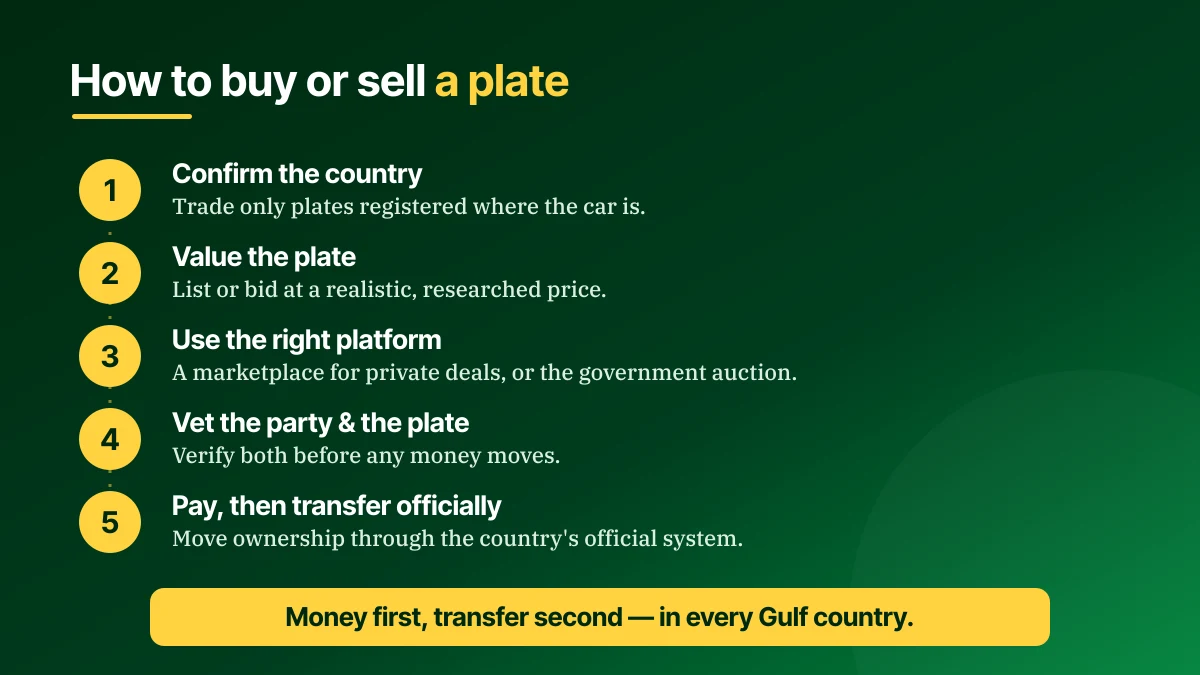
- Confirm the country. Trade only plates registered in the country where the car is.
- Value the plate. Use a calculator or price guide so you list or bid at a realistic number.
- List or shop on the right platform — a dedicated marketplace for a private deal, or the government auction for new premium plates.
- Vet the other party and the plate's record before any money moves.
- Pay, then transfer through the official system once the payment has cleared.
Money first, transfer second — in every Gulf country. A cleared payment is the only proof a buyer or seller is real.
Buying and selling safely
Plate scams across the Gulf follow the same script: a fake payment receipt, pressure to transfer fast, and a buyer or seller who avoids verification. Protect yourself with three rules that apply in every country — verify the other party, confirm the money has actually cleared, and only then transfer through the official system. Never share a banking OTP, never transfer a plate on a promise, and treat any deal that insists on speed or secrecy as a red flag. Our safe buying and selling guide details every warning sign.
Transfer and registration per country
Ownership of a plate transfers through each country's official vehicle system, not through the marketplace where you found the deal. In Saudi Arabia, transfers happen on Absher; in the UAE, through the relevant emirate's RTA or traffic department; and in Qatar, Kuwait, Bahrain and Oman through their respective traffic authorities. The marketplace introduces buyer and seller; the government system makes the change of ownership official. Agree in advance who pays the transfer fee, and keep a written record of the sale.
What plates are worth across the GCC
Across the Gulf, value follows the same logic everywhere: fewer digits, repeating or sequential numbers, and meaningful letters command the highest prices. The UAE sets the global ceiling — single-digit Dubai plates have sold for record sums — while Saudi Arabia, Qatar and Kuwait have their own strong premium markets. The number is the asset; the car is just where it sits.
Before you buy or sell, value the exact plate. Our free plate value calculator scores a Saudi number instantly, and the GCC market comparison shows how demand and prices differ between countries.
Trading a Saudi plate?
Value any number free, then buy or list it on the marketplace built for Saudi plates.
Value my plate List my plateFrequently asked questions
Where can I buy or sell a number plate in the Middle East?
Can I move a Saudi plate to a UAE car?
What is the biggest plate market in the GCC?
Is a marketplace or a government auction better?
How do I sell my plate in Saudi Arabia?
How is a plate transferred to the buyer?
Is it safe to buy a plate online in the Gulf?
What makes a Gulf number plate valuable?
Can expats buy and sell plates in the GCC?
Why are UAE plates so expensive compared to other GCC countries?
Do I pay a commission to sell my plate?
Where do I start if I have a Saudi plate to sell?
Conclusion & next steps
Buying and selling number plates in the Middle East comes down to two ideas: trade within the country where the car is registered, and choose between a dedicated marketplace and the government auction. The UAE leads on size and record prices, Saudi Arabia offers a deep market through KSAplate and Absher, and every country shares the same safe-transaction rules. Ready to act on a Saudi plate? Start with the complete plate guide, value your number on the calculator, then list it on the marketplace.