TL;DR:
- The moment to stop repairing is arithmetic, not emotion: when a single repair costs more than the car's remaining market value — or when the year's repairs exceed what a year of a replacement would cost — the car has crossed into end-of-life, whatever it feels like.
- You have four exits, not one: repair, sell as-is to a buyer who wants a project, scrap it at a tashlih yard, or part it out. Most owners default to the worst-value option because nobody showed them the other three.
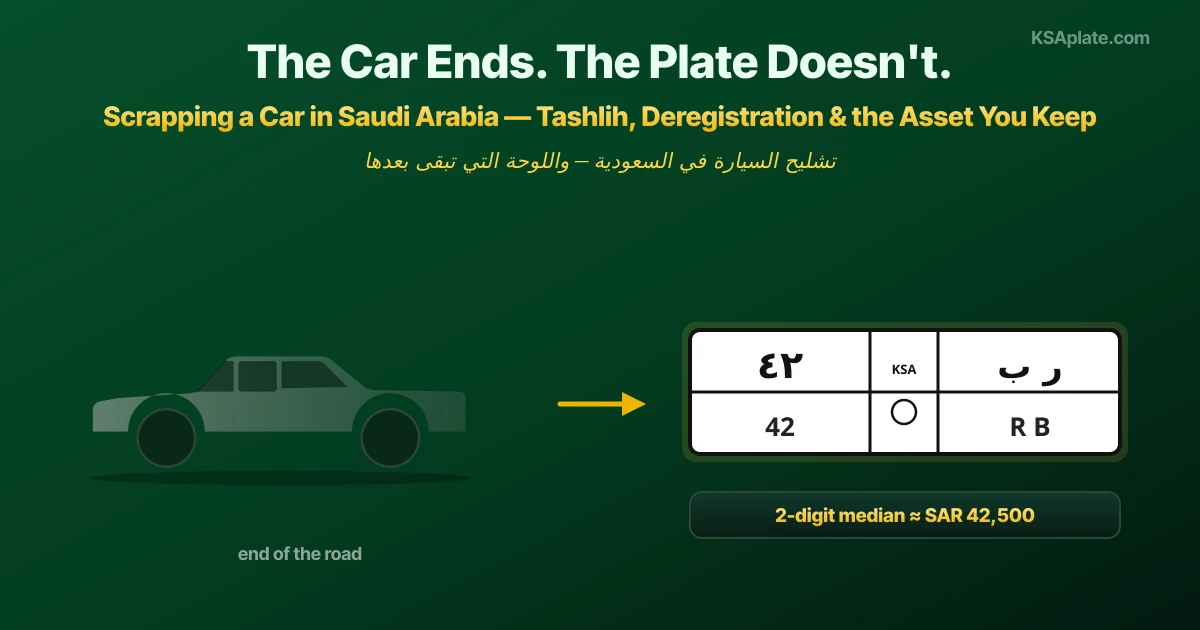
- The plate almost always outlives the car — and it is frequently worth more. Across our live marketplace, two-digit plates carry a median of ≈SAR 42,500 and three-digit plates ≈SAR 26,500. A tired sedan headed for scrap is worth a fraction of that. Detach the plate before the car goes.
- Deregistration is the step that protects you legally. A scrapped car still registered in your name is still your liability — fines, obligations and paperwork follow the registration, not the wreck.
- Settle everything before the car moves: outstanding fines, any finance, and insurance cancellation must be handled first, or the scrap transaction stalls exactly when the yard already has your car.
Quick answer: Scrap a car in Saudi Arabia when the repair costs more than the car is worth. First: settle fines and finance, and keep the distinctive plate — two-digit plates run a median ≈SAR 42,500 in our marketplace, often more than the car. Then use a licensed tashlih yard and deregister through Absher.
The moment the math flips
Every car in the Kingdom eventually reaches the same fork: the workshop quotes a number, and that number is larger than the car. The gearbox on a fifteen-year-old sedan. The AC compressor plus the suspension plus the tyres, all due in the same month. The accident repair that costs more than the car would sell for intact. At that point the vehicle stops being transport and becomes a decision.
Most owners handle that decision badly — not from carelessness, but because the alternatives were never laid out. They pay for one more repair, then another, until the cumulative spend exceeds what the car was ever worth. Or they abandon it in a lot behind the building, where it quietly accrues fines and obligations while still registered in their name. Or they hand it to the first man who offers cash, without ever asking the question this guide exists to answer: what is still valuable here?
Because something usually is. The engine may be finished, but the distinctive plate on the bumper is a separate, transferable asset with its own market — and in a striking number of cases it is worth several times the car carrying it. This guide is the complete end-of-life sequence: the arithmetic that tells you when to stop repairing, the four exits ranked by what they actually return, how tashlih and deregistration work, what must be settled first, and how to make sure the valuable part of your car does not leave with the scrap.
Four exits, compared
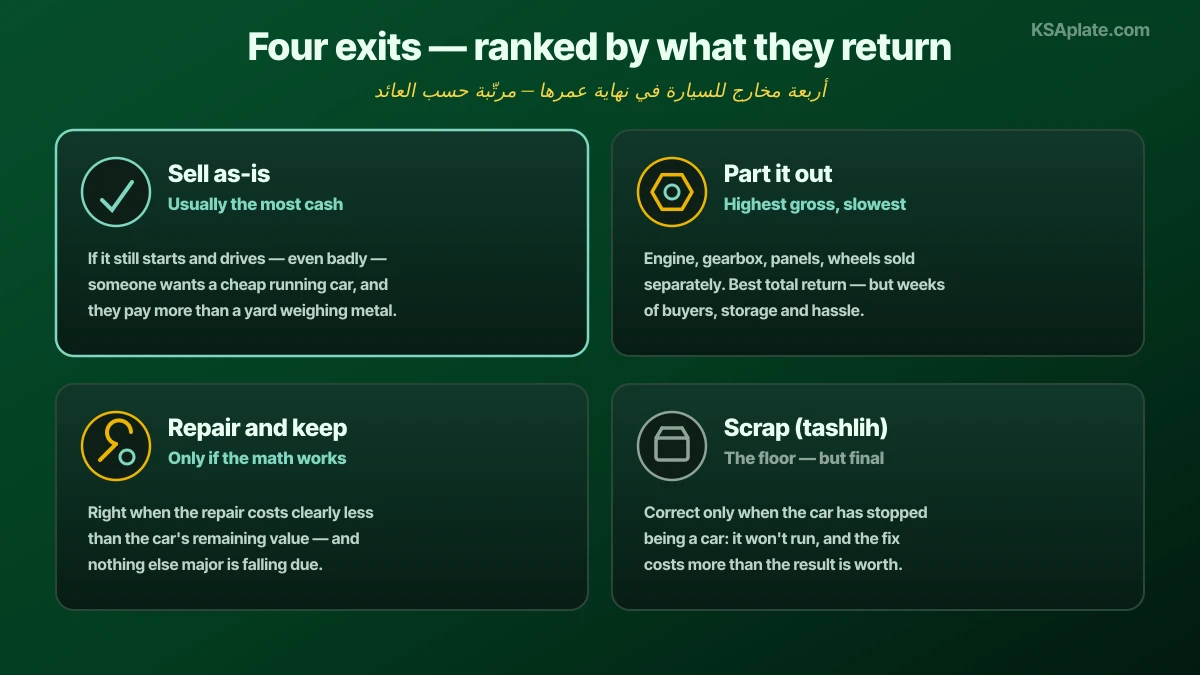
A car at the end of its life has four honest exits. Ranked by typical return, from highest to lowest:
| Exit | Choose it when | What it typically returns | Effort |
|---|---|---|---|
| Repair and keep | The repair costs clearly less than the car's remaining value — and nothing else major is due | Extends the asset you already own | Low |
| Sell as-is | It still runs and drives, even badly. Someone always wants a cheap running car | Usually the highest cash figure of the four | Low — one honest listing |
| Part it out | Desirable model, several valuable components (engine, gearbox, panels, wheels) | Highest gross, spread over weeks | High — many buyers, storage, hassle |
| Scrap (tashlih) | It no longer runs safely, or repair exceeds any plausible resale | The floor — but immediate and final | Lowest — one transaction |
The decision rule that resolves most cases: if the car still starts and drives, selling it as-is almost always beats scrapping it. A running car — however tired — has a buyer who wants exactly a cheap running car, and that buyer pays more than a scrap yard weighing metal. Scrapping is the right answer specifically when the car has stopped being a car: it does not run, cannot pass inspection, or the repair to change either fact costs more than the result would be worth.
What an end-of-life car is actually worth
Before choosing an exit, anchor the number. Three separate values matter, and owners routinely confuse them:
- Market value as-is. What someone will pay for the car in its current, honestly-described condition. Run the model, year and mileage through our free car value calculator to get the healthy-car baseline from real Saudi market curves, then subtract honestly for what is broken. Our curve data shows how differently models age: at ten years, a Toyota Land Cruiser still holds ≈SAR 91,500 in our dataset while a Ford Crown Victoria sits at ≈SAR 33,600 — the same decade treats different cars very differently, which is exactly why you check rather than assume.
- Repair-adjusted value. Market value minus the cost of making it sellable. If a car is worth SAR 12,000 running and needs SAR 9,000 of work to run, the repaired-and-sold path nets SAR 3,000 before your time — which is often worse than selling it broken for SAR 6,000 to someone who does the work themselves.
- Scrap value. What a tashlih yard pays, driven mainly by weight, model demand for parts, and the condition of major components. It is the floor of the range, not a market price — and it is the correct benchmark only for a car that genuinely cannot run. Ten minutes in the live listings for your model and era shows what tired examples actually change hands for.
Comparing all three honestly is the whole exercise. And there is a fourth number that belongs on the same page — the one most owners never calculate.
What's your car worth?
Get a free instant estimate based on real Saudi market data — then sell it on KSAplate with direct WhatsApp contact.
Value My Car — FreeThe plate outlives the car
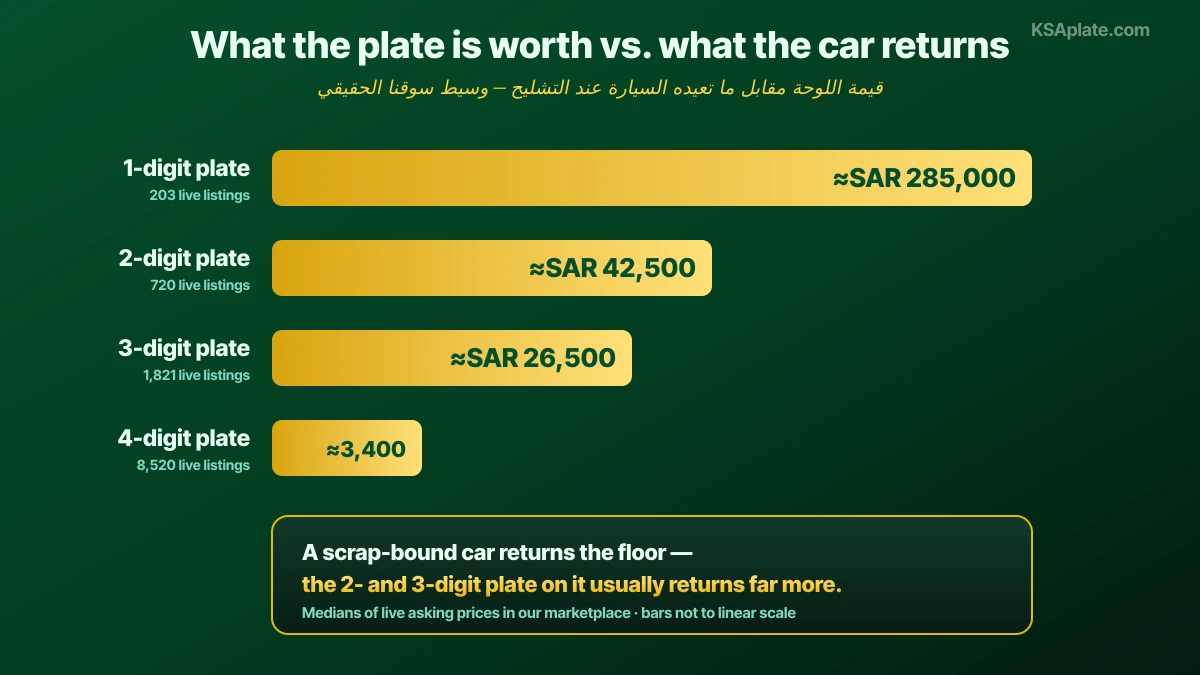
Here is the fact that reframes this entire decision: in Saudi Arabia the distinctive plate is a separate asset from the vehicle carrying it. Cars depreciate toward scrap. Distinctive plates do not — they trade in their own market, on their own logic of digit count and letter rarity. When the car dies, the plate does not have to die with it.
| Plate type | Live listings in our data | Median asking price | What it means at scrap time |
|---|---|---|---|
| 1-digit | 203 | ≈SAR 285,000 | Worth vastly more than almost any car it sits on |
| 2-digit | 720 | ≈SAR 42,500 | Typically several times the value of an end-of-life car |
| 3-digit | 1,821 | ≈SAR 26,500 | Usually still exceeds the car's scrap value many times over |
| 4-digit | 8,520 | ≈SAR 3,400 | Modest, but often comparable to what the scrap yard pays |
Read the middle rows carefully, because that is where most owners are. If your fifteen-year-old car wears a two- or three-digit plate, the plate is very likely the most valuable thing in the transaction — by a wide margin. Sending that car to tashlih without separating the plate first is, in plain terms, throwing away the asset and keeping the scrap.
The mechanism for keeping it is established and routine: a distinctive plate can be moved to another vehicle you own rather than dying with the old one — the full procedure is in our plate exchange guide. If you do not have another vehicle to hold it, the plate can be sold in its own right; see how to sell a Saudi plate for the process, and use our free plate value calculator to find out what yours is actually worth before you decide. The one thing you should not do is discover the number after the car is gone.
How tashlih actually works
Tashlih (التشليح) is the Saudi scrap and dismantling trade: yards that buy end-of-life vehicles, strip the reusable parts for resale, and process the remaining shell as metal. The practical shape of the transaction:
- The yard values weight plus parts demand. Two cars of the same mass are not worth the same to a dismantler — the one whose engine, gearbox, panels and electronics have live resale demand is worth more, because that is where the yard's margin actually sits.
- Get more than one quote. Prices between yards vary meaningfully for the same vehicle, and the first offer is rarely the best one. This is a negotiation, not a fixed tariff.
- Use a licensed yard, and keep the paperwork. The documentation from the transaction is what supports the deregistration step that follows. An informal cash handover with no paper is precisely the scenario that leaves the car legally yours long after it has physically left.
- Transport is part of the price. A car that cannot drive needs recovery, and whether the yard absorbs that cost is negotiable — ask before agreeing to a figure.
- Strip your own valuables first. New tyres, a recent battery, an aftermarket sound system, and above all the plate: anything with independent value should come off before the car is weighed, because it will not be priced separately once it is inside the gate.
Because yard procedures, accepted documents and current requirements do change, confirm the specifics with the yard and against official channels before the day itself rather than assuming last year's process still applies.
Deregistration: the step that protects you
This is the step owners skip, and it is the one with legal consequences. A vehicle that has physically been scrapped but is still registered in your name remains, on paper, your vehicle — with your obligations attached to it.
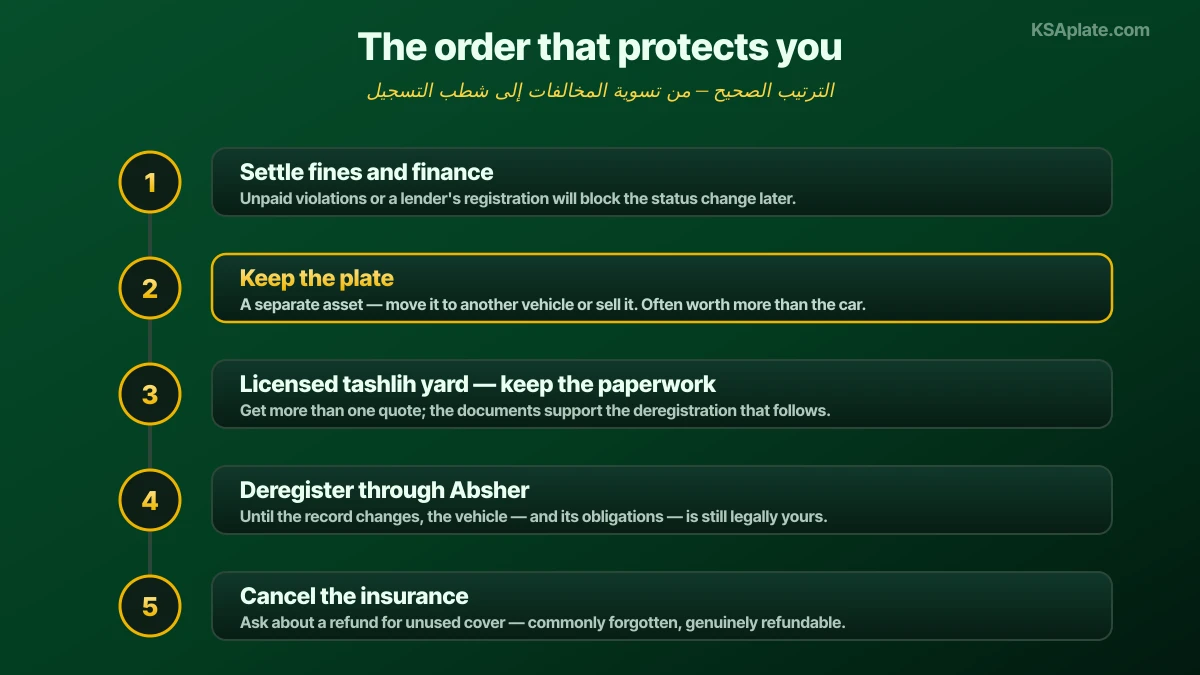
- Understand what deregistration does. It formally ends the vehicle's registration so the record no longer sits against your name. Until that happens, the registration — and everything that attaches to a registration — is still yours, regardless of the car's physical state.
- Do it through the official channel. Vehicle status changes run through Absher and the Traffic Department's services, the same infrastructure used for ownership transfers described in our ownership transfer guide. Follow the current in-service steps rather than a third-party description, including this one — the interface and requirements are updated periodically.
- Resolve blockers first. Outstanding fines, an active finance registration, or an unresolved accident record will typically block a status change. That is the subject of the next section, and the reason to handle it before the car moves.
- Keep the confirmation. Whatever record the process produces, save it. It is the evidence that the vehicle is no longer your responsibility, and the thing you will want if a question surfaces months later.
- Then cancel the insurance. Once the vehicle status is settled, close the policy — and ask about any refund for unused cover, which is a real and commonly forgotten amount. Our insurance guide covers how policies handle mid-term changes.
Settle this before the car moves
Every stalled scrap transaction has the same cause: something unresolved that surfaces only when the paperwork starts — usually after the yard already has the car. The pre-flight checklist:
- Traffic fines. Unpaid violations attached to the vehicle typically block status changes. Clear them first — the process is in our traffic fines guide.
- Finance. If the car carries an active loan or a lender's registration against it, it is not fully yours to dispose of. The lender must be settled and the registration released; our financed-car guide explains that sequence, and it applies to scrapping exactly as it applies to selling.
- Accident and insurance records. An open claim or unresolved accident file can complicate the vehicle's status. If the car is being scrapped because of an accident, coordinate with the insurer first — a total-loss settlement may be a better financial outcome than a scrap-yard cheque, and the accident reporting guide covers how that process runs.
- The plate decision. Made before the car moves, not after — for the reasons set out above.
- Personal items and documents. Registration papers, service records, the spare key, anything in the boot. Once the car is inside the yard, retrieving items ranges from awkward to impossible.
The expensive mistakes
Four failure modes account for nearly all the money lost at end of life:
- Scrapping the plate with the car. The single costliest error in this guide, and the most common. A two-digit plate at our marketplace median is worth many times what the car returns — and once the vehicle is processed, that conversation is over. Check the plate's value before anything moves.
- Abandoning the car instead of disposing of it. Leaving a dead vehicle in a lot or street does not end your relationship with it. The registration stays in your name, the obligations continue, and the eventual resolution is more expensive and more bureaucratic than the disposal you avoided.
- Scrapping a car that still runs. If it starts and drives, the as-is market almost certainly pays more than the yard. List it honestly — with the faults disclosed plainly, exactly as our selling guide recommends — and let the buyer who wants a project pay project money for it. Our current listings show that cheap running cars find buyers quickly.
- Handing over the car before the paperwork. Cash first, documents later is how vehicles end up physically gone and legally present. The transaction is not complete when the car leaves; it is complete when the record says so.
Leaving the Kingdom with a dead car
Expats face this decision on a deadline, which is exactly when the worst choices get made. The vehicle must be resolved before the iqama closes, and a car that is broken as well as unsold compresses the timeline further.
Two things change the calculus. First, time pressure destroys value — a car sold in the final week sells at the buyer's price, so a broken car should be listed or scrapped early rather than left as the last item on the exit list. Second, and more importantly, the plate is portable in a way the car is not: it does not have to be liquidated at exit-week speed if it is handled properly. The complete expat sequence — what happens to the plate, the wakala route for selling remotely, and the exit timeline — is covered in our leaving Saudi Arabia guide. Read it before booking the flight, not after.
When not to scrap
Some cars headed for the yard should not be. Pause the decision if any of these apply:
- It still runs. Covered above, and worth repeating because it is the most frequent unnecessary scrap. Running cars belong in the as-is market.
- It is a model that holds value. Our curve data is blunt about this: a decade-old Land Cruiser sits around ≈SAR 91,500 in our dataset. Some models simply do not reach end-of-life economics on the timeline owners assume — check the number before accepting that the car is finished.
- The expensive failure is a single component. One dead gearbox on an otherwise sound car is a repair decision, not an end-of-life event — especially with a used part. Weigh it against the car's running value rather than against zero.
- The plate has not been valued. Not a reason to keep the car, but an absolute reason to pause the transaction until you know what is sitting on the bumper.
Frequently asked questions
When should you scrap a car in Saudi Arabia?
What is tashlih in Saudi Arabia?
Can I keep my license plate when I scrap my car?
How much is a scrap car worth in Saudi Arabia?
Do I need to deregister a car after scrapping it?
What happens if I abandon a car instead of scrapping it?
Can I scrap a financed car in Saudi Arabia?
Should I repair my old car or scrap it?
Is it better to sell a broken car or scrap it?
What paperwork do I need to scrap a car?
What should expats do with a broken car before leaving Saudi Arabia?
Conclusion
End of life is the one point in a car's ownership where the biggest financial mistake is also the easiest to make, because the car looks worthless and the instinct is to be rid of it. The discipline is small and it pays: run the three numbers before deciding, remember that a running car belongs in the as-is market rather than the yard, settle the fines and the finance before anything moves, and complete the deregistration so the liability actually leaves your name.
Above all, look at the bumper before you look at the wreck. In our marketplace a two-digit plate carries a median of ≈SAR 42,500 and a three-digit plate ≈SAR 26,500 — figures that routinely dwarf what the car itself will ever return again. Check what yours is worth with the free plate value calculator, and if the car still has life in it, price it honestly with the car value calculator and list it on KSAplate for free rather than accepting the yard's floor. The car has reached its end. That is no reason for the valuable part of it to end too — and the plate can be listed the same way, long after the vehicle is gone.