


Last updated: September 2026 | 13 min read
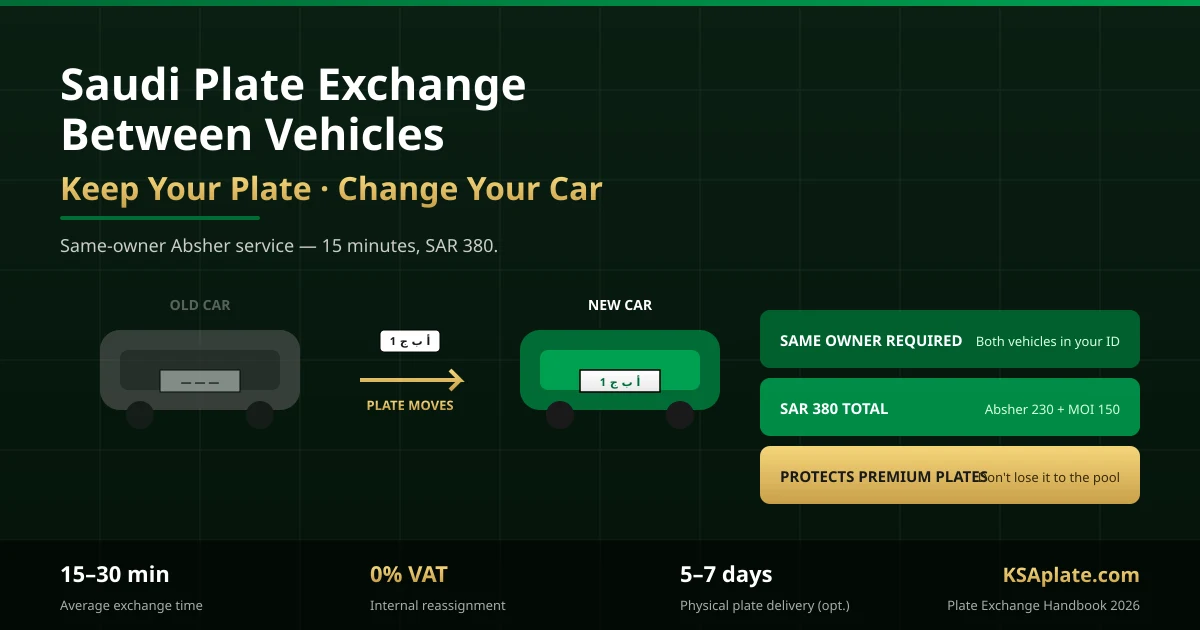
Buying a new car in Saudi Arabia does not require you to give up your prized license plate. The plate is a separately registered asset under your national ID or Iqama. When you upgrade vehicles, the Absher platform lets you reassign your existing plate to the new car in an online procedure. Most Saudi drivers don't know this service exists as a distinct path — they confuse it with ownership transfer or with plate replacement, and end up paying extra fees, losing valuable plates, or letting the dealer auto-assign a generic plate to the new car.
This guide walks through the complete 2026 Absher workflow for moving a license plate between vehicles you already own. It covers eligibility rules, the step-by-step procedure, the cost structure, the differences from the two adjacent Absher services, and the strategic implications for anyone holding a premium plate.
1. Quick Answer: Can You Move a Plate to a New Car?
Yes. The Absher platform lets any Saudi national or Iqama holder transfer a license plate from one of their vehicles to another vehicle they own. The service is Vehicle Plate Transfer (نقل اللوحات), option "transfer between my vehicles" (نقل بين مركباتي), and it is distinct from the Vehicle Ownership Transfer service (مبايعة). It is processed entirely online and costs SAR 1,030 in government fees for two private vehicles — SAR 400 per vehicle plus the SAR 230 Absher service fee. Absher does not publish a processing time. The only constraint is that both vehicles must be registered to the same owner and both must be in the same plate category (private, motorcycle, commercial, transport).
For premium-plate owners — anyone holding a single-digit, two-digit, mirror, repeating, or otherwise high-value plate — this service is the difference between preserving a six- or seven-figure asset and accidentally surrendering it back to the Ministry of Interior pool when scrapping or trading in the old car.
2. Three Absher Plate Services — Don't Confuse Them
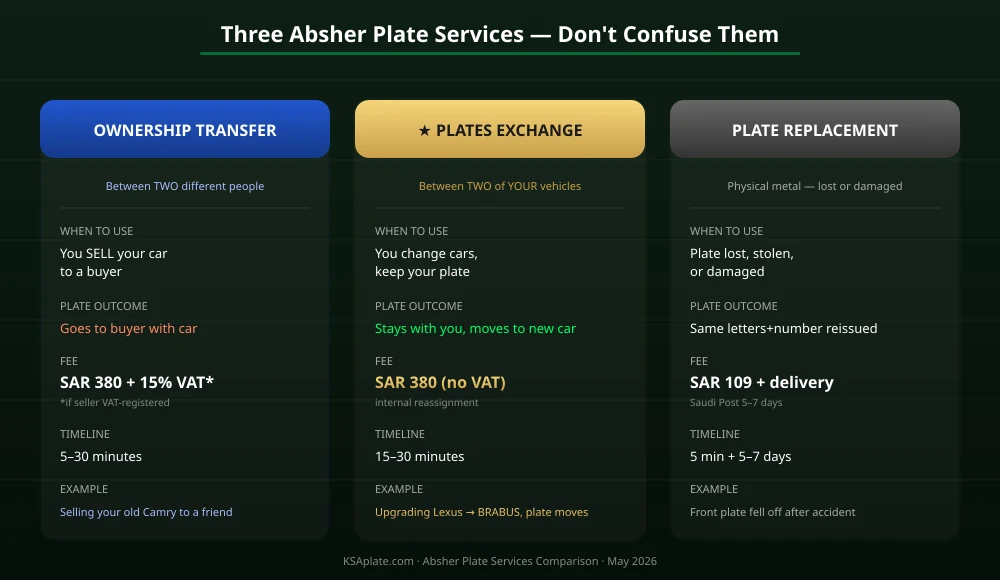
Absher publishes three separate plate services. They are not interchangeable, and choosing the wrong one is the most common reason a plate transaction fails or gets stuck in the system.
2.1 Vehicle Ownership Transfer
This is the service used when you sell your car (with its plate) to another person. The new owner receives both the car and the plate. Fees: SAR 230 Absher + SAR 150 MOI. Detailed walkthrough in our Absher transfer step-by-step guide.
2.2 Plate Transfer Between Your Own Vehicles (THIS POST'S TOPIC)
This is the service for moving a plate between two vehicles you own. No second party is involved. The plate detaches from Vehicle A and attaches to Vehicle B, both registered to you. Vehicle A then needs a replacement plate before it can be sold or driven.
2.3 Vehicle Plate Replacement
This is the service for replacing a lost, damaged, or stolen physical plate. The plate number and letters stay the same — only the metal plate itself is reissued. Different fee schedule (typically SAR 109 + delivery if mailed).
"The number of people who sell a car with a SAR 300,000 plate still attached, just because they didn't know the exchange service exists — that's the most expensive Absher knowledge gap in the Kingdom."
— Senior plate broker, Riyadh
3. Eligibility Rules for Plate Exchange
The Absher exchange service is generous in scope but enforces a small set of non-negotiable rules. Failing any of them stops the exchange at the validation step.
- Same owner. Both vehicles must be registered under your active national ID or Iqama in the Absher system. A plate cannot move directly from your vehicle to a family member's vehicle without first executing an ownership transfer.
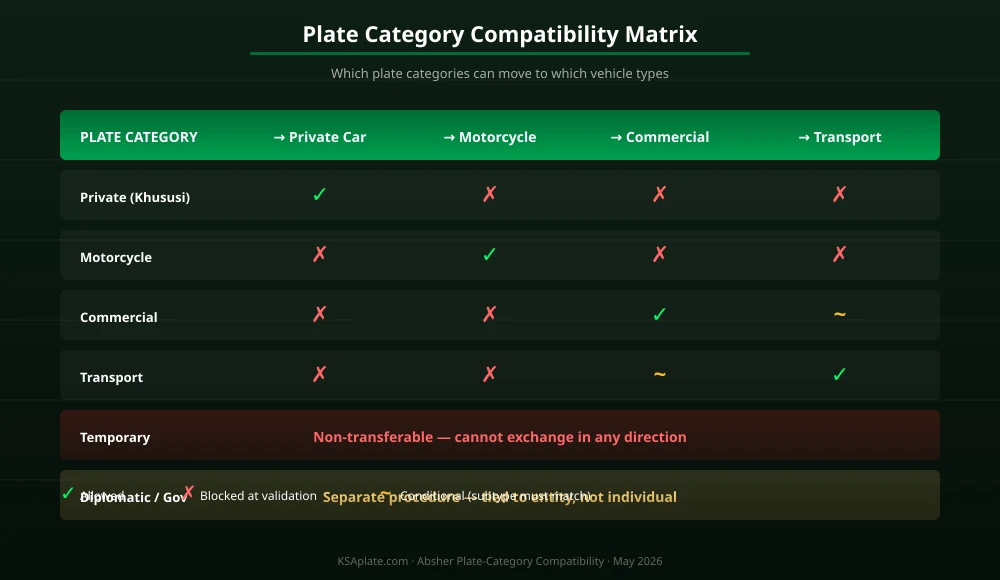
- Same plate category. The plate's classification (private, commercial, motorcycle, transport, diplomatic) must match the new vehicle's classification. The Ministry of Interior categorizes both plates and vehicles into the same taxonomy, and a mismatch invalidates the exchange.
- Both vehicles active in Absher. The old vehicle must currently hold the plate, and the new vehicle must be registered to you with active insurance and a valid Istimara (vehicle registration).
- No active traffic violations on either vehicle. Unsettled violations or unpaid fees on either vehicle block the exchange until cleared.
- No active lien or finance restriction. If either vehicle has a bank finance lien (Murabaha for the car itself), the bank must release the plate restriction before the exchange can complete.
- Both vehicles in the same physical owner's name. Vehicles registered through a company name (commercial registration) follow a separate procedure via the company's authorized signatory.
What's your plate worth?
Get an instant, free estimate with our plate value calculator.
Calculate My Plate's Value4. Step-by-Step Absher Walkthrough
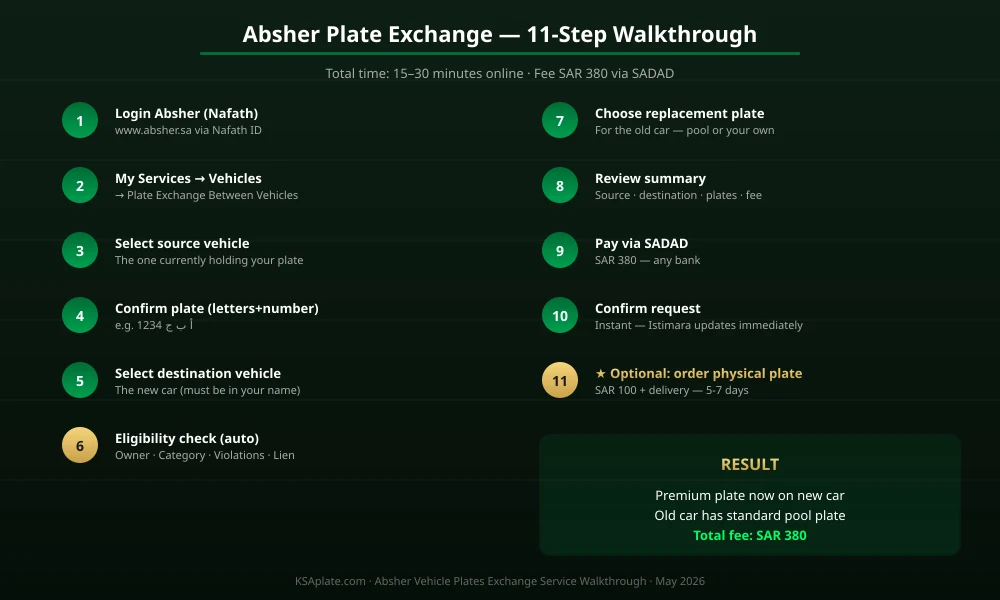
The exchange flow on Absher is short once every eligibility condition is met, but no official processing time is published — treat any figure you see quoted elsewhere as a guess. Here is the exact path:
- Log into the Absher Individuals portal via your Nafath digital identity.
- Navigate to My Services → Vehicles → Plate Exchange Between Vehicles.
- The system lists all vehicles currently registered to you. Select the source vehicle (the one currently holding the plate you want to move).
- Confirm the plate displayed (Arabic letters + number). This is the plate that will be moved.
- Select the destination vehicle from your list of registered vehicles.
- Absher runs a real-time eligibility check: same owner, same category, no violations, no liens. Any failure displays the specific reason.
- Select the new plate that the source vehicle will receive after the exchange. You can choose from the available standard plates in the pool, or — if you also own another premium plate — assign a different existing plate from your inventory.
- Review the summary: source vehicle, destination vehicle, plates being moved, and the SAR 1,030 fee.
- Pay the SAR 400 traffic fee for each vehicle through your bank's SADAD government-payments menu (Ministry of Interior — Traffic → Vehicle Plates – Change Vehicle Plate), then pay the SAR 230 Absher service fee inside Absher.
- Confirm the request. Once it is approved, the destination vehicle's Istimara is reissued showing the new plate and the source vehicle's Istimara shows the replacement plate. No processing time is published, so do not plan around one.
- Optionally, request a physical plate manufacturing if the destination vehicle needs a printed plate. Cost: SAR 100. Delivered by the approved postal carrier.
5. Fee Structure and Timeline
The exchange is priced per vehicle, not per transaction. The traffic department charges its plate-transfer fee for each of the two vehicles involved — the one losing the plate and the one receiving it — while Absher charges its service fee once. That is why an exchange costs more than an ownership transfer (مبايعة), which touches a single vehicle.
| Component | Cost (SAR) | When |
|---|---|---|
| Absher platform fee (VAT-inclusive) | 230 | Every exchange |
| Traffic fee (SAR 400 per vehicle × 2) | 800 | Every exchange |
| Plate manufacturing (optional, new physical plate) | 100 | When physical plate needed |
| Saudi Post delivery (optional) | 143.75 | When ordered |
| Minimum total | 1,030 | Two private vehicles, digital only |
| Maximum typical total | ~1,274 | With manufactured plate + delivery |
Notably, no VAT applies to the exchange itself because no asset is changing hands across taxpayers — this is purely an internal Absher reassignment under the same national ID.
6. Plate Categories — What Can Move Where
The category-matching rule is the source of more failed exchanges than any other eligibility check. Saudi Arabia classifies both plates and vehicles into a small taxonomy, and the two must align.
| Plate Category | Vehicle Types It Can Move To | Example Use Case |
|---|---|---|
| Private (Khususi) | Any private car owned by you (sedan, SUV, sports) | Move from Lexus to BRABUS |
| Motorcycle | Any motorcycle owned by you | Upgrade to a Ducati |
| Commercial / Transport | Trucks, buses, taxis (matching subtype) | Fleet rotation |
| Temporary | Cannot exchange — temporary plates are non-transferable | N/A |
| Diplomatic / Government | Tied to mission or entity, not personal — separate procedure | N/A for individuals |
A private-plate owner who buys a motorcycle cannot move their car plate onto the motorcycle. If they want to preserve the plate, they must either sell the car with the plate to recapture the plate's value, or sell the plate separately on the open market through KSAplate.com.
7. Strategy: When to Move, When to Sell
Owning a premium plate creates a decision point every time you change cars. The exchange service preserves the plate; selling it monetizes it. Both are legitimate, and the right answer depends on plate value, holding period, and your investment thesis.
7.1 Move the Plate
Recommended when:
- The plate has appreciated and you expect further appreciation.
- The plate carries personal or family meaning.
- You're upgrading to a more visible car where the plate's prestige amplifies.
- Liquidating into cash isn't needed for the new-car purchase.
7.2 Sell the Plate
Recommended when:
- The plate's market value funds a meaningful share of the new-car purchase.
- You have a more attractive plate already and don't need this one.
- The new-car category doesn't match the plate's category (motorcycle vs car).
- You're leaving Saudi Arabia and won't keep a Saudi-registered vehicle. See our expat plate guide for exit planning.
The Saudi plate market has appreciated consistently for low-digit and pattern plates over the past decade. For a deeper investment framework see our plate investment guide — for most premium plates above SAR 50,000, the historical math favors keeping and reassigning.
8. The Dealer Trap — Why Showrooms Don't Mention This
Most Saudi car showrooms do not proactively tell premium-plate customers about the exchange service. There are three reasons.
First, the dealer's standard delivery package includes a generic plate that the MOI auto-assigns to the new vehicle. Defaulting to that path is faster for the dealer's workflow. Second, dealers are typically not authorized agents for the exchange transaction — the owner must complete it personally through Absher. Third, some dealers have arrangements with plate brokers who profit from acquiring underpriced premium plates from owners who didn't realize they could keep them.
The defensive move is simple: complete the exchange on Absher before signing the dealer's vehicle delivery confirmation. Once the new car's Istimara shows your existing plate, the auto-assigned generic plate is replaced and the dealer's process continues normally. For the dealer it's a non-event; for you it's the difference between owning your prized plate or losing it to the pool.
9. If You're Selling the Old Car: Sequencing the Transfer
The most common real-world scenario is not "I own two cars" but "I'm selling my old car and buying a new one." In that case the exchange must be sequenced carefully — and ideally before the old car is transferred to its new owner.
- Day 1 — Buy the new car. Register it in your name on Absher. The dealer's auto-assigned plate sits on it for now.
- Day 1 (later) — Execute the plate transfer. Move your prized plate from the old car to the new car. The old car now holds a generic plate.
- Day 2+ — Sell the old car. Initiate Vehicle Ownership Transfer to the buyer. The buyer receives the old car with the generic plate — not your premium plate.
The order matters. Once you initiate ownership transfer of the old car (Step 3) to a buyer, the plate moves with the car by default. Reversing that to retain the plate requires the buyer's cooperation and a separate exchange — a real complication. Always do the exchange (Step 2) before the ownership transfer (Step 3).
10. Five Mistakes That Block the Exchange
- Trying to exchange across categories. Private plate to motorcycle, or commercial to private. The system rejects this at the validation step.
- Outstanding traffic violations. Even a SAR 100 unpaid violation on either vehicle freezes the exchange. Clear all violations on both vehicles before initiating.
- Initiating with the buyer side instead of the exchange side. Selecting "Vehicle Ownership Transfer" because that's what most people search for. Always pick "Vehicle Plate Transfer" (نقل اللوحات) from the Vehicle Services menu.
- Active bank lien on either vehicle. A finance-restricted vehicle cannot release its plate. Settle or transfer the lien first.
- Old vehicle scrapped before exchange. Once the old vehicle is deregistered or scrapped, the plate returns to the MOI pool. Always execute the exchange before deregistering the source vehicle.
11. Frequently Asked Questions
Can I move my plate to my wife's or son's car?
No — not directly. The exchange service requires both vehicles to be registered under the same national ID. To move a plate to a family member's car you must first execute an ownership transfer to put the source vehicle (with its plate) under the family member's name, then they exchange the plate to their vehicle. Alternatively, sell the plate at fair market value and let them buy it through Absher.
Do I have to pay VAT on the exchange?
No. VAT in Saudi Arabia applies to taxable supplies between taxpayers. Moving a plate between two vehicles you already own is not a supply — it is an internal reassignment. Only the SAR 230 Absher fee (which already includes its own VAT component) and the SAR 400 traffic fee per vehicle apply.
How long does the Absher exchange take?
Neither Absher nor the traffic department publishes a processing time for the exchange, so we do not quote one. The electronic Istimara is reissued for both vehicles once the request is approved. If you also order a new physical plate, it is delivered by the approved postal carrier.
What plate does the old car receive?
You select the replacement plate during the exchange flow. By default, Absher offers a standard plate from the available MOI pool at no extra cost. If you own another non-active premium plate in your inventory, you can also assign it to the old car. The old car cannot operate without a plate.
Can I exchange between three or more vehicles in one transaction?
No. Each exchange is a one-source-one-destination transaction. To rotate plates across three or more vehicles you must execute multiple exchanges in sequence, each with its own SAR 1,030 fee.
Does the plate's market value change when I move it?
No. The plate's letters and number remain identical, so its market value is unchanged. The only thing that changes is which vehicle the plate is currently bound to. Investors confirming value before resale should still use the same calculator inputs.
What if I sold my car privately and forgot to do the exchange first?
The plate now belongs to the new owner along with the car. To recover it, you must negotiate with the new owner to either sell the plate back to you (private transaction) or execute an ownership transfer in reverse for the plate. There is no automatic Absher remedy; the transfer is treated as completed.
Can a leased vehicle exchange plates?
Only if the lease structure transfers vehicle title to the lessee with the bank holding a lien. For operational leases where title remains with the leasing company, the plate is bound to the leasing company's records, not yours, and the exchange cannot be initiated by the lessee.
Is the exchange reversible?
Once completed, the exchange is final on Absher. To undo it you must execute another exchange transaction (an additional SAR 1,030 fee) returning the plate to the original vehicle. There is no free reversal window.
Will the exchange affect my insurance?
Yes — both vehicles' insurance policies need updating to reflect the new plate assignments. Most Saudi insurers process the update online within 24 hours when you submit the new Istimara. Premiums typically do not change since the underlying vehicles are unchanged; only the displayed plate number on the policy updates.
12. Conclusion & Next Steps
The Saudi license plate is your asset, not the car's. When you upgrade vehicles, the plate is supposed to come with you — and the Absher plate-transfer service exists specifically for that purpose. Failing to use it is the single most expensive Absher mistake premium-plate owners make in 2026, with six-figure plates surrendered to the pool every month simply because the owner didn't know the option existed.
The procedure is simple, the cost is modest, and the upside is preservation of the most expensive piece of registration in your portfolio. If you own a plate worth more than SAR 30,000 and you're shopping for a new car, the Absher exchange is the first item on the checklist — before the dealer's finance paperwork, before the insurance binding, before delivery confirmation.
Need to value your existing plate before deciding whether to move it or sell it? Use our free plate value calculator →
Considering selling the plate instead of moving it? List your plate for free on KSAplate.com →
Browsing for a complementary second plate for your new car? Browse plates marketplace →
Last updated: September 2026. Fee correction: this page previously quoted SAR 380, which is the fee for an ownership transfer (مبايعة), not for moving a plate between two vehicles. Always confirm current amounts in the SADAD payment screen before approving.