
Last updated: 9 September 2026 · 11 min read
If the ownership transfer went through, the plate is legally the buyer's — and there is no button in Absher that takes it back. Getting it returned needs the new owner to agree to a separate plate transfer, which costs SAR 1,030 and cannot be started without them. What you do next depends on one thing only: whether the sale has completed or is still sitting as a pending request.
Two of our own guides tell you to move a valuable plate off the car before you sell it. Neither answers the question people actually arrive with, which is what to do the morning after they didn't.
TL;DR
- The plate travels with the car by default. A مبايعة (vehicle ownership transfer) moves the whole vehicle, plates included. Doing nothing is a decision, and it is the one most sellers make by accident.
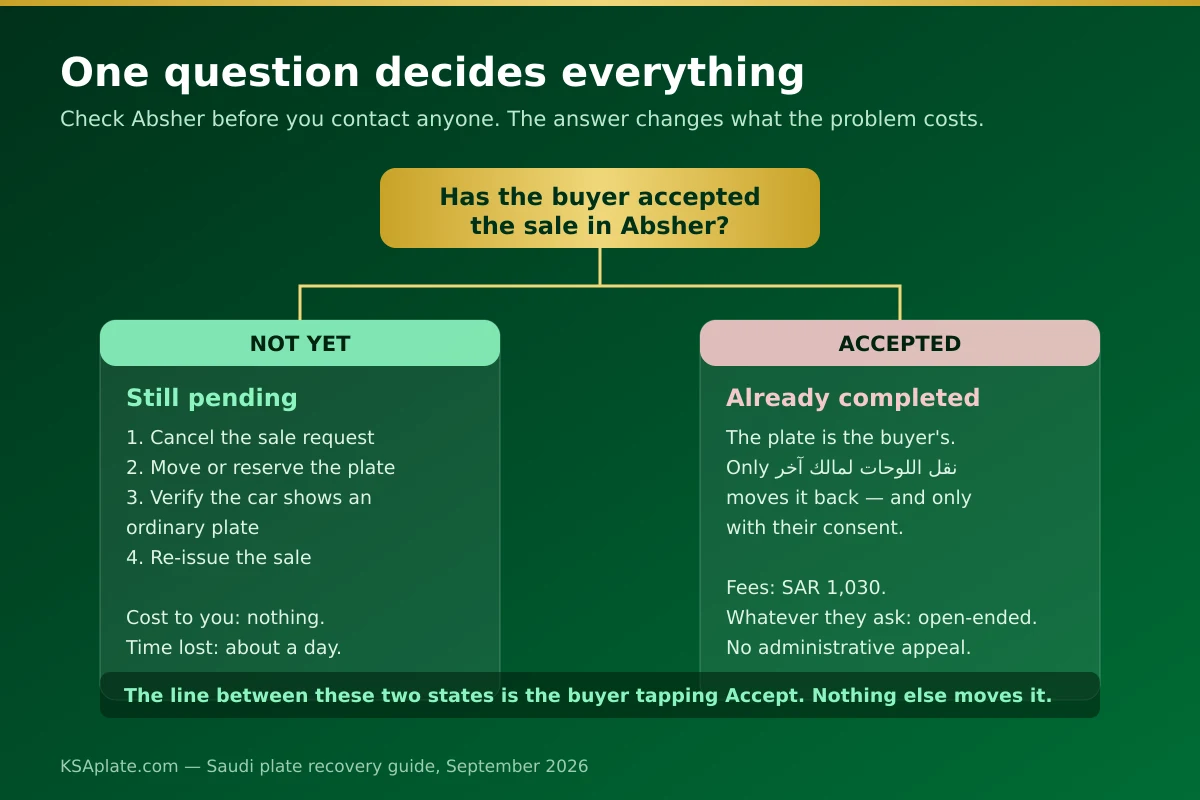
- Check whether the sale is pending or complete first. A pending transfer can be cancelled by either party inside Absher. A completed one cannot.
- After completion there is exactly one route back: نقل اللوحات لمالك آخر — a plate transfer from the new owner's vehicle to yours. It requires their consent through Absher. You cannot initiate it alone.
- It costs SAR 1,030 for a private vehicle: SAR 400 per vehicle in transfer fees plus a SAR 230 Absher service fee. Anything the new owner asks for on top is a private negotiation with no ceiling.
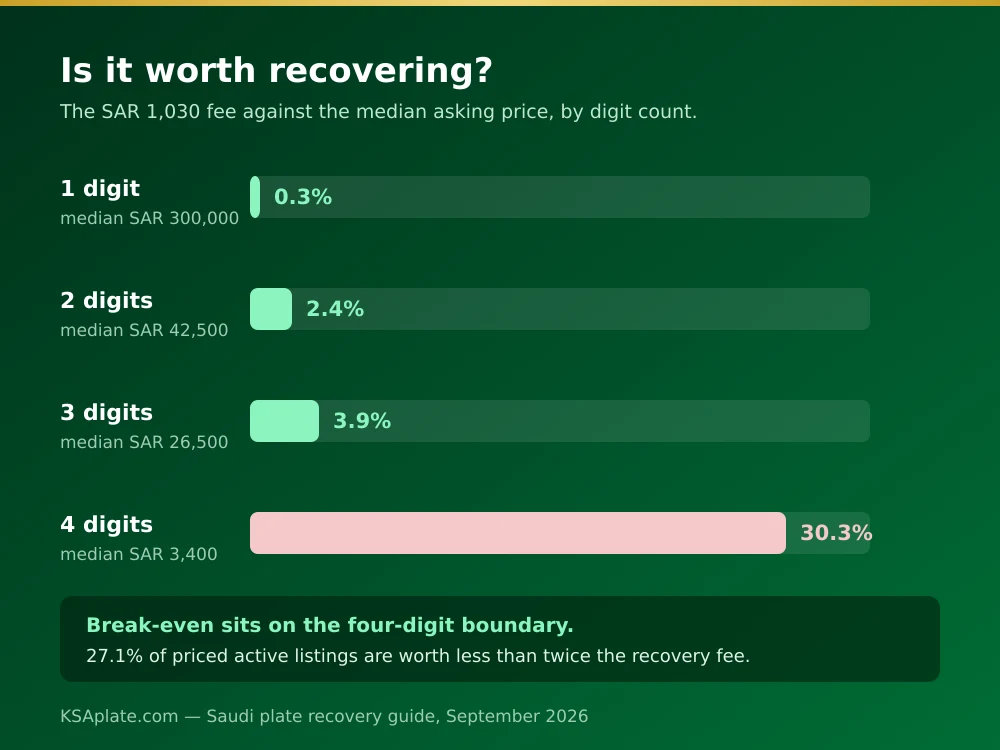
- For most plates it is not worth chasing. On the median four-digit plate the fees alone are 30% of what the plate is worth. On a three-digit plate they are 3.9%. That ratio is the whole decision.
What actually happened in Absher
A Saudi licence plate is an attribute of the vehicle, not of the person. When you complete a مبايعة المركبات — the vehicle ownership transfer — the registration record moves to the buyer in one action, and every plate attached to that record moves with it. The plate was never a separate line item you had to remember to include; it was included the moment you did nothing about it.
This is the part that catches sellers out. There is no confirmation screen that says "your distinctive plate will transfer too." The vehicle is the unit of the transaction, and the plate is part of the vehicle until somebody actively separates them.
Key takeaway: the default is transfer. Retention is the exception, and it is an action, not a setting.
Separating a plate from a vehicle is its own Absher service — نقل اللوحات — and our guide to transferring a plate through Absher covers how it runs. The important thing here is that it is a different service from the one you used to sell the car, with its own fees and its own consent requirements.
First: is the sale pending or complete?
A vehicle sale in Absher is a two-sided request: the seller initiates it and the buyer accepts. Until the buyer accepts, the sale exists only as a pending request, and the vehicle — with its plates — is still registered to you. After acceptance, ownership has moved and the record is closed.
Everything that follows depends on which side of that line you are on, so establish it before you do anything else. Open the Absher individuals app, go to Vehicle Services, and look at your vehicle list. If the car is still there with a pending transfer flag, the sale has not completed. If it has disappeared from your list, it has.
Key takeaway: a pending sale is reversible from inside the app. A completed one is a negotiation with another person.
If the car has vanished from your list but the buyer insists they never confirmed anything, you are in a different situation — that is an untransferred vehicle, and our guide on what to do when a car is not transferred after the sale deals with the liability side of it.
What's your plate worth?
Get an instant, free estimate with our plate value calculator.
Calculate My Plate's ValueIf it is still pending: cancel it
A pending sale can be withdrawn, and this is the only stage at which you can fix the plate problem unilaterally and for nothing. Do it in this order:
- Cancel the pending sale request in Absher under Vehicle Services. It disappears from both sides.
- Move the plate off the vehicle first. Use نقل اللوحات to transfer it to another vehicle you own, or reserve it if you have no second vehicle. Our guide to moving a plate between your own vehicles covers the eligibility rules, which are stricter than most people expect.
- Confirm the vehicle now shows an ordinary plate before you go any further. Do not take this on trust; check the record.
- Re-issue the sale request to the same buyer. Explain the delay — a day's pause is easier to explain than a five-figure loss.
Buyers occasionally resist this, because a car with an attractive number feels like the car they agreed to buy. That is a negotiation, not an obstacle: the plate was never priced into the car unless you priced it in.
If it has completed: the one route back
Once ownership has transferred, the plate belongs to the new owner as completely as the wheels do. The only mechanism that moves it back is the Absher service نقل اللوحات لمالك آخر — plate transfer to a different owner — and Absher is explicit that a transfer between two different owners happens with the consent of both parties through the platform.
In practice that means the new owner has to log in and approve the transfer. There is no form you can submit that compels them, no traffic-department counter that overrides them, and no fee you can pay to skip the step. Their agreement is the whole mechanism.
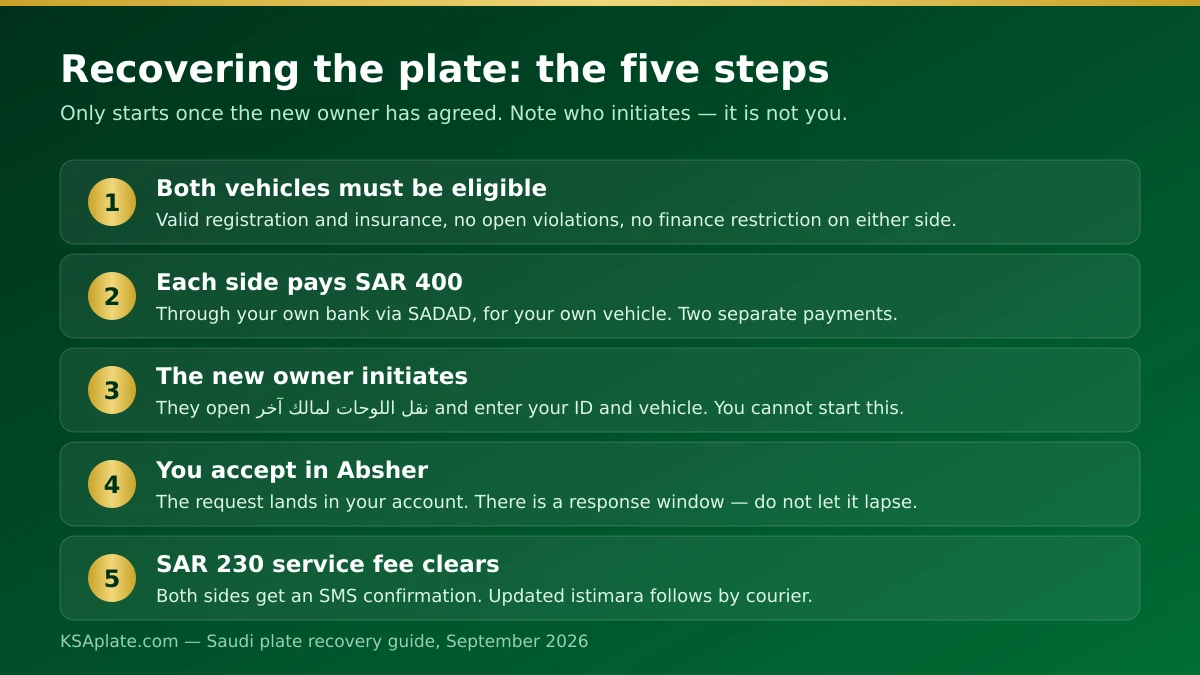
The sequence, once they have agreed:
- Both vehicles must be eligible. Valid registration, valid insurance, no outstanding violations on either vehicle, no finance restriction. A blocked vehicle on either side stops the request — see our guide on why Absher rejects a plate transfer.
- Each side pays SAR 400 through their own bank via SADAD, for their own vehicle.
- The current plate holder initiates the transfer to another owner and enters your national ID or Iqama and your vehicle details. Note the direction: the person who has the plate starts the request, which means the person you are asking for a favour is also the person who has to do the work.
- You accept the request in your own Absher account within the response window.
- The SAR 230 service fee is charged and both sides get an SMS confirmation with updated istimara documents to follow.
Key takeaway: you are not recovering property. You are buying it back, and the price is whatever they decide it is.
What recovery costs — and when it is worth it
The government side of the cost is fixed and knowable: SAR 400 per private vehicle plus a SAR 230 Absher service fee, so SAR 1,030 in total for a standard private-to-private move. For a نقل خاص (private transport) vehicle the per-vehicle fee is SAR 700, taking the total to SAR 1,630.
The part nobody can quote you is the second cost: whatever the new owner asks. They now hold an asset they did not pay for and you visibly want. Some hand it back for the fee alone. Some ask for the plate's market value. Both are within their rights.
So the question is not "can I get it back" but "should I spend money trying". We ran the fixed fee against the current asking prices in our own market data — 11,759 priced active Saudi listings as of 9 September 2026 — to see where the break-even sits:
| Plate | Listings | Median asking price | SAR 1,030 as a share of it | Verdict |
|---|---|---|---|---|
| 1 digit | 230 | SAR 300,000 | 0.3% | Chase it, at almost any price |
| 2 digits | 812 | SAR 42,500 | 2.4% | Clearly worth pursuing |
| 3 digits | 1,977 | SAR 26,500 | 3.9% | Worth pursuing |
| 4 digits | 8,740 | SAR 3,400 | 30.3% | Usually cheaper to buy another |
The break-even lands almost exactly on the four-digit boundary, and it lands hard. 27.1% of all priced active listings are worth less than twice the recovery fee — for those plates, the paperwork costs more than the number does. If you lost an ordinary four- or five-digit working number, the rational move is to stop, and to spend the SAR 1,030 on a plate you actually chose.
Recovery is worth it when the plate is scarce, not when it is sentimental. The fee does not scale with how much you liked the number.
If you do not know which side of the line your plate falls on, price it before you start the conversation — our guide to calculating a Saudi plate's value sets out what actually drives the number.
What you cannot do
Four routes people try, and why each fails:
- You cannot reverse a completed مبايعة. The cancellation option in Absher applies to a request the buyer has not yet accepted. Once accepted, the record is closed.
- You cannot transfer the plate to yourself. The service requires the current holder to initiate. Holding the original istimara, the purchase paperwork or photographs of the plate changes nothing.
- You cannot report it as lost or stolen. The plate is not lost; it is registered to someone else, lawfully. Filing a false report is its own offence, and our guide to plate cloning and fraud explains why the authorities treat plate identity so strictly.
- You cannot rely on a verbal side agreement. "He said I could keep the plate" has no effect on a completed electronic transfer. If it was not executed in Absher, it did not happen.
Key takeaway: there is no administrative remedy. There is only the new owner.
How to approach the new owner
You are asking someone to spend SAR 400, log into a government portal, and give up something valuable they legally own. Approach it as a purchase, not as a correction of an error.
What works, in the order it works:
- Contact them early. Attachment grows. A buyer who has driven the car for a week is easier to move than one who has had it for six months and told people about the number.
- Name a figure first. "I will cover both transfer fees and pay you SAR X" is a proposal. "Can I have my plate back?" is a request for a gift, and it invites a no.
- Offer a replacement, not just money. Buying them a comparable plate from the open market and covering the transfer is often cheaper than a cash figure they invent, and it leaves them no worse off.
- Put the sequence in writing. Agree who pays what, and when. Both sides pay before the transfer clears, so a written order of steps prevents the argument.
- Do not mention what the plate is worth. If they did not know, they do now, and you have just repriced your own negotiation.
If you no longer have their number, the plate itself is a route back to them: Absher's التواصل عبر اللوحة service forwards a purchase request to a vehicle's registered owner without either side seeing the other's details. Our guide on contacting a car owner by plate covers exactly how it works and what it will and will not carry.
If they refuse
A refusal is final in any practical sense. There is no appeal, because nothing has gone wrong in the legal record — the transfer you authorised did what it was designed to do.
Two things are still worth doing. First, ask once more after a few months; circumstances change, and a plate becomes less interesting when the car is sold on again. Second, treat the loss as a purchase decision rather than a grievance: a comparable number is usually available, and the median priced listing on the Saudi market sits at SAR 5,700. For most four-digit numbers, replacing is faster, cheaper and entirely within your control.
The plate you lost and a plate just like it are not the same thing emotionally. On a spreadsheet they usually are.
The sequence that prevents it
The whole problem is ordering. Retention is something you do to a vehicle you still own, so it has to happen while you still own it. The safe sequence has four steps and takes a day:
- Decide before you advertise the car whether the number goes with it. If it is distinctive, it does not.
- Move or reserve the plate while the vehicle is still registered to you, using نقل اللوحات.
- Verify in Absher that the car now carries an ordinary plate.
- Only then initiate the مبايعة.
Our guide to keeping your plate when you change cars covers the reservation window and the eligibility conditions in detail. The one rule worth memorising: never start a vehicle sale request while a plate you want to keep is still on the vehicle, not even for an hour, because acceptance can happen faster than you expect.
Frequently asked questions
Does the licence plate transfer with the car in Saudi Arabia?
Can I cancel a car sale in Absher to get my plate back?
Can I take my plate back without the buyer's agreement?
How much does it cost to get a plate back after a car sale?
Is it worth paying to recover an ordinary plate?
What if the buyer will not answer my calls?
Can I report the plate as stolen to get it back?
Does a written agreement with the buyer help?
What happens to the plate if the buyer sells the car again?
What to do next
Check Absher first and establish whether the sale is pending or complete, because that single fact decides whether this costs you nothing or becomes a negotiation. If it is pending, cancel, move the plate, and re-issue — you have lost a day and nothing else.
If it has completed, price the plate before you make contact. The number tells you whether to open a negotiation or to stop and replace it, and it is the one input that turns this from a grievance into a decision.
Find out what the number was worth
Enter the letters and digits and get a value range built from live Saudi listings — then see what a comparable plate costs on the open market today.
Value a plate freeBrowse comparable platesLast reviewed on 9 September 2026 by Khalid Al-Rashid, Saudi License Plate Expert. Fee figures are the published Absher schedule for نقل اللوحات (SAR 400 per private vehicle, SAR 700 for نقل خاص, plus a SAR 230 service fee); the both-parties-consent condition is stated in Absher's own description of the plate-transfer service. Market figures are a snapshot of 11,759 priced active Saudi plate listings held by KSAplate on 9 September 2026 — these are seller asking prices, not confirmed sale prices. Confirm the current service menu and fees in your own Absher account before acting.
Sources: Absher (نقل اللوحات and مبايعة المركبات service cards); General Directorate of Traffic fee schedule.