
Last updated: 10 August 2026 · 11 min read
If you sold your car in Saudi Arabia and the buyer never completed the Absher transfer, the vehicle is still legally yours — and so is every fine, accident and impound notice it collects. Handing over the keys does not move ownership. Ownership moves the moment the transfer is confirmed in the records of the General Directorate of Traffic (Muroor), and not one minute earlier. The good news is that the situation is recoverable, and the sequence for recovering it is short.
Possession and ownership are two different things in Saudi traffic law. The buyer has your car. The Muroor register says you do.
- You are still the legal owner until Absher confirms the transfer. Fines, Saher tickets and accident liability recorded against the vehicle remain attached to your name and your Absher account.
- The transfer is meant to complete within 30 days of the sale. Beyond that, both parties are exposed to penalties reported in the SAR 500–1,000 range, and the vehicle can be impounded until its status is corrected.
- Check your Absher vehicle list first. If the car still appears under your vehicles, the transfer did not complete — regardless of what the buyer told you.
- An unaccepted sale request can be cancelled. If the buyer never accepted, the seller can withdraw the request and re-issue it, which is far simpler than chasing a completed-but-disputed transfer.
- Escalate in order: Absher record → buyer contact with a deadline → cancel and re-issue → Muroor → formal complaint. Skipping rungs wastes weeks.
- Prevent it next time by sequencing the handover: payment, then buyer insurance, then transfer confirmation, then keys. Keys last, always.
Quick answer: What happens if the buyer does not transfer the car in Saudi Arabia? The car stays registered in your name, so you remain liable for its traffic fines, Saher violations and accident consequences, and you cannot renew or clear your own record cleanly. Open Absher and check whether the vehicle still appears in your list. If a sale request is pending and unaccepted, cancel it and re-issue. If the buyer is unresponsive, escalate to Muroor with your sale evidence. Transfer is meant to be completed within 30 days of the sale.
Selling your car? List it on KSAplate for free
No commission on the sale, no account needed, and buyers contact you directly on WhatsApp. Keep or sell the plate separately.
List your car free Browse carsWho legally owns the car right now
Vehicle ownership in Saudi Arabia is the name recorded against the vehicle in the Muroor register, not the person holding the keys. A car is transferred when the seller initiates a sale on Absher, the buyer accepts it, pays the transfer fee, places insurance in their own name, and confirms delivery. Until that final confirmation lands, the register still says you.
This is the single most misunderstood point in a private Saudi car sale. Money changed hands, the car drove away, and both parties behave as though the deal is closed. Legally it is half-closed. The contract of sale between you and the buyer may well be valid; the registration is a separate act, and only the registration decides who the state holds responsible.
Key takeaway: a signed agreement and a paid price do not transfer a vehicle in Saudi Arabia. Only a completed Absher transfer does.
Step 1: check Absher before you do anything else
An Absher vehicle check is the fastest way to establish your actual position, and it takes under a minute. Sign in to your Absher Individuals account and open your vehicles list. If the car appears there, the transfer did not complete — whatever the buyer said, whatever screenshot they sent.
Look for one of three states, because the remedy is different for each:
- Car present, no pending request. The sale was never initiated, or it was initiated and expired. You are the full owner in the eyes of the state.
- Car present, request pending. You initiated the sale; the buyer never accepted. This is the easiest case to fix, and the one with a clean self-service remedy.
- Car absent. The transfer completed. If fines are still reaching you, they were issued before the transfer date and belong to your period of ownership.
Do this check before you contact the buyer. Walking into that conversation knowing which of the three states you are in changes what you ask for, and stops you chasing a problem that has already resolved itself.
The seller liability timeline: day 0 to day 30 and beyond
Seller liability is not binary — it escalates. Most guides say "you are liable until transfer" and stop there. The exposure actually changes shape over time, and knowing which stage you are in tells you how urgently to act.
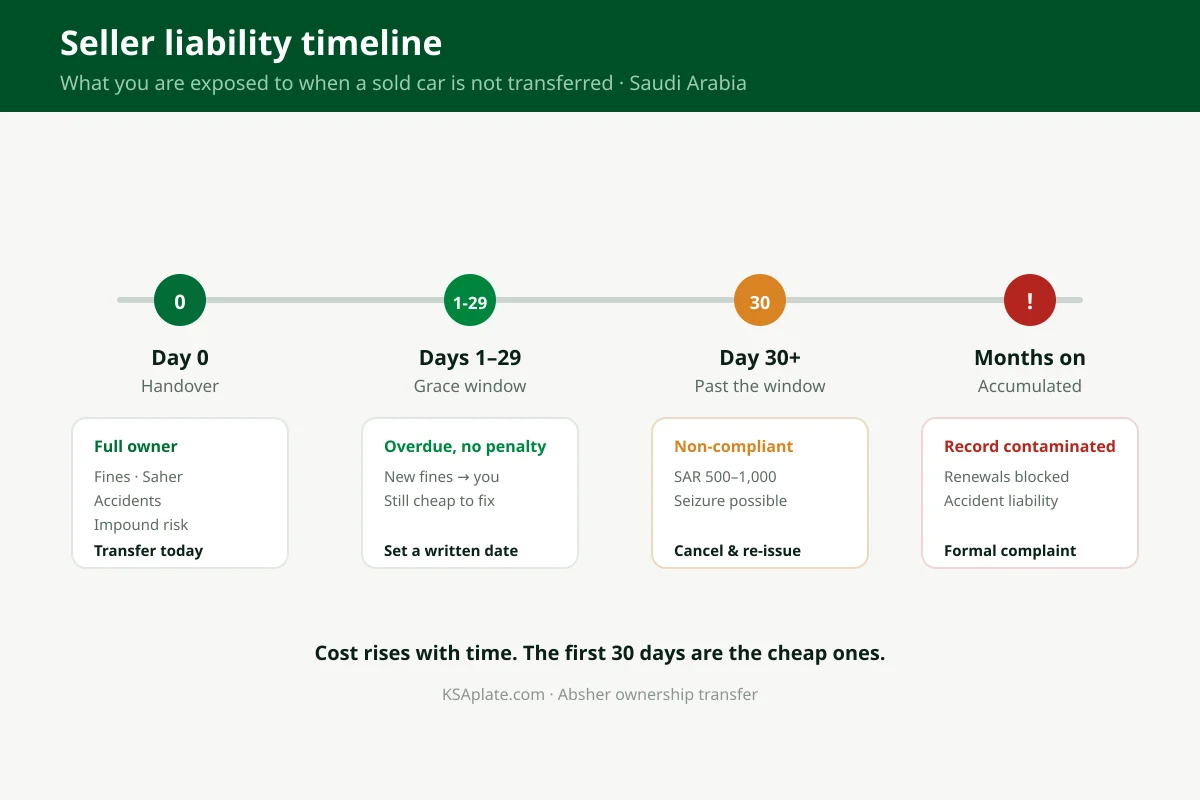
| Stage | Your position | What you are exposed to | What to do |
|---|---|---|---|
| Day 0 Handover day |
Full registered owner | Everything. Fines, Saher tickets, accidents, impound. | Complete the transfer the same day, ideally before the keys move. |
| Days 1–29 Grace window |
Registered owner, transfer overdue but within the normal window | New fines attach to you. No penalty for lateness yet. | Contact the buyer with a firm date. Most cases resolve here. |
| Day 30+ Past the window |
Registered owner, transfer now non-compliant | Fines, plus non-transfer penalties reported in the SAR 500–1,000 range, plus possible vehicle seizure until the status is corrected. | Cancel and re-issue if pending; otherwise escalate to Muroor. |
| Months later Accumulated |
Registered owner with a contaminated record | Unpaid fines can block your own renewals and services. Accident liability is the worst case. | Formal complaint with full evidence. Do not let it reach here. |
Key takeaway: the first 30 days are cheap to fix and the months after are expensive. The cost of this problem is almost entirely a function of how long you leave it.
What's your car worth?
Get a free instant estimate based on real Saudi market data — then sell it on KSAplate with direct WhatsApp contact.
Value My Car — FreeWhat you are actually exposed to
Seller exposure on an untransferred vehicle is broader than most people assume, because the register drives several separate systems at once. It is not only about parking tickets.
| Consequence | Transfer completed | Transfer not completed |
|---|---|---|
| New traffic fines and Saher violations | Buyer's record | Your record, your Absher account |
| Accident liability and Najm reports | Buyer named as owner | You named as registered owner |
| Vehicle impound for non-transfer | Not applicable | Possible until status corrected |
| Your ability to clear your own record | Unaffected | Blocked by unpaid fines on a car you don't have |
| The licence plate attached to the car | Moves with the vehicle or is retained by you | Frozen — still bound to a car in your name |
| Insurance position | Buyer's policy, buyer's risk | Ambiguous, and disputed after an incident |
The accident column is the one that should concentrate the mind. A fine is a number you can pay and argue about later. An incident involving a vehicle registered to you, driven by somebody you sold it to informally, is a materially harder problem — which is why insurance in the buyer's name is a mandatory step in the transfer rather than an optional courtesy.
The escalation ladder: five rungs, in order
The escalation ladder is an ordered sequence of remedies that moves from self-service to formal authority, and it works because each rung produces the evidence the next rung needs. Skipping rungs is the single biggest reason these cases drag on for months.
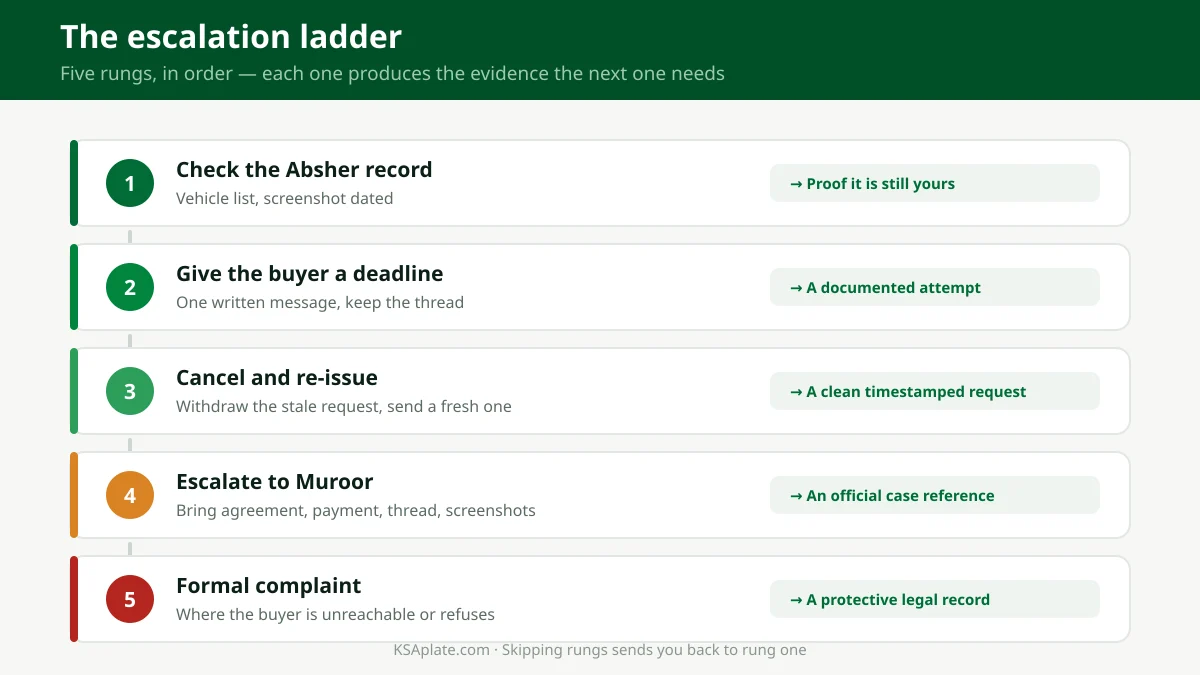
- Establish the record. Absher vehicle list, screenshot dated. This is your baseline and it is what every later step is measured against. Evidence produced: proof the car is still registered to you on a specific date.
- Put the buyer on a deadline. One written message — WhatsApp is fine — stating the car is still in your name, that fines are accruing to you, and naming a date. Keep the thread. Evidence produced: a documented attempt to resolve it directly.
- Cancel and re-issue. If a sale request is sitting unaccepted, withdraw it and issue a fresh one. Expired and stale requests are a common silent failure. Evidence produced: a clean, current, timestamped request.
- Escalate to Muroor. Take your sale evidence — agreement, payment proof, message thread, Absher screenshots — to the General Directorate of Traffic. Evidence produced: an official case reference.
- Formal complaint. Where the buyer is unreachable or refuses, the matter moves from administrative to formal. Evidence produced: a legal record that protects you for anything that happens next.
Every rung on the ladder exists to create the document the next rung asks for. Jump straight to rung four with nothing in your hand and you will be sent back to rung one.
Cancelling and re-issuing a pending sale
A pending sale request is a sale that the seller started and the buyer never accepted, and it is the most common and most fixable version of this problem. The request sits in the system doing nothing, the seller assumes it went through, and the car quietly stays registered where it was.
The remedy is to withdraw the pending request and issue a new one once the buyer is genuinely ready to complete their side — meaning they have an active Absher account, the transfer fee available, and insurance ready to place in their own name. Re-issuing into the same unreadiness produces the same result.
Key takeaway: if the buyer could not complete the transfer the first time, find out why before re-issuing. The blocker is usually insurance or an outstanding fine, not unwillingness.
When the buyer has gone quiet
An unresponsive buyer changes the problem from a coordination failure into an evidence exercise. You are no longer trying to persuade somebody; you are building a file that lets the authorities act without them.
Assemble, in this order: the sale agreement or written terms, proof of payment received, the message thread showing your attempts to resolve it, dated Absher screenshots showing the vehicle still registered to you, and the buyer's identifying details as recorded at the sale. That last item is exactly why a written agreement with an ID number matters more than sellers think on the day — see the common used-car scams in Saudi Arabia for how thin documentation is exploited.
If the vehicle has vanished along with the buyer, that is no longer an administrative matter and should be reported as such. The registration problem and the missing-vehicle problem are handled through different channels, and conflating them slows both.
Fines already issued in your name
Fines follow the register, so a violation recorded while the car was still in your name is recorded against you, and completing the transfer later does not retroactively move it. This is the part sellers find hardest to accept, and it is also why the 30-day clock matters in cash terms rather than just in principle.
Check what is outstanding before you negotiate anything with the buyer — you can check and pay traffic fines through Absher in a few steps, and the list itself becomes part of your evidence file. Where fines were clearly incurred after the handover date, they are a matter between you and the buyer, and a documented sale date is what makes that argument possible at all.
Unpaid fines are not a passive problem. They sit on your record and interfere with your own transactions, including renewing the istimara on any vehicle you actually still own.
The plate problem nobody warns you about
A distinctive licence plate attached to an untransferred vehicle is frozen twice over, and this is the consequence that catches out exactly the people who can least afford it — owners of valuable numbers. The plate cannot move to your next vehicle, because plate retention requires a clean action on a vehicle whose ownership is settled. It cannot be sold separately for the same reason.
So a seller with a valuable plate and an unresolved transfer is holding an asset they cannot use, cannot move and cannot liquidate, on a car they no longer have. If the plate was supposed to stay with you, the sequencing matters even more than usual: retention is an action you take before the vehicle changes hands, not a correction you make afterwards. Our guide to keeping your plate when you change car covers the reservation window in detail.
A valuable plate on an untransferred car is the worst of both positions: you carry the liability of ownership without the freedom of it.
If you are leaving Saudi Arabia
An untransferred vehicle becomes materially more serious when the registered owner exits the Kingdom, because unresolved obligations attached to your record do not travel well. Expatriate sellers are disproportionately affected here for an obvious reason: the sale is often rushed into the final weeks, when there is least time to chase a slow buyer.
If you are on a departure timeline, treat the transfer as a hard dependency rather than a loose end — complete it before the final month, not during it. Sell earlier than feels necessary, and refuse a handover that is not accompanied by a completed transfer. The same principle applies to any plate you own; what happens to your plate when you leave Saudi Arabia sets out the options while you still have them.
The handover sequence that prevents all of this
The handover sequence is a fixed order of operations at the point of sale that makes non-transfer structurally impossible, and it works because it never leaves the seller in a position where the buyer has both the car and the incentive to stop cooperating. Every case in this article traces back to one broken rule: the keys moved too early.
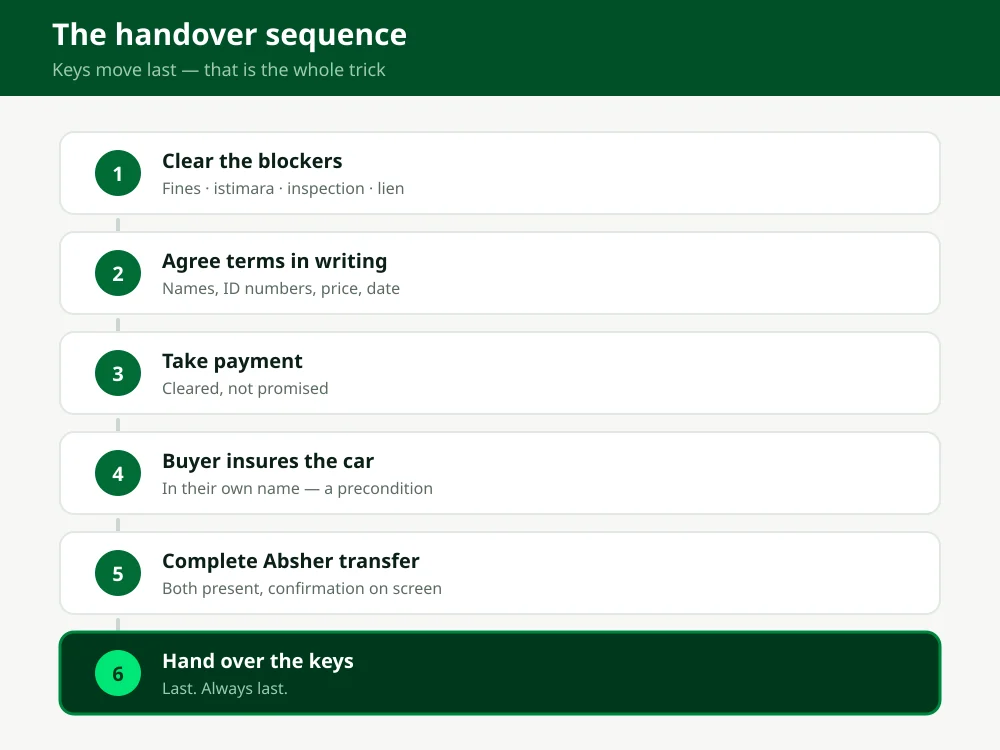
- Clear the blockers first. Outstanding fines, expired istimara or periodic inspection, and any bank lien on a financed car will each stop the transfer dead. Clear them before you list, not on handover day. If the car is financed, settle the finance side first.
- Agree terms in writing. Price, date, both parties' full names and ID or Iqama numbers, vehicle details. This document is what rungs four and five of the ladder run on.
- Take payment. Confirmed and cleared, not promised.
- Buyer places insurance in their own name. The transfer will not complete without it, so treat it as a precondition rather than a step.
- Complete the Absher transfer together, in person. Both parties present, both phones out, confirmation on screen. Our full Absher transfer walkthrough covers the exact flow and the current fees.
- Hand over the keys. Last. Always last.
Key takeaway: steps five and six are in that order for a reason. A buyer with the keys has no remaining reason to hurry; a buyer without them completes the transfer in four minutes.
The numbers that matter
A short set of figures worth committing to memory before your next sale:
- 30 days — the window in which the ownership transfer is expected to be completed after a sale.
- SAR 500–1,000 — the range of penalties reported for failing to transfer within the required period, alongside possible vehicle seizure until the status is corrected.
- ~SAR 380 — the typical total cost of a private ownership transfer, around SAR 150 in government fees plus around SAR 230 in Absher service fees including VAT, with the buyer usually paying the Absher portion.
- 85%+ — the share of Saudi vehicle ownership transfers now completed through Absher rather than in person.
- 4 minutes — roughly how long the transfer takes when both parties are present and prepared. There is no good reason to postpone it.
And if the sale has already gone through with the plate still attached, retention is no longer the question — recovery is. Our guide on what to do when you sold the car with the plate still on it sets out the one route back and what it costs.
Frequently asked questions
Is the car still mine if the buyer has not transferred it?
How long does the buyer have to transfer the car?
Can I cancel a sale on Absher if the buyer never accepted it?
Who pays fines issued after I sold the car but before the transfer?
What evidence do I need to escalate to Muroor?
Why did the transfer fail even though we both tried?
Can I still keep my distinctive plate if the car was never transferred?
I am leaving Saudi Arabia and the car is still in my name. What now?
What to do next
Open Absher and check your vehicle list. That single action tells you which of the three states you are in, and every sensible next move follows from it. If a request is pending, cancel and re-issue. If nothing is pending, contact the buyer with a date in writing. If the buyer has gone quiet, start building the file.
And when you sell your next car, run the handover in the order above. The transfer problem is not really a legal problem — it is a sequencing problem, and sequencing is free.
Selling your car? List it on KSAplate for free
No commission on the sale, no account needed, and buyers contact you directly on WhatsApp. Keep or sell the plate separately.
List your car free Browse carsReviewed by Khalid Al-Rashid, Saudi vehicle market specialist. Last reviewed 10 August 2026.
Sources: Vehicle Ownership Transfer is published as an official service on the Saudi National Platform (my.gov.sa) and executed through Absher (absher.sa), the Ministry of Interior e-services platform; the General Directorate of Traffic (Muroor) is the responsible authority (moi.gov.sa). The 30-day transfer window, the SAR 500–1,000 non-transfer penalty range and the vehicle-seizure provision reflect 2025–2026 Saudi traffic-regulation reporting and are indicative; penalty figures vary between sources, so confirm the current amount for your case. Transfer cost (~SAR 380) and the 85%+ Absher share reflect the same period. This article is general guidance on registration procedure, not legal advice — for a disputed sale, take your evidence to Muroor.