


Last updated: 29 August 2026
TL;DR:
- A Saudi plate transfer is refused because a precondition on the vehicle failed, not because the plate is faulty. Absher checks the registration, the insurance, the inspection, the fines and any bank lien before it will move a plate.
- The most common cause is an expired istimara — and that usually means something upstream lapsed, because the registration cannot be renewed while insurance or the periodic Fahes inspection has expired.
- The slowest cause is a financed vehicle. The bank must be settled and must issue a release letter (NOC) before the registration can move at all. Everything else on this list is same-day to a few days.
- Two blockers sit with the buyer, not the seller — having no vehicle registered in your name to receive the plate, and a transfer already pending on that plate.
- Once the path is clear the fee is SAR 1,030 — SAR 400 in traffic-department fees for each of the two vehicles involved, plus a SAR 230 Absher service fee, VAT inclusive. The SAR 380 quoted in many guides is the ownership-transfer fee, charged when a whole vehicle changes hands.
Quick answer: A Saudi license plate transfer is refused when the vehicle the plate sits on fails one of Absher's preconditions: an expired istimara, lapsed insurance, an overdue Fahes inspection, unpaid traffic fines, an unsettled bank lien, a seller who is not the registered owner, or a buyer with no eligible vehicle to receive the plate. Absher blocks the request without naming which one. Work down the list in order.
Why Absher refuses without explaining
A refused license plate transfer is a failed precondition on the vehicle, not a fault in the plate itself. Absher validates the state of the car the plate is mounted on before it will let the plate move, and when one of those checks fails the request simply does not proceed.
The frustrating part is the silence. The platform is built to confirm that a transfer is permitted, not to diagnose why it is not. So a seller sees a request that will not complete and assumes the plate is somehow flagged, when in almost every case the plate is fine and the vehicle underneath it is not. Sellers describe it either as the transfer being refused or as the plate being rejected; the wording differs, the cause does not.
That distinction is the whole article. Stop investigating the number and start working through the vehicle's status in order, because the checks are sequential: a lapsed insurance policy blocks the registration renewal, and the expired registration is what blocks the transfer. Fix the wrong one first and nothing changes.
Key takeaway: The plate is rarely the problem. The registration it is attached to almost always is.
The expired istimara, and what sits behind it
The istimara is the Saudi vehicle registration card, and an expired one blocks a plate transfer outright. It is the document that ties one vehicle and one plate to one owner, so if it is not current there is nothing valid for Absher to move the plate off.
An expired registration also stops you transferring the vehicle, renewing insurance cleanly, or selling either the car or the plate. Sellers discover this at the worst moment: the plate may be worth six figures, but if the registration lapsed months ago the transfer will not go through until it is renewed. Our guide to what the istimara actually is covers every field on the card and why the owner name and plate number appearing together is what makes it proof of ownership.
Renewal itself is an online process and usually same-day. What makes it fail is almost always something upstream, which is the next section.
Key takeaway: Check the expiry date on the istimara before you check anything else. It is the single most common blocker and the fastest to confirm.
Insurance and Fahes: the two upstream blockers
An istimara cannot be renewed while the insurance or the periodic Fahes inspection has lapsed. That makes them indirect blockers: they never refuse the transfer themselves, they refuse the renewal that the transfer depends on.
This is where most of the confusion in a stalled transfer comes from. The seller tries to renew the registration, the renewal is refused, and it looks like a second unrelated problem. It is not — it is the same chain, one link further up. Valid insurance and a passed inspection are preconditions for the registration, and the registration is a precondition for the transfer.
Newer vehicles are exempt from Fahes for their first years, so the inspection is more often the blocker on older cars. Our guide to the Fahes inspection explains what is tested and when a vehicle becomes due; renewing the istimara covers the order of operations.
Key takeaway: Insurance and Fahes do not block the transfer. They block the renewal, which blocks the transfer. Fix them first or the renewal keeps failing.
What's your plate worth?
Get an instant, free estimate with our plate value calculator.
Calculate My Plate's ValueOutstanding traffic fines
Unpaid traffic violations attach to both the vehicle and the ID, and outstanding fines can block a registration renewal or an ownership transfer. Saher speed-camera penalties are the usual culprit because they accrue without any interaction, so an owner can be carrying several without knowing.
Fines are the easiest blocker on this list to clear. They are visible in Absher or the Tam app, linked to the vehicle and the ID, and payable immediately — which makes this typically a same-day fix rather than a multi-day one. That is worth knowing before you assume a stalled transfer is serious.
A buyer can and should check this before agreeing anything. Our guide to checking a Saudi plate before you buy walks through the Absher and Tam lookups, and checking and paying traffic fines covers the payment routes.
Key takeaway: Fines feel like a serious obstruction and are usually the least serious one. Check them early because clearing them is fast.
A financed vehicle and the release letter
A vehicle under finance carries a lien, and the registration cannot be transferred until the bank releases it. The sequence is fixed: request a settlement figure from the bank, pay the remaining balance, receive a release letter or no-objection certificate, and only then can the istimara be transferred.
This is the slowest blocker on the list by a wide margin. Fines clear in an afternoon and a registration renews the same day; a bank settlement and release letter runs from days into weeks depending on the lender. If you are buying and the seller mentions financing late in the conversation, expect the timeline to change rather than the price.
Early settlement is usually permitted, and under a murabaha structure it can reduce the total owed. The mechanics — settlement figures, early-settlement costs, and the release letter — are set out in our guide to selling a financed car in Saudi Arabia.
Key takeaway: Ask about finance in the first conversation, not the last. It is the one blocker that turns a same-day transfer into a multi-week one.
When the seller is not the registered owner
Only the registered owner can transfer a plate, or an agent holding a valid power of attorney on their behalf. If the name on the istimara does not match the person you are dealing with, the transfer cannot complete no matter how genuine the intent.
This appears constantly in family sales — a son selling his father's plate, a brother acting for a brother abroad. The fix is a wakala, and a buyer is entitled to see it before any money moves. A relative selling without one cannot finish the transfer, and you will find that out only after you have paid. Our guide to the wakala for remote plate buyers explains what a valid one looks like.
The check costs nothing: compare the owner name printed on the istimara against the person messaging you. If they differ, ask for the wakala in the same breath.
Key takeaway: A name mismatch is not a technicality. Without a wakala the transfer is impossible, and it is invisible until you try.
The two blockers that are yours, not the seller's
Two of the preconditions sit entirely on the buyer's side, and neither has anything to do with the seller's paperwork. Both are common and both are checked inside your own Absher account.
The first is having no eligible vehicle. A plate transfers onto an existing registration rather than existing on its own, so you need a vehicle registered in your name for the plate to be fitted to. Buyers who own no car sometimes purchase and hold a plate through a family member's registration, which solves the immediate problem and creates a different one when they later try to move it.
The second is a transfer already pending on the plate. If an earlier request was started and never completed, it occupies the plate until it is finished or cancelled. Confirming that a plate has no pending transfers is part of the standard pre-purchase check described in our guide to verifying a plate before buying.
Key takeaway: If the seller's side is demonstrably clean and the transfer still will not go, stop asking the seller. The block is in your account.
Who has to clear each blocker
Every blocker belongs to exactly one party, and most of the delay in a stalled transfer comes from the wrong person trying to fix it. A buyer cannot clear a seller's fines; a seller cannot register a vehicle for the buyer to receive the plate.
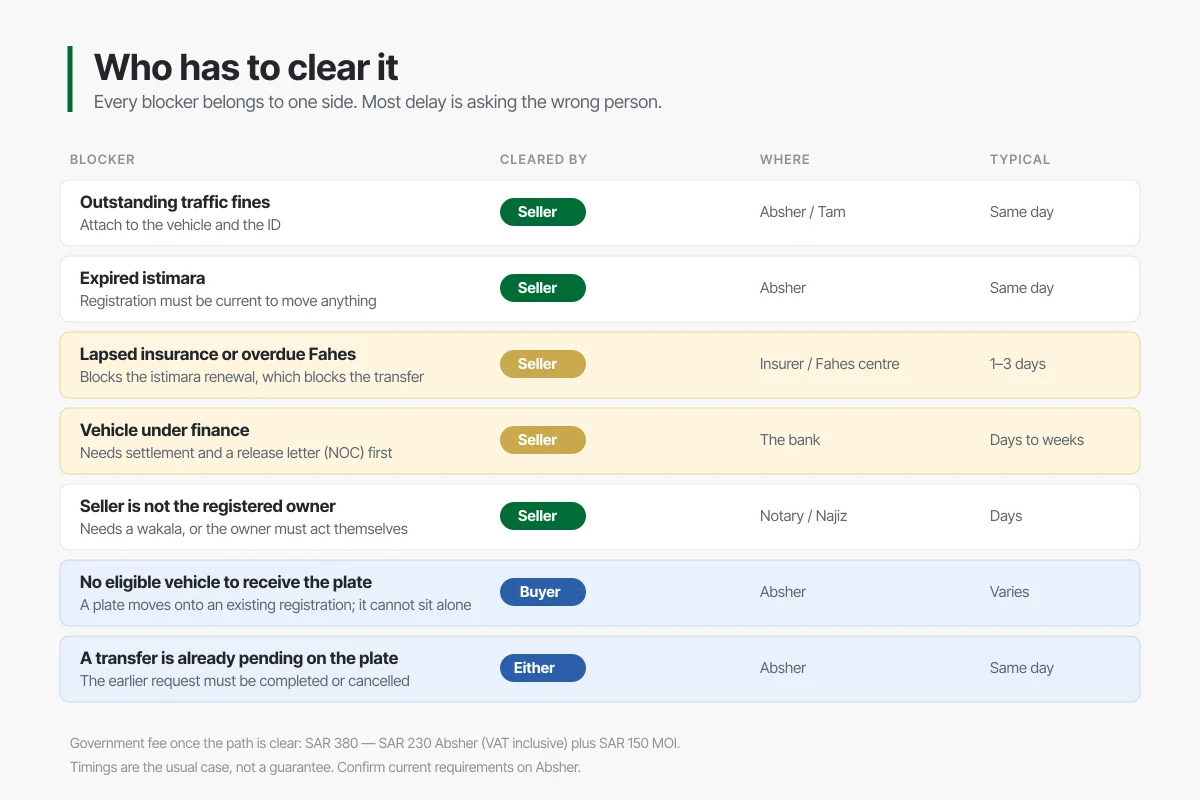
| Blocker | Cleared by | Where | Typical time |
|---|---|---|---|
| Outstanding traffic fines | Seller | Absher / Tam | Same day |
| Expired istimara | Seller | Absher | Same day |
| Lapsed insurance or overdue Fahes | Seller | Insurer / Fahes centre | 1–3 days |
| Vehicle under finance | Seller | The bank | Days to weeks |
| Seller is not the registered owner | Seller | Notary / Najiz | Days |
| No eligible vehicle to receive the plate | Buyer | Absher | Varies |
| Transfer already pending on the plate | Either | Absher | Same day |
Read the table as a triage tool rather than a reference. The two gold rows are the ones that cost real time; everything in white is usually resolved within a day of someone actually looking at it.
Key takeaway: Identify whose blocker it is before you try to fix it. That single step removes most of the back-and-forth.
The five-minute pre-flight check
A pre-flight check is the set of confirmations to make before agreeing a price, rather than after the transfer fails. Every item is free, every item is visible to a buyer, and together they catch all seven blockers above.
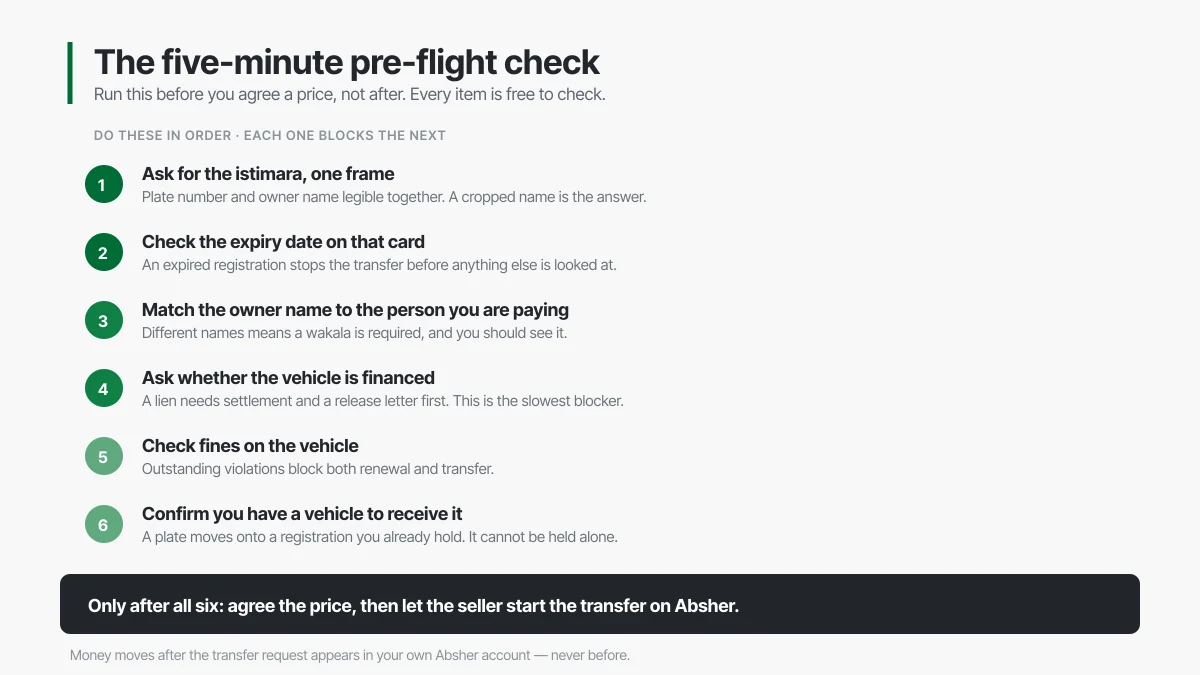
- Ask for the istimara in one frame. Plate number and owner name legible together. A seller who crops the name has told you something.
- Read the expiry date on that same card. This is the most common blocker and it takes two seconds to rule out.
- Match the owner name to the person you are paying. If they differ, ask for the wakala now rather than later.
- Ask directly whether the vehicle is financed. A lien is the only blocker that changes the timeline by weeks.
- Check the vehicle for outstanding fines. Visible in Absher or Tam, payable the same day.
- Confirm you have a vehicle registered in your name for the plate to move onto.
Only after all six should you agree a price and let the seller start the transfer. And the rule that protects you regardless: money moves after the transfer request appears in your own Absher account, never before.
If you are still comparing plates, the free plate value calculator gives you a range from the letters and number alone before you commit to a figure.
Key takeaway: Six checks, five minutes, no cost. Every one of them is cheaper before the money moves than after.
What it costs once the path is clear
The government fee for a Saudi plate transfer is SAR 1,030 in total. That is SAR 400 in traffic-department fees for each of the two vehicles involved — the one the plate leaves and the one it moves to — plus a SAR 230 Absher service fee including VAT. The SAR 380 figure repeated across many guides belongs to a different service: the ownership transfer (مبايعة), when a whole vehicle changes hands rather than the plate on its own.
That figure is the transfer only. Clearing a blocker carries its own cost — fines at their face value, a Fahes inspection, an insurance policy, or a bank settlement — and none of that is part of the SAR 1,030. A buyer budgeting for a plate should treat the fee as the floor rather than the total.
For context on what plates themselves cost, the highest publicly reported Saudi auction result is SAR 21 million for the plate ع 1 at an Absher electronic auction in April 2024, reported by Gulf News. Every sourced auction result we can verify is listed with its publication on our market data page, alongside asking-price statistics from the live listings.
Key takeaway: SAR 1,030 is the transfer. The blockers are priced separately, and the bank settlement is the only one that can run into real money.
Frequently asked questions
Why was my Saudi plate transfer rejected on Absher?
Can I transfer a plate if the car has unpaid fines?
Can I transfer a plate from a financed car?
Do I need to own a car to buy a distinctive plate?
My insurance expired. Does that stop the plate transfer?
What if the seller is not the person named on the istimara?
How long should a clean plate transfer take?
What does a plate transfer cost in Saudi Arabia?
Everything on the seller's side is clean and it still will not transfer. Why?
Does a refused transfer mean the plate is fake or stolen?
What to do next
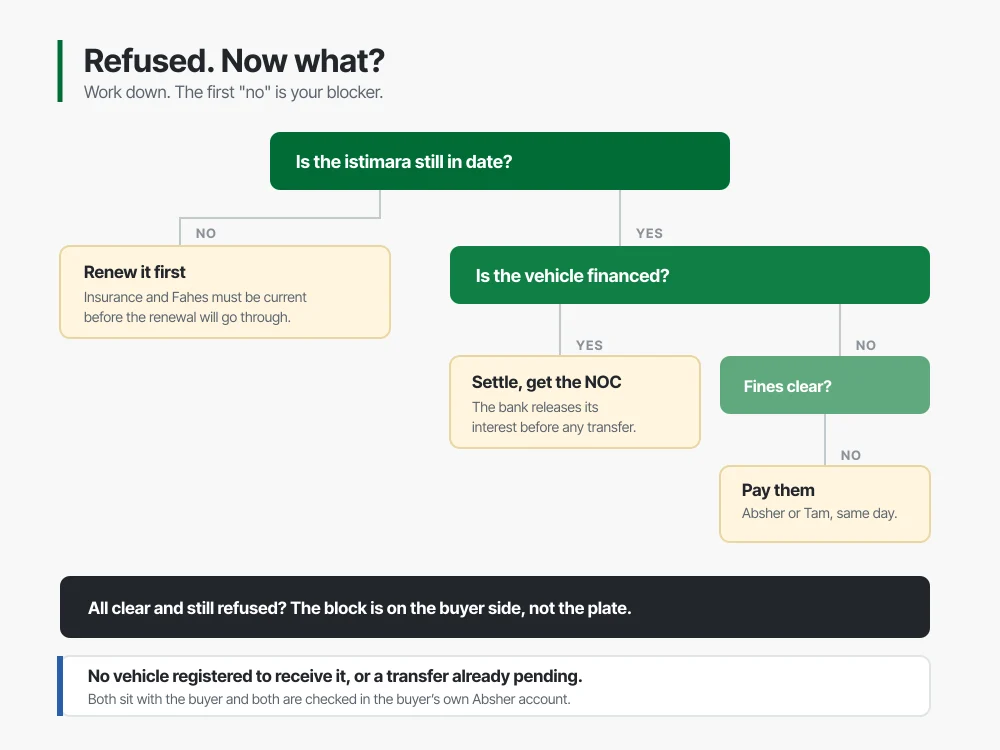
If your transfer has already been refused, start at the istimara expiry date and work down the decision tree above. The first "no" you hit is your blocker, and everything below it is irrelevant until that one is cleared.
If you have not agreed a price yet, run the six pre-flight checks first. They cost nothing, take about five minutes, and catch every blocker on this page while you still have the leverage to walk away.
Listing a plate on KSAplate is free and there is no commission on the sale. List your plate free →
Written by Khalid Al-Rashid, who reviews plate valuation, the ABSHER transfer procedure and market guidance for KSAplate. The transfer fee and the preconditions described here are consistent with the procedure set out across our Absher transfer guide; documented auction results with their sources are published on the market data page.
Last reviewed on 29 August 2026 by the KSAplate editorial team. Transfer rules and fees are set by the General Directorate of Traffic — confirm current requirements on Absher before acting.