
TL;DR:
- Expats can fully own cars in Saudi Arabia. A valid Iqama is the key that unlocks everything — buying, registering, insuring and selling are all done in your own name through Absher.
- Financing is possible but conditional: banks typically want a minimum salary around SAR 3,000–5,000, salary transfer to that bank, a few months with your employer, and a loan that ends comfortably before your contract logic runs out.
- Your Iqama's expiry date silently controls your car. An expired Iqama freezes Absher services — including registration renewal and ownership transfer — so renew it before it blocks everything else.
- The final-exit trap is real: you cannot leave on a final-exit visa with a car still registered to you. Selling takes longer than most people plan — start 4–6 weeks before your exit date, earlier if the car is financed.
- Job changes don't take your car, but they can break your loan conditions and your insurance pricing — tell the bank, keep the salary transfer clean, and keep every renewal current during the transition.
Quick answer: Yes — expats in Saudi Arabia can buy, register and own cars in their own name with a valid Iqama. You need the Iqama, a Saudi driving license to drive (not to own), and cash or bank financing that typically requires salary transfer and a minimum income. The car registers to you through Absher, insurance is mandatory, and before any final exit the car must be sold and transferred out of your name — a process that realistically takes weeks, not days.
Can expats own cars in Saudi Arabia?
Yes — completely, and in your own name. Unlike some Gulf property rules that limit foreign ownership, car ownership in Saudi Arabia is open to any resident with a valid Iqama. The registration (istimara) carries your name, the plates belong to the vehicle you own, and you sell whenever you choose. There is no sponsor signature on the purchase, no employer permission and no special expat license class for ownership.
The one distinction worth understanding early: owning and driving are separate permissions. The Iqama qualifies you to own and register a vehicle; only a Saudi driving license qualifies you to drive it. Plenty of expats legally buy a car for a spouse to drive, or buy before their own license conversion is finished — the paperwork allows it, as long as whoever drives holds a valid license.
What actually limits expats in practice is not law but time: everything about your car is tied to the validity of your Iqama, and the end of your residency creates the one deadline that cannot be negotiated. That deadline shapes several decisions in this guide, so we treat it as a first-class topic rather than a footnote — see the final-exit section.
The paperwork stack, explained
Four documents run the entire ownership lifecycle. Get them in order once and every later step becomes routine.
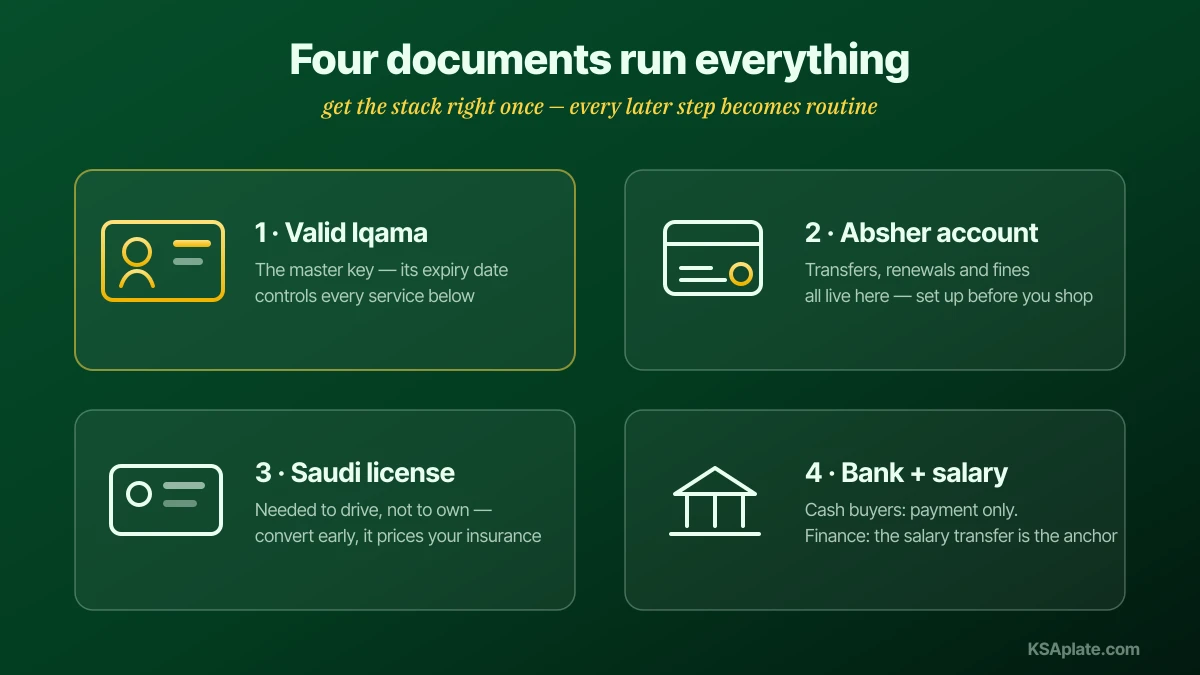
- Valid Iqama. The master key. Buying, registering, insuring, renewing and selling all authenticate against it. Its expiry date matters more than any other date in this guide.
- Absher account. Saudi Arabia's government portal is where vehicle ownership actually lives: transfers happen there, registration renewals happen there, traffic fines appear there. Set it up before you shop, not after.
- Saudi driving license — to drive, not to own. Depending on your nationality your home license may convert directly; otherwise you attend driving school. Details in the license section.
- Bank account with salary transfer. Cash buyers need it only for payment; finance buyers need the salary relationship, because Saudi car loans are built around salary-transfer commitments.
That is the whole stack. No attestation chains, no sponsor letters for the purchase itself — the system is more digital and less bureaucratic than most newcomers expect, provided every document is current.
Where and how expats actually buy
The buying channels are the same ones citizens use, and your Iqama is accepted everywhere: new-car dealerships, used-car showrooms, and the private market. The trade-offs differ, and for expats one factor deserves extra weight — resale discipline, because your ownership has a built-in end date even if you don't know it yet.
- New from a dealer buys warranty peace and financing convenience, and loses the famous first-years depreciation. If your time horizon in the Kingdom is short or uncertain, that depreciation lands on you at exit time.
- Used from a showroom trades a margin for convenience and sometimes limited warranties; quality varies enormously between houses.
- Used from a private seller is where the value sits, and the risk. The full inspection-and-transfer discipline is covered in our used-car buying guide; the short version is: verify the seller against the registration, inspect in daylight, and never pay before the Absher transfer is real.
Whichever channel you choose, anchor the price before you negotiate: browse current used-car listings across Saudi Arabia to see real asking prices for your target model, and run the exact car through the free market-value calculator so you know what the number should be rather than what the seller says it is.
What's your car worth?
Get a free instant estimate based on real Saudi market data — then sell it on KSAplate with direct WhatsApp contact.
Value My Car — FreeCar loans on an Iqama
Expats can finance cars in Saudi Arabia — the products are Sharia-structured (murabaha: the bank buys the car and resells it to you at a fixed profit), and every major bank offers them to residents. But approval logic for expats has its own shape, and knowing it before you visit a showroom saves wasted applications.
What banks typically look for:
- Minimum salary — commonly in the SAR 3,000–5,000 range depending on the bank and whether your employer is on the bank's approved list.
- Salary transfer to the financing bank, or an existing salary relationship. This is the anchor of the whole product.
- Employment seasoning — usually a few months with your current employer; probation periods often don't count.
- Debt burden ratio — total monthly obligations, including the new installment, generally capped around a third to 45% of salary under responsible-lending rules.
- Tenor that respects your residency logic — loans commonly run 12–60 months, and lenders prefer structures that end within your realistic employment horizon.
| Factor | Cash purchase | Bank financing |
|---|---|---|
| Total cost | Price only | Price + fixed profit margin over the tenor |
| Ownership paper | Clean from day one | Bank lien until final installment + clearance |
| Exit flexibility | Sell any day | Early settlement + bank release first — add 1–3 weeks |
| Requirements | Iqama + funds | Salary transfer, minimum income, seasoning |
| Best for | Short/uncertain horizons | Stable multi-year contracts |
The exit column is the one expats underestimate. A financed car cannot transfer to a buyer until the bank issues clearance, and that sequence — settle, release, then sell — has its own guide: selling a financed car in Saudi Arabia. If your remaining time in the Kingdom is uncertain, weigh that friction honestly against the convenience of installments, and read the broader car finance guide before signing anything.
Insurance as an expat
Insurance is mandatory and fully available to expats — the policy prices on the car and on you, not on your passport. What actually moves your premium:
- License age. A freshly converted Saudi license reads as a new driver to many insurers even after fifteen years abroad. Some accept foreign driving history if documented — asking costs nothing and can cut the quote meaningfully.
- Claims record in the Kingdom. Clean years earn no-claims discounts that follow you between insurers.
- Car profile. Value, repair-part costs and theft statistics of the model.
- Coverage level. Third-party is the legal floor and is what the registration system checks; comprehensive is priced on the car's value and is usually mandatory anyway while a bank lien exists.
Practical sequencing: insurance must exist in your name before ownership transfer completes, so get quotes while you negotiate the car rather than after — the full market breakdown is in the Saudi car insurance guide.
Registration and the istimara
The istimara is the vehicle registration card, and for an expat it lives in a chain of dependencies worth seeing clearly:
Iqama → Absher → insurance → inspection → istimara.
Each link requires the previous one to be valid. The transfer of ownership into your name happens digitally through Absher (the walkthrough is in our ownership transfer guide); renewals then repeat on a cycle — insurance in force, periodic technical inspection passed for older cars, fees paid, istimara renewed. The renewal steps and costs are covered in the istimara renewal guide.
The expat-specific warning sits at the first link: if the Iqama lapses, the chain freezes. You cannot renew a registration, transfer a car in, or transfer one out with an expired residency. People discover this at the worst moments — mid-sale, or mid-exit. Calendar your Iqama expiry with the same seriousness as your passport.
Driving licenses: foreign, converted, new
Three paths put an expat legally behind the wheel:
- Short-term visitors drive on an international driving permit with their home license — but that is a visitor arrangement, not a resident one.
- Conversion. Holders of licenses from many countries can convert to a Saudi license with an eye test and paperwork rather than a full course. Whether you qualify depends on the issuing country.
- Driving school. Everyone else attends an accredited school, passes the assessments, and receives the Saudi license.
Two details matter more than expats expect. First, once you are a resident, authorities expect a Saudi license — do not stretch the visitor arrangement into residency. Second, the license's age affects your insurance pricing (see above), so convert early rather than someday. The complete process, costs and school comparison live in the Saudi driving license guide.
The real running costs
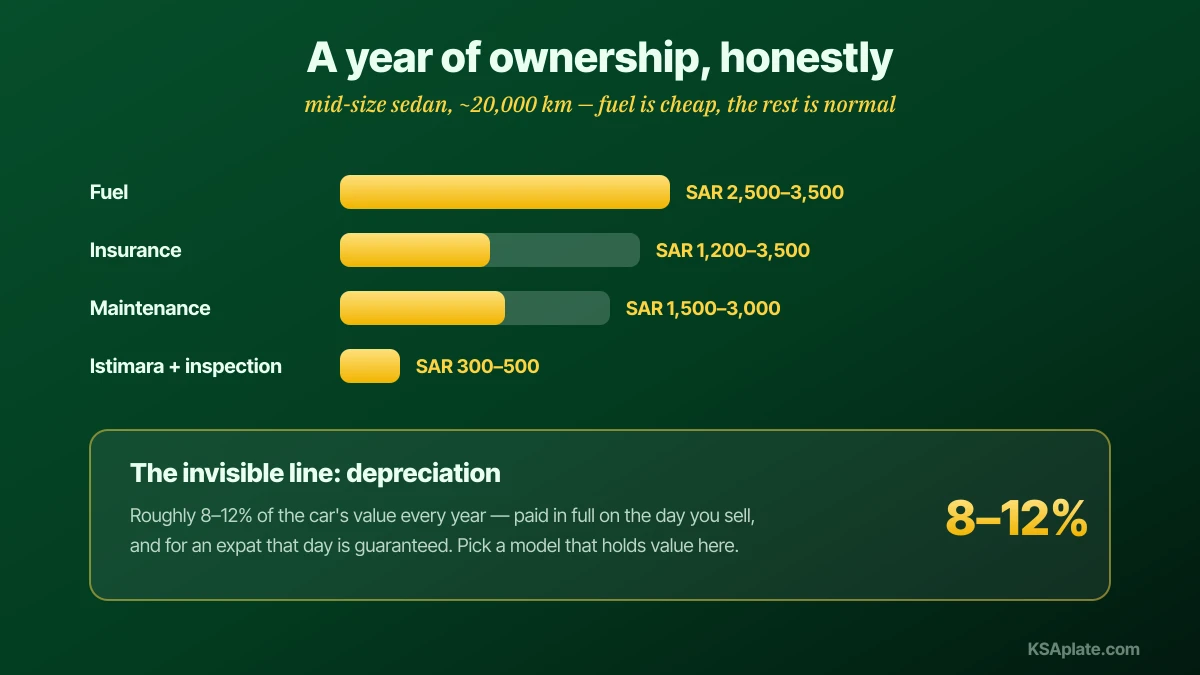
Fuel is famously affordable in the Kingdom; the rest of the budget behaves like anywhere else, and pretending otherwise is how first-year expats end up surprised. A realistic annual picture for a mid-size sedan driven ~20,000 km:
| Cost line | Typical annual range | Notes for expats |
|---|---|---|
| Fuel (~20,000 km) | SAR 2,500–3,500 | The famous bargain of Saudi motoring |
| Insurance | SAR 1,200–3,500 | License age moves this more than anything |
| Scheduled maintenance | SAR 1,500–3,000 | Heat is brutal on batteries, tires, AC |
| Istimara renewal + inspection | SAR 300–500 | Older cars need the periodic inspection |
| Depreciation (the honest line) | ~8–12% of car value | Realized in full on your exit sale |
The last line is the one to internalize: depreciation is invisible until the day you sell, and for an expat that day is guaranteed to come. Choosing a model that holds value in the Saudi market is the single biggest running-cost decision you make — and it is made on purchase day, not later.
Job changes, sponsor changes, Iqama expiry
Your car is registered to you, not to your employer — changing jobs does not touch the ownership. But three second-order effects deserve attention:
- The loan's salary anchor. If your financing lives at the bank receiving your salary and the new employer pays elsewhere, you have broken a loan condition. Talk to the bank before the switch, not after the first missed sweep — restructuring is routine when it is proactive.
- Iqama continuity through the transfer. Sponsor transfers usually keep the Iqama valid, but timing gaps happen. Remember the dependency chain from the registration section: an Iqama gap freezes every vehicle service exactly when life is already complicated.
- Insurance and address reality. Moving cities with a new job changes your risk profile and sometimes your premium; keeping the policy accurate keeps claims clean.
The overall rule: employment events don't threaten the car, they threaten the infrastructure around it. Keep the Iqama, the salary path and the policy aligned during transitions and nothing else changes.
Selling before final exit
This is the section to read twice, because the final-exit rule is absolute: a final-exit visa and a car still registered in your name do not coexist. Vehicles, fines and obligations must be cleared for the exit to process cleanly — and clearing a vehicle means a completed sale and Absher transfer, not a handshake and a promise.
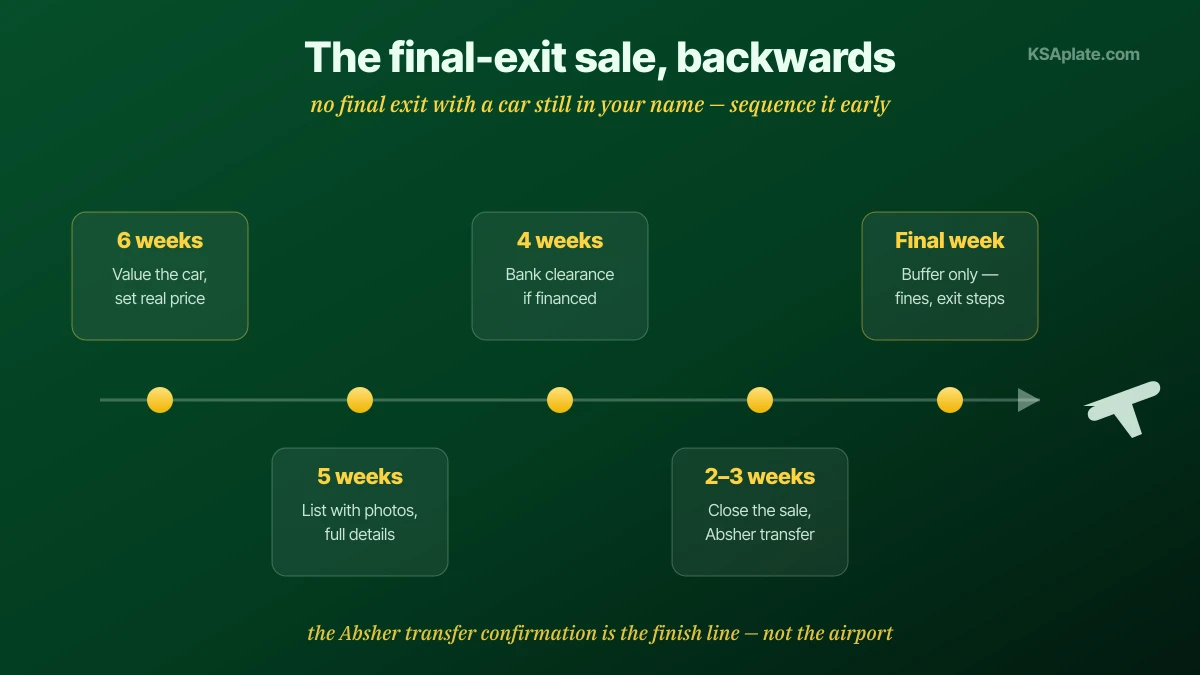
Work backwards from your flight:
- 6 weeks out — price it honestly. Run the exact model, year and mileage through the valuation tool. Note the quick-sale floor as well as the private range: your deadline decides which number is realistic.
- 5 weeks out — list it properly. Photos in daylight, complete specs, honest condition, asking price near the top of the range with your real target underneath. List it for free and buyers contact you directly on WhatsApp.
- 4 weeks out — start bank clearance if financed. Settlement plus lien release takes 1–3 weeks on its own; running it parallel to the sale saves the timeline. The sequence is detailed in the financed-car guide.
- 2–3 weeks out — close and transfer. Payment confirmed, then the Absher transfer, then confirm the vehicle no longer appears under your identity. That confirmation — not the buyer's word — is your finish line.
- Final week — buffer, not business. Fines cleared, insurance handled, exit processing. If the car is still yours at this point, the discount to sell it becomes brutal; sequence so it never happens.
If time collapses anyway, the fallback ladder is: quick-sale services (fast, roughly 15–20% below private value), then a trusted power-of-attorney arrangement to sell after departure — a legal construction that works but adds cost, trust risk and delay. Both are worse than starting two weeks earlier; almost every exit-sale horror story is a timeline story.
FAQ
What do I need to buy a car in Saudi Arabia as an expat?
Can I buy a car in instalments in Saudi Arabia as an expat?
Can an expat buy a car in Saudi Arabia without a Saudi driving license?
What salary do I need to finance a car as an expat?
Can I buy a car in cash as an expat?
Does my employer or sponsor need to approve my car purchase?
What happens to my car loan if I change jobs?
Can I drive in Saudi Arabia with my home-country license?
What happens if my Iqama expires while I own a car?
Can I leave Saudi Arabia on final exit while still owning a car?
Should an expat buy new or used?
How do I know a fair price when buying or selling as an expat?
Can I sell my car after leaving Saudi Arabia?
Conclusion
Car ownership as an expat in Saudi Arabia is refreshingly open: the Iqama unlocks it, Absher digitizes it, and nothing about buying, financing or insuring treats you as a second-class owner. The genuinely expat-specific skill is calendar discipline — keeping the Iqama, license, insurance and registration chain unbroken through job changes, and respecting the one immovable deadline at the end of your residency.
Buy with resale in mind, finance only with your realistic horizon in view, and when the exit approaches, start earlier than feels necessary: value the car on the calculator, list it for free while you still have negotiating time, and let the Absher transfer confirmation — not the airport — be the moment you stop owning a car in the Kingdom.