
Last updated: 7 August 2026
A company license plate is a vehicle plate registered in the name of an establishment or company that holds a valid Commercial Registration (CR / السجل التجاري), rather than in an individual's name. In Saudi Arabia a company with a CR can own vehicles and register plates — including a distinctive premium plate (لوحة مميزة) — through Absher Business (أبشر أعمال) and the Ministry of Interior traffic department (Muroor), using its authorized signatory. The number is owned by the legal entity, not by any one manager, which changes who signs, how VAT is treated, and how the plate is later transferred or sold. Getting that ownership layer right is what separates a clean company asset from a paperwork headache later.
A distinctive number on an executive car or a fleet vehicle is a business asset, not a personal indulgence — it sits on the company's books, moves with the company, and can be sold by the company.
- Yes, a company can own a license plate. An establishment or company with a valid Commercial Registration can own vehicles and register plates in the company's name through Absher Business and Muroor.
- A company can hold a distinctive (premium) plate. Distinctive numbers are open to companies as well as individuals, acquired at the government auction, on the private marketplace, or by transfer.
- You need a CR and an authorized signatory. The person acting for the company must be authorized to sign on the CR, with an Absher Business account linked to the entity.
- VAT is 15% and applies to the purchase. A VAT-registered company should treat inputs per ZATCA rules — confirm expense and input-VAT treatment with your accountant; do not assume automatic reclaim.
- The number is a company asset. It can be transferred to or from an individual, fitted to fleet or executive cars, and later sold in the company's name — list distinctive numbers on KSAplate for free.
Quick answer: Can a company own a license plate in Saudi Arabia, and how? Yes. Any establishment or company with a valid Commercial Registration can own vehicles and register plates in its own name, and that includes a distinctive premium number. The company acts through an authorized signatory using an Absher Business account linked to the Ministry of Interior traffic services. The plate is acquired at the government distinctive-plate auction, bought on the private marketplace, or transferred in — then registered against the entity's CR and fitted to a company vehicle.
What is a company license plate?
A company license plate is a vehicle plate whose registered owner is a legal entity — an establishment (مؤسسة) or company (شركة) holding a Commercial Registration — rather than a natural person. The plate and the vehicle it sits on belong to the business, are recorded against its CR in the Ministry of Interior traffic system, and are managed through the company's Absher Business account instead of a personal Absher profile.
The practical effect is that ownership, liability and value all attach to the company, not to the individual who happens to drive the car. A company plate is registered, insured, taxed and eventually sold as a business asset, which is exactly why the paperwork differs from a private plate — the signatory must be authorized on the CR, and the transaction flows through the business, not personal, channel.
This matters most for two groups: businesses running a fleet of vehicles that need to be owned centrally, and companies that want a distinctive number on an executive car for prestige and recognition. Both are ordinary, legitimate uses. For the full grounding on how Saudi plates are structured and priced, start with the complete guide to Saudi license plates.
Can a company own a distinctive plate?
Yes — a company can own a distinctive plate in Saudi Arabia exactly as an individual can. The distinctive-plate framework (لوحة مميزة) does not restrict premium numbers to natural persons; an establishment or company with a valid CR can hold a distinctive number in the entity's name, acquire it at the government auction, and register it against a company vehicle.
A distinctive plate owned by a company is a business asset that can appear on an executive car, be moved between qualifying company vehicles, and be sold later in the company's name. Nothing about the "premium" status changes the ownership rule — the number belongs to whoever it is registered to, and that can be a legal entity.
The distinctive-plate auction and the private marketplace are both open to companies. A CR-holding entity bids, buys and holds a premium number the same way an individual does — only the account and the signatory differ.
Because the number, not the metal, is the asset, a distinctive plate held by a company behaves like any other appreciating holding — a point explored in depth in Saudi license plates as an investment. The company simply owns it the way it owns any other titled asset.
Eligibility and documents
Eligibility for company plate ownership rests on one core requirement: a valid Commercial Registration acting through an authorized signatory. If the entity has a current CR and the person transacting is authorized to sign on that CR, the company can own vehicles and register plates; if either is missing or expired, the transaction cannot proceed in the company's name.
The essential ingredients are consistent across most establishment and company types, though the exact document list and current steps should always be confirmed on Absher because requirements are updated over time.
What a company typically needs
- Valid Commercial Registration (CR). Current and not expired, identifying the entity that will own the plate and vehicle.
- Authorized signatory. A person named or empowered to act for the company — an owner, partner, or a delegate holding a valid authorization — able to sign on the CR.
- Absher Business account (أبشر أعمال). The business channel linked to the entity, through which vehicle and plate services are performed.
- National ID / Iqama of the signatory. A valid identity for the individual acting on the company's behalf.
- ZATCA / VAT registration where applicable. A VAT-registered company will need its VAT details for correct tax treatment of the purchase.
- Vehicle and insurance records for the car the plate will be fitted to, held in the company's name.
| Requirement | Applies to a company plate? | Notes |
|---|---|---|
| Valid Commercial Registration | Yes — mandatory | Must be current; identifies the owning entity |
| Authorized signatory | Yes — mandatory | Owner, partner or delegate authorized on the CR |
| Absher Business account | Yes | Business channel, not a personal Absher profile |
| Can hold a distinctive (premium) plate | Yes | Same framework as individuals |
| VAT (15%) on purchase | Yes | ZATCA rules; confirm input treatment with your accountant |
| Expat-owned company qualifies | Yes, via the CR | Ownership sits with the entity, subject to CR validity |
What's your plate worth?
Get an instant, free estimate with our plate value calculator.
Calculate My Plate's ValueIndividual vs company plate ownership
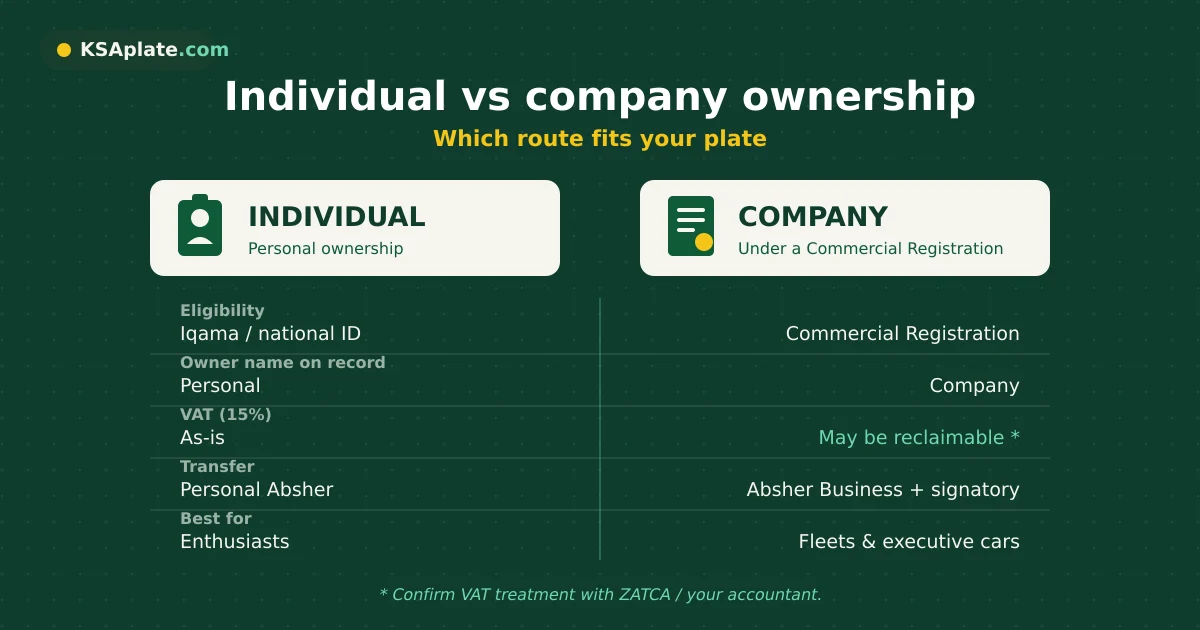
Individual and company plate ownership differ mainly in who the legal owner is and which account and documents the transaction uses. An individual plate is owned by a person via a personal Absher profile and national ID; a company plate is owned by a legal entity via Absher Business, its CR and an authorized signatory. The number itself, and its value, behave identically — only the ownership wrapper changes.
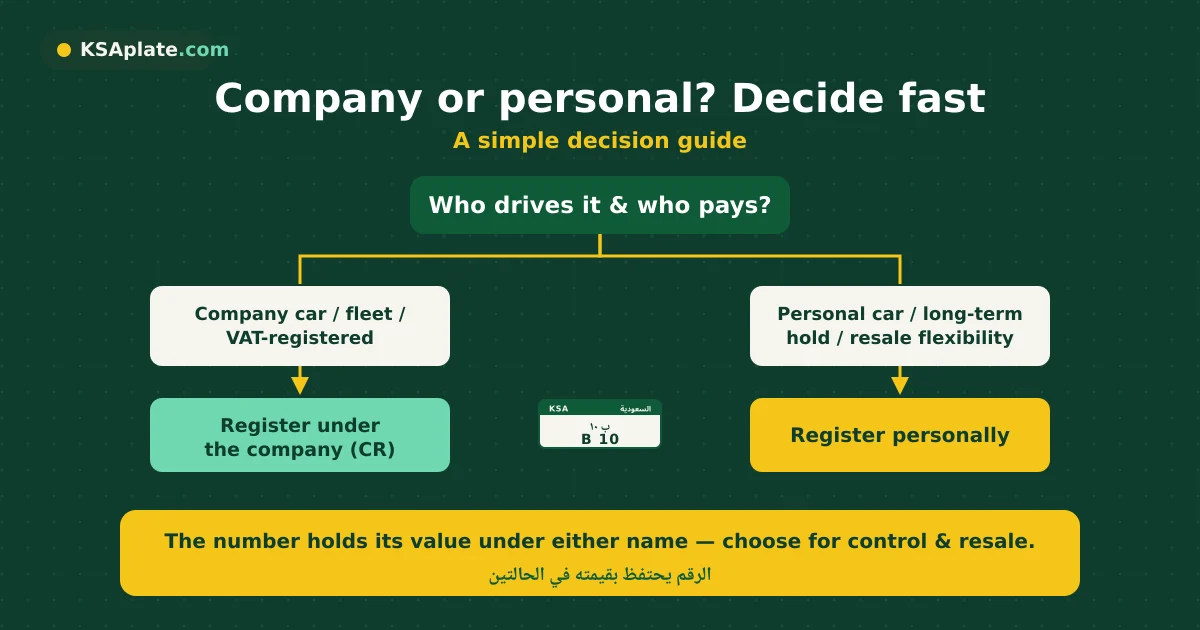
Choosing between them is a business decision, not a rules question: register in the company's name when the vehicle and its plate belong on the business books — a fleet car, an executive vehicle bought by the company, or a number you want the entity to own and later sell. Register personally when the car and plate are genuinely private.
| Factor | Individual ownership | Company ownership |
|---|---|---|
| Legal owner | A natural person | An establishment or company (the CR entity) |
| Eligibility | Valid national ID / Iqama | Valid Commercial Registration + authorized signatory |
| Account used | Personal Absher | Absher Business (أبشر أعمال) |
| Key documents | ID, vehicle and insurance records | CR, signatory ID/authorization, VAT details, vehicle records |
| Distinctive plate | Yes | Yes |
| VAT treatment | 15% paid; personal, no input recovery | 15% paid; VAT-registered entity applies ZATCA input rules |
| Transfer | Person to person via Absher/Muroor | To/from the entity via Absher Business, signatory required |
| Resale | Sold by the individual | Sold by the company in its own name |
| Best for | Private cars, personal prestige | Fleets, executive cars, business-owned assets |
How a company acquires a distinctive plate
A company acquires a distinctive plate through one of three routes: the government distinctive-plate auction, the private marketplace, or a transfer of an existing plate into the company. Each ends the same way — the number registered against the entity's CR — but they differ in how you find the number, what you pay, and how quickly it completes.
The auction is the primary market run by the authorities, where new and released distinctive numbers are offered and companies can bid alongside individuals — the mechanics are laid out in how Saudi government plate auctions work. The private marketplace is the secondary market, where a specific number already owned by someone can be bought directly. A transfer moves a plate you or an owner already hold into the company.
| Route | What it is | Best when |
|---|---|---|
| Government auction | Official bidding for new/released distinctive numbers | You want a fresh number and will compete on price |
| Private marketplace | Buying a specific existing number from its owner | You want a particular sequence, now, at an agreed price |
| Transfer in | Moving an existing plate into the company's name | An owner or director already holds the number |
For a specific number — a repeating sequence, a low digit, or a letter set that matches the brand — the private marketplace is usually faster than waiting for the right plate to surface at auction.
Whichever route you choose, verify the number's status before money changes hands, exactly as you would for a personal purchase — the checks are the same and are covered in how to verify a Saudi license plate before buying.
Registering a plate under your company via Absher Business
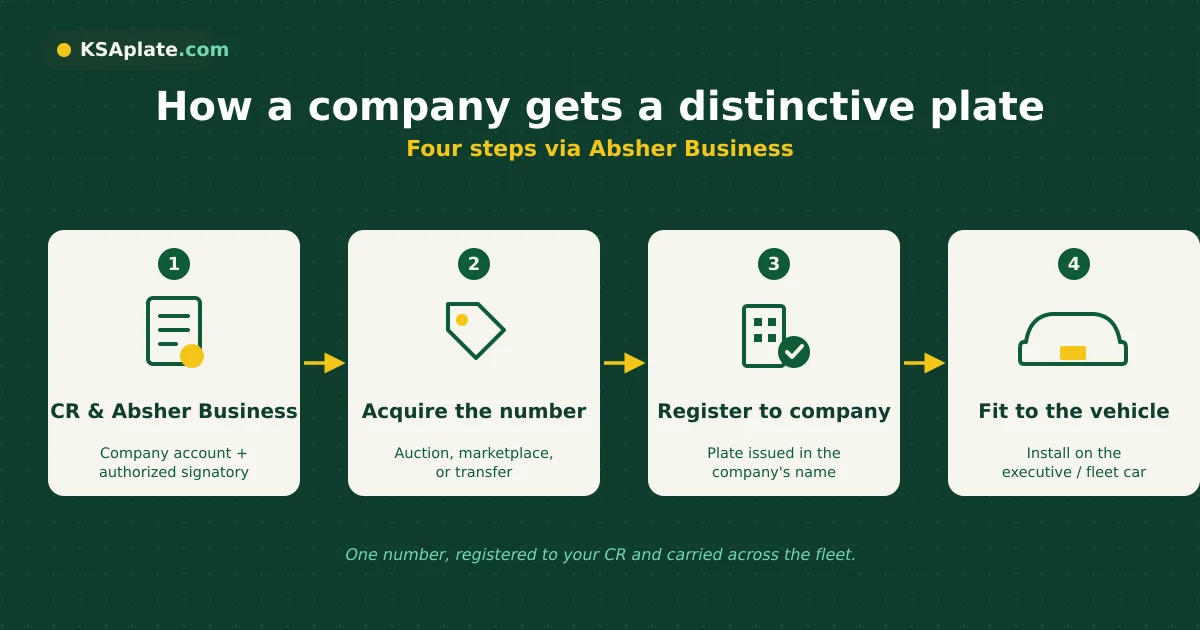
Registering a plate under a company is the process of recording a distinctive or standard number against the entity's Commercial Registration through Absher Business and the Muroor traffic services. The signatory acts for the company, the plate is tied to a company-owned vehicle, and the record shows the entity — not an individual — as owner.
The steps below are the general shape of the process; treat them as a map, not a fixed script, and confirm each current requirement on Absher, since the authorities update fields and fees over time.
- Confirm the CR and signatory. Make sure the Commercial Registration is valid and that the person transacting is authorized to sign on it.
- Access Absher Business (أبشر أعمال). Log in to the business account linked to the entity and open the vehicle and traffic services section.
- Acquire the number. Win it at the distinctive-plate auction, buy it on the marketplace, or start a transfer of an existing plate into the company.
- Match it to a company vehicle. Select the company-owned car the plate will be registered to; the vehicle must be in the entity's name.
- Complete ownership and fees. Settle the applicable government fees and 15% VAT through the business channel, keeping the ZATCA-compliant tax invoice.
- Register and issue the plate. Finalise the registration so the record shows the company as owner, then have the physical plate manufactured and fitted.
- Keep the digital record. Retain the updated istimara (vehicle registration) and the tax invoice in the company's files for accounting and any future transfer.
Verify the current documents, fields and fees on Absher before you start. The framework is stable, but exact requirements change, and the business channel occasionally differs from the personal one.
Fitting plates to fleet and executive vehicles
Fitting a company plate to a vehicle means registering the entity-owned number to a car that is itself owned by the company and used for business — a fleet vehicle or an executive car. The plate follows the entity's ownership, so both the car and the plate must sit under the same CR for the registration to be clean.
For a fleet, central company ownership keeps registration, insurance and resale organised under one entity, and a distinctive series can even reinforce a brand across vehicles. For an executive car, a single premium number does the branding work while the company retains the asset. If you change the executive's car but want to keep the number, the plate can move with the company — the mechanics of keeping a number across a vehicle change are explained in how to keep your plate on a new car in Saudi Arabia.
Because the vehicle itself is a company asset, its own ownership transfers follow the standard process too — useful background when you buy or sell the car under the plate, set out in how to transfer car ownership in Saudi Arabia.
VAT and expense treatment
VAT in Saudi Arabia is a 15% value-added tax administered by ZATCA (the Zakat, Tax and Customs Authority), and it applies to plate and vehicle purchases. A company buying a distinctive plate pays the 15% like any other buyer; what differs for a business is that a VAT-registered entity may be able to treat the input under ZATCA's rules, subject to the usual conditions.
The honest, safe position is that input-VAT recovery and expense deductibility are not automatic and depend on your VAT registration, the business use of the asset, and ZATCA's current rules. Treat the plate as a company purchase with a proper tax invoice, and confirm the exact treatment with your accountant rather than assuming a reclaim.
A distinctive plate bought by a company is a taxable purchase at 15% VAT. Whether any of that input VAT is recoverable, and how the cost is expensed or capitalised, is a ZATCA question for your accountant — do not assume automatic reclaim.
Keep the ZATCA-compliant tax invoice in the company's name for every plate and vehicle transaction; it is the document that makes any input treatment or expense claim possible. For the wider picture of Saudi plate fees, taxes and VAT, see Saudi license plate fees, taxes and VAT in 2026, and confirm rates and rules directly with ZATCA at zatca.gov.sa.
Transferring a plate between an individual and the company
Transferring a plate between an individual and a company is the process of changing the registered owner from a person to the entity, or the reverse, through Absher and Muroor with the CR and an authorized signatory. It is a legitimate, common move — for example, a founder moving a plate they bought personally onto the company, or a company releasing a number to an individual.
A transfer into the company requires the entity's CR and a signatory authorized to accept the plate on its behalf; a transfer out of the company requires the same authorization to release it. In both directions the transaction runs through the business channel and results in a new ownership record. Where a precise current step or fee is uncertain, verify it on Absher.
Moving a plate from your personal name to your company is straightforward in principle — but it must be done through Absher with the CR and an authorized signatory, so the record cleanly shows the entity as the new owner.
The direction that trips people up is resale: if you intend the company to sell the number, make sure it is actually owned by the company first. Selling a plate that is still registered to an individual, while treating the proceeds as the company's, creates a mismatch you want to avoid — settle ownership before you list.
The executive-branding value of a premium plate
The executive-branding value of a premium plate is the recognition and prestige a distinctive number gives a company car in a market where plates are a visible status signal. In Saudi Arabia, a short, low, repeating or meaningful number on an executive vehicle communicates standing instantly, the way a memorable phone number or a prime address does.
For a business, that signal is an asset with two returns: the intangible prestige it lends the executive fleet, and the tangible resale value the number retains or grows. A distinctive plate on the chairman's car is both a branding choice and a holding on the balance sheet — which is what makes it different from an ordinary expense.
Numbers carry cultural weight too, and the sequences buyers chase — lucky digits, repeating patterns — are worth understanding before you choose one, as set out in Saudi plate numerology and lucky numbers. For a company, picking a number that aligns with the brand can turn a plate into a quiet, permanent piece of marketing.
Selling a company-owned plate
Selling a company-owned plate is the process of transferring a distinctive number out of the entity to a buyer, with the sale made and recorded in the company's name. Because the company is the legal owner, the authorized signatory conducts the sale, the transfer runs through Absher Business, and the proceeds and any VAT belong to the entity.
The steps mirror any plate sale — agree a price, verify the number is clean, transfer ownership through the official channel — but the signatory and the company account replace the personal ones. A company can realise the value of a number it no longer needs exactly as an individual can, and the resale market for distinctive plates is active.
To reach buyers, list the number where plate demand actually concentrates rather than on a general classifieds site; the options and mechanics are compared in where to sell a Saudi license plate. On KSAplate a company can list a distinctive number for free with no commission, keeping the full sale value with the entity.
Pitfalls to avoid
The main pitfalls with company plates are authorization gaps, ownership mismatches at resale, and VAT assumptions — each avoidable with a little care up front. Most problems trace back to acting for the company without the right authorization, or blurring the line between what the individual owns and what the entity owns.
The common mistakes
- Acting without authorization. If the person transacting is not authorized on the CR, the registration or transfer can stall. Confirm signatory rights first.
- Resale ownership mismatch. Selling in the company's name a plate still registered to an individual (or vice versa) creates a records conflict. Settle ownership before listing.
- Assuming automatic VAT reclaim. The 15% VAT is real; recovery is conditional. Confirm treatment with your accountant and keep the ZATCA tax invoice.
- Expired CR. An expired Commercial Registration blocks company vehicle and plate services. Keep it current.
- Skipping verification. Buying a number without checking its status can inherit someone else's problem — verify before you pay.
Almost every company-plate headache comes down to two things: who was authorized to act, and who actually owned the number. Fix both on paper before you transact, and the rest is routine.
Frequently asked questions
Can a company own a license plate in Saudi Arabia?
Can a company buy a distinctive or VIP plate?
How do I register a plate under my company?
Company vs personal plate ownership — which is better?
Is VAT charged on a company plate?
Can I transfer my personal plate to my company?
Can a company sell its plate?
Do expats' companies qualify?
Does the number lose value when a company owns it?
Can a distinctive plate move between company vehicles?
Put a distinctive number on your company's cars
Give your executive and fleet vehicles a plate that signals standing — and holds value on the company's books. Browse distinctive Saudi numbers, or list a plate your company owns for free with no commission.
List your company's plate Browse distinctive numbersReviewed by Khalid Al-Rashid, Saudi License Plate Market Analyst.
Sources: Absher digital government platform and Absher Business (absher.sa) for vehicle, plate and business e-services; the Ministry of Interior (moi.gov.sa) and its traffic department (Muroor) for registration and plate ownership; and the Zakat, Tax and Customs Authority (zatca.gov.sa) for the 15% VAT and tax-invoice rules. Company plate ownership described qualitatively as of 2026: a valid Commercial Registration and an authorized signatory are the core requirements. Confirm current documents, steps, fees and VAT treatment through official Absher and ZATCA channels and with your accountant, as requirements can change.