Last updated: 11 August 2026
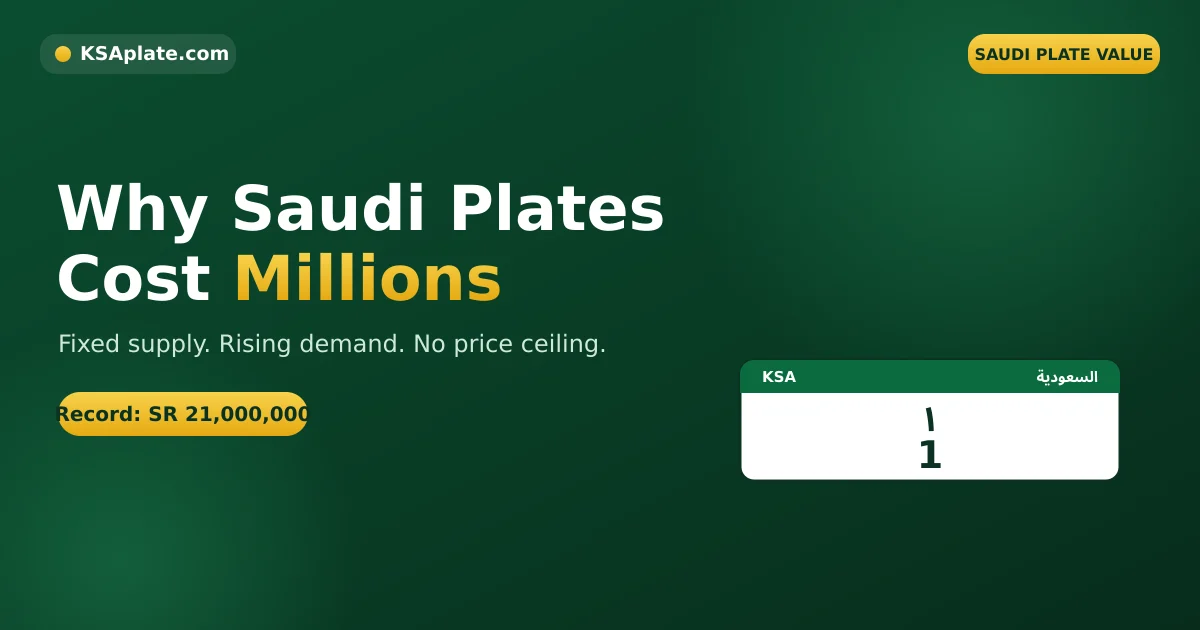
Saudi license plates are expensive because supply is fixed by the government while demand for low, clean, and meaningful numbers keeps rising — so a short number like "1" or "77" behaves less like a car part and more like a scarce luxury asset. A single-digit plate has only nine possible combinations per letter set, and when thousands of buyers chase those nine numbers through open Absher auctions with no price ceiling, the result is figures that reach into the millions of riyals.
A Saudi plate is not priced by what it costs to make. It is priced by how few of them exist, how many people want that exact number, and what that number signals about the person behind the wheel.
TL;DR
- Fixed supply meets rising demand: the General Directorate of Traffic (Moroor) controls how many short plates exist, and it cannot print more "1"s — scarcity is engineered, not accidental.
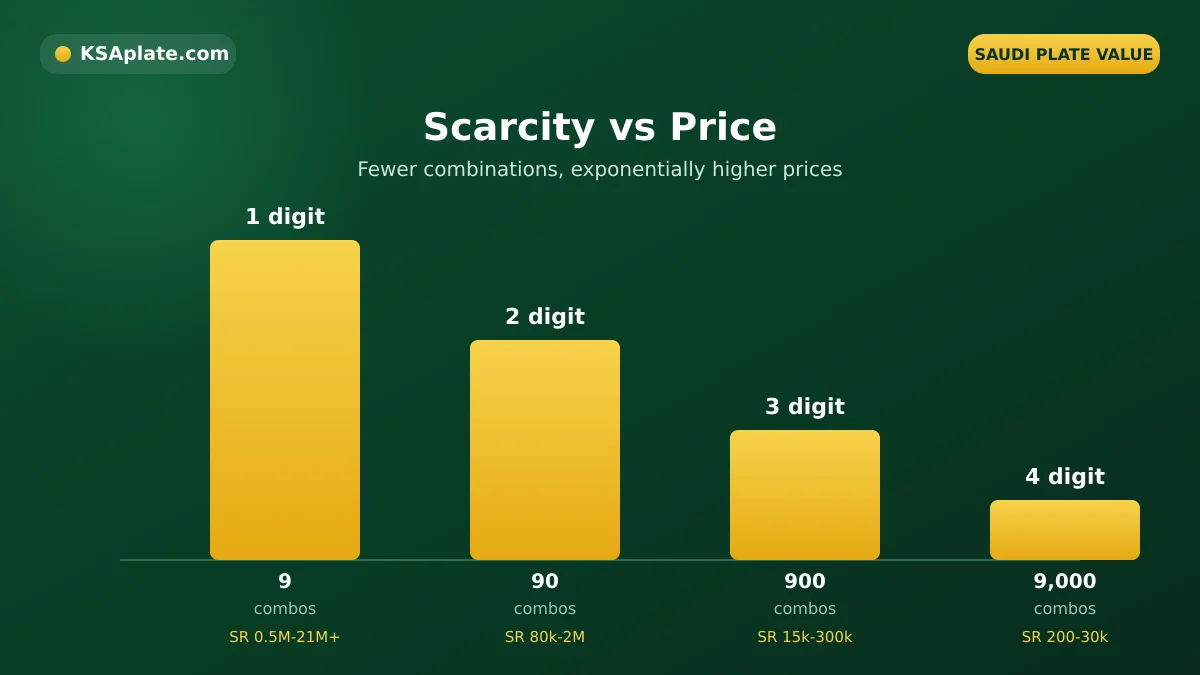
- Fewer digits means exponentially higher prices: there are 9 single-digit combinations, 90 two-digit, and 900 three-digit per letter set — each step down in length multiplies rarity and price.
- Plates are status symbols and heirlooms: a low number signals seniority and prestige in Saudi culture, and families pass prized plates down like property.
- Auctions with no ceiling set the record prices: the plate "1 E" reportedly sold for SR 21 million through a Moroor electronic auction, because competitive bidding, not a fixed tag, decides the final number.
- Your plate may be worth more than you think: pattern, letter quality, and digit count each add value — a free plate value calculator estimates yours in seconds.
The short answer, in one paragraph
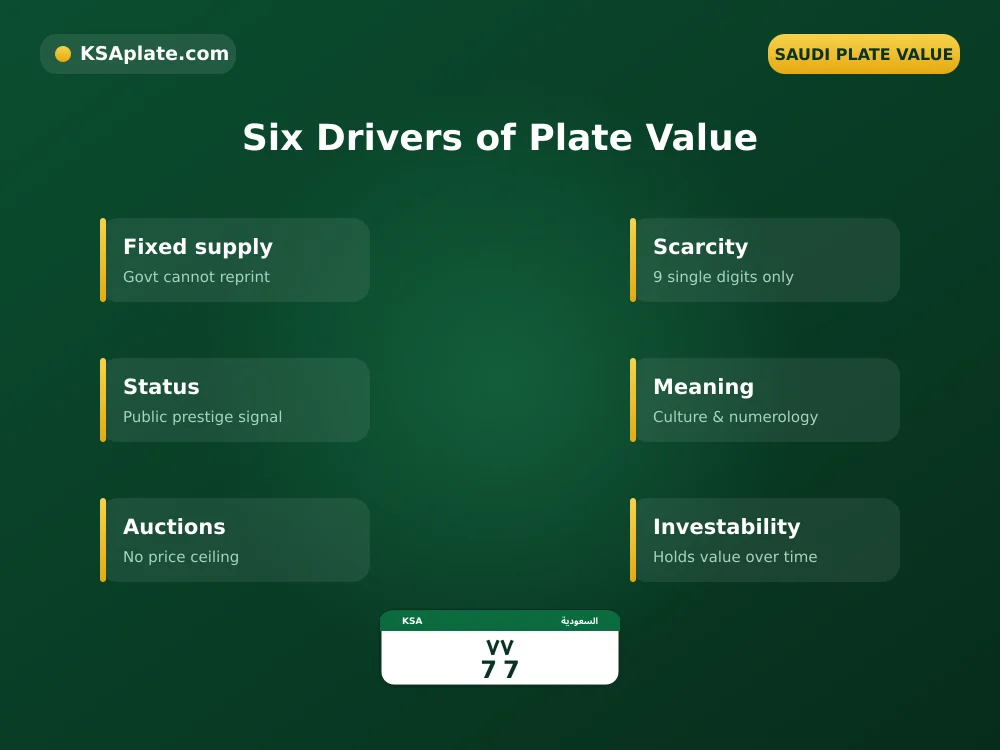
Saudi license plate prices are driven by six forces working together: government-fixed supply, extreme scarcity of short numbers, cultural status, numerological meaning, open competitive auctions, and a growing view of plates as investable assets. Remove any one and prices would soften. Together, they turn a strip of aluminium into one of the few luxury goods in the Kingdom that can appreciate over decades. The core mechanism is simple: the state cannot create more "1" plates, but every year more wealthy buyers want one.
Curious what your own number is worth?
Before you read the theory, get a real estimate. Our free calculator scores your plate on digit count, pattern, and letter combination — no signup needed.
Value my plate free List my plate for free
Reason 1: supply is fixed, so scarcity is engineered
Engineered scarcity is the deliberate limiting of supply by an authority to preserve value. In Saudi Arabia, the General Directorate of Traffic issues plates in a fixed format — up to four digits paired with three letters drawn from a set of permitted characters — and the shortest, cleanest numbers can never be reprinted once claimed.
This is the foundation of every high price. A luxury watchmaker can choose to make more watches; Moroor cannot choose to make a second plate numbered "5". When a number is minted and sold, that specific combination is gone from the primary market forever. Anyone who wants it later has to buy it from the owner, which is exactly why a resale market — and platforms like KSAplate — exists at all.
Every other luxury market can expand supply when demand spikes. The Saudi plate market physically cannot. That single fact underwrites the entire price structure.
Key takeaway: plate value starts with a hard supply cap the government sets and the market cannot break. To see how format shapes value, our guide to how to read a Saudi license plate breaks down the letter-and-digit anatomy.
What's your plate worth?
Get an instant, free estimate with our plate value calculator.
Calculate My Plate's ValueReason 2: a low number is a public status symbol
A status symbol is a possession that signals rank, wealth, or seniority to others without a word being spoken. In the Kingdom, a one- or two-digit plate on a luxury car does exactly that: it tells everyone at the traffic light that the owner was early, connected, or willing to outbid the field.
Numbers carry an implied hierarchy. "1" reads as first, foremost, and singular. Repeated numbers such as "111" or "7777" read as deliberate and premium. A messy four-digit number with awkward letters reads as ordinary. Because the plate is visible to thousands of people every day, it works as continuous, public advertising of standing — a rare thing money can buy openly and legally.
For example, two identical Range Rovers can sit side by side: one wears a random four-digit plate worth a few hundred riyals, the other wears "8 8" worth several hundred thousand. The cars are the same. The signal is not.
Key takeaway: in a market where cars are common but short numbers are not, the plate — not the vehicle — becomes the real status object.
Reason 3: cultural meaning multiplies demand
Cultural value is the extra demand a number attracts because of what it means to buyers, beyond pure rarity. Saudi buyers assign strong meaning to certain figures, and meaning stacks on top of scarcity to push prices higher.
Some numbers are prized for religious or cultural resonance, others for personal significance such as a birth year, a phone ending, a tribal association, or a business brand. A plate that is both rare and meaningful attracts two demand pools at once — collectors chasing scarcity and buyers chasing personal connection.
Our deep dive into lucky numbers like 786 and 777 shows how a number with cultural weight can command a premium over an equally rare but "meaningless" combination. This is why two plates with the same digit count can sell for wildly different sums.
Rarity sets the floor. Meaning sets the ceiling. The most expensive plates are the ones that are scarce and significant at the same time.
Key takeaway: a number's meaning is a genuine, priced-in demand driver — not a rounding error.
Reason 4: open auctions with no price ceiling
An open auction is a sale format where price is discovered by competitive bidding rather than set by a seller. The official route for premium new plates is the Absher electronic auction run by Moroor, and its design is a big reason record prices exist.
Here is how the government auction works in practice:
- Announcement: upcoming premium plates are published on the Absher platform, typically one to two weeks ahead.
- Registration: bidders enrol and pay a refundable registration fee (reported around SAR 1,000) to take part.
- Opening bids: bidding starts low — figures from SAR 10,000 are common — with no maximum.
- Competitive bidding: buyers raise each other in real time until one remains; there is no cap, so the price rises to the last bidder's limit.
- Transfer: the winner completes payment and the plate is registered through Absher, and proceeds support the General Directorate of Traffic.
Because there is no ceiling, two determined billionaires can push a single number into the millions. That is precisely what happened with the plate "1 E," reported at SR 21 million. For the full mechanics and how private resale differs, see our Absher auction bidding guide.
Key takeaway: auctions do not just sell plates — they manufacture the headline prices that reset the whole market's expectations.
Reason 5: plates behave like an asset class
An asset class is a group of investments that share similar behaviour and can hold or grow value over time. Increasingly, Saudi buyers treat distinctive plates this way — a store of value that is portable, ownable, and detachable from any single car.
Three features make plates investable. First, they are permanent: a number does not wear out like a vehicle. Second, they are separable — you can sell the plate and keep the car, or keep the plate and sell the car, a point we cover in keeping your plate when you change cars. Third, the best combinations have a track record of holding value because supply can never expand. For a full risk-and-return view, our plate investment guide weighs the upside against liquidity and holding costs.
The comparison that matters: a new car loses value the moment it leaves the showroom, while a scarce plate on that same car can hold or gain value across the years you own it. One depreciates; the other can appreciate.
Key takeaway: the more buyers treat plates as assets rather than accessories, the more the top tier detaches from ordinary pricing.
The Plate Value Pyramid: how the tiers stack
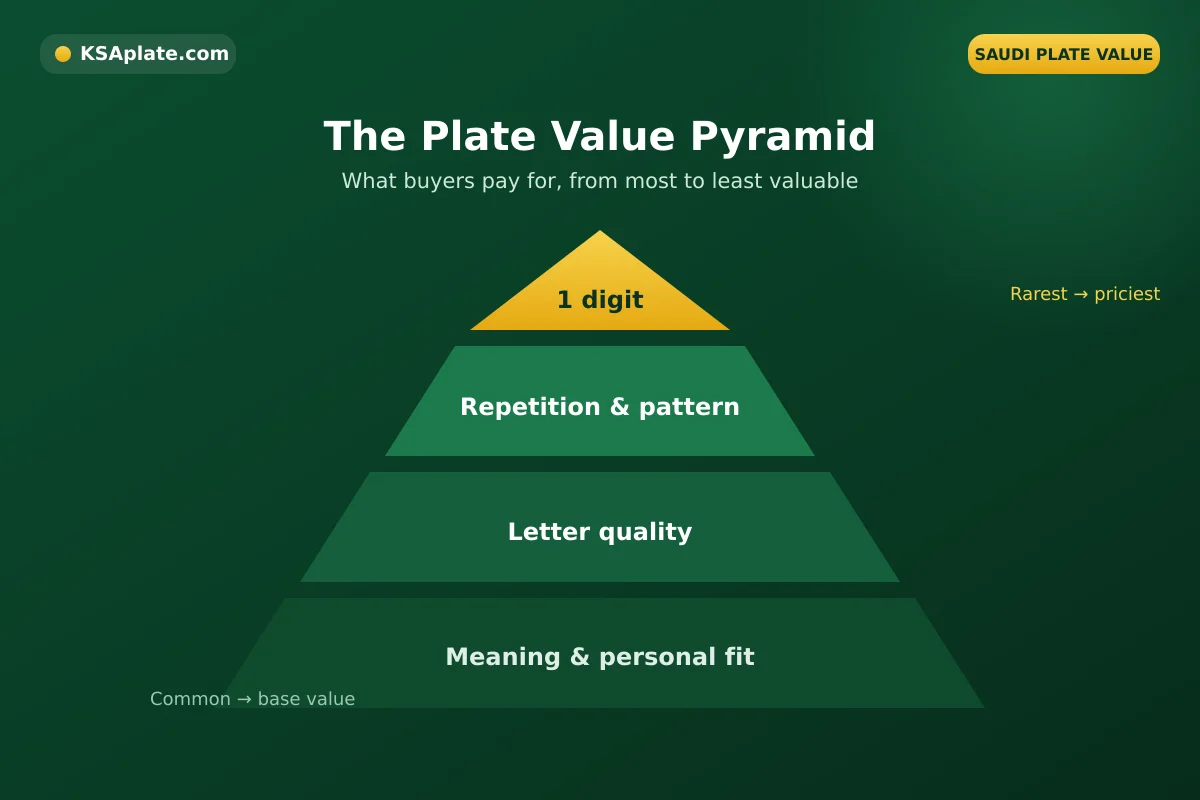
The Plate Value Pyramid is a simple model that ranks plates from most to least valuable by the traits buyers pay for. It exists because "how much is a plate worth" has no single answer — value is built from stacked characteristics, and the pyramid shows the order in which they matter.
From the apex down:
- Digit count — the biggest lever. One digit beats two, two beats three, three beats four.
- Repetition and pattern — identical digits (77, 999), mirror numbers (1221), and sequences (123) command premiums within their length. See repeating plates and mirror plates.
- Letter quality — clean, prestigious, or matching letters add value; awkward combinations subtract it.
- Meaning — cultural or personal significance layered on top of the above.
Two buyers, same budget: one pays for a shorter number, the other for a nicer pattern. The pyramid tells you which choice usually holds value better — length first, pattern second.
Key takeaway: value is not one thing; it is a stack, and digit count sits at the top of that stack. Our plate value calculation guide turns this pyramid into an actual estimate.
Scarcity vs price: the real math
Scarcity math is the relationship between how many of a thing exist and what people will pay for it. For Saudi plates, the relationship is non-linear: prices rise far faster than rarity does, which is why single-digit plates feel disproportionately expensive.
The table below combines the fixed combination counts per letter set with typical market price bands. Combination counts are arithmetic facts; price bands are indicative ranges observed across auction reports and resale listings, not guarantees.
| Plate length | Combinations (per letter set) | Rarity vs 4-digit | Indicative price band |
|---|---|---|---|
| 1 digit | 9 | 1,000× rarer | SR 500,000 – 21,000,000+ |
| 2 digits | 90 | 100× rarer | SR 80,000 – 2,000,000 |
| 3 digits | 900 | 10× rarer | SR 15,000 – 300,000 |
| 4 digits | 9,000 | baseline | SR 200 – 30,000 |
Notice the mismatch. A single-digit plate is only 1,000 times rarer than a four-digit plate, yet the top of its price band is tens of thousands of times higher. That gap is the status and auction premium made visible — scarcity explains the direction, but culture and competitive bidding explain the size. Our single-digit rarity guide and two-digit price guide go deeper on each tier.
Key takeaway: price is not a straight line from rarity — the shortest plates carry a premium far beyond their raw scarcity.
Is an expensive plate actually worth it?
Worth is the balance between what you pay and the mix of status, meaning, and resale potential you receive. Whether a costly plate is "worth it" depends on which of the six drivers matter to you — and on price discipline at the moment of purchase.
For a buyer who values daily status and can afford it, a premium plate delivers something few purchases can: visible, lasting prestige with a real resale market underneath. For a buyer treating it as an investment, the answer hinges on entry price, the quality of the combination, and patience, because the market for seven-figure plates is thin and can take time to clear.
On KSAplate, the pattern we see repeatedly is that clean short numbers and strong repeats attract the most buyer interest, while long numbers with weak letters sit longer regardless of asking price. The lesson for sellers is to price to the pyramid, not to hope.
Thinking of selling a plate you already own?
List it in front of active Saudi buyers for free — no commission on the sale. Price it right using the calculator first, then publish in minutes.
List my plate now Read the selling guideKey takeaway: an expensive plate is worth it when the driver you care about — status, meaning, or investment — is priced sensibly at entry.
How to value your own plate in three steps
Plate valuation is the process of estimating a fair market price from a plate's measurable traits. You can approximate it yourself in three steps before ever talking to a buyer.
- Count and classify: note the digit count first, then flag any pattern — repeat, mirror, or sequence — and judge the letter combination.
- Benchmark against live listings: compare your plate to similar ones currently for sale and recently reported auction results, not to wishful headlines.
- Run the calculator: our free plate value calculator scores digit count, pattern, and letters into an instant estimate you can sanity-check against step two.
For higher-value plates, cross-check with our VIP plate valuation guide, which maps the top tier in detail. Then, if you decide to sell, confirm the transfer path in our Absher plate transfer guide so the handover is clean.
Key takeaway: you do not need an appraiser to get within range — traits plus live benchmarks plus the calculator get you most of the way.
Frequently asked questions
Why is a Saudi license plate worth more than the car it is on?
Which sale best shows why Saudi plates get so expensive?
How does single-digit scarcity drive the price up?
Do Saudi license plates increase in value over time?
Why do auctions produce such high prices?
Can expats own valuable Saudi plates?
Are shorter plates always more expensive than longer ones?
How can I find out what my plate is worth right now?
The bottom line
Saudi license plates are expensive for one connected reason: a government-fixed supply of short, meaningful numbers meets rising demand from buyers who treat those numbers as status and as assets, and open auctions with no ceiling turn that pressure into headline prices. Scarcity points the direction, culture and bidding decide the size. If you own a plate, the practical move is to find out where it sits on the pyramid — then decide whether to hold it or put it in front of buyers.
Turn a number you own into an offer
Value it free in seconds, then list it to active Saudi buyers for free — no commission when it sells.
Value my plate List for freeLast updated: 11 August 2026. Written and reviewed by Khalid Al-Rashid, Saudi License Plate Market Analyst, drawing on KSAplate marketplace data and public Absher auction reports.
Sources: General Directorate of Traffic / Absher (absher.sa), Ministry of Interior (moi.gov.sa), and public auction reporting (Gulf News, Arab News). Prices are indicative; confirm any specific plate's status and value in Absher before buying or selling.