Last updated: September 5, 2026 · 14 min read
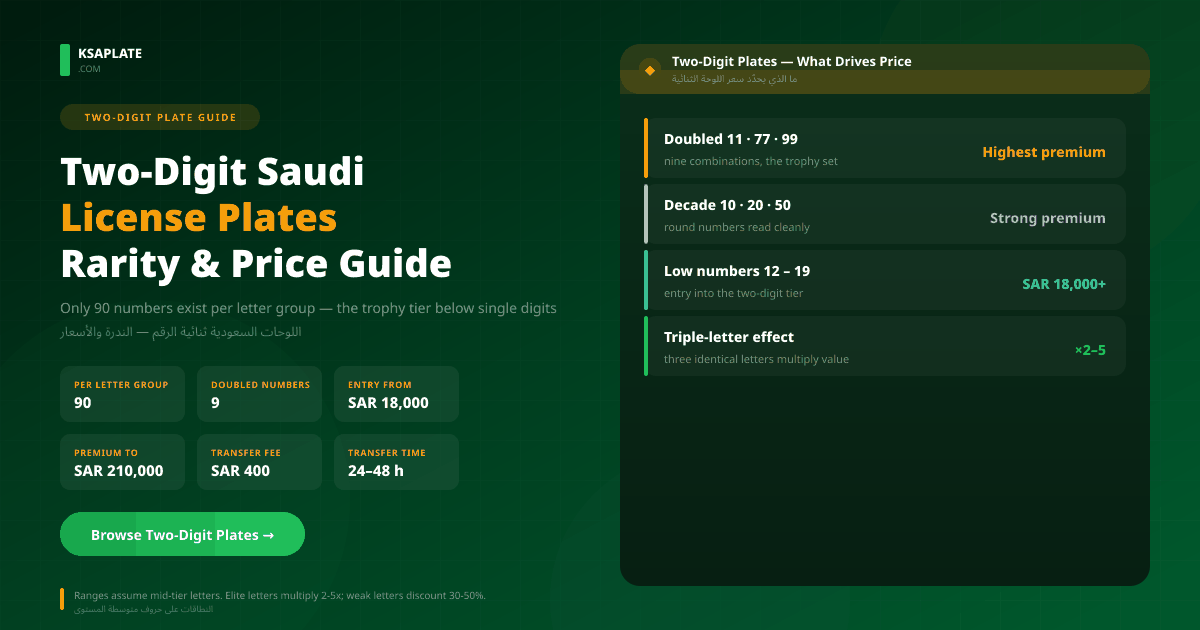
- Two-digit Saudi license plates (numbers 10–99) are 100× rarer than standard four-digit plates — only 90 combinations exist per letter group. That part is arithmetic, not marketing.
- Asking prices on our live listings run from SAR 12,000 to SAR 315,000, with a median of SAR 42,500 across 808 priced two-digit plates.
- Double-pattern numbers (11, 22, 77, 88, 99) ask a median of SAR 54,500 against SAR 40,000 for other two-digit numbers — about 1.4×, not the "2×–4×" this page used to claim.
- Round-decade numbers (10, 20, 30…) are the cheapest group in our data at a median of SAR 34,000, which is the opposite of the premium this page previously asserted.
- Browse all active listings at KSAplate.com → Two-Digit Plates — no account required to search.
A two-digit Saudi license plate is any private plate where the numeric portion is a number from 10 to 99. With exactly 90 possible numeric combinations per letter group — against 9,000 for four-digit plates — two-digit plates sit firmly in the rare category: 100 times scarcer than the standard plates most Saudis drive. On our own live listings the median two-digit ask is SAR 42,500 against SAR 300,000 for single-digit plates, so the tier costs roughly a seventh of the one above it. That combination of genuine scarcity and relative accessibility is why it is the busiest premium segment on the platform.
What Is a Two-Digit Saudi License Plate?
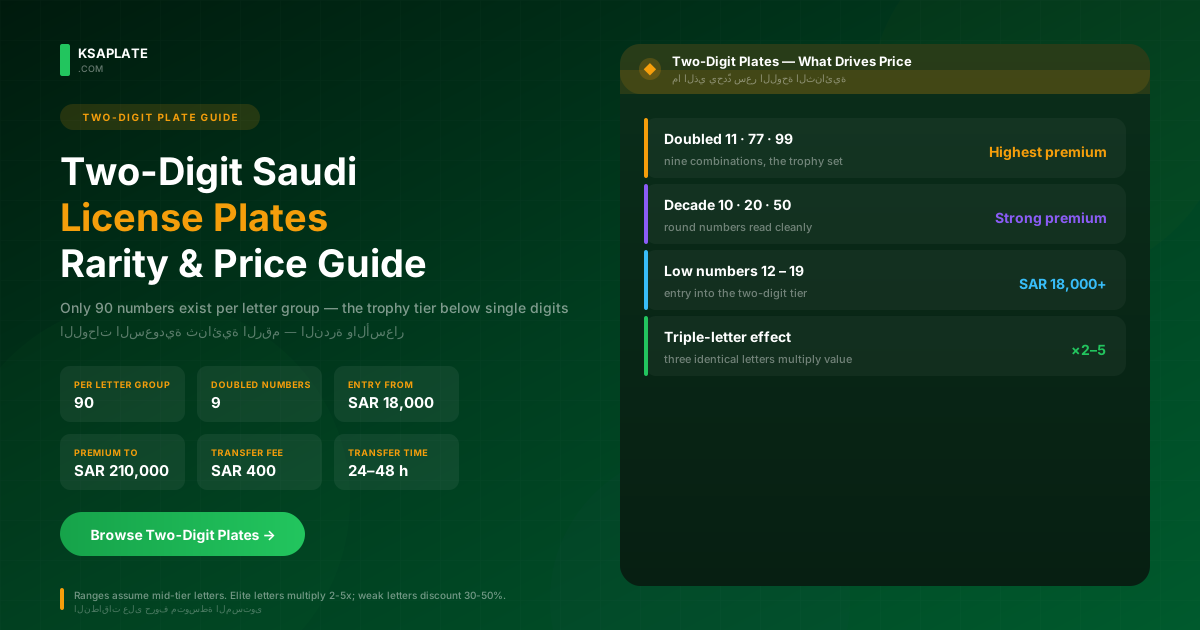
A two-digit Saudi license plate is a private vehicle registration plate where the plate number — the numeric field on the right side of the plate — consists of exactly two digits, ranging from 10 to 99. This definition excludes the number 01 through 09, which are classified as single-digit plates by their actual digit count, regardless of any zero-padding in display format.
The standard Saudi private plate format is: up to three Arabic letters (right side) followed by one to four digits (left side). Two-digit plates fit within this format with the numeric field set to values 10–99. They are issued under the same Ministry of Interior framework as all private plates, are transferable via the Absher platform, and carry full legal registration status when attached to a vehicle.
How the Number Field Works
Saudi plates are formatted so the number reads left-to-right in Arabic numeral order. A plate showing 77 with the letters س أ ن is written as it appears: the digits are the primary identifier, with the letters providing a secondary identifier that separates combinations across registration groups. The same number 77 can exist with many different letter combinations — each is a distinct, independently valued plate.
Two-Digit vs. Other Plate Types
Two-digit plates are private plates, which means they are the white-background, black-text plates used on privately owned passenger vehicles. They are distinct from commercial plates (yellow background), diplomatic plates, government plates, and the golden VIP plates used for specialized categories. For a complete breakdown of all plate types in the Kingdom, see our Saudi plate types and colors guide.
Two-digit Saudi plates are often called "VIP plates" in casual market terminology — not because of a regulatory classification, but because their rarity places them firmly in the premium tier that most buyers associate with status and exclusivity.
How Rare Are Two-Digit Plates? The Math
Rarity in the Saudi plate market is mathematically determined by the total number of possible combinations in a given digit category. The calculation is straightforward:
- 4-digit plates: numbers 1,000–9,999 = 9,000 combinations per letter group
- 3-digit plates: numbers 100–999 = 900 combinations per letter group
- 2-digit plates: numbers 10–99 = 90 combinations per letter group
- 1-digit plates: numbers 1–9 = 9 combinations per letter group
Two-digit plates represent exactly 1% of all four-digit combinations and 10% of three-digit combinations. Against the entire plate universe for a given letter group, two-digit plates are 100 times rarer than standard plates. This is not a marketing claim — it is arithmetic.
| Digit Count | Number Range | Combinations per Letter Group | Rarity vs. 4-Digit | Asking prices on our live listings — min / median / max (Sep 2026) |
|---|---|---|---|---|
| 1 digit | 1–9 | 9 | 1,000× rarer | 23,000 / 300,000 / 7,451,000 (228 listings) |
| 2 digits | 10–99 | 90 | 100× rarer | 12,000 / 42,500 / 315,000 (808 listings) |
| 3 digits | 100–999 | 900 | 10× rarer | 5,000 / 26,500 / 352,000 (1,971 listings) |
| 4 digits (standard) | 1,000–9,999 | 9,000 | Baseline | 500 / 3,400 / 4,000,000 (8,732 listings) |
As of September 2026, KSAplate.com carries 908 active two-digit listings, 808 of which show a price — the rest are listed on request. That is a deep enough pool to compare like with like before committing, while remaining a fraction of the four-digit inventory, which runs to 8,732 priced listings. One caveat applies to every number on this page: these are asking prices. Private Saudi plate sales settle through Absher without a public price, so nobody publishes what plates actually sell for.
Two-Digit vs. Single-Digit: Which Should You Buy?
The most common question buyers face once they move beyond standard plates is whether to stretch their budget for a single-digit plate or lock in the superior value-per-riyal of a two-digit plate. The answer depends on your primary goal.
| Factor | Single-Digit Plates | Two-Digit Plates |
|---|---|---|
| Lowest asking price on our listings | SAR 23,000 | SAR 12,000 |
| Median asking price | SAR 300,000 | SAR 42,500 |
| Highest asking price on our listings | SAR 7,451,000 | SAR 315,000 |
| Highest documented auction result | SAR 21,000,000 (ع 1, Apr 2024) | None published |
| Supply | 9 per letter group | 90 per letter group |
| Live listings | 228 priced | 808 priced |
| Status signal | Maximum | Strong |
| Best for | Collectors at the very top of the market | Buyers who want scarcity without six figures |
A two-digit plate is 100× scarcer than a four-digit plate by combination count, at a median asking price of SAR 42,500 against SAR 3,400. That ratio is the honest case for the two-digit tier. What we cannot tell you is whether it has paid: no return series exists for Saudi plates in any tier.
Our Saudi plate investment guide goes through what can and cannot be measured in this market — the two documented auction results, the price distribution across our listings, the tax position, and why no return figure exists for any tier.
What's your plate worth?
Get an instant, free estimate with our plate value calculator.
Calculate My Plate's ValueMost Valuable Two-Digit Combinations (Ranked)
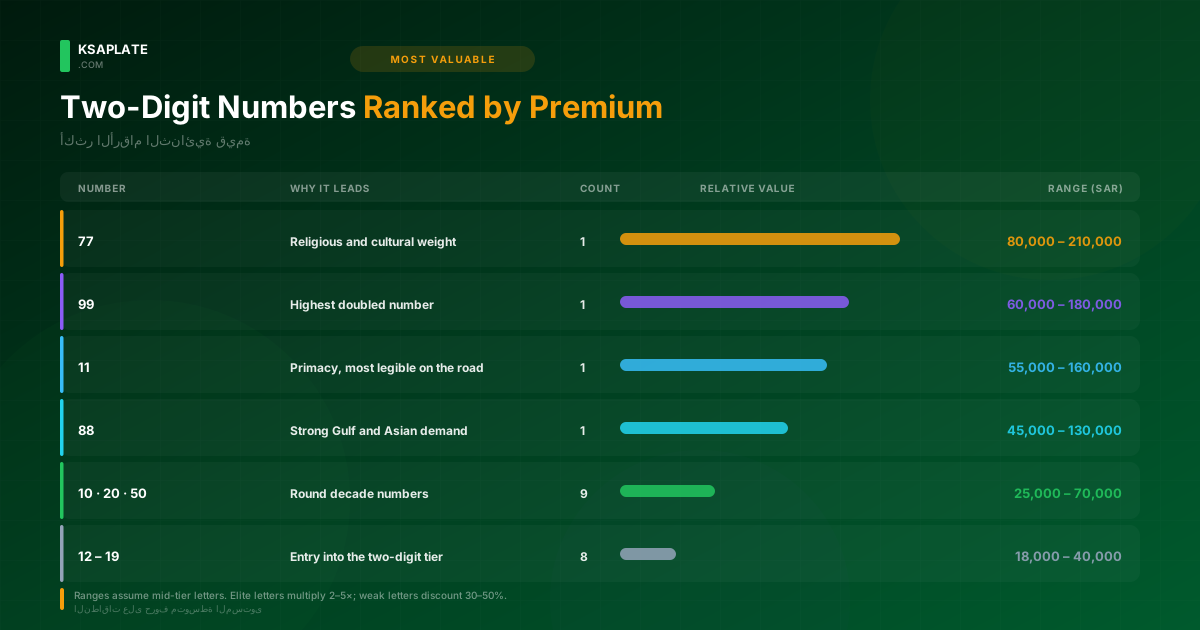
Within the two-digit category, not all combinations are equal. Value is driven by three independent factors: number pattern, cultural significance, and letter combination. Here is how they rank:
Tier 1: Double-Pattern Numbers (Highest Premium)
Double-pattern numbers — where both digits are identical — are the most sought-after two-digit combinations. They mirror the "repeating quad" logic that makes plates like 7777 or 1111 so valuable in the four-digit market. In the two-digit tier, these patterns are:
- 11 — Carries the "number one" prestige plus the repeating pattern. Across 22 active listings the number 11 spans SAR 16,500 for standard letter sets up to SAR 306,000 for the strongest combinations.
- 77 — The strongest cultural association: the number 7 holds deep Islamic significance (seven heavens, seven tawaf circuits). Twenty active listings span SAR 25,500 to SAR 130,000 — notably, the narrowest top end of the double-pattern group.
- 99 — The 99 names of Allah (Asmaa ul Husna) give this number strong religious resonance. Sixteen active listings span SAR 23,500 to SAR 264,000.
- 88 — Prosperity associations from Arabic-Asian cultural overlap. Eighteen listings span SAR 18,500 to SAR 309,000.
- 44, 33, 22, 55, 66 — Follow the same double-pattern logic. The single highest-priced two-digit listing on the platform is in fact أ ب ح 44 at SAR 315,000, not one of the culturally loaded numbers — which is the clearest evidence that inside the double-pattern tier the letter set moves the price more than the number does.
Tier 2: Decade Numbers (Round-Decade Premium)
Numbers ending in zero are often described as carrying a round-decade premium. Our own listings do not show one — they show the opposite, which is worth saying plainly rather than repeating the received wisdom.
- 10 — The lowest two-digit number. Five active listings span SAR 18,000 to SAR 136,000.
- 20, 30, 50, 70, 80, 90 — Taken together, the 68 priced decade listings ask a median of SAR 34,000, against SAR 40,000 for two-digit numbers that are neither decades nor double-patterns. On our data the decade group is the cheapest of the three. An earlier version of this page promised a "30%–50% premium" over other two-digit plates; that figure was invented and the measurement points the other way.
Tier 3: All Other Two-Digit Numbers
Random two-digit numbers without special pattern significance (e.g., 46, 57, 62, 76, 83) still command premiums over three- and four-digit plates due to their inherent scarcity. On KSAplate.com as of September 2026, these range from SAR 18,000 to SAR 200,000 depending primarily on the letter combination.
| Number | Category | Premium Driver | Live SAR Range (KSAplate.com, Sep 2026) |
|---|---|---|---|
| 44 | Double-pattern | Symmetry — holds the platform's top two-digit ask | 20,000 – 315,000 |
| 88 | Double-pattern | Prosperity associations | 18,500 – 309,000 |
| 11 | Double-pattern | Leadership + symmetry | 16,500 – 306,000 |
| 22 | Double-pattern | Symmetry | 25,000 – 298,000 |
| 99 | Double-pattern | 99 Names of Allah | 23,500 – 264,000 |
| 77 | Double-pattern | Islamic 7 significance | 25,500 – 130,000 |
| 10 | Decade | Lowest two-digit number | 18,000 – 136,000 |
| 14 | Random number, triple-letter | ك ك ك letter set, not the number | 16,000 – 210,000 |
For context on how these numbers intersect with cultural numerology across the GCC, see the lucky numbers for Saudi license plates guide.
Current Market Prices in 2026
Current two-digit plate prices in Saudi Arabia’s private market — based on KSAplate.com active listings as of September 2026 — reflect the following bands:
Entry Level: SAR 12,000 – SAR 40,000
Decade numbers (10, 20, 30, 50) and random two-digit numbers with standard three-letter combinations fall in this range. These represent the best entry point for buyers who want genuine rarity without stretching to six figures. A SAR 18,000 two-digit plate is 100 times rarer than a comparable four-digit plate that might cost SAR 2,000–5,000. Just under 400 of the active two-digit listings sit in this band, so there is real choice at the entry point.
Mid-Market: SAR 40,000 – SAR 100,000
Double-pattern numbers (77, 88, 11) and random combinations with desirable letters cluster here. It is the busiest band by listing count. The plate ب ح أ 58 lists at SAR 41,000; ب ر ط 62 at SAR 52,500; and م ر ق 76 at SAR 100,000 — all active as of September 2026. Around 270 priced two-digit listings fall in this band. We deliberately do not quote a typical time-to-sale: we do not track completed sales, and neither does any platform in this market.
Premium: SAR 100,000 and Above
The top of the two-digit private market. Prices here are driven by letter combination quality at least as much as by number pattern. The highest triple-same-letter listing is ك ك ك 14 at SAR 210,000 — the number 14 has no pattern significance at all, so the price is coming from the letters. The ceiling of the wider two-digit market sits a little higher: أ ب ح 44 at SAR 315,000, followed by و ط 88 at SAR 309,000 and ل ك هـ 11 at SAR 306,000, all active as of September 2026. 154 priced two-digit listings sit above SAR 100,000 — about 19% of the segment.
The two-digit ceiling of about SAR 315,000 is roughly 1.5% of the SAR 21 million single-digit auction record, while the rarity differential between the two tiers is 10× (90 combinations against 9). Whether that gap is an opportunity or simply what the market has decided the two tiers are worth, we cannot tell you — there is no transaction record from which either reading could be tested.
Absher Auction Starting Prices
New two-digit plates also enter the market through Absher's electronic plate auctions, announced in advance on the platform. We are not going to quote starting bids or a typical uplift over the opening price: an earlier version of this page gave both (SAR 10,000–25,000 opening, "50%–200% above starting price"), and we could not source either figure. Absher publishes the terms and the opening bid on each auction itself, and that is the only version worth relying on. Our Absher auction guide walks through the mechanics.
The Triple-Letter Multiplier Effect
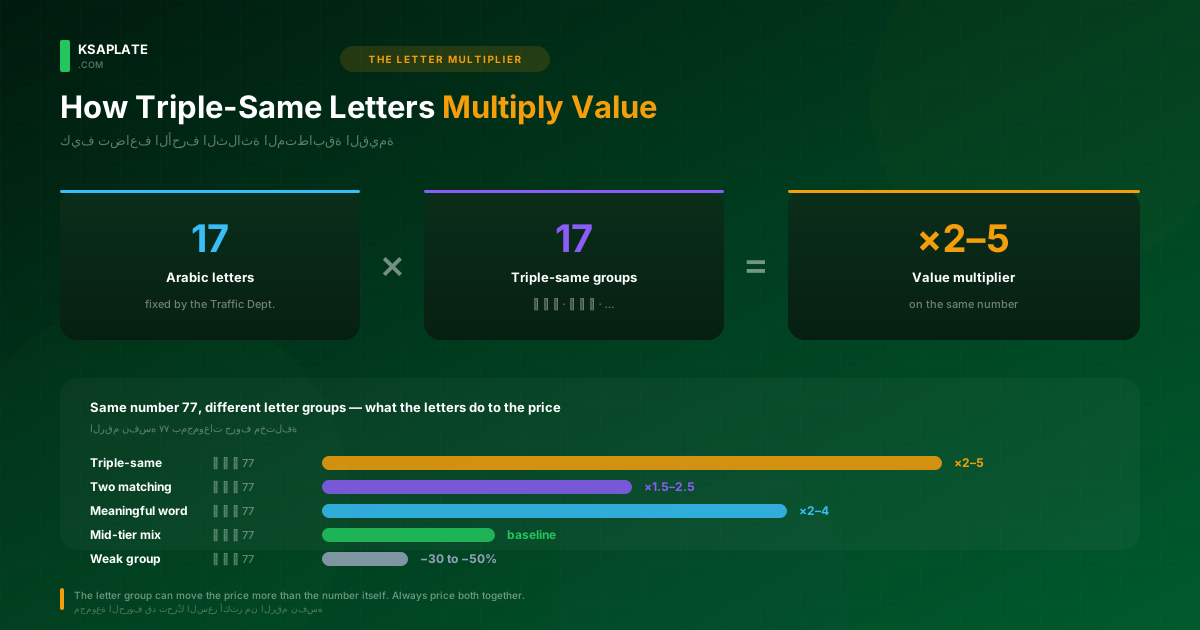
The letter combination on a Saudi plate is an independent value multiplier that stacks on top of digit rarity. This effect is especially pronounced in the two-digit market, where the letter premium can exceed the digit rarity premium — a counterintuitive but well-documented market reality.
Three letter factors drive premiums in the two-digit tier:
1. Triple-Same-Letter Combinations
When all three letters are identical — ك ك ك, ص ص ص, ح ح ح, ب ب ب — the symmetry does carry a premium, but a smaller and less certain one than this page used to claim. Measured across our two-digit listings, the 21 priced triple-same plates ask a median of SAR 56,000 against SAR 40,500 for the rest: about 1.4×, not the "3×–8×" previously stated. Individual cases run far higher — ك ك ك 14 lists at SAR 210,000 against SAR 65,000 for a random-letter plate with the same number, a 3.2× gap — but a single pair is an anecdote, not a multiplier. The category is also small: 25 of 908 active two-digit listings.
2. Two-Letter Combinations
Some plates carry only two Arabic letters instead of three, a format from earlier registration periods. They are less common than three-letter plates but not rare in our inventory: 262 of the 808 priced two-digit listings, just under a third. Their median ask is SAR 47,500 against SAR 40,500 for three-letter plates — about 1.2×. An earlier version of this page claimed a 5×–15× premium and described them as "rare relics"; neither survives contact with the data.
3. Culturally Meaningful Letter Combinations
Certain letter combinations approximate Arabic words or prestigious associations, and buyers do talk about them. We have no way to isolate that effect: our data records the letters and the asking price, not why a seller chose that price. Treat cultural letter premiums as real in the market's conversation and unmeasured in ours — this page previously claimed they were "confirmed by auction premium data", and no such data exists.
| Letter Type | Example | Median ask vs. 3-letter plates | Notes |
|---|---|---|---|
| Triple-same | ك ك ك, ب ب ب, ح ح ح | SAR 56,000 vs 40,500 — about 1.4× | Only 21 priced examples; individual cases vary widely |
| Two-letter only | ل ن, ص ن | SAR 47,500 vs 40,500 — about 1.2× | 262 listings — a third of the segment, not a rarity |
| Culturally resonant | ح ح ح, م ل ك | Not measurable from our data | Discussed by buyers; we cannot isolate the effect |
| Random 3-letter | م ر ق, ن ز أ | SAR 40,500 (baseline) | 525 priced listings |
Where Two-Digit Plates Trade in Saudi Arabia
Two-digit plates move through three channels in Saudi Arabia’s 2026 market:
KSAplate.com — The Specialized Private Marketplace
KSAplate.com is Saudi Arabia’s dedicated license plate marketplace, listing only plates with no other vehicle categories to dilute search results. As of September 2026, the platform carries over 900 active two-digit listings. Filtering is available by digit count, price range, city, and plate emblem. All transfers complete through the official Absher platform, eliminating custody risk. No account is required to browse listings.
Absher Electronic Plate Auctions
The General Directorate of Traffic releases new two-digit plates into the market via periodic Absher auctions. These are the only channel for acquiring plates that have never previously been sold into the private market. Auctions are announced 1–2 weeks in advance on the Absher platform. Starting bids begin at SAR 10,000 with no ceiling — final prices are determined entirely by competitive bidding. Absher auctions represent the price discovery mechanism for the entire Saudi plate market, and their results set benchmarks for private market valuations.
General Classifieds (OpenSooq, Dubizzle, SOUM)
General classified platforms carry some plate listings but lack filtering, verification, and the specialized buyer pool of a dedicated plate marketplace. Deals found here often require more due diligence. All transfers still go through Absher regardless of where the introduction happens — the classified platform is only the matchmaking layer. For the risk management framework around private market purchases, the safe buying guide covers the full checklist.
How to Buy a Two-Digit Plate: Step-by-Step
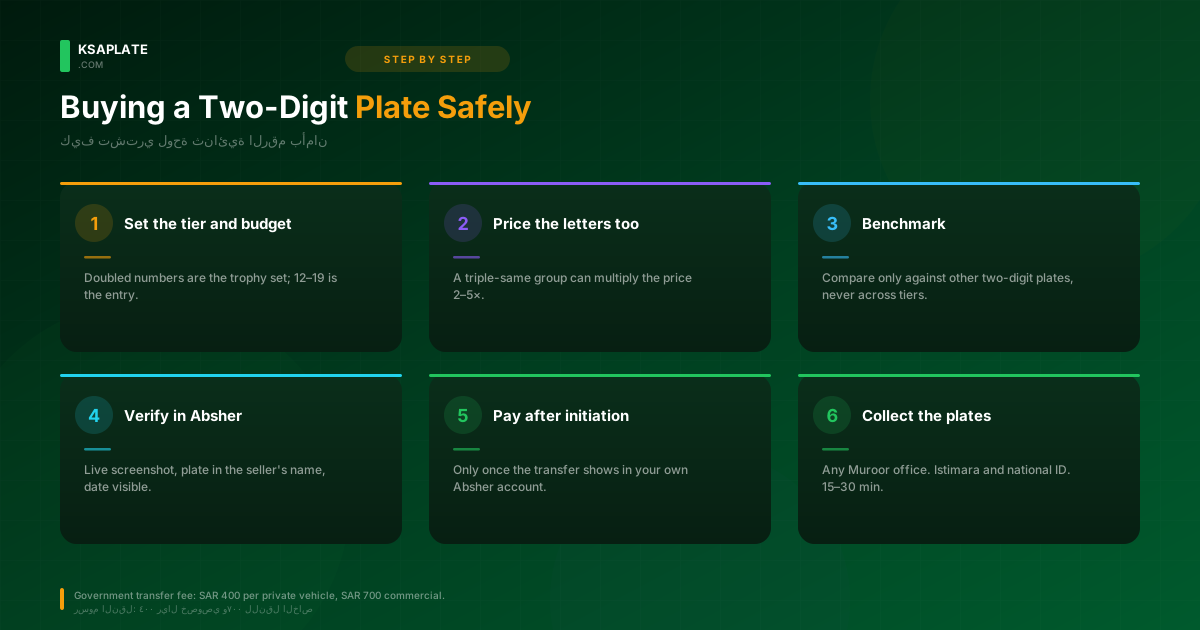
Route A: Buying via Private Market (KSAplate.com)
- Set your budget and target combination. Decide whether you are prioritizing a specific number (e.g., 77), a specific letter type (triple-same), or maximum rarity within a budget range. Having clarity before you browse prevents anchoring to overpriced listings.
- Search KSAplate.com with the digit filter set to 2. Sort by price, view count, or recency. With 908 active listings, the two-digit market is deep enough to comparison shop — and view counts tell you what other buyers are looking at, not what anything sold for.
- Contact the seller directly through the platform messaging system. How much a seller will move is between the two of you; we do not publish a typical discount, because we have no completed sales to derive one from. Referencing comparable live listings is the strongest argument you actually have.
- Agree on a price and initiate the Absher transfer. Both buyer and seller need active Absher accounts, and each needs a vehicle of their own — buying the number is a plate transfer, not a vehicle sale. Fees are SAR 400 per private vehicle plus a single SAR 230 Absher service fee, SAR 1,030 in total. No processing time is published, so do not plan around one. Never send payment before the transfer is initiated.
- Confirm transfer completion in Absher before releasing any payment. The platform generates a confirmation reference number. Screenshot and save this confirmation.
- Attach the plate to your vehicle or place it in your Absher plate wallet. The digital plate wallet (محفظة لوحات المركبات الرقمية) lets you hold a plate without registering it on a vehicle; Saudi press coverage notes it carries an annual renewal fee.
Route B: Bidding at an Absher Plate Auction
- Monitor Absher for auction announcements under Vehicles → Plate Auctions, and read the terms published with each auction. Those terms are the only authoritative source for the registration requirements, the deposit and the opening bid — an earlier version of this page quoted a SAR 1,000 registration fee and a 10% deposit, and we could not source either.
- Research comparable private market prices on KSAplate.com before you bid. Knowing that ب ر ط 62 is listed at SAR 52,500 privately gives you a rational ceiling for a similar combination — the only kind of reference point this market actually publishes.
- Decide your maximum before the auction opens and write it down. Competitive bidding is designed to move you past it.
- Understand the timing rules from the auction page itself. We previously described how the timer extends on late bids and what experienced bidders supposedly do in the final minutes; that was advice we could not substantiate, and auction mechanics are stated on the auction. See our Absher auction bidding guide for the process.
- If you win, pay within the window shown on the auction — missing it cancels the sale and forfeits the deposit. The plate can then be registered onto a vehicle or held in your Absher plate wallet.
How to Sell Your Two-Digit Plate
Selling a two-digit plate is straightforward if you use the right channel and price it correctly relative to current market data.
Pricing Your Plate for Sale
Search KSAplate.com for all active listings with the same number or the same pattern type (double-digit, triple-letter, etc.). Your price should sit within 10%–20% of comparable active listings — any higher and buyers skip to the next option; any lower and you leave money on the table. For plates without direct comparables, use the plate value calculator to establish a market-based estimate.
Listing on KSAplate.com
Listing on KSAplate.com is free — no commission. Create your listing with the plate number, letter combination, asking price, and your contact preference. Featured and spotlight listing tiers increase your listing’s visibility to active buyers — particularly valuable for premium plates above SAR 80,000 where the buyer pool is smaller and finding the right buyer takes longer. Our seller's guide walks through the full process in under five minutes.
Timing Your Sale
Sellers commonly time listings around Eid Al-Fitr, Eid Al-Adha and Saudi National Day, on the reasoning that prestige purchases cluster around them. That is a plausible pattern and a common practice, but we want to be straight about its status: we have not measured it, because measuring seasonality needs completed sales and those are not published. Listing several weeks ahead of a period you expect to be busy costs nothing and gives the listing time to accumulate views. Our market timing guide discusses the calendar in more detail.
Due Diligence Before You Pay
For any plate purchase above SAR 30,000, treat the due diligence phase as non-negotiable. Two-digit plates attract motivated buyers — and, occasionally, motivated fraudsters.
Verify Ownership via Absher
Before agreeing to a price, ask the seller to share their Absher account name. Cross-check this against the registered owner visible in the Absher transfer initiation screen. If the names do not match, require a notarized power of attorney from the actual registered owner before proceeding. This single step eliminates the majority of fraud risk.
Check Plate Status
Plates pledged as loan collateral, subject to outstanding traffic fines, or under legal dispute cannot be transferred via Absher — the system will block the transfer. Run the status check in Absher before any negotiation to confirm the plate is clean and transferable.
Never Pay Before Transfer Initiation
The Absher transfer system requires both parties to complete digital steps simultaneously. No legitimate seller needs full payment before the transfer is initiated. Any seller requesting advance payment via bank transfer before the Absher process starts should be treated as a red flag.
A SAR 50,000–100,000 plate purchase warrants the same discipline as a real estate transaction. Use the official Absher transfer system. Verify ownership. Payment follows transfer confirmation — never precedes it.
For a complete fraud prevention checklist applicable to all premium plate purchases, see the safe buying and scam avoidance guide.
Frequently Asked Questions
What is a two-digit Saudi license plate?
How much does a two-digit Saudi plate cost?
Which two-digit number is the most valuable?
Can I buy a two-digit plate without a vehicle to attach it to?
Are two-digit plates a good investment in 2026?
Can expats (Iqama holders) buy two-digit Saudi plates?
What is the difference between a two-digit plate and a VIP plate?
How long does the Absher transfer process take for a two-digit plate?
Why does the letter combination affect a two-digit plate's price so much?
Where can I find two-digit Saudi plates for sale right now?
Conclusion & Next Steps
Last updated: September 5, 2026
Two-digit Saudi license plates sit between the single-digit tier and the standard market, and the case for them is arithmetic rather than promotional: 90 combinations per letter group against 9,000 for four-digit plates, with asking prices between SAR 12,000 and SAR 315,000 and a median of SAR 42,500. The single-digit tier starts at SAR 23,000 on our listings but has a median of SAR 300,000 — that median, not the entry price, is what puts it out of reach for most buyers.
Three things move a two-digit plate's asking price: the number (double-patterns ask about 1.4× the rest; round decades, contrary to the usual claim, ask less), the letter combination (triple-same letters about 1.4× on the median, though individual cases run much higher), and the channel — private listing or Absher auction. All of these are measured on asking prices, because that is the only price this market publishes.
KSAplate.com carries an active two-digit section with transparent asking prices, direct seller contact, and transfer through Absher. No commission, no fees for buyers.
Browse Two-Digit Plates For Sale Now
Filter by digit count, number pattern, or budget. No account required to search.
Search Two-Digit Plates → Value My Plate