Last updated: 9 August 2026 · 12 min read
Negotiating a car price in Saudi Arabia is expected, not rude — most private sellers deliberately price 10–15% above what they will accept. The number on the listing is an opening position, whether you are buying on Haraj, from a showroom, or through a certified marketplace. Your job as a buyer is to find the real floor beneath that number; your job as a seller is to defend a price you set with room to give. Do it with market data and a calm walk-away, and a fair discount is not luck — it is the default outcome.
The asking price is the seller's hope, not the car's value. About 80% of real discounts happen the moment you're genuinely willing to leave.

- Expect 10–15% room on private cars. Around 90% of private sellers price above their floor; dealers hold roughly 8% wiggle room.
- Open low, then counter. A first offer near 20% below asking is normal — it sets the anchor, and you meet in the middle.
- Timing moves the price. Month-end, Ramadan and Eid, and any car listed 3+ weeks (which can fall 15–20%) are your best windows.
- Cash is leverage. A private, cash C2C sale avoids the 15% VAT that organized dealers add, and a ready buyer is worth a discount.
- The walk-away closes the deal. Be polite, be ready to leave, and let silence do the work — most price drops come right there.
Quick answer: How do you negotiate a car price in Saudi Arabia? Research the real market value first, then open below the asking price — around 20% under for private cars, less for dealers. Most private sellers leave 10–15% to give, so counter calmly toward a fair middle, use any fault or a fresh Fahes inspection as leverage, and be ready to walk away. Pay in cash where you can, and target month-end or Ramadan and Eid for the biggest movement.
Selling your car? List it on KSAplate for free
No commission on the sale, no account needed, and buyers contact you directly on WhatsApp. Keep or sell the plate separately.
List your car free Browse carsCan you negotiate a car price?
Negotiating a car price in Saudi Arabia is the normal, expected practice of agreeing a final figure below the listed asking price. Almost every private listing is written with a cushion built in, and Saudi buyers — especially on Haraj — simply will not pay the sticker. Treating the asking price as fixed is the single most expensive mistake a buyer makes.
The market itself rewards negotiation. Roughly 90% of private sellers set an asking price 10–15% above the figure they will actually accept, and even franchised dealers usually hold around 8% of room. Private consumer-to-consumer (C2C) sales dominate the Saudi used-car market — unorganized vendors held about 59% of it in 2025 — precisely because buyers control the price and avoid dealer markups. That structure means the room is real; you just have to ask for it correctly.
Key takeaway: the question is never whether to negotiate — it is how far the floor sits below the number you can see.
How much can you negotiate off?
The realistic discount on a used car in Saudi Arabia is 10–15% off a private asking price, and more when the listing has gone stale. That band is the starting expectation, not the ceiling. How much you actually capture depends on demand for the model, how long the car has sat, and how ready you are to buy today.
Here is what the market data supports. A car listed for three weeks or more often drops 15–20% as the seller tires of tyre-kickers. Unpopular or slow-moving models can fall as much as 25%. Dealers move less — expect around 8% — but they add other giveaways instead. In our testing across Haraj listings, the same model asked wildly different prices, and the sellers who had re-posted twice were the fastest to deal.
Key takeaway: anchor your expectation to the car's real market value, not a flat percentage — a 10% cut on an overpriced car is still a bad deal.
The anchor-and-counter framework
The anchor-and-counter framework is a four-move method for pulling a price down without insulting the seller or overpaying. It works because the first serious number spoken sets the mental centre of the whole conversation — so it should be yours, and it should be low but defensible. Used well, it turns a tense haggle into a predictable meeting in the middle.
- Set the anchor. Open around 20% below the asking price, tied to a reason: "Two similar ones are listed at X, and this one needs tyres." A naked lowball gets ignored; an anchored one resets the range.
- Counter toward the middle. Expect the seller to jump partway back. Move in small, shrinking steps — SAR 2,000, then 1,000, then 500 — so each concession signals you are near your limit.
- Trade, don't just cut. If the price stalls, shift to value: a fresh Fahes inspection, a full tank, new tyres, or the seller clearing an outstanding fine. Dealers who won't drop cash will often add maintenance or insurance.
- Deploy the walk-away. Politely say the number that works for you, then stop talking. Silence and a genuine willingness to leave is where roughly 80% of discounts actually happen.
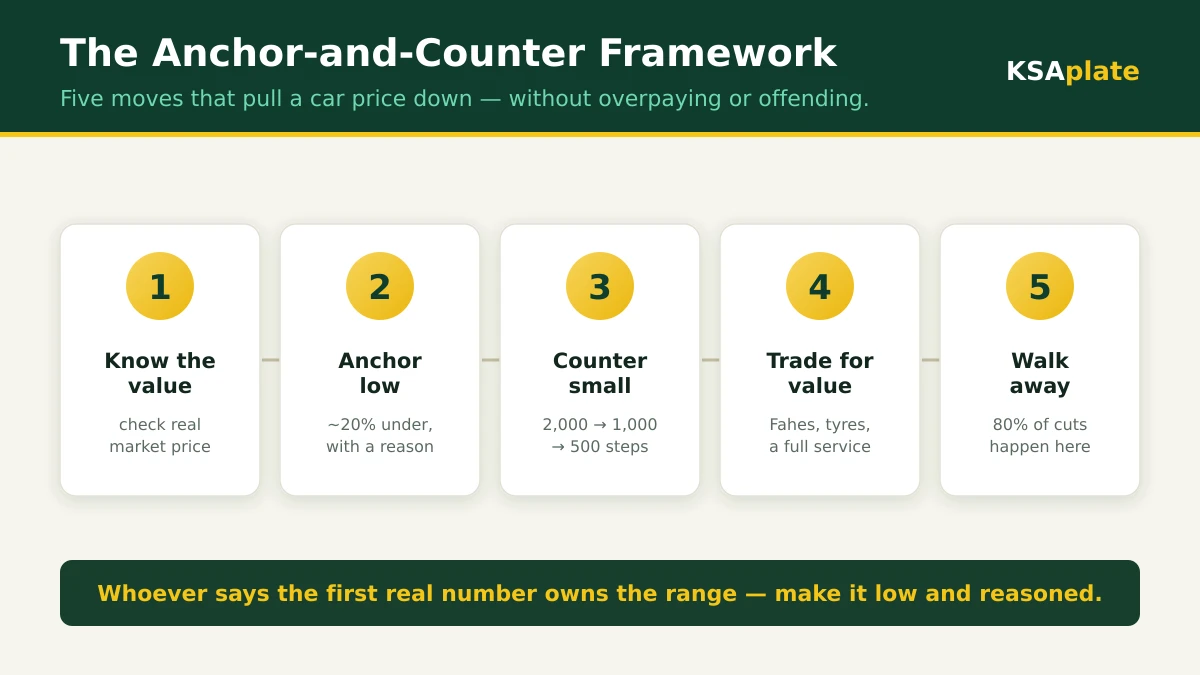
Whoever says the first real number owns the range. Make it low, make it reasoned, and never apologize for it.
Ready to sell it?
List your car on KSAplate for free — no commission on the sale, and buyers reach you directly on WhatsApp.
List My Car — FreeWhere you negotiate changes everything
The channel you buy through sets how much room exists before you say a word. A private seller on Haraj, a showroom dealer, a certified marketplace, and a trade-in desk each price differently and cave differently. Matching your tactics to the channel is what separates a good deal from a missed one.
| Channel | Typical room | What works | Watch out for |
|---|---|---|---|
| Private / Haraj | 10–15% (up to 25%) | Cash, walk-away, comps, listing age | Hidden faults — verify first |
| Showroom dealer | ~8% + freebies | Ask for maintenance, tyres, insurance | 15% VAT added on top |
| Certified marketplace | Low on price | Warranty, return policy, inspection value | Premium price for peace of mind |
| Trade-in desk | Below private sale | Speed and convenience | You lose 15–25% vs selling privately |
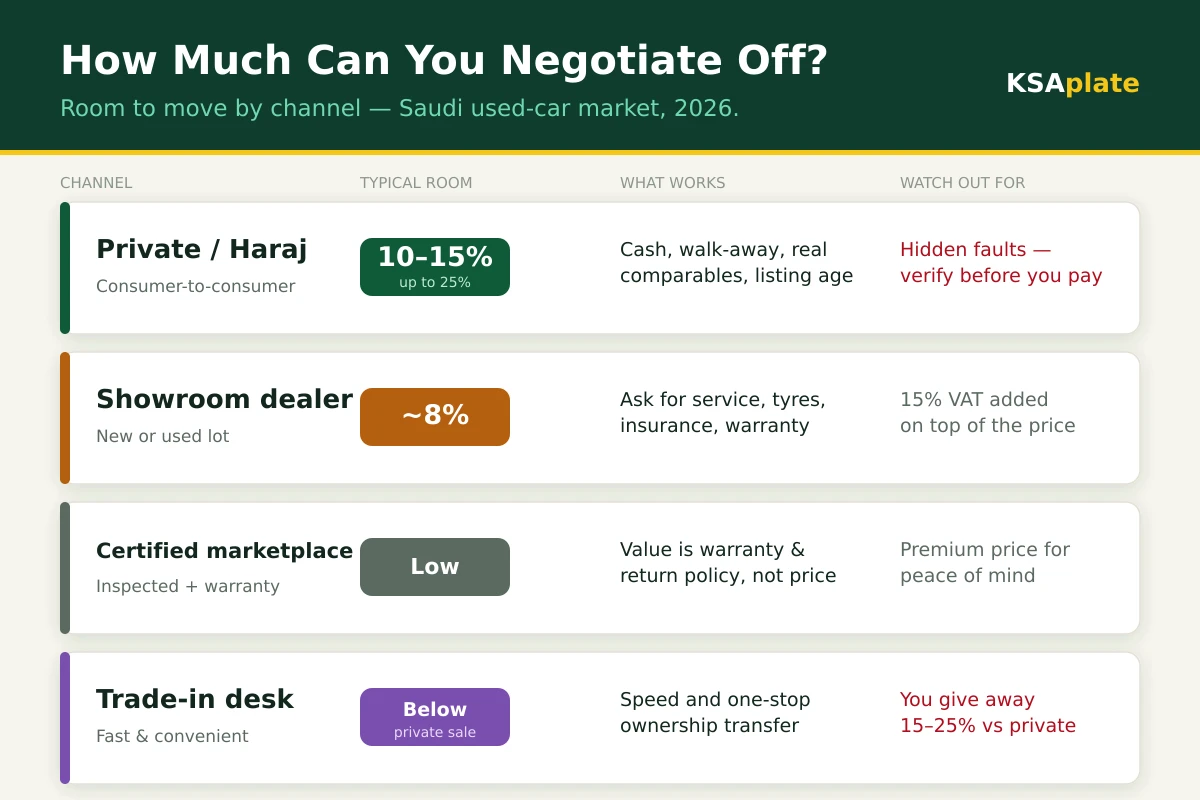
Key takeaway: the cheapest headline price is usually private on Haraj; the safest is certified. If you sell privately instead of trading in, you keep the 15–25% a trade-in gives away.
Timing: when sellers cave
Timing in a car negotiation is choosing the moment when the seller's motivation to sell is highest and yours to buy looks lowest. The same car has a different floor on the first day of a listing than on day 25, and a different floor at month-end than mid-month. Buy when the seller is under pressure, not when you are.
Three windows move prices in Saudi Arabia. Month-end is the classic one — private sellers chasing a deadline and dealers chasing targets both soften. Ramadan and Eid bring the year's most aggressive dealer promotions; in 2026, February and March carried direct cash discounts and free-maintenance packages. And listing age is a quiet signal: a car that has sat three weeks is a seller who has already lowered their expectations. Cross-reference these with the best time to buy a car and you stack the odds before you make an offer.
Key takeaway: a motivated seller beats a hard bargainer — find the person who needs to sell this week.
Cash vs finance: which has more leverage?
Cash gives a buyer more negotiating leverage than finance in a private Saudi sale, because it removes risk and delay for the seller. A private C2C cash deal also sidesteps the 15% VAT that organized dealers add to the price, which is a large part of why unorganized private sales dominate the market. With a dealer, though, the picture flips — the finance arrangement itself becomes the thing to negotiate.
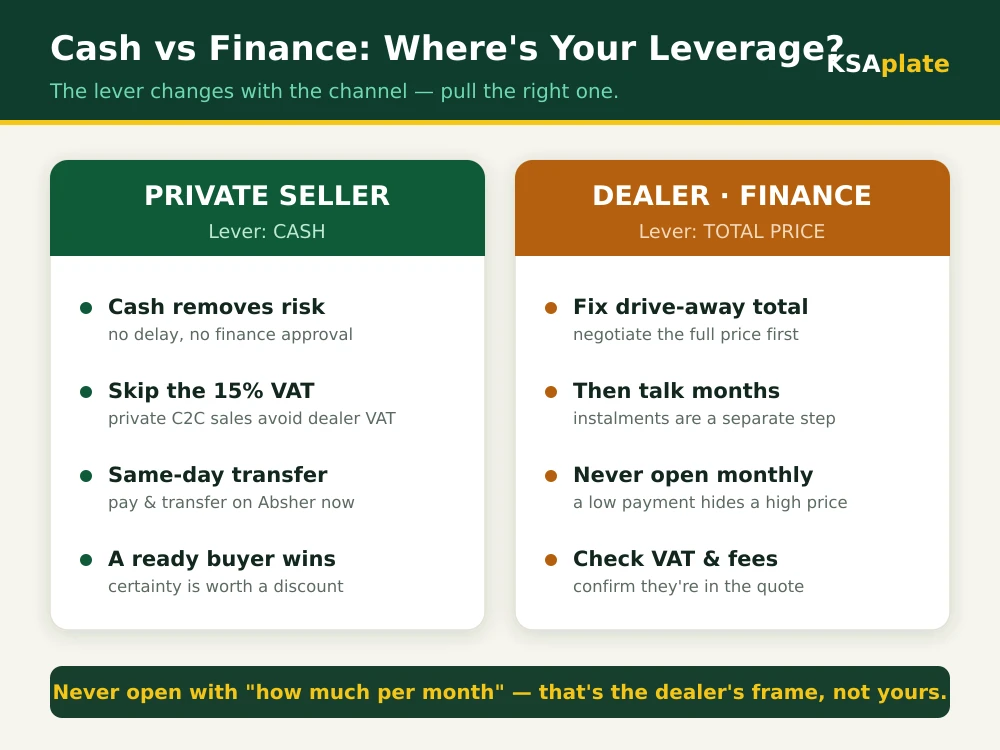
Play it by channel. Buying privately, lead with cash and a same-day transfer on Absher — that certainty is worth a real discount. Buying from a dealer on finance, negotiate the total drive-away price first and only then discuss monthly instalments, so a low-looking monthly payment can't hide a high price or a long term. Never let the conversation start at "how much per month"; that is the dealer's favourite frame, not yours.
Key takeaway: with a private seller, cash is the lever; with a dealer, the out-the-door total is the lever — never the monthly figure.
Leverage you can create
Leverage in a car negotiation is any verifiable fact that justifies a lower number, and you can manufacture most of it before you meet. The seller has emotion and an asking price; you bring evidence. Evidence wins, because it moves the talk from opinion to fact.
- A Fahes inspection. An independent periodic-inspection report that flags brakes, tyres or suspension is a costed reason to knock money off — not an insult.
- A history check. Run a car history check for past accidents, odometer issues or an outstanding lien; each finding is a price argument.
- Real comparables. Two or three genuine listings of the same model and year at a lower price reset the seller's sense of "fair".
- Visible faults. Worn tyres, kerbed wheels, a service due — each carries a real SAR cost you can subtract out loud.
- Scam awareness. Knowing the common used-car scams keeps you from overpaying for a car that isn't what it claims.
Never negotiate on feelings — negotiate on the invoice. "New tyres are SAR 1,600" beats "it looks a bit worn" every time.
Negotiating as the seller
Negotiating as a seller in Saudi Arabia means pricing with deliberate room, then defending your floor against the same tactics buyers use on you. If buyers expect 10–15% to give, you price 10–15% above your real target — so a "discount" still lands where you wanted. The listing sets the frame; a strong, honest one does half the negotiating for you.
Start with an accurate value and a clean, complete listing — good photos, a stated honest price, and every fault disclosed so nothing gets used against you later. When a lowball arrives, don't counter your own price; ask the buyer to justify theirs, then move in small steps. A well-built listing on the KSAplate marketplace reaches serious cash buyers directly, and a serious buyer rarely needs to grind you the way a dealer will. Price it right, and you hold the line.
Key takeaway: sellers who price with room and disclose faults keep control; sellers who price to the exact figure they need get talked below it.
Scripts that actually work
A negotiation script is a short, rehearsed line that holds your position without raising the temperature. The words matter because a calm, specific sentence is harder to argue with than a demand. Keep them polite, factual, and final.
- The anchored open: "I've seen two like it around SAR X. I can pay SAR Y today, cash, and transfer on Absher now."
- The costed cut: "It needs tyres and a service — that's about SAR 2,000. Let's meet at SAR Z."
- The freebie pivot (dealer): "If the price can't move, include the first service and a new set of tyres and we have a deal."
- The walk-away: "I understand — that's more than I can do. Here's my number if you change your mind." Then leave.
Key takeaway: the strongest line in any negotiation is a real number followed by silence.
Mistakes that cost you money
The most expensive negotiating mistake in Saudi Arabia is showing you love the car, because eagerness deletes your leverage instantly. Sellers read enthusiasm and stop moving. Nearly every costly error traces back to the same root — negotiating with emotion instead of evidence.
- Naming your top number first. Let the anchor be low and reasoned; never open at what you'd actually pay.
- Negotiating the monthly payment. Always fix the total drive-away price before instalments.
- Skipping the inspection. No Fahes check means no costed leverage — and real risk of a bad buy.
- Not being able to walk away. If you must buy today, you will overpay today.
- Forgetting the paperwork. Agree who clears fines and completes the Absher transfer before money changes hands.
Ready to put it to work? Value the car first so your anchor is real, browse listings to build your comparables, or list your own car free on KSAplate and price it with room. Buyers can also start from the full used-car buying guide.
Is it normal to negotiate car prices in Saudi Arabia?
How much can I negotiate off a used car in Saudi Arabia?
What should my first offer be?
Does paying cash get me a better car price?
When is the best time to negotiate a car in Saudi Arabia?
How do I use a car inspection to negotiate?
What is the walk-away tactic?
Should I negotiate the monthly payment or the total price?
How do I negotiate as the seller without losing money?
Can I negotiate at a new-car showroom too?
Conclusion & next steps
Negotiating a car price in Saudi Arabia is a repeatable process, not a personality trait. Start from the car's real value, open with a low anchored offer, counter in shrinking steps, create leverage with an inspection and real comparables, and keep a genuine walk-away in your pocket. Buyers who do this save 10–15% as a matter of course; sellers who price with room and disclose faults hold their line against the same tactics.
Make your next move from a position of information. Check the car's value so your anchor is grounded, browse the KSAplate marketplace to build your comparables, and when it's your turn to sell, list your car free and price it with room to give. The best negotiators aren't the loudest in the room — they're the ones who already know the number.
Reviewed by Khalid Al-Rashid, Saudi vehicle market specialist. Last reviewed 9 August 2026.
Sources: Zakat, Tax and Customs Authority (zatca.gov.sa) for the 15% VAT applied by registered dealers; the Saudi Central Bank (sama.gov.sa) for regulated auto-finance terms; and Fahes, the national periodic vehicle-inspection operator, for inspection-based leverage. Negotiation-margin figures (10–15% private room, ~8% dealer, 15–20% on stale listings, ~80% of discounts at the walk-away) reflect 2025–2026 Saudi used-car market reporting and are indicative, not guaranteed. Confirm VAT, fees and finance terms for your specific purchase before you commit.