


Last updated: 1 September 2026
TL;DR:
- Your insurance policy does not follow the plate. A motor policy is written against a vehicle, identified by its chassis and sequence number. Moving a plate does not move the cover.
- But insurance still decides whether the transfer happens at all. Absher checks the vehicle's registration, and the registration cannot be current without valid insurance — so a lapsed policy blocks a plate move indirectly.
- Buying a plate on its own has no insurance consequence until you attach it to a car. A plate held in your Absher wallet needs no cover.
- Swapping a plate between two cars you already own changes nothing about either policy. Each vehicle keeps its own cover; only the displayed number changes.
- Tell your insurer after the change. The policy stays valid, but the plate on record should match the plate on the car — mismatches surface at claim time, not before.
Quick answer: Transferring a licence plate in Saudi Arabia does not cancel, move or invalidate your car insurance. Cover is written against the vehicle, not the number on it. What insurance does control is whether the transfer can proceed: an expired policy stops the registration from being renewed, and Absher will not move a plate on or off a vehicle whose registration is not current.
What your policy is actually attached to
A Saudi motor insurance policy is written against a vehicle, not against a plate number. The identifying anchor is the chassis and the vehicle sequence number, both of which stay with the car for its entire life.
The plate number appears on the policy document, which is why people assume it is the thing being insured. It is a label, not the subject. The car keeps its identity when the number on the bumper changes, and the cover follows the car.
Compare it to the registration itself. Your istimara names the vehicle and shows the plate currently assigned to it. Change the plate and the istimara is reissued with the new number, but it is still the same vehicle record underneath — same chassis, same sequence number, same history of fines and inspections. If the distinction between the vehicle record and the number on it is new to you, what the istimara actually is sets it out.
Key takeaway: Insurance attaches to the car. The plate is an attribute of the car's registration, not a separate insured object.
The chain that decides whether a transfer clears
Insurance does not move with the plate, but it does gate the move. The dependency runs in one direction, and it is the reason so many transfers fail for what looks like an unrelated reason.
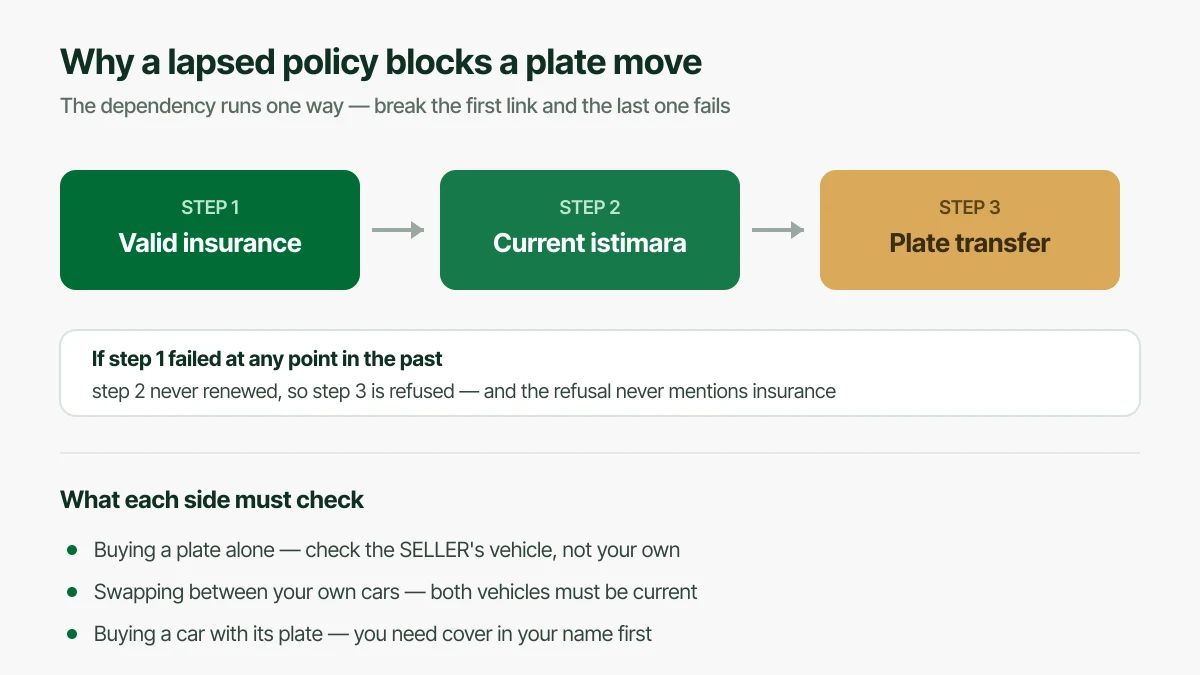
The order is fixed. Valid insurance is required to renew the vehicle registration. A current registration is required for Absher to act on the vehicle. And Absher will not move a plate on or off a vehicle whose registration is not current. Break the first link and the third one fails, even though nobody mentioned insurance when the request was refused.
This is why "my insurance is fine, so why was my plate transfer rejected" is the wrong question. Insurance being valid today does not help if the registration lapsed while the policy was expired and was never renewed since. The preconditions that block a plate transfer sit in exactly this chain.
Key takeaway: Insurance does not travel with the plate — it decides whether the plate is allowed to travel at all.
The one field people misread in that chain is the vehicle sequence number, which is not the plate and not the chassis number. We explain what the sequence number is and where to find it separately.
Four scenarios, four different answers
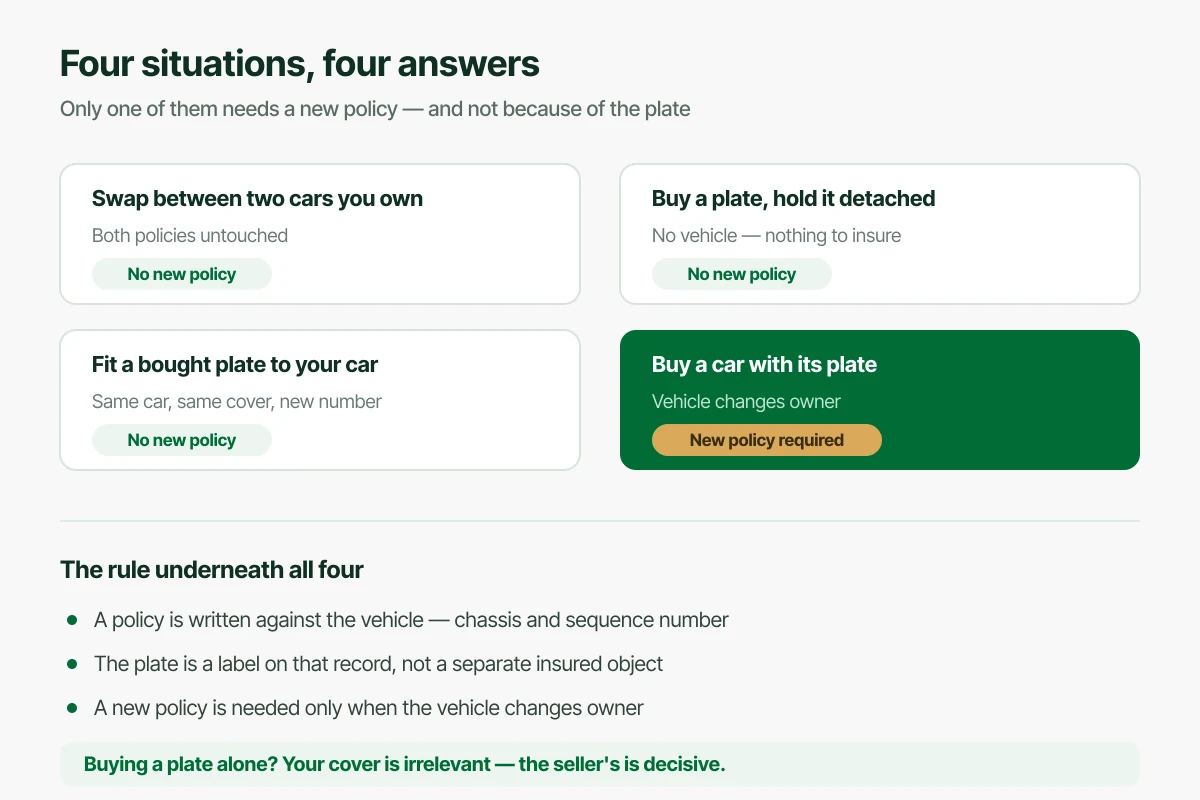
The answer depends entirely on whether a vehicle changes hands, and which vehicle the plate lands on. These four cases cover almost every real situation.
| Situation | Does your policy move? | New policy needed? | What to tell the insurer |
|---|---|---|---|
| Swap a plate between two cars you own | No | No | Update the plate on record for both |
| Buy a plate, hold it detached | No | No | Nothing — no vehicle involved |
| Buy a plate and fit it to your car | No | No | Update the plate on record |
| Buy a car and its plate together | No — the seller's does not transfer | Yes, in your own name | Arrange cover before the transfer completes |
Only the last row requires a new policy, and that requirement comes from the vehicle changing owner, not from the plate moving. A buyer must hold cover in their own name before an ownership transfer will complete on Absher.
What's your plate worth?
Get an instant, free estimate with our plate value calculator.
Calculate My Plate's ValueSwapping a plate between two cars you own
Moving a plate between two vehicles registered to you leaves both insurance policies untouched. Neither car changes owner, so neither policy changes hands.
What happens is a paperwork swap. Car A gives up the number, car B receives it, and both registrations are reissued. Car A's policy continues to cover car A under whatever number it now carries; car B's policy continues to cover car B under its new number. Cover, premium and expiry dates are unaffected.
The one administrative task left is telling each insurer the plate on record has changed. This is a record update, not a new contract. Doing it promptly keeps the policy document consistent with the istimara, which matters later rather than now.
Both vehicles still need their own valid cover for the swap to clear in the first place, because both registrations must be current. If one of the two cars has been sitting with a lapsed policy, fix that before you start.
Buying a plate without buying a car
A plate bought on its own and held detached in your Absher wallet carries no insurance obligation. There is no vehicle behind it, so there is nothing to insure.
This is the cleanest case in the whole subject. You buy the number, it sits in your wallet, and no policy, registration or inspection applies to it. The plate only enters the insurance world at the moment you attach it to a registered vehicle — and at that point it attaches to a car that already has its own cover.
The seller's side is where insurance re-enters. For the seller to detach and hand over the number, their vehicle's registration must be current, which means their policy must be valid. A buyer with perfect paperwork can still be blocked by a seller whose insurance lapsed months ago.
Key takeaway: When you buy a plate alone, your insurance is irrelevant and the seller's is decisive. Check theirs, not yours.
Selling the car but keeping the number
If you sell the vehicle and keep the plate, your policy ends with the vehicle, not with the number you retained. The cover was always the car's.
The sequence matters here. You detach the plate first, the car takes a replacement number, and only then does the vehicle transfer to the buyer. Your policy on that car stops being relevant to you at the point of sale — the buyer arranges their own cover in their own name before the ownership change completes.
The retained number sits in your wallet, uninsured and uninsurable, until you put it on another car you own. At that moment it joins a vehicle that already has a policy, and nothing about that policy changes except the plate shown on it. The mechanics of retaining a number are set out in keeping your plate when you change cars.
Telling your insurer, and why the timing matters
Notifying your insurer of a plate change is a record update, not a re-underwriting. The premium is priced on the vehicle and the driver, and neither has changed.
Do it after the transfer completes and the reissued istimara is in hand, not before. Notifying while the change is still pending means giving your insurer a number that may not end up on the car, which creates the exact mismatch you are trying to avoid.
Keep the reissued istimara. It is the document that proves which plate belonged to which vehicle on which date, and it is the fastest way to resolve any later question about a gap between the policy and the car.
Key takeaway: Update the insurer once the new istimara exists — not when you agree the deal, and not while the transfer is still pending.
Where a plate mismatch actually bites
A stale plate number on a policy rarely causes a problem until something goes wrong. It is a dormant discrepancy, and the moment it wakes up is the worst possible moment.
Two situations surface it. The first is a claim, where the vehicle on the accident report and the vehicle on the policy have to be reconciled. The second is a traffic stop or an automated fine, where the plate on the road is matched against records.
The underlying cover is not void because a record is out of date — the policy still names the correct chassis. But reconciling a mismatch costs time at exactly the point you need the process to be simple. Fixing the record takes minutes; explaining it during a claim does not.
If a plate change coincides with an incident, the reissued istimara and the policy update together establish the timeline. That is why keeping both matters more than most people expect. For the wider picture of what a policy covers in the Kingdom, see the Saudi car insurance guide.
The order that avoids the whole problem
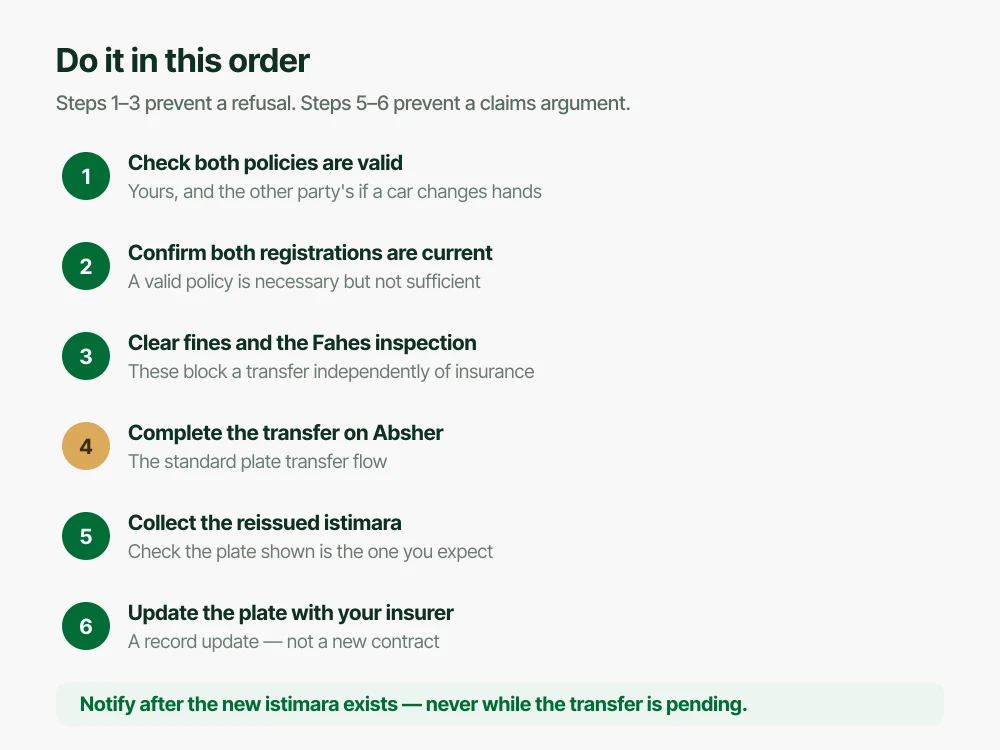
Almost every insurance complication around a plate transfer comes from doing the steps in the wrong order. Run them in this sequence and the insurance side stays uneventful.
- Check both policies are valid — yours and, where a vehicle changes hands, the other party's. An expired policy is the most common hidden blocker.
- Confirm both registrations are current. A valid policy is necessary but not sufficient: the istimara has to have been renewed on the back of it. See how istimara renewal works.
- Clear the vehicle's other preconditions — outstanding fines and an overdue Fahes inspection both stop a transfer independently of insurance.
- Complete the transfer through Absher using the standard flow in the plate transfer guide.
- Collect the reissued istimara and check the plate shown matches what you expect.
- Update the plate on record with your insurer and keep the confirmation with the istimara.
Steps one to three are the ones people skip, and they are the ones that cause a refusal. Steps five and six are the ones people forget, and they are the ones that cause a claims argument two years later.
There is one edge case worth stating plainly, because it is where the two systems genuinely touch. If a vehicle is written off or scrapped while its plate is still attached, the plate goes with the vehicle record unless you detach it first. The insurance settlement concerns the car; the number is a separate asset that you can only preserve by acting before the vehicle leaves your name. Owners who care about the number treat detachment as the first step of any write-off conversation, not the last.
The reverse case is simpler and more common. A policy that lapses on a car you rarely drive quietly stops the registration from being renewed, and the plate on that car becomes immobile without anyone noticing. Nothing alerts you until the day you try to move the number, which is often years later. A quick annual check of whether every vehicle in your name still carries valid cover costs nothing and prevents exactly that surprise.
Frequently asked questions
Does transferring a licence plate cancel my car insurance?
Does my insurance move to the new car when I move my plate?
Do I need insurance to buy a plate on its own?
Can an expired insurance policy block a plate transfer?
Whose insurance matters when I buy a plate from someone else?
Do I have to tell my insurer that my plate changed?
Will my premium change after a plate transfer?
What happens at claim time if the plate on my policy is out of date?
Do I need new insurance when I buy a car together with its plate?
Does a plate transfer affect my no-claims record?
What to do next
If a plate transfer is on your list, deal with the insurance question in the order above rather than treating it as an afterthought. The policy will survive the change; what will not survive is a registration that lapsed because the cover did.
Before you commit to a number, check what it is worth. The free plate value calculator gives an estimate from digit count, pattern and letters, and you can compare it against live asking prices on the plate marketplace before deciding.