


TL;DR:
- Buyers decide in a fraction of a second of scrolling — and they decide on your first photo. In a market where most listings are shot at night, at a fuel station, with last week's dust on the paint, thirty minutes of craft puts your car in the top few percent of everything on the page.
- Light is the whole game in Saudi Arabia: shoot in the golden hour after sunrise or before sunset, never at midday (vertical sun kills every surface) and never at night. The sun does the professional's work free of charge — twice a day.
- Twelve photos sell a car: front three-quarter lead shot, profile, rear three-quarter, straight rear, cabin wide, dashboard with odometer, rear seats, boot, engine bay, wheels, service file — and the defects, photographed honestly.
- Honesty is a speed strategy, not a virtue signal: the scratch you photograph costs you a little in the price; the scratch the buyer discovers costs you the deal and the afternoon. Documented flaws pre-sell the inspection.
- The photos get the click, the description and price close it: anchor the number to real market data, write the description in checkable facts (service history, ISOFIX, tire dates), and the listing does the negotiating before the phone rings.
Quick answer: To photograph a car for sale in Saudi Arabia: wash it the day before, shoot in the golden hour (shortly after sunrise or before sunset) against a clean, uncluttered background, and take at least twelve photos — front three-quarter as the lead, side profile, rear three-quarter, straight rear, interior wide, dashboard with the odometer visible, rear seats, boot, engine bay, wheels, the service file, and honest close-ups of any defects. Shoot at bumper height from a few steps back rather than up close with a wide lens, keep the horizon straight, and never use night shots or fuel-station lighting. Then price against real market data and write the description in verifiable facts — the photos earn the click, the details close the sale.
The 0.3-second decision
Nobody reads a car listing. They scroll a wall of thumbnails, and somewhere in a fraction of a second per image, a thumb decides: stop or keep moving. Everything you want from your sale — the calls, the serious buyers, the price you have in mind — passes through that instant, and that instant is decided by one photograph.
Here is the good news, and it is very good: the standard in the used-car listing market is astonishingly low. Scroll any page of listings and count — cars shot at night under sodium lamps, cars with the seller's shadow across the bonnet, cars photographed diagonally from above like crime-scene evidence, dusty cars in front of dustier walls. The buyer's thumb has learned that these listings mean friction: a seller who couldn't be bothered to wash the car probably couldn't be bothered to service it.
This is why thirty minutes of deliberate craft — one wash, one good hour of light, twelve intentional frames — doesn't just improve your listing. It moves it into a different category, the small percentage that reads as "cared-for car, serious seller." That category gets the clicks, and the clicks get the price. This guide is the complete craft: light, staging, the shot list, phone technique, the honesty strategy, and the description and price that convert the click into a viewing. The mechanics of the sale itself — transfer, documents, payment — live in our how-to-sell guide; this article is about the twenty minutes that decide whether anyone ever asks.
Light: the Saudi photographer's free professional
Professional car photographers spend most of their budget controlling light. In Saudi Arabia, the sky does it for free — twice a day, at precisely predictable times:
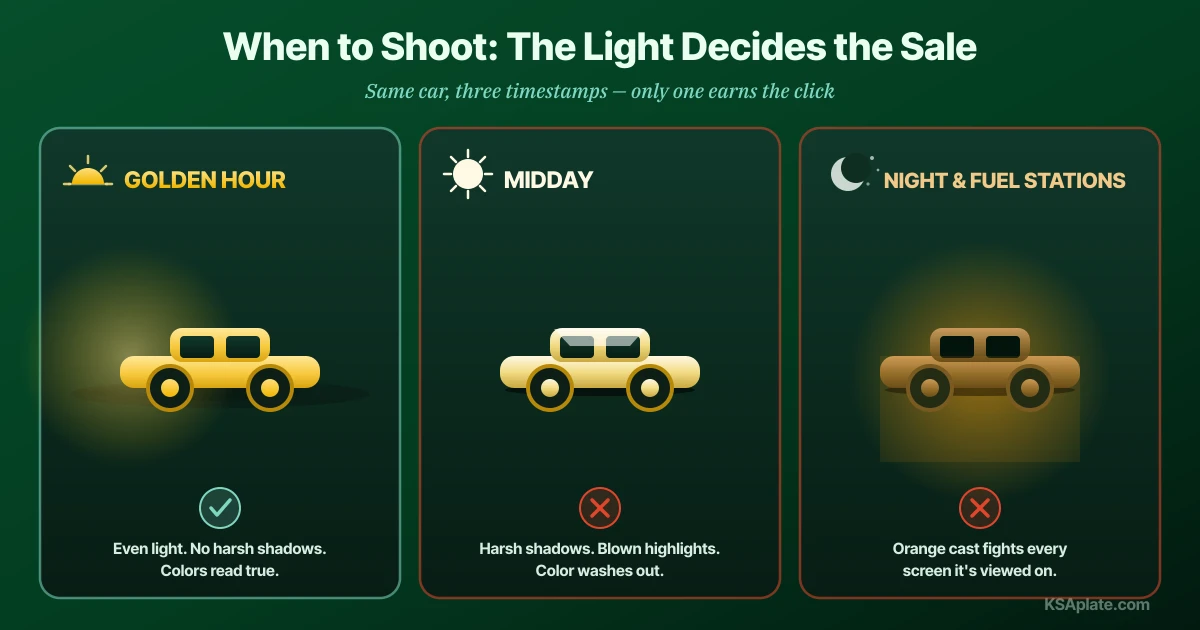
- The golden hour is the whole secret. The first hour after sunrise and the last before sunset give low, warm, directional light: paint glows, curves show their shape, chrome and glass pick up sky instead of glare. Every car — every color — looks its honest best in it. In summer, the morning slot also means you and the car aren't cooking.
- Midday is the enemy. From roughly ten to four, the vertical Saudi sun flattens every panel, burns highlights into white patches, and drops black shadow pools under the car and inside the wheel arches. Dark cars become shapeless; white cars become overexposed sheets. If midday is truly your only option, find open shade — the shadowed side of a large building — and never dappled tree shade, which paints leopard spots on the paint.
- Night is a non-starter. Phone sensors smear detail in low light, mixed street lighting turns every color wrong, and — bluntly — night listings read as "what is this seller hiding?" The same goes for fuel-station canopies: green-white LED glare, oil-stained concrete, and a background that says "shot in a hurry."
- Overcast is a gift. The rare hazy or cloudy Saudi day is a giant softbox — even light, no harsh shadows, shoot any time. Dust haze works too, at the small cost of duller colors.
- Sun behind the camera, always. Position so the light falls onto the side of the car you are shooting. Shooting into the sun gives you a silhouette and lens flare; side light is acceptable for one dramatic frame, not the set.
The thirty-minute stage
The photos start before the camera comes out:
- Wash the day before, wipe the morning of. A proper wash including wheels and door shuts, then a morning microfiber pass for overnight dust — in the kingdom there is always overnight dust. Dressing the tires (that satin-black look) is the single highest-impact five minutes of the whole preparation.
- Empty the car completely. Every buyer mentally moves into the cabin. Charging cables, tissue boxes, the seat organizer, prayer beads on the mirror, children's crumbs — all of it out. The only thing allowed to stay visible is the service file, which is not clutter; it is the co-star.
- Find your wall. The ideal background is boring: a clean plain wall, an empty stretch of parking, a desert frontage road. What must not be behind the car: other cars (buyers' eyes wander to them), bins, construction, your building's laundry lines, and — critically — anything that casts pattern shadows across the paint.
- Angle the wheels. Front wheels turned slightly away from the camera for the three-quarter shots shows the face of the wheel and gives the car a planted stance. Straight-ahead wheels photograph as skinny ovals.
- Kill your reflection. Dark paint and glass mirror everything. Check every frame for yourself, your phone and your shadow — shift a step sideways rather than accepting a ghost seller in the rear door.
Ready to sell it?
List your car on KSAplate for free — no commission on the sale, and buyers reach you directly on WhatsApp.
List My Car — FreeThe twelve photos that sell
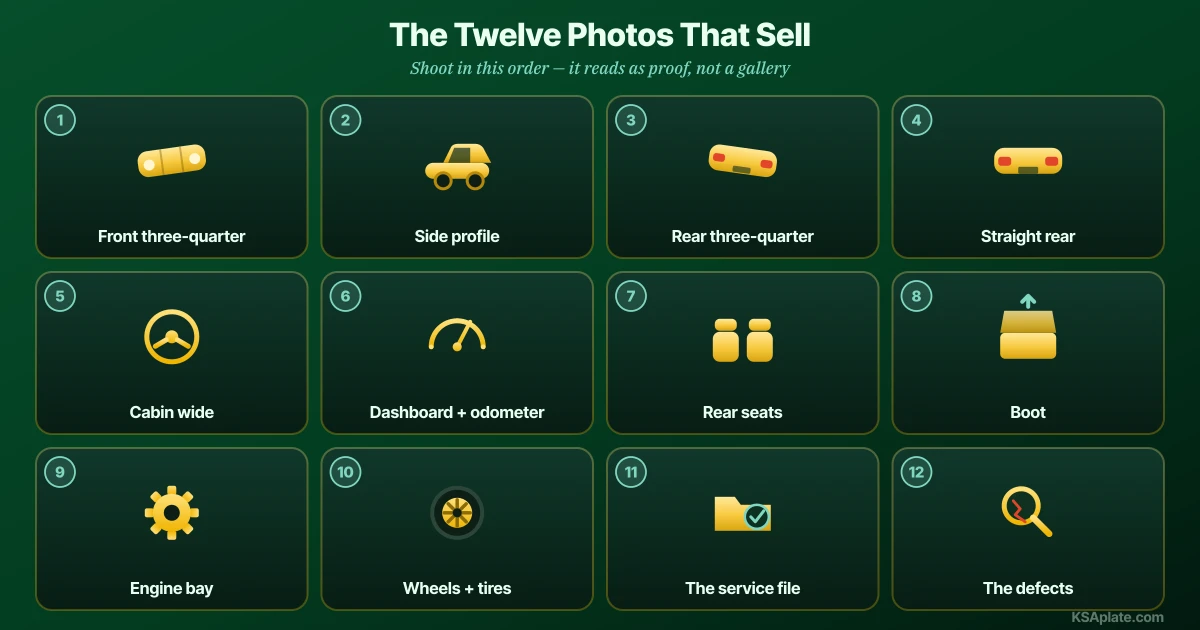
The complete set, in shooting order. Listings with this coverage answer the buyer's questions before they are asked — which is precisely what makes the phone ring with serious calls instead of interrogations:
| # | Shot | What it must show | The common mistake |
|---|---|---|---|
| 1 | Front three-quarter | The lead photo: face and profile in one, wheels angled, full car with margin | Cropping the wheels; shooting from standing height |
| 2 | Side profile | Straight-on stance, panel lines, ride height | Slight diagonal that bends the car |
| 3 | Rear three-quarter | The second-best angle; tail and haunch | Skipping it entirely |
| 4 | Straight rear | Bumper condition, symmetric tail lights | Your reflection in the rear glass |
| 5 | Cabin wide | From the open driver's door: wheel, seats, console in one frame | Clutter still aboard; dark underexposed cave |
| 6 | Dashboard + odometer | Ignition on, mileage readable — the most-checked photo in the set | Blurry cluster; mileage hidden "to discuss" |
| 7 | Rear seats | Space, upholstery condition, ISOFIX anchors for family buyers | Shot through a closed window's tint |
| 8 | Boot | Open, empty, spare-wheel well visible | Family belongings still in it |
| 9 | Engine bay | As it is — buyers check for leaks and fresh "show wash" | Degreasing to suspiciously new; or skipping it |
| 10 | Wheels + tires | One clear wheel with tread visible; date code if you're proud of it | Kerbed rims hidden until the viewing |
| 11 | The service file | The folder, open on stamps — the trust shot | Claiming "full history" with no photo of it |
| 12 | The defects | Every scratch, ding and worn corner, close and sharp | The subject of its own section below |
Twelve is the floor, not the ceiling — more genuine angles never hurt. What does hurt: fifteen near-identical front shots, filters, and stock-photo-style renders of "the same model." Buyers pattern-match those to dealership games instantly.
Phone technique: five rules
Any phone from the last five years out-photographs the average listing. The gap is technique, and it compresses to five rules:
- Shoot from bumper height. Crouch. Photos from standing height look down on the car and make it look small and wedge-shaped — the single most common amateur signature. Lens at headlight level makes every car look planted and deliberate.
- Step back, zoom with your feet — never the wide lens up close. The default wide angle two meters from the car bulges the nose and warps the proportions. Stand five or six meters away and use the main (1×) lens, or the 2× if you have it. The car keeps its real shape.
- Keep the horizon level. Turn on the camera grid and put the ground line on a gridline. Tilted "dynamic" angles read as hiding something; automotive dealers shoot level for a reason.
- Tap to expose on the car, not the sky. One tap on the body sets focus and exposure where it matters; drag the exposure slider down a touch if the paint blows out. HDR on is fine; "beauty" filters are not.
- Wipe the lens. The most skipped step in phone photography. A pocket-hazed lens turns golden-hour light into a soft-focus smear on every single frame.
Photograph the flaws — it's a speed strategy
The counterintuitive craft: your defect photos are sales assets. Here is the mechanism, because once you see it you will never hide a scratch again:
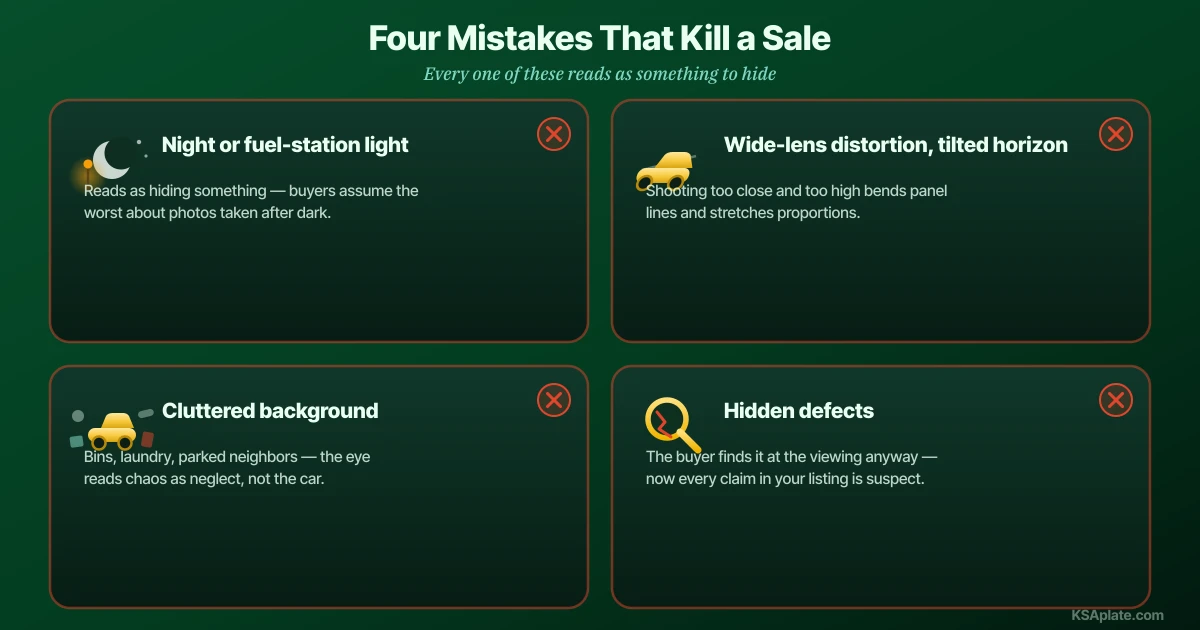
- The hidden flaw costs more than the visible one. A buyer who discovers an undisclosed scratch at the viewing doesn't subtract the scratch — they subtract trust. Now every other claim in your listing is suspect, the negotiation reopens from below your floor, and half the time the deal dies on the spot after costing you both an afternoon.
- The photographed flaw pre-sells the inspection. A sharp, well-lit close-up of the kerbed rim and the car-park ding, captioned plainly, does three jobs: it filters out the buyers for whom it's a deal-breaker (saving you their viewing), it converts the viewing into a confirmation rather than an investigation, and it signals that the rest of the listing is equally honest — which is worth real riyals on everything the buyer can't see.
- Shoot defects like a workshop, not a confession. Close enough to show the true size, with a finger or coin for scale on small dings, in the same good light as the rest of the set. One frame per flaw. Don't editorialize with ten angles of the same scratch — document and move on.
- The honesty rule extends to the mechanical story. If the AC needs a service or a tire is due, the description states it with a riyal estimate. Buyers at this level of transparency stop haggling recreationally — the serious ones simply verify and pay. The full catalog of what dishonest listings look like from the buyer's side is in our scams guide; being the opposite of every item on it is the entire strategy.
The description: facts a buyer can check
After the photos earn the click, the description has one job: convert interest into a viewing request. It does that with verifiable facts, not adjectives:
| Block | What goes in it | Example line |
|---|---|---|
| The header facts | Year, exact trim, mileage, color, spec (GCC), owner count | "2021 · Full option · 84,000 km · GCC spec · first owner" |
| The service story | Where maintained, what's stamped, what was just done | "Agency-serviced, file in photos — oil and filters done at 82k" |
| The honest list | Every flaw from the photos, with repair estimates where known | "Two door dings (photographed), front tires due ~SAR 900" |
| The family/usage facts | ISOFIX, rear AC, smoking status, how the car was used | "Non-smoking family car, school-run and highway use" |
| The transaction terms | Price basis, what's firm, viewing location and times | "Priced to market data — see below. Viewings evenings, [district]" |
What stays out: "serious buyers only" (hostile), "no time wasters" (hostile and useless), walls of exclamation marks, and adjectives doing fact work — "excellent condition" is what every listing says; "compression-tested in June, report available" is what sells. Buyers will pull the vehicle history anyway (it takes minutes) — a description that matches it word for word is the deepest trust signal available. Write it once in clean English and once in Arabic; the bilingual listing doubles its audience for ten minutes of work.
The price: anchored, not hoped
The best photo set in the kingdom cannot sell a mispriced car — it just makes the overpricing more visible. The pricing discipline in three steps:
- Pull the honest number. Run your exact model, year and mileage through the free car value calculator — it prices from real Saudi market curves and returns the fair private-sale range, the same data we quote across our buying guides. That range is your anchor, and quoting it in the listing ("priced on market data") preempts the lowball opener.
- Position inside the range deliberately. Top of the range with the full service file and fresh tires; middle for a clean average car; bottom only if you need speed — and if you do, say so ("priced for quick sale") so the low number reads as strategy, not desperation.
- Check the live competition. Ten minutes in the current listings for your model tells you exactly what a buyer's comparison set looks like this week. If three identical cars sit at your price with worse photos, you win; if they undercut you with equal cars, adjust or out-document them. The seasonal layer — when demand peaks and when listings glut — is mapped in the timing guide.
Publishing: order, lead photo, timing
The last five minutes decide how the work performs:
- Lead with the front three-quarter. It is the thumbnail, the 0.3-second photo, the whole first impression. Golden light, wheels angled, level horizon, nothing cropped.
- Order the rest as a walk-around: exterior circuit, then cabin, then dashboard/odometer, then boot and engine, then wheels, then the service file, defects last. The sequence mirrors how a buyer inspects in person — which makes the listing feel complete instead of assembled.
- Publish into demand, not into the void. Evenings after salary week outperform quiet mid-month afternoons; the first 48 hours decide whether the platform's algorithm and the buyers' saved-search alerts treat your listing as fresh inventory or scenery.
- List where the buyers are. List it on KSAplate for free — no commission taking a percentage of your craft — with all twelve photos, the bilingual description, and the market-anchored price. A listing built to this standard is its own advertising — and if you were weighing the dealer trade-in shortcut instead, run the numbers in the trade-in comparison first: the private premium is largest for exactly the well-documented cars this guide produces.
After it goes live
The listing's job ends when the phone rings; yours continues:
- Answer fast, answer with facts. The first hours of interest are the hottest; a same-hour reply with a direct answer ("yes, second owner — transfer history in the file") keeps serious buyers moving toward a viewing.
- Pre-qualify with the listing itself. When a caller asks something the photos already answer, point them kindly back — buyers who haven't read it yet will negotiate as if the defects are discoveries.
- Run viewings and payment by the book. Daylight viewings, a safe meeting spot, test drives with your conditions, and transfer-before-payment discipline — the complete protocol, including the Absher transfer steps and the plate decision, is in the selling guide.
- Refresh honestly if it stalls. Two weeks without serious calls means price or photos — usually price. Reshoot the lead frame in better light or move within the calculator's range; do not "relist" the same car with tricks, which saved-search buyers notice instantly.
Selling your car? List it on KSAplate for free
No commission on the sale, no account needed, and buyers contact you directly on WhatsApp. Keep or sell the plate separately.
List your car free Browse carsFrequently asked questions
What is the best time of day to photograph a car for sale in Saudi Arabia?
How many photos should a car listing have?
Which photo should be first in the listing?
Should I show scratches and dents in my car listing?
Is a phone camera good enough to sell a car?
Should the odometer be visible in listing photos?
How do I price my car before listing it?
Should I write my listing in Arabic or English?
Should I clean the engine bay before photographing it?
When is the best time to publish a car listing?
Why is my car listing getting views but no calls?
Conclusion
A car listing is a small piece of craftsmanship pretending to be a chore. The materials cost nothing — an evening's light, a washed car, a clean wall, a charged phone — and the technique fits on one hand: golden hour, bumper height, step back, level horizon, twelve honest frames. What it buys is everything a seller wants: the click against a wall of midnight fuel-station listings, the trust before the viewing, the negotiation that starts from your number instead of under it.
So run the sequence: wash it today, shoot it tomorrow at first light, pull the honest price from the free value calculator, check the live competition once, and publish it on KSAplate for free with the service file in frame eleven and the flaws in frame twelve. Somewhere out there a buyer is scrolling past forty careless listings tonight — and stopping, for exactly 0.3 seconds longer, on yours.