


Last updated: 2 September 2026
TL;DR:
- No. Absher is the only channel that completes a Saudi plate transfer. There is no counter you can walk into that performs the transfer for you instead.
- Almost nobody searching this actually wants a different channel. They want a way past something that is blocking them — an account, an Iqama, an absent seller, a deceased owner.
- Each blocker has a real, documented path — and none of them is an offline workaround. A power of attorney, an heirs certificate or a company registration is the answer, depending on which one you have.
- Absher account problems are the largest group. An unverified account, a lapsed Iqama or a number that is not registered to you all present as "the system will not let me".
- Diagnose first, act second. Working out which of the six blockers you actually have takes minutes and saves a wasted trip.
Quick answer: You cannot transfer a Saudi licence plate without Absher. Every plate transfer in the Kingdom is completed through the Absher platform, whatever channel the deal was agreed on. If Absher will not let you proceed, the problem is almost always eligibility or account status rather than the channel itself — and the fix depends on which blocker you have.
The short answer, and why it surprises people
Absher is the single channel through which a Saudi plate transfer is completed. Both parties act inside the platform, and the ownership record updates there. No alternative route produces the same result.
That catches people out because so much of the transaction happens elsewhere. The plate is found on a marketplace, the price is agreed on WhatsApp, the money moves through a bank. All of that is outside Absher. Only the last step — the part that actually changes who owns the number — happens inside it.
Compare it to selling a property. You can negotiate anywhere, but the transfer is registered in one place. The negotiation channel and the registration channel are different things, and only the second one is fixed.
Key takeaway: The deal can happen anywhere. The transfer happens in one place. Confusing the two is what sends people looking for a counter that does not exist.
Why people search for a way around Absher
The search "transfer a plate without Absher" is nearly always a symptom, not a request. Something has refused, and the reader assumes a different channel would accept.
The refusal is rarely explained on screen. A request stops, a button is greyed out, or a service is unavailable, and nothing names the cause. Faced with that, looking for another door is a reasonable instinct — it is just the wrong diagnosis.
There is a second group: people who cannot use Absher at all, because the account belongs to someone else, or the person who needs to act is abroad, or the registered owner has died. Those are genuine problems. They have genuine answers, and none of the answers is an offline transfer.
Key takeaway: Stop looking for another channel. Work out which of the six blockers below applies, because the fix is specific to it.
Six blockers, and what each one actually means
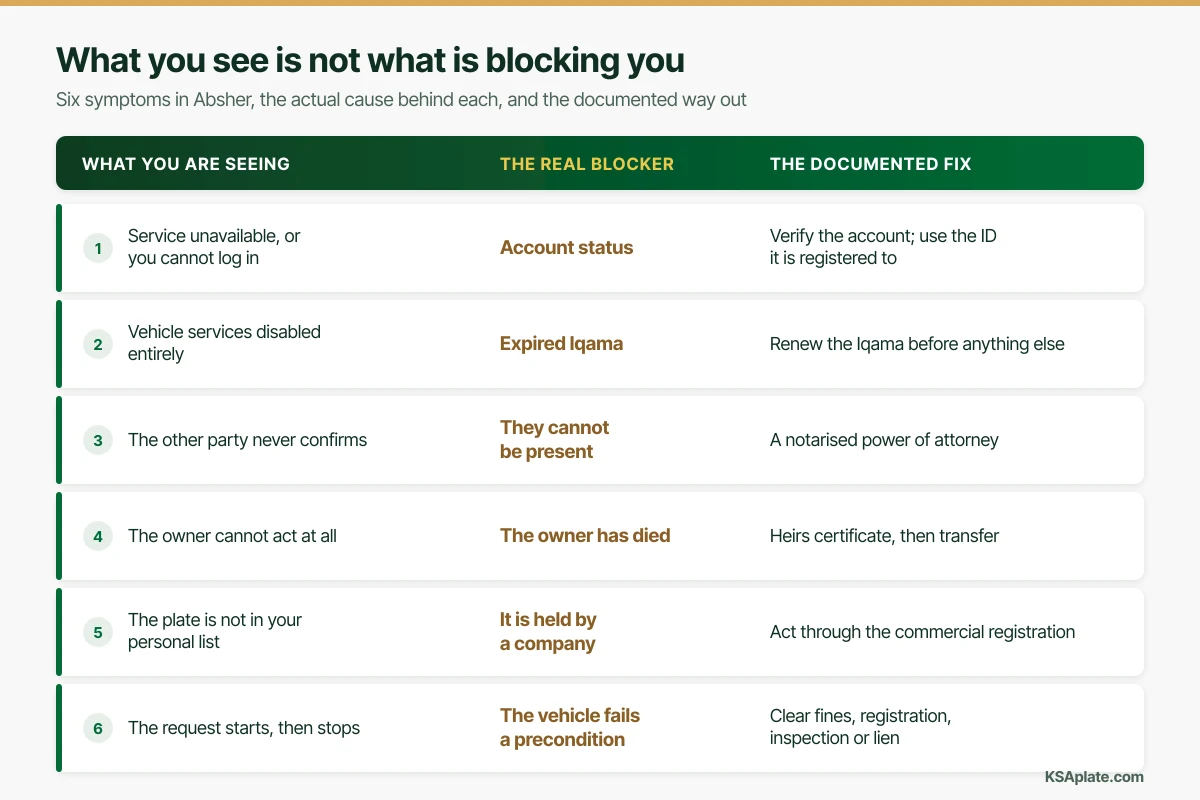
Every "Absher will not let me" case falls into one of six categories, and each has a different fix. Identifying yours is the whole task.
| What you are seeing | The real blocker | The documented fix |
|---|---|---|
| Service unavailable, or you cannot log in | Account status | Verify the account; use the ID it is registered to |
| Vehicle services disabled entirely | Expired Iqama | Renew the Iqama before anything else |
| The other party never confirms | They cannot be present | A notarised power of attorney |
| The owner cannot act at all | The owner has died | Heirs certificate, then transfer |
| The plate is not in your personal list | It is held by a company | Act through the commercial registration |
| The request starts, then stops | The vehicle fails a precondition | Clear fines, registration, inspection or lien |
Note what is absent from the third column: there is no row where the answer is "go to a branch and do it there". That is the finding this article exists to deliver.
What's your plate worth?
Get an instant, free estimate with our plate value calculator.
Calculate My Plate's ValueBlocker 1: your Absher account itself
An Absher account that is not fully verified cannot complete vehicle services, even when everything else is in order. This is the most common cause and the least visible one.
Three variants account for most cases. The account exists but was never completed to the verified level. The account is registered to a different national ID or Iqama number than the one that owns the plate. Or the mobile number on the account no longer belongs to the user, which breaks the confirmation step even though login still works.
The fix is the account, not the transfer. Once the account is verified and matches the identity that owns the plate, the same request that was refused goes through unchanged. Nothing about the plate or the vehicle needed to change.
Key takeaway: If the service is unavailable rather than refused, suspect the account before you suspect the plate.
Blocker 2: an expired or changed Iqama
An expired Iqama disables vehicle services, which includes plate transfers. For residents this is the single most consequential deadline in the whole process.
The behaviour is absolute rather than gradual. There is no reduced service while the Iqama is lapsed — vehicle services simply stop. Plates registered under an expired Iqama cannot be transferred until it is renewed, which matters enormously to anyone selling up before leaving the Kingdom.
The order is the lesson. Sell or detach while the Iqama is still valid, not after. Someone finishing a contract who plans to sell a plate "once things settle down" often discovers the window closed first. The wider consequences of leaving with vehicles in your name are covered in expat vehicle ownership in Saudi Arabia, and eligibility by residency status in the Iqama holder plate guide.
Blocker 3: the other party cannot be present
A power of attorney lets someone act on another person's behalf inside Absher, which is the documented answer when one party cannot participate. It is not an offline workaround — it is a formal instrument that works within the platform.
This is the case that most often sends people looking for a counter. The seller is abroad, the buyer is travelling, or a family member is handling the sale for someone who cannot. The transfer still runs through Absher; the wakala simply establishes who is authorised to act.
The instrument has to be notarised properly and scoped to the right actions. A power of attorney written for something else will not carry a vehicle transfer. The wakala guide for plate transfers sets out the scope and the process.
Key takeaway: "The other person cannot come" is not a reason to leave the platform. It is a reason to authorise someone inside it.
Blocker 4: the registered owner has died
A plate registered to a deceased owner cannot be transferred until inheritance is formally established. No branch visit shortcuts this, because the obstacle is legal rather than technical.
The sequence is fixed: the heirs certificate is issued first, and only then can the estate's assets — including a plate — be transferred or sold. Any agreement made before that certificate exists is not enforceable, however sincere the parties are.
This is also the case where the delay is longest and least avoidable. Families frequently park the vehicle and wait rather than attempt anything through Absher, which is the correct instinct. The full process, including what happens when heirs disagree, is in the plate inheritance guide.
Blocker 5: the plate belongs to a company
A plate registered to a commercial entity does not appear in an individual's personal Absher vehicle list, which reads as though the plate has vanished. It has not — it is simply held by a different owner.
The distinction matters because moving a company plate to a director personally is a transfer between two separate owners. It carries the same steps and the same fees as any other change of ownership. It is not an internal reshuffle, and it cannot be treated as one.
Anyone managing a fleet or holding plates commercially should read how company plates work before assuming a personal account will show them.
Blocker 6: the vehicle itself is the problem
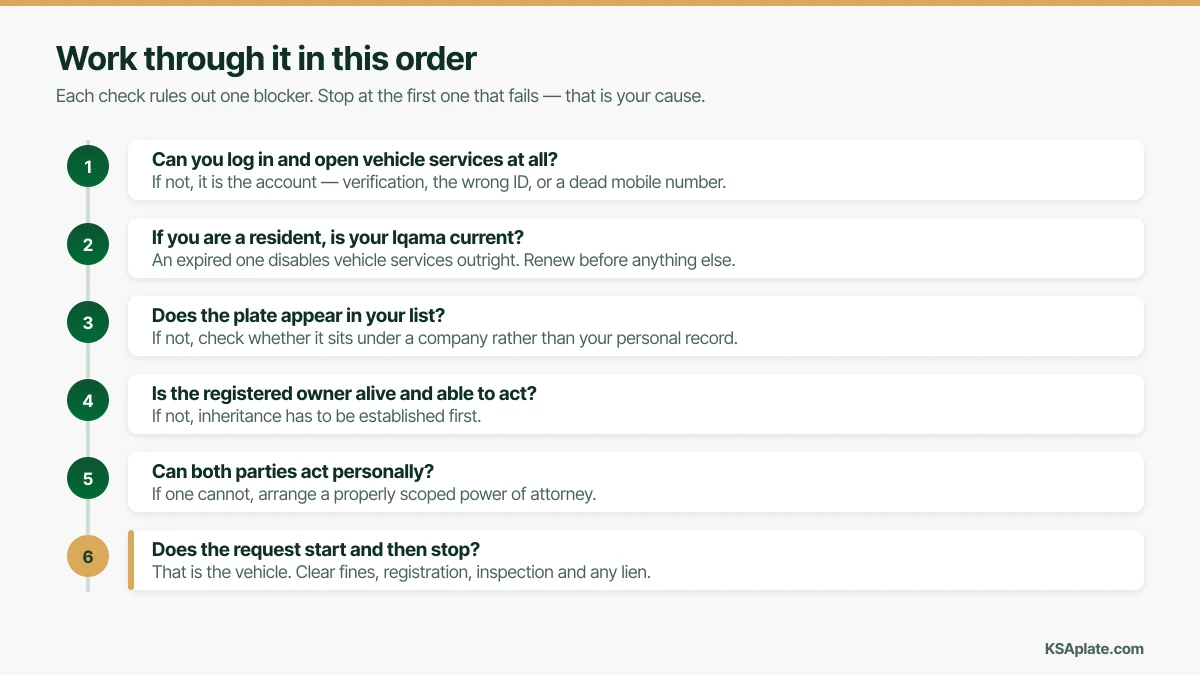
When the request starts and then stops, the obstacle is usually the car rather than the people. Absher validates the vehicle before it will move a plate on or off it.
Unpaid fines, an expired registration, an overdue periodic inspection or an unsettled bank lien each block the transfer independently. Any one of them is enough. The refusal does not name which, which is exactly why this blocker gets misread as a system fault.
Work through them in order rather than guessing, because they are sequential: lapsed insurance stops the registration renewal, and the expired registration is what stops the transfer. The full chain is set out in why a plate transfer gets refused, and the insurance dependency specifically in how a transfer interacts with your policy.
Key takeaway: A request that starts and then halts is a vehicle problem. A service that never opens is an account problem. The two feel identical and have nothing in common.
What a traffic department visit does and does not solve
Visiting a traffic department branch does not produce a plate transfer. Branches handle identity, documentation and exception cases; the transfer itself remains an Absher operation.
That distinction is worth being precise about, because the two get conflated. A branch can help with the things that feed into a transfer — resolving a document problem, dealing with an exceptional case that has no online path. It does not perform the transfer as an alternative to the platform.
Which means a trip is only worth making once you know which blocker you have. Turning up with "the app will not let me" produces the same answer as reading this page: identify the cause first. For the ordinary path once your blockers are cleared, follow the standard Absher transfer guide.
Work through it in this order
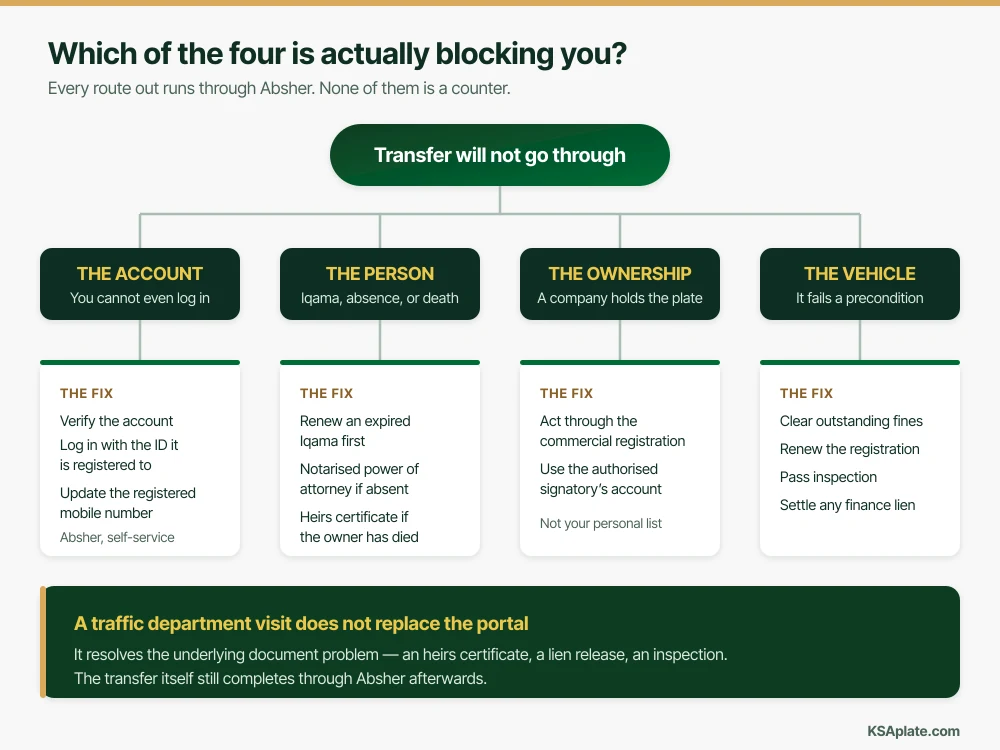
Diagnosis is faster than it looks, because the six blockers separate cleanly. Six checks, in this order, resolve nearly every case.
- Can you log in and open vehicle services at all? If not, it is the account — verification, the wrong ID, or a dead mobile number.
- If you are a resident, is your Iqama current? An expired one disables vehicle services outright. Renew before anything else.
- Does the plate appear in your list? If not, check whether it sits under a company rather than your personal record.
- Is the registered owner alive and able to act? If not, inheritance has to be established first.
- Can both parties act personally? If one cannot, arrange a properly scoped power of attorney.
- Does the request start and then stop? That is the vehicle. Clear fines, registration, inspection and any lien.
Steps one and two account for the majority of cases and cost nothing to check. Step six is where the real work usually is, because clearing a vehicle can take days rather than minutes.
One thing worth stating plainly, because it saves wasted effort: none of these six is solved by finding a different person to ask. They are conditions, not decisions. Nobody at a counter can waive an expired Iqama or an unsettled lien, which is why the fix is always to clear the condition rather than to escalate it.
Frequently asked questions
Can I transfer a Saudi licence plate without using Absher?
Can I go to a Muroor branch and transfer a plate there instead?
Why does Absher say the service is unavailable rather than refusing my request?
My Iqama has expired. Can I still sell my plate?
The seller is abroad. Is there an offline way to complete the transfer?
Can I buy a plate from someone whose Absher account is not verified?
The plate is not showing in my Absher account. Where has it gone?
Does a bank lien on the car block a plate transfer?
How long does it take to clear a blocked transfer?
Is there any case where a plate transfer happens outside Absher?
What to do next
Run the six checks in order before you do anything else. Most blocked transfers turn out to be the first two, and both cost nothing but a few minutes to confirm.
If your side is clear and you are still choosing a plate, value it before you commit. The free plate value calculator estimates from digit count, pattern and letters, and you can check that against what similar numbers are asking on the plate marketplace.