


Last updated: 5 September 2026
TL;DR:
- A written-off car does not have to take the plate with it. The plate is a separate asset in the record, and it survives the vehicle — but only if it is moved before the wreck changes hands.
- The window closes at one specific moment: when ownership transfers to the insurer as part of the settlement. Before that point the plate is yours to move. After it, the plate sits on a vehicle that belongs to someone else.
- Nobody in the process will remind you. The assessor values the car. The insurer settles the car. Neither is looking at what the number on it is worth.
- Theft is the hardest case, because there is no vehicle in front of you and the claim can run for weeks before anything is settled.
- Act while the car is still in your name. Moving a plate to another vehicle you own, or holding it, is an ordinary Absher operation — it only becomes impossible once the record has moved.
Quick answer: When an insurer declares your car a total loss in Saudi Arabia, the settlement transfers the vehicle into the insurer's name so it can be sold as salvage. Anything still attached to that vehicle record goes with it, including a premium plate. To keep the number you have to separate it from the car before the ownership transfer completes, using the plate services in Absher.
The short answer, and the window it depends on
A licence plate is a separate asset from the vehicle it is fitted to, but the two share one record until somebody separates them. A total-loss settlement does not separate them. It moves the whole record, plate included, to the insurer.
That is the entire problem in one sentence. The plate is not destroyed with the car, and it is not confiscated. It is simply carried along by a transfer that was about something else, because nothing in the settlement process asks whether the number should stay behind.
The practical consequence is a deadline rather than a rule. For as long as the car is registered to you, the plate on it is yours to move. Once the vehicle belongs to the insurer, the plate is attached to property you no longer own, and getting it back becomes a negotiation instead of a procedure.
Key takeaway: Nothing about a write-off destroys a plate. What destroys the plate is a transfer that happens while the number is still attached to the car.
What a total loss actually means here
A total loss is an insurer's decision that paying out the vehicle's value costs less than repairing it. It is an accounting judgement about the car, not a statement about whether the car is physically finished.
Insurers in the Kingdom generally split it two ways. A technical total loss is a vehicle that cannot be safely repaired at all. An economic total loss is a vehicle that could be repaired, but where the repair bill passes a threshold against the car's value — commonly cited at around half. The second kind is far more common, and it surprises owners because the car in the yard often looks fixable.
Both kinds end the same way. The insurer pays you an agreed value, takes possession of the wreck to sell as salvage, and the vehicle leaves your name through the traffic record maintained by the Ministry of Interior. Reported settlement timelines put the payment within roughly fifteen working days of the vehicle being handed over and the ownership moved — which tells you something useful: the ownership transfer comes before the money. Confirm the exact sequence and thresholds with your own insurer, because policy wording varies.
Key takeaway: A total loss is a decision about cost, not damage. A car you would happily have repaired can still be written off, and the plate is exposed either way.
Why the plate is the part nobody mentions
Every party in a total-loss claim is measuring the vehicle, and a plate's value lives entirely outside that measurement. The number could be worth more than the car and still not appear anywhere in the file.
The assessor prices bodywork, mechanical damage and market value for that make and model. The insurer applies the policy. The salvage buyer bids on parts and metal. None of those three has any reason to look at whether the registration is a four-digit ordinary number or a two-digit number that took years to acquire.
Compare it to a house sale where a valuable painting is hanging in the hallway. The surveyor values the building. If nobody takes the painting off the wall before completion, it goes with the house — not because anyone decided it should, but because it was attached to the thing being transferred. A plate on a written-off car is the painting.
This is also why the mistake clusters among people who are otherwise careful. They handle the claim correctly, answer everything the insurer asks, and lose the plate precisely because they were following the process rather than looking past it. If you are not sure what your number is actually worth, run it through the plate valuation method before you agree to anything.
What's your plate worth?
Get an instant, free estimate with our plate value calculator.
Calculate My Plate's ValueThe separation window: five stages, one hinge
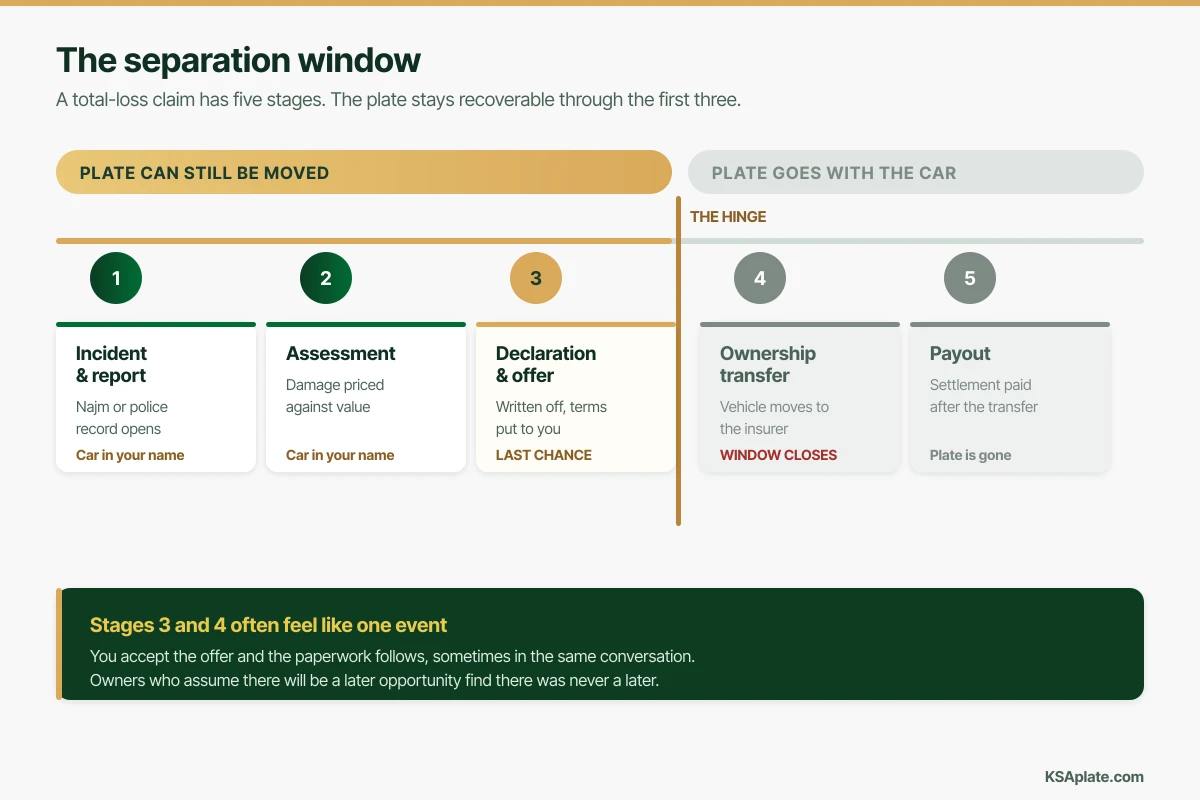
A total-loss claim runs through five stages, and the plate stays recoverable through the first three. Knowing which stage you are in tells you immediately whether you still have a choice.
The stages are: the incident and the report; the assessment; the total-loss declaration and settlement offer; the ownership transfer to the insurer; and the payout. The hinge is the fourth. Everything before it is preparation, and the car is still yours throughout. The moment the transfer completes, the plate is attached to a vehicle in someone else's name.
What makes this dangerous is that stages three and four often feel like one event. You accept the offer and the paperwork follows, sometimes within the same conversation. Owners who assume they will have a separate opportunity later discover there was never a later — the acceptance and the transfer were the same step in practice.
The first stage sets the record everything else runs on, which is why the accident report itself matters more than it looks. A claim that starts with a clean report moves predictably, and a predictable timeline is what lets you act inside the window rather than after it.
Key takeaway: Ask one question the moment a write-off is mentioned: has the vehicle left my name yet? Everything else follows from the answer.
Four loss events, four different answers
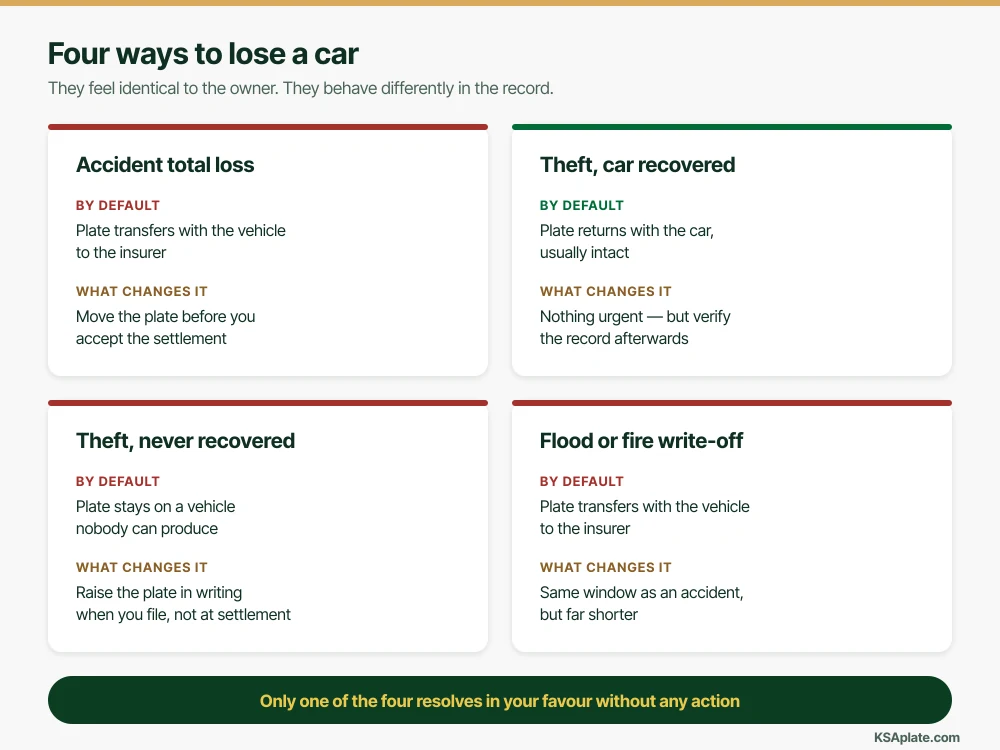
Four different events end a car's life, they feel identical to the owner, and they behave differently in the record. The difference is whether you have physical access to the vehicle and whether the claim resolves quickly.
| How the car was lost | What happens to the plate by default | The action that changes it |
|---|---|---|
| Accident total loss | Transfers with the vehicle to the insurer | Move the plate before accepting settlement |
| Theft, car recovered | Returns with the car, usually intact | Nothing urgent; verify the record afterwards |
| Theft, car never recovered | Stays on a vehicle nobody can produce | Raise the plate with the insurer at claim stage |
| Flood or fire write-off | Transfers with the vehicle to the insurer | Same window as an accident, but shorter |
Read the middle column carefully. Only one of the four resolves in your favour without any action, and it is the one where you get the car back. In the other three the default outcome is that you lose the number, and the difference between them is only how much time you have.
Total loss after an accident
An accident write-off is the most recoverable case, because the car is in front of you and the timeline is visible. You know when the assessment happened and you know when the offer arrived.
The sequence that works is simple. When the assessor signals that a write-off is likely, treat that as the starting gun rather than waiting for a formal declaration. Move the plate onto another vehicle you own, or arrange to hold it, while the car is still registered to you. Then accept the settlement with an ordinary plate on the wreck.
The mechanics are the same ones people use when changing cars voluntarily — the service that moves a plate between vehicles is already documented in the plate exchange guide, and the retention route in keeping your plate when you change cars. Nothing about a claim makes those services unavailable. What changes is that you now have a deadline attached to them.
Key takeaway: Do not wait for the declaration letter. The moment a write-off becomes likely, the plate work should start.
Theft, where the window never opens cleanly
Theft is the one case where you cannot separate the plate from the car, because you do not have the car. The plate is physically gone with the vehicle and administratively still attached to it.
Two things follow. First, the claim runs on a waiting period — insurers hold a stolen-vehicle claim open while recovery is still plausible, and that period can stretch for weeks. Second, when the claim finally settles, the vehicle transfers to the insurer in the same way a wreck would, except there is no wreck to hand over.
The move that helps is raising the plate explicitly and early, in writing, at the point you file the claim rather than at settlement. A premium number on a stolen vehicle is an unusual enough situation that it needs to be visible in the file from the start. The wider recovery sequence, including what to do in the first hour, is set out in the theft prevention and recovery guide.
If the car is recovered, the situation usually resolves itself and the plate comes back with the vehicle. That is the good outcome, and it is worth noting that it is also the most common one. Recovery does not make the record automatically correct, though — check that the registration reads the way it did before.
Flood and fire write-offs
Flood and fire produce the same settlement mechanics as a collision, but on a compressed timeline. Water and fire damage are assessed faster because the verdict is rarely in doubt.
A car that has sat in standing water is usually written off on sight of the water line, and the assessment that would take a week after a collision can take a day. That speed is the risk. Owners who would have had time to think after a crash find the settlement already drafted.
There is a second wrinkle specific to water damage. Flood-damaged cars have a way of reappearing on the used market later, which is exactly why the salvage chain is watched — the tells are catalogued in spotting a flood-damaged car. A distinctive plate travelling onward with a car like that is not a small administrative untidiness. It attaches a number you are known for to a vehicle with a history.
Key takeaway: The faster the write-off is obvious, the less time you have. Flood cases give you days where a collision might give you weeks.
What holding a plate without a car changes
A plate does not need to sit on a vehicle to belong to you. Distinctive plates bought through the official auction can be held in a digital plate wallet in Absher rather than registered to a car, with an ownership document available for the plate itself.
That matters here for one reason: it means "I do not have another car to move it to" is not the obstacle it appears to be. The alternative to moving a plate onto a second vehicle is not leaving it on the wreck. Holding is a real option, and it is the option most people in a write-off do not know exists.
The limits are worth being precise about, because they are easy to overstate. Wallet holding is documented for plates acquired through the auction route, and eligibility for holding a plate at all still depends on who you are — the constraints by residency status are set out in how many plates you can own. Check your own case in Absher rather than assuming.
Do it in this order
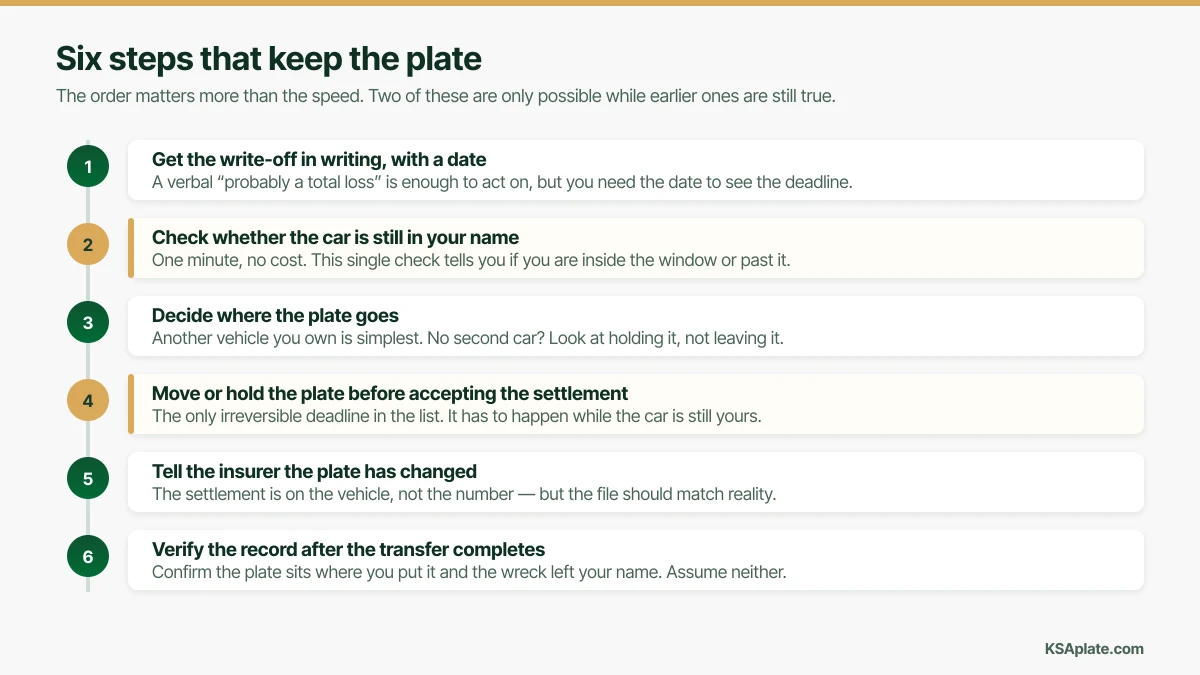
Six actions, in sequence, cover every version of this situation. The order matters more than the speed, because two of the steps are only possible while earlier ones are still true.
- Get the write-off in writing, with a date. A verbal "it is probably a total loss" is enough to start acting on, but you need the written version to know where the deadline sits.
- Check whether the car is still in your name. Open the vehicle record in Absher, or through the National Platform. This single check tells you whether you are inside the window or past it.
- Decide where the plate goes. Another vehicle you already own is the simplest destination. If there is no second car, look at holding it rather than defaulting to leaving it.
- Move or hold the plate before accepting the settlement. This is the step that has to happen while the car is still yours, and it is the one people postpone.
- Tell the insurer the plate has changed. The settlement is on the vehicle, not the number, but the file should match reality — and the policy-to-vehicle relationship is where mismatches cause trouble later.
- Verify the record after the transfer completes. Confirm the plate shows where you put it and the wreck left your name. Do not assume either.
Steps two and four are the load-bearing ones. Step two costs nothing and takes a minute. Step four is the only irreversible deadline in the list.
One thing worth stating plainly: none of this requires anyone's permission. These are ordinary self-service operations, and the reason they fail is timing rather than eligibility. Nobody refuses the request — the request simply becomes impossible once the vehicle has moved.
What acting costs, and what waiting costs
Moving a plate costs an ordinary transfer fee; losing one costs whatever the number is worth. The asymmetry is the whole argument, and it is unusually lopsided even by insurance standards.
A plate move is priced like any other plate operation — a modest administrative fee, in the same range as the transfer costs set out in plate fees and VAT. Against that sits the market value of a distinctive number, which for a short or patterned plate can run to many multiples of what the written-off car was worth in the first place.
That is the part which makes this worth planning rather than improvising. On an ordinary four-digit plate the calculation is genuinely marginal and it is reasonable to let it go with the car. On a two-digit or a strong repeating number, the fee is a rounding error against the exposure, and the only thing standing between you and the loss is whether anybody thought about it during a stressful week.
Key takeaway: Ordinary plate, ordinary decision. Distinctive plate, and the fee is not the thing you should be weighing.
Frequently asked questions
If my car is written off, do I automatically lose the licence plate?
When exactly is it too late to save the plate?
Can I move the plate before the insurer has formally declared a total loss?
What if I do not have another car to move the plate onto?
My car was stolen and never found. Is the plate gone too?
Does the insurer care which plate is on the wreck?
Can I buy my own plate back from the insurer afterwards?
Does a write-off affect what the plate is worth?
What about a flood-damaged car that the insurer writes off?
I already accepted the settlement. Is there anything left to try?
What to do next
If a write-off is on the table right now, do step two before anything else: open the vehicle record and confirm the car is still in your name. That check takes a minute and it decides which of the two situations you are in.
If you are past it and the number is gone, the practical move is replacing it rather than chasing it. Value what you are looking for with the free plate value calculator, then compare that against what similar numbers are actually being asked for on the plate marketplace.
Written by Khalid Al-Rashid, who reviews plate valuation and Absher transfer procedure for KSAplate.com. Last reviewed 5 September 2026. Method note: the claim sequence described here reflects publicly documented Saudi motor-claim practice and the plate services published by Absher; total-loss thresholds and settlement timelines vary by insurer, so confirm the specifics in your own policy before acting on a deadline.