
Last updated: 14 August 2026 · 13 min read
If your temperature gauge is climbing, switch the air conditioning off, turn the cabin heater to maximum, and pull over safely — those three actions buy you the minutes that decide between a hose repair and a new cylinder head. Engine overheating is the most expensive summer failure in Saudi Arabia because the damage compounds by the kilometre. A stuck thermostat costs little; the head gasket it destroys twenty minutes later does not. The gauge is not a warning to finish your trip. It is a warning to stop.
Nothing on a Saudi road converts a small bill into a catastrophic one faster than driving "just to the next exit" with the needle in the red.
- Stop driving. Immediately. Continuing with the gauge in the red risks a warped cylinder head, a blown head gasket or a seized engine — repairs many times the cost of the original fault.
- Heater on full is a real emergency tool. The cabin heater is a second radiator; running it dumps engine heat into the cabin and can drop the gauge while you find somewhere to stop.
- Never open a hot radiator cap. The system is pressurised and the coolant is above boiling point — opening it sprays scalding liquid. Wait until the engine is cold.
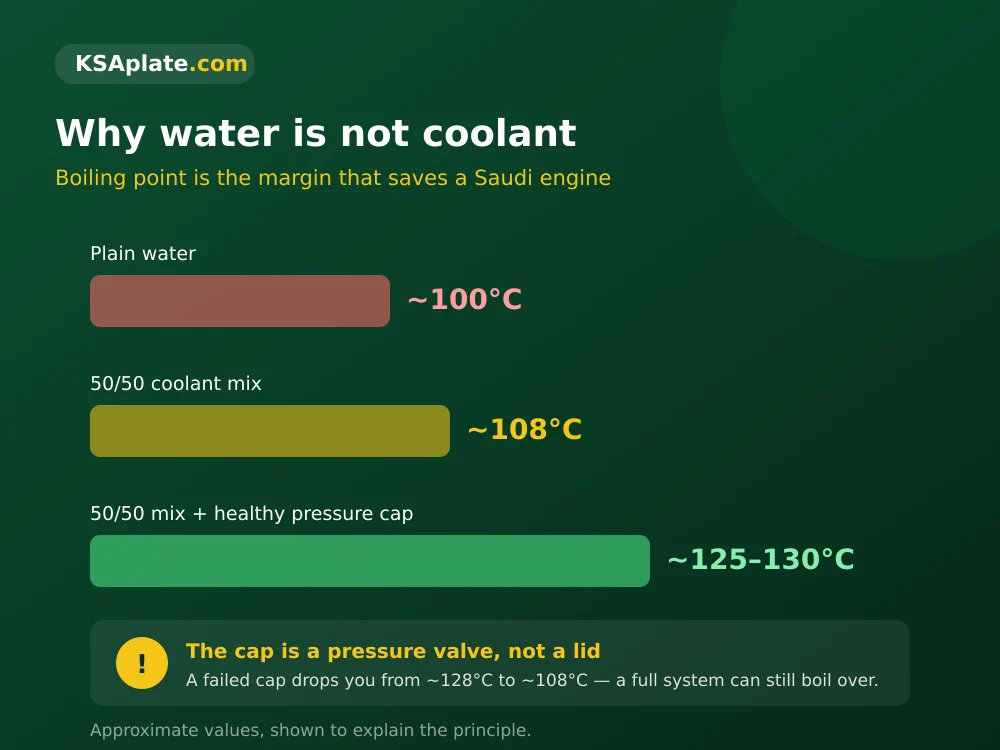
- Plain water is not coolant. Water boils at about 100°C; a proper 50/50 mix with a healthy pressure cap holds off boiling until roughly 125–130°C. In Saudi heat that margin is the whole game.
- Cools on the highway, overheats in traffic points at airflow — a dust-blocked radiator or a dead cooling fan, not necessarily low coolant.
Why engines overheat in Saudi Arabia
Engine overheating is what happens when the cooling system can no longer move heat out of the engine faster than combustion creates it. Every engine makes roughly the same heat in Riyadh as it does in a mild climate — but the system's ability to shed that heat depends on the temperature difference with the outside air, and in a Saudi summer that difference collapses.
When the National Center for Meteorology is recording highs in the high forties, a radiator designed to dump heat into 35°C air is working with a fraction of its intended margin. Add the local multipliers — fine dust packing the radiator fins, long idling in city traffic with no ram airflow, and the air conditioning running at full load all day — and a cooling system that would survive years elsewhere fails here in a single season.
Key takeaway: overheating in the Kingdom is rarely one dramatic failure. It is a system with no margin left, pushed over the edge by heat, dust and idling — the same three forces behind premature battery death and weak air conditioning.
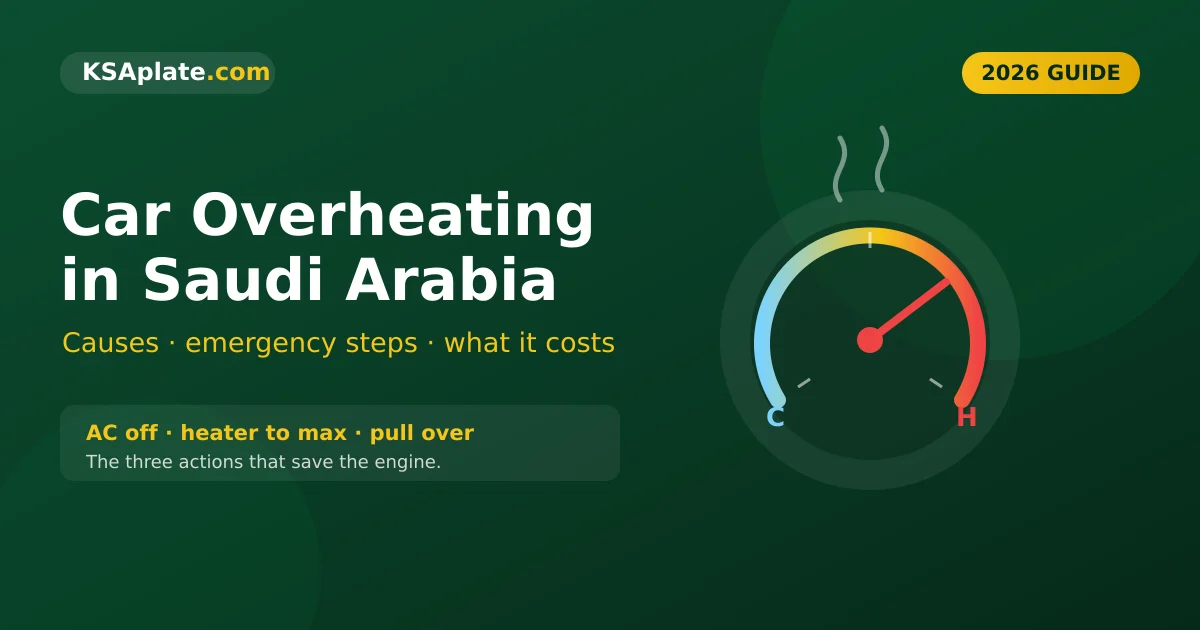
Read the gauge: the three zones
The temperature gauge is a triage instrument, and what you should do depends entirely on which zone the needle is in. Most drivers treat it as a single warning light, which is why they either panic at a normal reading or keep driving through a critical one.
| Gauge zone | What it means | What to do |
|---|---|---|
| Normal — needle steady near the middle | Thermostat is regulating correctly | Nothing. A gauge that sits mid-scale and does not wander is healthy. |
| Rising — creeping above normal, especially in traffic | Cooling capacity is marginal: airflow, coolant level or fan | AC off, heater to max, keep moving if safe, plan to stop. Do not ignore it. |
| Red / warning light | Coolant near or past boiling; damage clock has started | Pull over safely and switch off. Every extra kilometre multiplies the repair. |
| Steam or a sudden drop to cold | Boil-over, or coolant lost so completely the sensor is reading air | Stop immediately. A gauge that falls to cold mid-overheat is worse news, not better. |
That last row catches people out. When the coolant is gone, the temperature sensor is sitting in hot vapour rather than liquid, and it can read low or erratic while the metal around it is glowing. Trust steam, smell and loss of power over a needle that suddenly looks fine.
Key takeaway: a rising needle is a request to plan a stop; a red needle is an instruction to stop now.
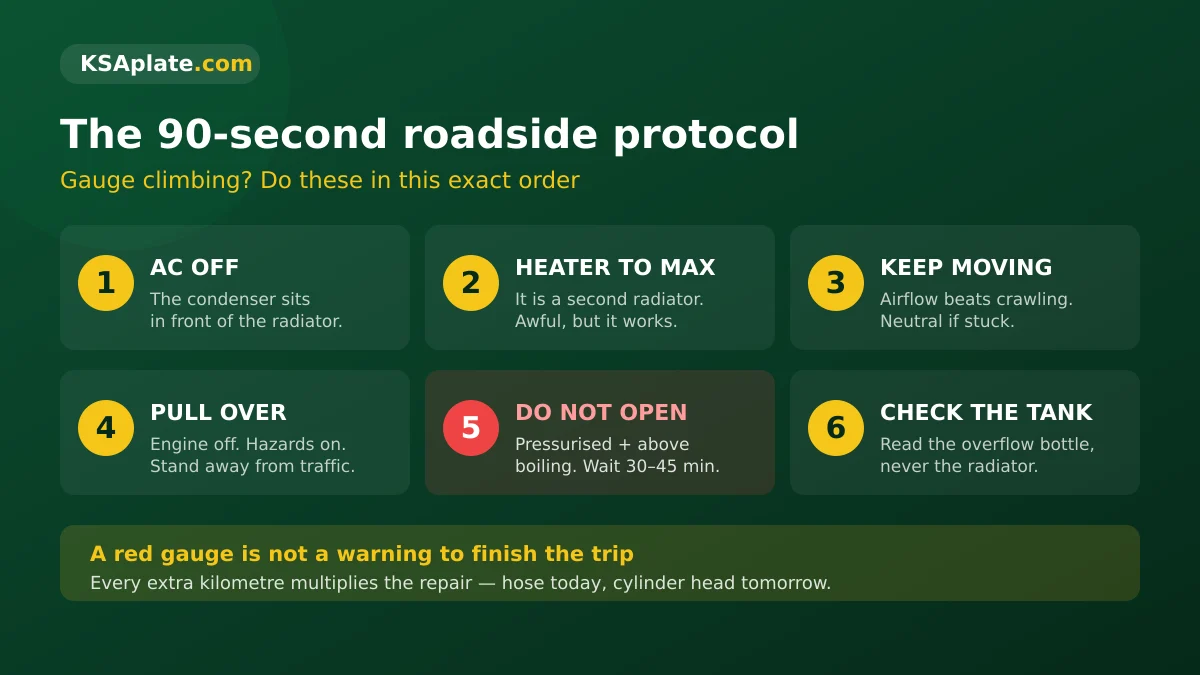
The 90-second roadside protocol
The roadside overheating protocol is a fixed order of actions that protects the engine first and diagnoses second. Follow it in sequence — improvising here is how people get burned or destroy an engine that was still saveable.
- Switch the AC off. The air conditioning condenser sits in front of the radiator and adds heat exactly where you cannot afford it. This alone sometimes stops the climb.
- Turn the cabin heater and fan to maximum. The heater core is a small second radiator. It is unpleasant at 47°C, but it genuinely pulls heat out of the engine and can buy you several minutes.
- Get out of stop-start traffic if you safely can. Steady movement gives the radiator airflow; crawling gives it none. If you are stuck, shift to neutral and raise the idle slightly rather than creeping.
- Pull over safely and switch the engine off. Choose shade if any exists. Hazard lights on, and stand well away from the road — the roadside safety rules matter more here than the mechanical problem.
- Wait. Do not open the radiator cap. Give it a minimum of 30–45 minutes. The system is pressurised and its contents are above the normal boiling point; opening it hot sprays scalding coolant and steam. For serious burns, Saudi Red Crescent emergency medical response is reached on 997.
- Once cold, check the expansion tank — not the radiator. The translucent overflow bottle shows the level safely at a glance. If it is empty, you have a leak, and topping it up to drive on is a temporary measure at best.
The heater trick feels like a punishment in a Saudi summer. It is also the only free cooling capacity your car has left when the gauge is climbing.
Key takeaway: AC off, heater on, stop safely, wait, then look. In that order, every time.
What's your car worth?
Get a free instant estimate based on real Saudi market data — then sell it on KSAplate with direct WhatsApp contact.
Value My Car — FreeThe 7 causes, ranked by how often they happen here
Overheating has a small number of root causes, and in Saudi conditions they do not occur with equal frequency. This ranking reflects what actually fails in the Kingdom, paired with the symptom that identifies each one and the rough scale of the repair.
| # | Cause | The tell | Cost tier |
|---|---|---|---|
| 1 | Coolant leak (hose, reservoir, gasket) | Level drops repeatedly; sweet smell; puddle under the car | Low–medium |
| 2 | Dust-blocked radiator | Fine in motion, climbs in traffic | Low |
| 3 | Failed cooling fan or fan clutch | Overheats at idle, cools on the highway | Medium |
| 4 | Stuck-closed thermostat | Gauge spikes fast, often soon after starting | Low |
| 5 | Weak or wrong radiator cap | Boil-over and overflow despite a full system | Lowest |
| 6 | Failing water pump | Whine or bearing noise, then rapid overheating | Medium–high |
| 7 | Head gasket failure | White exhaust smoke, bubbles in the tank, milky oil | Highest |
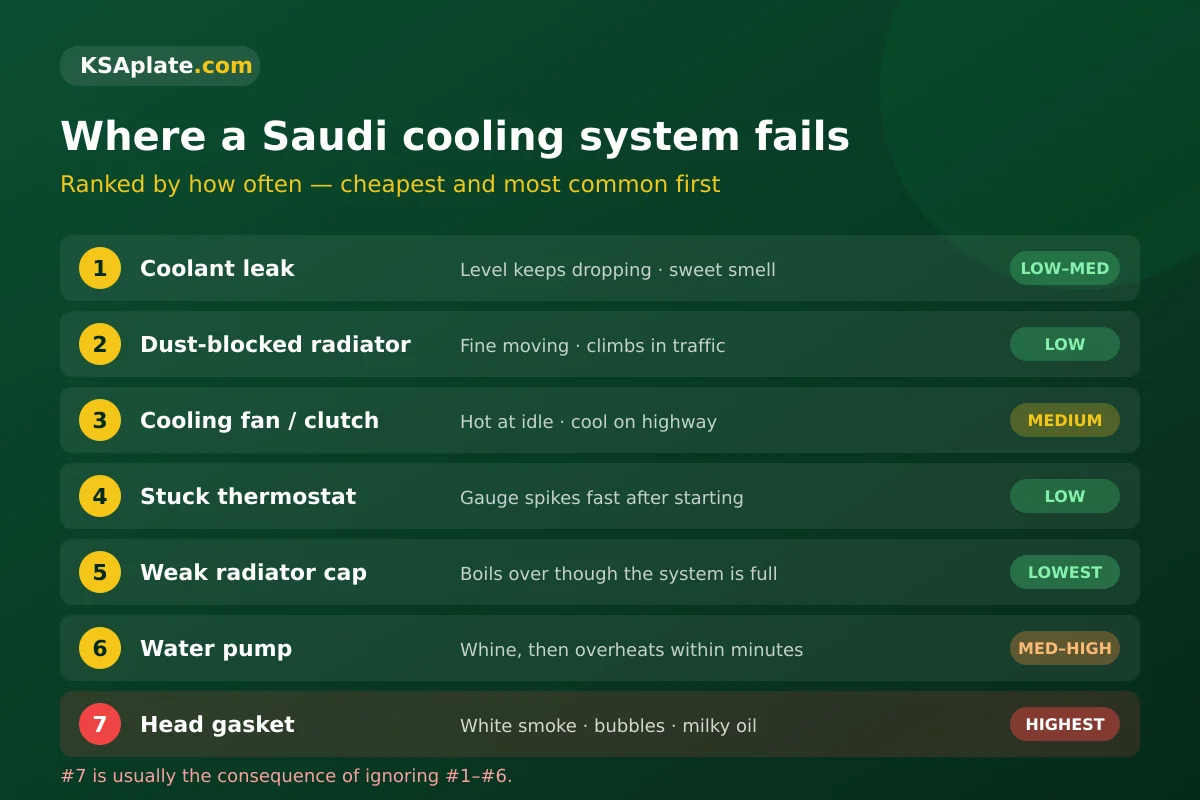
Read that table as a diagnostic sequence rather than a list. Items 2 and 3 both produce the classic "fine on the highway, hot in traffic" pattern and are the cheapest to rule out, so check them first. Item 7 is usually a consequence of ignoring items 1 through 6 — which is why the same fault can cost a modest amount on Tuesday and a fortune by Friday.
Key takeaway: the symptom pattern tells you where to look. Highway-versus-traffic behaviour is the single most useful clue you can give a workshop.
Coolant chemistry: why water alone fails
Coolant is not just water with dye in it — it is a mixture engineered to raise the boiling point, lower the freezing point, and protect metal from corrosion. In Saudi Arabia the boiling point is the property that saves engines, and it is exactly the one plain water cannot deliver.
The physics is simple. Water boils at roughly 100°C. A standard 50/50 coolant-and-water mixture pushes that to about 108°C. Add a healthy pressure cap holding the system at around one bar above atmospheric, and the boiling point climbs to roughly 125–130°C. That margin is what stops an engine sitting in Riyadh traffic from boiling over. Fill the system with tap water and you delete most of it — and you add scale and corrosion that block the radiator you just paid to clean.
| What is in the system | Approximate boiling point | Verdict for Saudi use |
|---|---|---|
| Plain water, no pressure | ~100°C | Emergency only — get it flushed |
| 50/50 coolant mix, no pressure | ~108°C | Still not enough on its own |
| 50/50 mix + healthy pressure cap | ~125–130°C | The intended design margin |
Coolant types you will be offered
Workshops in the Kingdom stock several chemistries, and mixing them is a genuine mistake rather than a preference. Older IAT (inorganic) coolants are conventional green formulas with short service lives. OAT (organic acid) and HOAT (hybrid) coolants last far longer and are commonly recommended in Gulf conditions for their durability in sustained heat. Use what the manufacturer specifies, and if the colour in the tank does not match what you are adding, ask before pouring — mixed chemistries can gel and block the system.
Key takeaway: water gets you to a workshop. It does not get you through a Saudi summer.
The radiator cap: the cheapest part that matters most
The radiator cap is a pressure valve, not a lid. It holds the cooling system above atmospheric pressure, and that pressure is what raises the coolant's boiling point into the safe range described above. A cap that no longer seals turns a well-designed system into an open pot of hot liquid.
This is why a car can overheat with a completely full radiator and fresh coolant. The mixture is correct, the level is right, but without pressure the coolant boils at 108°C instead of 128°C, vents into the overflow, and the level drops for reasons the owner cannot see. Drivers then chase expensive theories — water pump, thermostat, head gasket — when the failed component is among the least expensive parts on the entire car.
Key takeaway: if you are diagnosing repeat overheating or unexplained coolant loss, replace the cap early. It is cheap, fast, and eliminates a whole category of misdiagnosis.
Dust, the radiator and the airflow problem
The radiator sheds engine heat into passing air, so anything that blocks airflow through it directly reduces cooling capacity. In Saudi Arabia the blocker is almost always fine dust, packed into the fins until the surface can no longer transfer heat.
The diagnostic signature is unmistakable: the car is comfortable at 120 km/h on the highway and climbs toward the red in city traffic. At speed, ram air forces its way through a partly blocked core; at idle, only the fan is working and a blocked core gives it nothing to work with. The identical logic explains a weak air conditioner, because the AC condenser sits in the same airstream — which is why AC that only cools when moving and an engine that only stays cool when moving are frequently the same underlying problem.
Clean it gently. Low-pressure water from the engine side outward, never a pressure washer held close, and never bend the fins — flattened fins block airflow permanently and cost more than the cleaning saved. Make it part of the Saudi maintenance routine rather than a reaction to a hot gauge.
Key takeaway: cools on the highway, heats in traffic means airflow. Check the radiator face and the fan before spending on internal parts.
What keeps breaking if you keep driving
Overheating damage is progressive, which means the repair bill is a function of how long you kept driving after the gauge went red. Aluminium cylinder heads distort as they overheat, and once the head warps the gasket below it can no longer seal.
The escalation runs in a predictable order. First, coolant boils and vents — a leak repair. Then the head gasket fails, mixing coolant and combustion gases: white exhaust smoke, bubbles in the expansion tank, milky residue on the oil cap. Then the cylinder head itself warps and needs machining or replacement. At the end of the ladder, bearings starve and the engine seizes, which on many cars costs more than the vehicle is worth. Each step is several times the price of the one before it.
| Stage | What has happened | Relative cost |
|---|---|---|
| 1 | Boil-over, coolant lost, hose or cap fault | ×1 |
| 2 | Head gasket failed | Many times ×1 |
| 3 | Cylinder head warped — machining or replacement | Higher again |
| 4 | Engine seizure | Often exceeds the car's value |
The distance between a cheap repair and a written-off engine is usually about ten kilometres of denial.
If the car will not cool down or you are far from a workshop, do not drive it. Arrange recovery — the options and what your policy covers are set out in our towing and recovery guide, and if the car is still in warranty, check what your coverage includes before authorising work.
The pre-summer cooling check
The pre-summer cooling check is a short spring inspection that catches the cheap faults before the heat converts them into expensive ones. Done in March to May, it costs very little; done in July on a hard shoulder, the same faults cost a great deal more.
- Check the coolant level cold at the expansion tank, and note whether it keeps dropping between checks.
- Have the coolant tested for concentration and condition, and confirm the correct type is in the system.
- Replace the radiator cap if it is old or the system has ever boiled over. It is the cheapest insurance on this list.
- Clean the radiator and condenser face gently, and inspect for bent fins and stone damage.
- Confirm the cooling fans cut in when the engine is hot or the AC is running.
- Squeeze the hoses cold — rock hard, mushy or cracked all mean replace, not wait.
Bundle it with battery, tyres and AC so the car meets summer as a whole, exactly as you would prepare for a long Saudi road trip. Budget it as routine rather than emergency spending using our cost-of-ownership breakdown, and remember that tyre age deserves the same seasonal attention.
Overheating history and what your car is worth
A documented overheating event is one of the few faults that permanently changes what a Saudi buyer will pay, because buyers cannot verify what the heat did to the engine internally. Even after a correct repair, the suspicion of a warped head or a patched gasket follows the car.
Informed buyers test for it directly: they check the oil cap for milky residue, look for bubbles in the expansion tank with the engine running, and watch the gauge through a full warm-up on the test drive. These checks belong in any serious used-car inspection, alongside a proper history check. Sellers should assume every one of them will be performed.
The practical advice runs both ways. If you are buying, an overheating history is a legitimate reason to negotiate hard or walk away. If you are selling, fix the cooling system properly and keep the invoices — documented repair evidence protects your price far better than silence, and it blunts the ordinary depreciation discount that a nervous buyer will otherwise apply on top of any valuation.
Key takeaway: repair the cause, keep the paperwork, and sell with evidence. An undocumented overheating history costs more at sale than the repair ever did.
Cooling system sorted? Sell with the receipts
List your car on the only Saudi marketplace that is also a plate market — and see what your distinctive plate is worth before it leaves with the car.
List my car Value my plateFrequently asked questions
Can I keep driving if my car is slightly overheating?
Why does my car overheat in traffic but not on the highway?
Can I put plain water in my radiator in an emergency?
How long should I wait before opening the radiator cap?
Does turning on the heater really help an overheating engine?
Why is my coolant disappearing with no visible leak?
What are the signs of a blown head gasket?
Is coolant colour a reliable guide to what to buy?
Does running the air conditioning cause overheating?
Should I buy a used car that has overheated before?
Reviewed by Khalid Al-Rashid, Saudi Car & License Plate Market Expert. Temperature and boiling-point figures are approximate engineering values used to explain the principle; cost tiers are relative, not quotes. Confirm your vehicle's coolant specification in the owner's manual and get any repair quoted in writing.
Sources: National Center for Meteorology (ncm.gov.sa) for Saudi summer temperature context; Saudi Red Crescent Authority (emergency 997) for medical response; standard automotive engineering values for coolant boiling points and cooling-system pressure; KSAplate workshop and listing observations, 2026.