TL;DR:
- There are four ways to get a car towed in Saudi Arabia — and which one you use decides whether it's free or costs you. Accident? Najm dispatches a tow at no charge. Breakdown with comprehensive insurance? Roadside assistance is usually already in your policy. Neither applies? You call a private satha (سطحة) and pay directly.
- The flatbed satha is the Saudi default — it loads the whole car flat, the only safe method for a modern automatic, low car, or all-wheel-drive. The cheaper wheel-lift/hook can damage those; insist on a flatbed unless you know your car tolerates otherwise.
- Settle two things before the hook touches the car: the exact destination and the total price. Every surprise charge in the towing business lives in a destination changed mid-tow or a price agreed after loading.
- If the authorities towed it, that's an impound (hajz), not a breakdown — you recover it by clearing the underlying reason (fines, expired registration, an accident hold) through Absher and the traffic department, then paying the release, before the daily storage fee grows.
- A car that needs towing more than once is sending a financial signal. Before paying for the third tow this year, check what the car is still worth against what keeping it costs — the repair-or-exit decision is where real money is saved.
Quick answer: To get a car towed in Saudi Arabia, use one of four routes: for an accident, the Najm app dispatches a tow at no cost; for a breakdown with comprehensive insurance, use the roadside assistance already in your policy; otherwise call a private satha (flatbed tow truck) via a towing app and agree the price and destination before loading. If authorities impounded the car, recover it by clearing the fines or violations on Absher, then paying the release and storage fees.
Towing in Saudi Arabia: the satha reality
Every driver in the Kingdom meets the satha eventually — the flatbed tow truck that is as much a part of Saudi roads as the fuel station. A dead battery in a Riyadh underground car park, an overheat on the Makkah highway in July, a locked transmission after a curb strike, or a car lifted by the traffic department while you were arguing the ticket: all of them end the same way, with a car that cannot move under its own power and a decision about who moves it.
That decision is where money is won or lost, because towing in Saudi Arabia is not one service — it is four different systems that look identical from the roadside and price completely differently. Two of them are usually free and most drivers forget they have them; one is a government process with its own clock (recovering an impounded car); and one is the open market, where the price depends entirely on what you agree before the car is loaded. This guide separates the four cleanly, so that the next time your car stops moving, you already know which call to make. The roadside-survival side of a breakdown — the shoulder, the heat, the wait — is covered in our roadside emergency guide; this article is about the tow itself, from the first phone call to getting the car back.
Flatbed vs wheel-lift: which satha you need
Before the money question comes the equipment question, because the wrong truck can turn a simple tow into a repair bill:
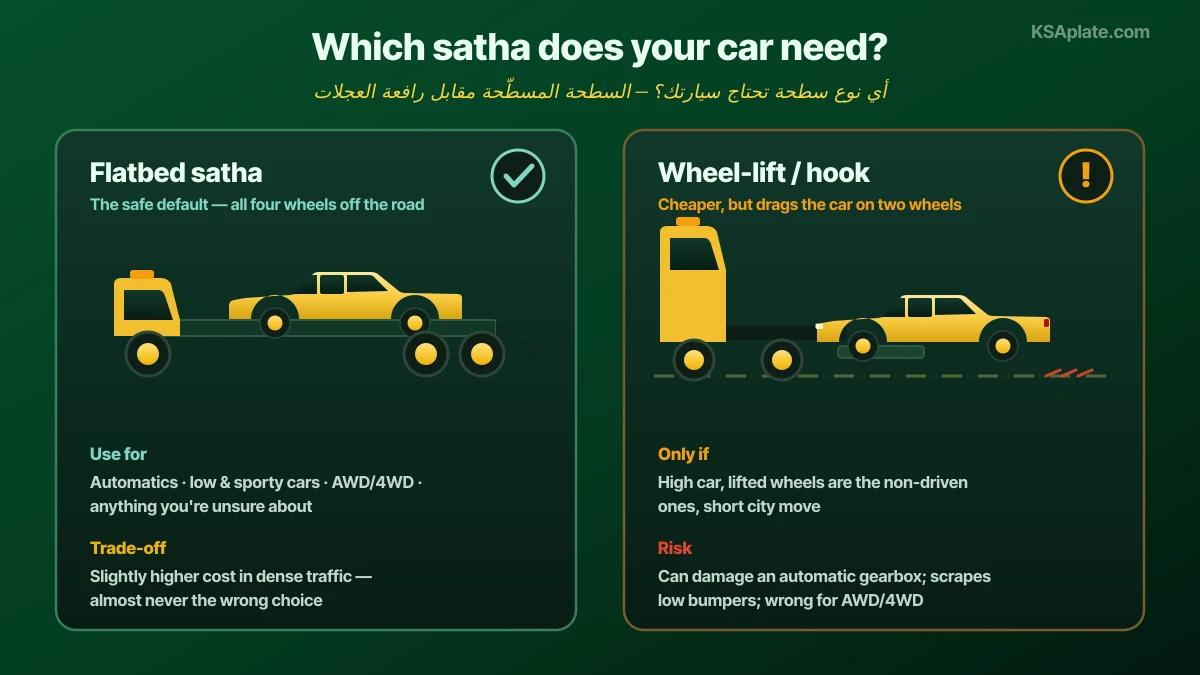
- The flatbed satha (سطحة) — the safe default. The bed tilts to the ground, the car is winched fully onto it, and it travels with all four wheels off the road. This is the correct method for the vast majority of cars on Saudi roads: any automatic transmission, any low or sporty car, any all-wheel-drive or four-wheel-drive vehicle, and any car whose drivetrain you are unsure about. If in doubt, ask for a flatbed — it is the default for a reason.
- The wheel-lift / hook truck — cheaper, narrower use. It raises two wheels and lets the car roll on the other two. It is faster and often cheaper in dense city traffic, but towing an automatic on its driven wheels can damage the transmission, and dragging a low car scrapes bumpers and undertrays. It is acceptable only when the lifted wheels are the driven ones and the car sits high enough — a judgment most drivers should not have to make under stress. Default to the flatbed.
- Heavy recovery — for the stuck, not the broken. A car dropped off a shoulder, bogged in sand, or rolled needs a winch-recovery truck, not a standard satha. This is a different call and a different price; say "recovery" (سحب/إنقاذ), not "tow," so the right truck is dispatched.
| Truck | Best for | Avoid it when |
|---|---|---|
| Flatbed satha | Automatics, low or sporty cars, AWD/4WD, anything you're unsure about — the safe default | Almost never the wrong choice; only downside is slightly higher cost in dense traffic |
| Wheel-lift / hook | A high-riding car whose lifted wheels are the non-driven ones, short city moves | Automatics with driven wheels down, low cars (bumper scrape), any AWD/4WD vehicle |
| Winch recovery | A car off the shoulder, bogged in sand, or rolled — a rescue, not a tow | A simple flat-lane breakdown, where it's overkill and overpriced |
The four ways to get a tow
This is the table that saves the most money, because most drivers pay for a tow they were already entitled to for free. Identify your situation first, then call:
| Route | When it applies | Who pays |
|---|---|---|
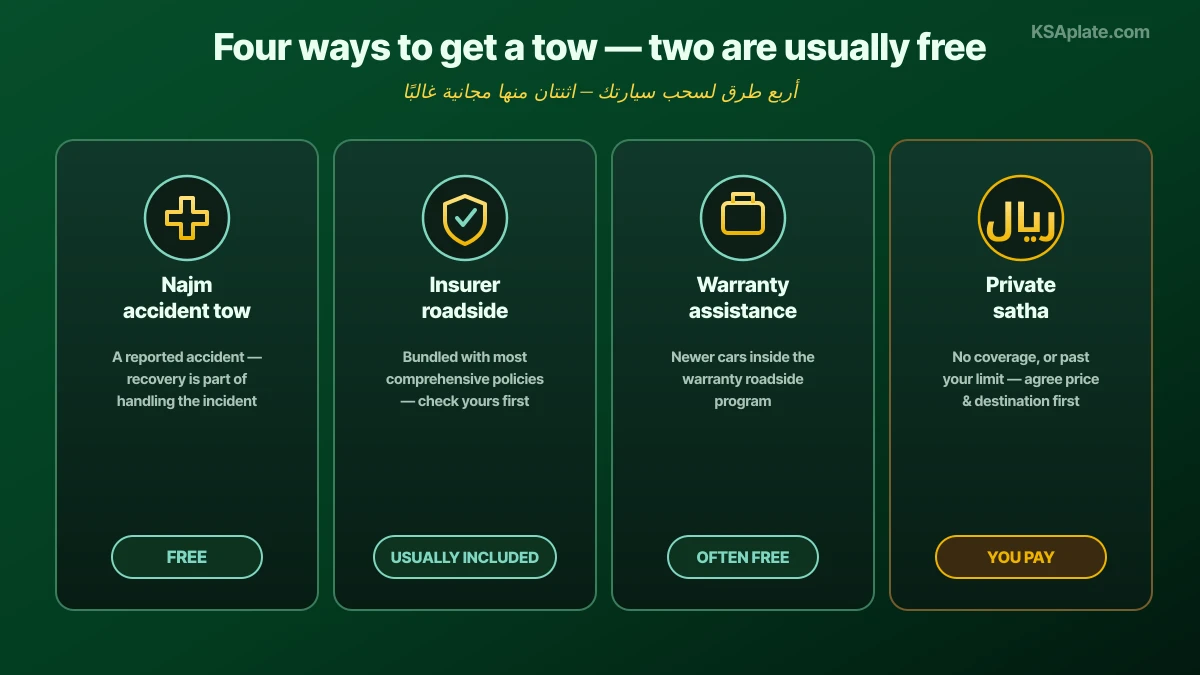
| Najm accident tow | A reported traffic accident — Najm dispatches recovery as part of handling the incident | No charge to you for the accident tow — reported via the Najm app |
| Insurer roadside assistance | A breakdown when you hold comprehensive cover that bundles roadside help (most do) | Included up to a distance/usage limit — check your policy before paying anyone |
| Manufacturer assistance | A newer car still inside its warranty roadside program | Often free — the most forgotten benefit a new car carries |
| Private satha | No coverage applies, or you are past your program's limit | You pay directly — agree price and destination before the hook |
The rule that follows from the table: make the free calls first. After an accident, the tow rides on the Najm report — the full accident procedure, and why the order of your calls affects your payout, is in our Najm accident guide. For a breakdown, your comprehensive insurance very likely already includes roadside assistance with a tow allowance most drivers never use. Only when neither applies do you reach for the open market — and only then does the price become your responsibility.
What's your car worth?
Get a free instant estimate based on real Saudi market data — then sell it on KSAplate with direct WhatsApp contact.
Value My Car — FreeAccident tow vs breakdown tow
These two look identical on the shoulder and work completely differently underneath. Confusing them is the most expensive towing mistake in the Kingdom:
- Accident tow — Najm first, then move. If the car stopped because of a collision, the tow is part of the accident process, not a separate purchase. Report through the Najm app; the recovery is dispatched as part of handling the incident, and the destination is tied to the claim. Paying a passing private satha to move an accident car before the report can complicate both the fault assessment and the insurance payout — the sequence matters.
- Breakdown tow — coverage first, then market. If the car stopped because of a mechanical or electrical failure with no collision, Najm is not the route. Check roadside assistance on your comprehensive policy or your manufacturer program first; only if both are exhausted do you pay a private satha.
- The grey zone: a breakdown that becomes an accident. A car that dies in a live lane and is then struck is an accident from that moment — stop, secure the scene, and report through Najm rather than treating it as a simple breakdown. When in doubt, the accident path protects you better.
What a private tow really costs
When you are paying out of pocket, the price is not fixed by a meter — it is set by three variables you can see before you agree. Understanding them is how you tell a fair quote from an opportunistic one:
- Distance is the base. A short in-city flatbed move is the cheapest tow there is; the price climbs with every kilometer to the destination. This is why agreeing the destination up front is not optional — a workshop across town and a dealer in the next city are very different bills.
- Difficulty adds to it. A car sitting flat in an open lane is a simple load. A car in a tight underground car park, wedged against a wall, dropped off a shoulder, or bogged in sand is a recovery, and it prices like one. Describe the situation honestly on the phone so the quote you get is the quote you pay.
- Time and place move it. Late night, a remote stretch of highway, or peak summer demand all push the number up — the same tow costs more at 2 a.m. on the Taif road than at noon in Riyadh. This is normal market pricing, not a scam; the defense is simply agreeing the figure before loading, never after.
The single discipline that protects you across all three: get the total, to the exact destination, confirmed before the car moves. A quote that is vague on destination or "we'll sort it at the end" is the one to refuse. Ranges vary too widely by city, distance and hour to quote a reliable number here — which is exactly why the confirmed-price-first rule matters more than any figure would.
Before the hook: the five-point checklist
The two minutes before your car is loaded decide whether the tow is uneventful or a dispute. Run this list every time, coverage or not:
- Confirm the price and the destination together. One without the other is half a deal. "How much, to exactly where?" is the whole negotiation.
- Photograph the car before it's loaded. All four sides, the wheels, and any existing damage — exactly like a rental pickup. If the car arrives with a new scrape, that photo is your only evidence.
- Insist on a flatbed unless you're certain otherwise. For any automatic, low, or all-wheel-drive car, the flatbed is not a preference; it is damage prevention.
- Remove your valuables and documents. The istimara, anything in the glovebox, the contents of the boot — a towed car passes through hands and depots. Take what matters with you.
- Note the driver and truck details. Company name, plate, and a phone number. A legitimate satha gives these without hesitation; reluctance is a red flag worth acting on.
Recovering an impounded car (hajz)
Not every tow is one you asked for. When the traffic department (Muroor) moves a car to a government depot, that is an impound — hajz (حجز) — and getting it back is an administrative process, not a phone call to a satha. The mechanism:
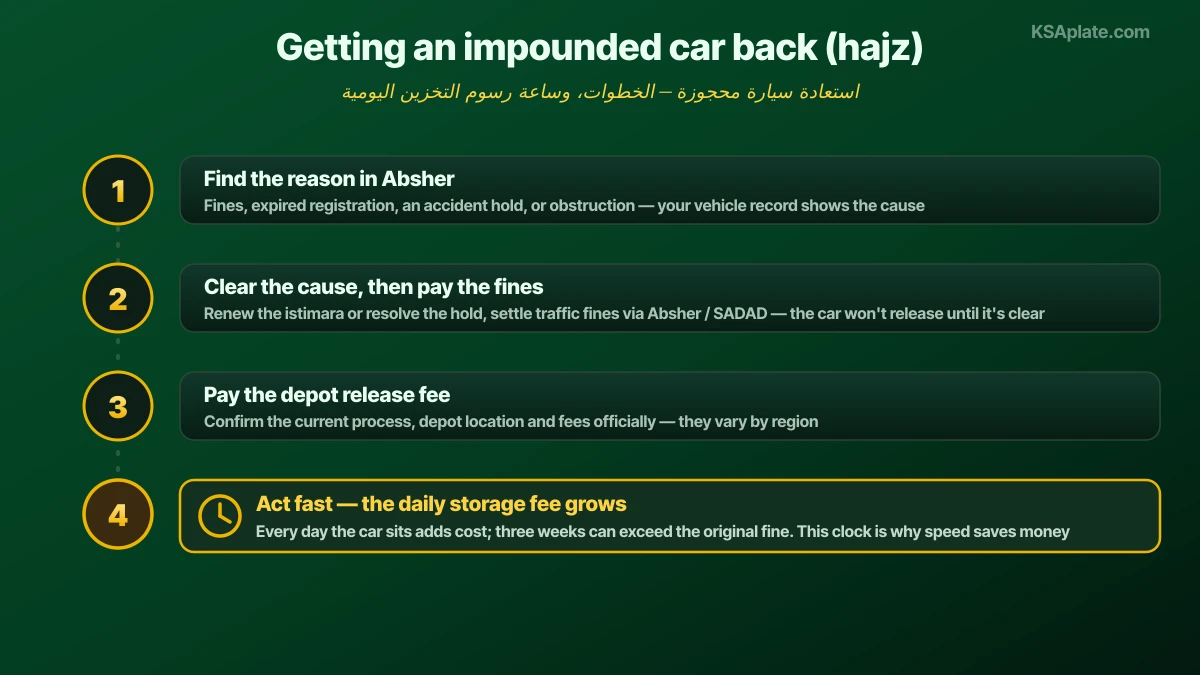
- First, find the reason. Cars are impounded for accumulated violations, an expired or invalid registration, an accident hold, or being parked where they obstruct. The reason is visible in your Absher vehicle record, and it is the thing you must clear first — the car will not be released while the underlying cause stands.
- Clear the cause, then the fines. Settle the outstanding traffic fines and fix whatever triggered the hold — renew the istimara, resolve the accident file, whatever the record shows. Payment runs through the normal Absher/SADAD channels.
- Pay the release and storage, and move fast. The depot charges a release fee and, critically, a daily storage fee that grows for every day the car sits. This is the clock that turns a minor impound into an expensive one — the difference between recovering the car in three days and three weeks can exceed the original fine. Act early.
- Confirm the current process officially. Impound rules, depot locations and fee schedules change and vary by region, so verify the exact steps for your case through Absher or the traffic department directly rather than relying on any single quoted figure.
How to call a satha: apps and numbers
The way Saudi drivers summon a tow has moved almost entirely onto the phone. Your options, in order of who to try first:
- Your insurer's app or hotline. If you hold comprehensive cover, the roadside-assistance button in the insurer's app is the first thing to press — it dispatches a tow that is likely already paid for. The number is on your policy card; save it before you need it.
- The Najm app, for anything accident-related. Report the incident and the recovery is handled as part of it. Do not substitute a private tow for the Najm process on a reportable accident.
- Dedicated towing and roadside apps. Several Saudi apps summon a nearby satha the way a ride-hailing app summons a car, with the quote shown before you confirm — the transparency of an up-front price is their main advantage over a roadside flag-down.
- A known local workshop. Many neighborhood workshops run or partner with a satha and will collect a car they are about to repair, sometimes folding the tow into the job. If you already trust a mechanic, this is often the smoothest path.
Whichever channel you use, the before-the-hook checklist above still applies — an app quote is a starting agreement, not a reason to skip the photos and the destination confirmation.
Highway, desert and cross-GCC tows
Distance changes the towing problem, and Saudi Arabia has a lot of distance. Three situations need their own thinking:
- Highway breakdowns: safety before the tow. On a fast road, securing the scene comes before summoning anyone — car as far onto the shoulder as possible, hazards on, warning triangle back, and everyone out and behind the barrier, not in the car. Only then make the call. The full shoulder-survival routine is in the roadside emergency guide; a tow you survive to receive is the only good tow.
- Desert and remote roads: know your location. A satha cannot reach what it cannot find. Share a precise pin, note the last kilometer marker or exit you passed, and expect a longer wait and a higher price for the distance. This is the scenario where comprehensive roadside coverage with a generous distance allowance pays for itself.
- Cross-GCC and long-haul: settle it before you cross. A car that breaks down abroad, or one you are transporting between countries, is a different arrangement — often a booked flatbed haul rather than an emergency call. Confirm coverage across borders before you drive out; the driving-abroad rules and what your policy does at the border are covered in the insurance guide.
When towing is a sell signal
Here is the question a towing guide is uniquely placed to ask: should this car be towed to a workshop, or towed to its next owner? A single breakdown is bad luck. A second or third tow in a year is data — the car is telling you its reliable life is ending, and every future tow, repair and roadside hour is money spent defending a declining asset.
Before authorizing another expensive repair on a car that keeps stopping, run the honest comparison: enter its real details in the free car value calculator to see what it is still worth, and weigh that against the repair quote in front of you. When the repairs in a year start approaching what the car would sell for, the tow to the workshop is the expensive choice and the tow to a buyer is the smart one. A running car — even a tired one — sells for far more than a non-runner, so the moment to sell is before the failure that strands it, not after. Browse the current market to see what your model trades for today, and when the numbers say exit, list it on KSAplate for free while it still drives. If the car is genuinely finished, the end-of-life playbook — including the plate you should never scrap with it — is in our scrapping guide; and if there is still finance on it, selling a financed car has its own sequence.
Frequently asked questions
How do I call a tow truck in Saudi Arabia?
How much does towing cost in Saudi Arabia?
Is towing free with car insurance in Saudi Arabia?
What is a satha in Saudi Arabia?
Flatbed or wheel-lift tow — which is safer?
How do I get my car back after it was impounded (hajz)?
Should I call Najm or a private tow after an accident?
Can a wheel-lift tow damage an automatic transmission?
What should I do before my car is towed?
Can expats and Iqama holders use towing and recovery services?
My car keeps breaking down and needing tows — should I repair or sell it?
Conclusion
A car that won't move feels like an emergency, but the tow itself is a solved problem the moment you know which of the four systems you're in. Accident: Najm, at no charge, before you move anything. Breakdown with comprehensive cover: the roadside assistance already in your policy. Neither: a private flatbed satha, at a price you confirm to a destination you name before the hook touches the car. Authorities took it: an Absher-and-fines process against a daily clock. Four situations, four different answers — and knowing them turns the worst moment of a driving day into a phone call.
The deeper lesson sits underneath all four: towing is a cost of keeping a car, and a car that keeps needing it is quietly making the case to move on. So handle the tow correctly — free calls first, flatbed for safety, price and destination locked before loading, photos for evidence — and then ask the harder question the roadside is prompting. Check what the car is still worth in the value calculator, look at the live market, and if the repairs are starting to rival the resale, list it on KSAplate for free while it still drives under its own power — because the best tow is the one you never need to call.