
Last updated: 18 August 2026 · 13 min read
In Saudi Arabia the sun does not fade your paint — it destroys the clear coat above it, and once that layer starts peeling no coating on the market can bring it back. That single fact decides how you should spend. Protection is cheap and effective while the clear coat is intact; after it fails, the only real fix is a respray. So the useful question is not "ceramic or PPF" but "what is my paint's condition today, and what is the cheapest thing that keeps it there".
Every paint protection product sold in the Kingdom is preventive. None of them is a cure. Buy them while you still have something worth protecting.
- Clear-coat failure is irreversible. Oxidation dulls it, then it clouds, then it peels. Coatings applied after peeling starts will not restore it — that stage needs a respray.
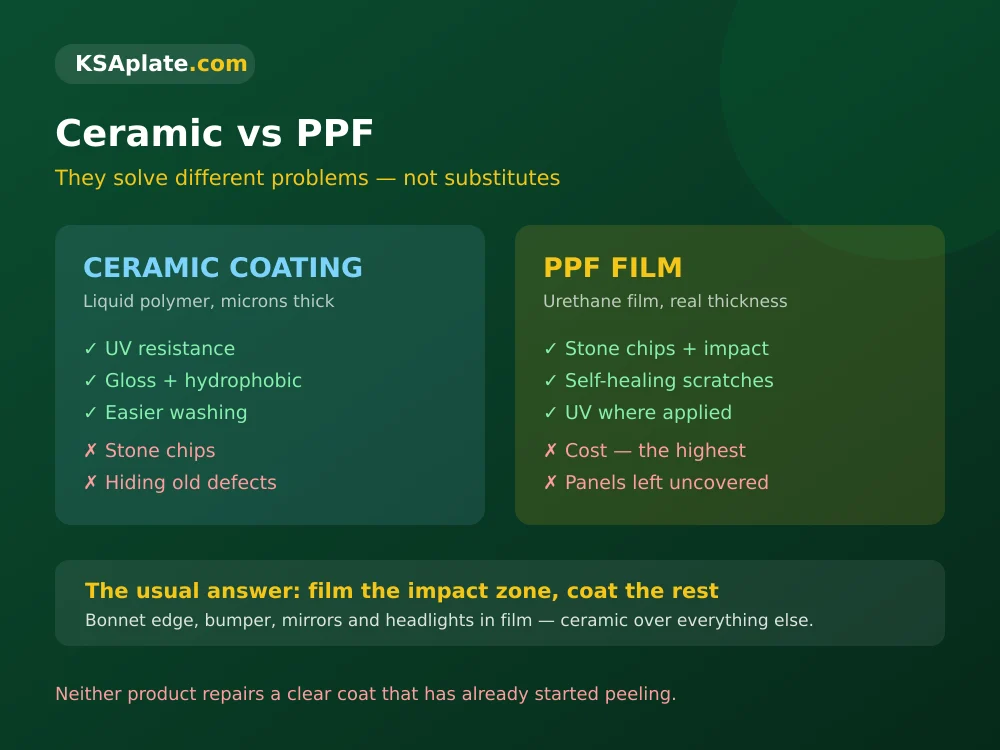
- Ceramic coating does not stop stone chips. It resists UV, adds gloss and makes washing easier. Stone chips need film, not chemistry.
- PPF stops physical damage; it is a thick urethane film for the front end and high-impact panels, and it is the most expensive option by a wide margin.
- The free measures do most of the work. Shade, a sunshade, prompt washing and removing bird droppings within a day or two prevent more damage than any product you can buy.
- Paint is the first thing a Saudi buyer judges. Faded, patchy or peeling panels cut your resale price far more than the protection would have cost.
What actually destroys car paint here
Car paint damage in Saudi Arabia is primarily clear-coat degradation caused by ultraviolet radiation and heat cycling, not by the colour layer fading. Modern automotive paint is layered: primer, then the colour base, then a transparent clear coat that carries the gloss and the UV inhibitors. The clear coat is the sacrificial layer, and it is the one the Saudi climate attacks.
Three local forces do the work. UV radiation breaks down the clear coat's polymer chains and consumes its UV inhibitors. Heat cycling — a panel that bakes past 70°C in the afternoon and cools sharply at night — expands and contracts the film until it micro-cracks. Airborne sand then abrades the weakened surface, and any contaminant left sitting on hot paint, from bird droppings to hard-water spots, etches into it far faster than it would in a mild climate.
Key takeaway: your paint is not fading from the inside out. A transparent layer above the colour is failing, and everything you spend should be aimed at keeping that layer alive — the same heat-and-dust logic behind accelerated tyre ageing and weak air conditioning in the Kingdom.
- Summer highs across much of the Kingdom sit in the mid-to-high 40s °C, per National Center for Meteorology records — and a parked car's panels run far hotter than the air.
- Saudi Arabia receives among the highest solar irradiance levels on earth, which is why clear coats age here in years rather than decades.
- Contaminants etch fastest on hot paint, so the same bird dropping does more damage at 2pm in Riyadh than overnight in a cool climate.
The clear-coat failure ladder
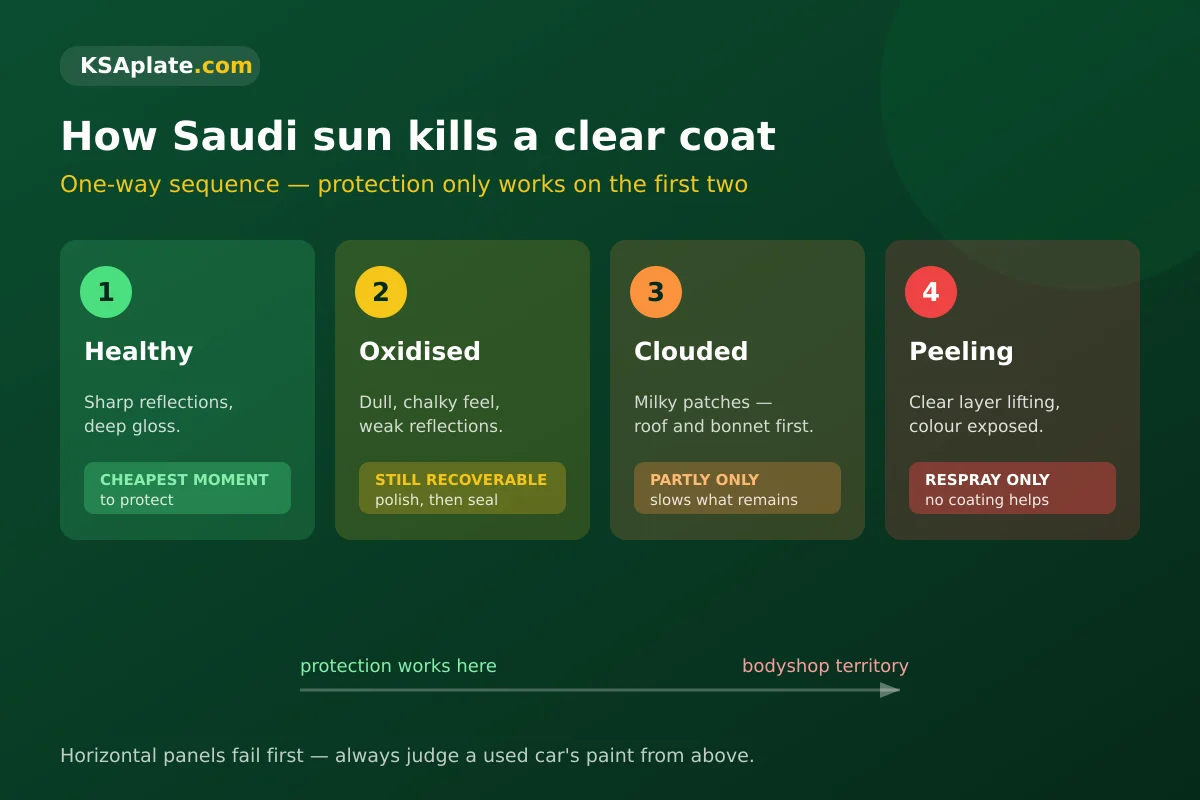
Clear-coat failure is a one-way sequence, and knowing which rung you are on tells you exactly what to buy. Protection products work on the early rungs. Past a certain point they are decoration on a surface that is already dying.
| Stage | What you see | What still works |
|---|---|---|
| 1. Healthy | Sharp reflections, deep gloss | Anything — this is the cheapest moment to protect |
| 2. Oxidised | Dull, chalky feel, weak reflections | Polishing then sealing or coating restores most of it |
| 3. Clouded / hazing | Milky patches, usually roof and bonnet first | Correction may help; protection slows what remains |
| 4. Peeling / flaking | Clear layer lifting in sheets, colour exposed | Nothing. Respray of the affected panels |
The jump from stage 3 to stage 4 is the expensive one. Once the clear coat lifts, the colour base is unprotected and will chalk quickly, and no ceramic coating or film bonds reliably to a failing surface. Horizontal panels go first because they take the most direct sun — which is why roofs and bonnets fail while doors still look acceptable.
Key takeaway: protect at stage 1 or 2. At stage 4 you are not buying protection any more, you are budgeting for paintwork.
The six options, compared honestly
Paint protection in Saudi Arabia comes down to six realistic choices, and most vendor pages only compare the two they sell. This matrix is the neutral version: what each option costs relative to the others, how long it survives Saudi conditions, and — the part usually left out — what it does not do.
| Option | Relative cost | Realistic lifespan here | Stops UV? | Stops chips? |
|---|---|---|---|---|
| Nothing + good habits | Free | Ongoing | Partly (shade) | No |
| Carnauba wax | Lowest | Weeks in summer heat | Weakly | No |
| Synthetic sealant | Low | A few months | Moderately | No |
| Ceramic coating | High | Roughly 2–5 years | Yes | No |
| PPF (front end) | Very high | Roughly 5–10 years | Yes, where applied | Yes, where applied |
| PPF + ceramic | Highest | 5–10 years | Yes | Yes, where filmed |
Lifespans are typical manufacturer and installer expectations for Gulf conditions; heat, parking and wash frequency move them significantly. Get any quote in writing and ask what the warranty actually covers.
Two honest observations from this table. Wax is close to pointless in a Saudi summer — it melts off far faster than the label suggests, and people who wax quarterly are effectively unprotected most of the year. And the expensive options are not substitutes for each other: ceramic is chemistry that handles UV and cleaning, PPF is a physical barrier that handles impact. Buying ceramic to prevent stone chips is the single most common and most expensive misunderstanding in this category.
Ask an installer one question before you pay: "what will this not protect me from?" The quality of that answer tells you more than any brochure.
What's your car worth?
Get a free instant estimate based on real Saudi market data — then sell it on KSAplate with direct WhatsApp contact.
Value My Car — FreeCeramic coating: what it does and does not do
A ceramic coating is a liquid polymer, usually silica-based, that cures into a hard semi-permanent layer chemically bonded to the clear coat. It raises UV resistance, adds gloss, and makes the surface strongly hydrophobic so dust and water sheet off rather than clinging — genuinely useful in a country where cars are washed constantly.
What it does not do is absorb impact. A ceramic layer is measured in microns; a stone thrown from a truck on the Riyadh–Dammam road does not care. It also will not hide existing defects: coating over swirl marks and oxidation locks them in under a glossy layer, which is why any competent installer insists on paint correction first and why a cheap "coating" with no prep is money wasted.
The practical case for ceramic in Saudi Arabia is UV defence plus easier washing, and easier washing matters more than it sounds — most swirl marks are self-inflicted during cleaning, so a surface that releases dirt easily is a surface you scratch less.
Key takeaway: buy ceramic for UV protection, gloss and wash-resistance on healthy paint. Do not buy it expecting armour, and never buy it applied over uncorrected paint.
Paint protection film (PPF): when it is worth it
Paint protection film is a thick, transparent thermoplastic urethane applied over panels to absorb physical damage. Unlike a coating, it has real thickness, and better films are self-healing: light scratches and swirl marks close up when the film is warmed by sun or hot water. Expect roughly five to ten years from a professionally fitted film.
PPF earns its cost in specific situations rather than universally. It is worth it if you drive long highway distances where stone chips are constant, if you have an expensive or hard-to-match paint finish, if you plan to keep the car many years, or if you are protecting resale on a premium vehicle. A full-body wrap is the most expensive option in this article by a wide margin; the common compromise is filming the impact zone — bonnet leading edge, bumper, mirrors, headlights — and coating everything else.
Verify two things before committing: that the film carries a real warranty against yellowing and lifting in high heat, and that the installer wraps the film around panel edges rather than cutting on the paint. Products and films sold in the Kingdom fall under the standards regime administered by the Saudi Standards, Metrology and Quality Organization, and separately, any tint or film applied to glass must respect the Saudi tinting and modification rules — paint film on bodywork is not the same thing legally as window film.
Key takeaway: film the impact zone, coat the rest. Full-body PPF only makes financial sense on cars where the paint itself is expensive to replace.
The free 80%: habits that beat products
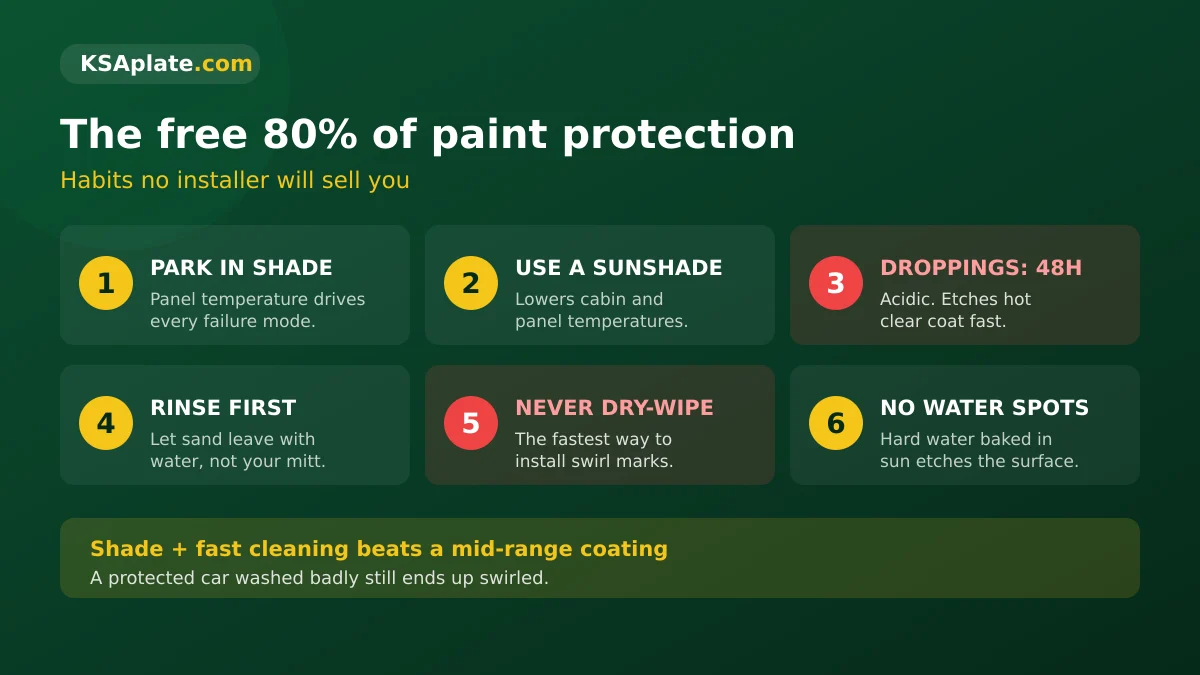
The cheapest paint protection in Saudi Arabia is behavioural, and it outperforms every product for owners who do it consistently. No installer will tell you this, because there is nothing to sell — but shade and speed prevent more damage than chemistry does.
- Park in shade, always, even for short stops. Covered parking is the single highest-value habit. Panel temperature drives both clear-coat ageing and how fast contaminants etch.
- Use a windscreen sunshade. It protects the dashboard and interior plastics, and lowers the cabin and surrounding panel temperatures your paint has to survive.
- Remove bird droppings and tree sap within a day or two. These are acidic and etch quickly into hot clear coat. This is the highest-return two-minute job in car care.
- Rinse off dust before it is ground in. Sand sitting on paint becomes sandpaper the moment anything wipes across it — including a careless cloth.
- Never dry-wipe a dusty car. The "quick wipe" with a dry cloth in a car park is the most reliable way to install permanent swirl marks.
- Do not let hard water dry on the paint. Mineral spots baked on in direct sun etch into the clear coat and eventually need polishing to remove.
Most of the damage on a five-year-old Saudi car was not caused by the sun alone. It was caused by the sun plus a dry cloth.
Key takeaway: if you do nothing else, park in shade and remove droppings fast. Those two habits are free and beat a mid-range coating applied to a car that lives in the open.
Washing without scratching in a dusty country
Most swirl marks on Saudi cars are wash damage, not sun damage — fine scratches created by dragging airborne sand across the clear coat. Because dust settles on every car here within hours, wash technique matters more in the Kingdom than in almost any other market.
The sequence that prevents it is simple. Rinse thoroughly before touching the paint, so loose sand leaves with the water rather than under your mitt. Wash in shade on cool panels, never in direct sun where shampoo dries instantly and leaves mineral spots. Use two buckets — one with shampoo, one with clean water to rinse the mitt — so grit is not carried back to the paint. Dry with a clean microfibre or filtered air, and start from the roof down.
Automatic brush washes are the fastest way to undo all of it. The brushes retain grit from previous cars and drag it across your panels at speed. If you rely on them for convenience, accept that you are trading paint condition for time, and be honest about that trade before paying for a coating you will then scrub.
Key takeaway: rinse first, wash in shade, two buckets, never dry-wipe. A protected car washed badly still ends up swirled.
How to choose: a decision path
Choosing paint protection is a function of three inputs: the paint's current condition, where the car sleeps, and how long you intend to keep it. Work through them in order and the answer is usually obvious.
- Assess the clear coat first. Peeling anywhere? Stop — price a respray of those panels, not a coating. Dull but intact? A correction plus protection will transform it.
- Ask where the car parks. Covered every night: habits plus a sealant may be entirely sufficient. Outdoors permanently: UV defence becomes the priority, which favours ceramic.
- Ask how long you will keep it. Selling within a year: correction and a sealant present the car well without a large outlay. Keeping it five-plus years: ceramic, and PPF on the impact zone if you drive long distances.
- Match the spend to the car. Full-body PPF on a modest commuter rarely returns its cost; on a premium car with expensive paint it can.
- Get the prep in writing. Whatever you choose, confirm what correction is included. Protection applied over neglected paint preserves the neglect.
Budget this as part of running the car rather than a one-off luxury — our cost-of-ownership breakdown puts it in context alongside servicing, and the same seasonal thinking applies as in the Saudi maintenance schedule. If a coating is being sold as part of a new-car deal, check what your warranty already covers before paying twice.
Paint condition and what your car is worth
Paint is the first thing a Saudi buyer evaluates, and it functions as a proxy for how the whole car was treated. A buyer who sees a chalky roof and hazed bonnet assumes the servicing was neglected too — fairly or not — and prices that assumption into their offer.
The effect is asymmetric, which is what makes it worth acting on. Good paint rarely earns a premium above the market price, but bad paint reliably triggers a discount, and that discount is usually far larger than a correction and sealant would have cost before listing. Faded, patchy panels also photograph badly, and since almost every sale now starts with photos, dull paint costs you enquiries before anyone sees the car — which is why our guide to photographing a car for sale starts with surface preparation.
Buyers should read paint in the other direction. Mismatched panels, overspray on trim, or a bonnet that is glossier than the wings can indicate accident repair — worth checking against a proper history check and the warning signs in our guide to used-car scams. A fresh coating on a tired car can also be used to mask oxidation for a few weeks, so inspect in daylight and look along panels at a low angle.
Key takeaway: correct and protect before you list, and keep the invoice. It is one of the few pre-sale expenses that reliably returns more than it costs, and it blunts the ordinary depreciation discount applied to any valuation.
Paint sorted? List it while it looks its best
Sell on the only Saudi marketplace that is also a plate market — and check what your distinctive plate is worth before it leaves with the car.
List my car Value my plateFrequently asked questions
Is ceramic coating worth it in Saudi Arabia?
Can ceramic coating fix faded or peeling paint?
How long does PPF last in Saudi heat?
Does car wax work in Saudi summer?
Why does my car roof fade before the doors?
How quickly do bird droppings damage paint?
Are automatic car washes bad for paint?
Should I protect a new car immediately?
Does paint protection increase resale value?
Can I apply a ceramic coating myself?
Reviewed by Khalid Al-Rashid, Saudi Car & License Plate Market Expert. Lifespans and cost tiers are indicative market expectations for Gulf conditions, not quotes — confirm product, preparation and warranty in writing before purchase.
Sources: National Center for Meteorology (ncm.gov.sa) for Saudi temperature and solar exposure context; Saudi Standards, Metrology and Quality Organization (saso.gov.sa) for the standards regime covering films and coatings; manufacturer and installer durability expectations for ceramic coatings and paint protection film; KSAplate listing observations, 2026.