
Last updated: 19 August 2026 · 13 min read
Cutting a replacement car key does not disable the one you lost — until the missing key is erased from your car's immobilizer, whoever finds it can still start your car. That step is missing from almost every quote, and it is the difference between a key replacement and an actual security fix. The second thing nobody tells you: duplicating a spare while you still have a working key is cheap, while replacing a key when all keys are gone is a different, far more expensive procedure.
A new key solves your problem. Deleting the old one solves your car's problem. Pay for both, or you have only bought convenience.
- Always ask for the lost key to be deleted from the immobilizer. A new key does not deactivate the old one, and a found key still starts the car.
- Get the spare before you need it. Duplicating from a working key is routine; originating a key with none left ("all keys lost") costs several times more and takes longer.
- Bring proof of ownership. Any legitimate locksmith or dealer will ask for your istimara (vehicle registration) and national ID or Iqama. If nobody asks, walk away.
- Locksmiths are cheaper than dealers — indicative Saudi figures put dealer pricing roughly a third to half above an independent auto locksmith for the same key.
- A missing second key costs you at resale. "How many keys?" is a standard buyer question, and one key invites a discount larger than the spare would have cost.
Which key do you actually have?
A car key in Saudi Arabia falls into one of four types, and the type — not the car's value — decides what a replacement costs. Identifying yours before you call anyone is the single most useful thing you can do, because it tells you whether you are facing a small bill or a large one.
| Key type | How to recognise it | Replacement cost tier |
|---|---|---|
| Mechanical blade | Plain metal key, no buttons, no plastic head electronics | Lowest — cutting only |
| Transponder key | Metal blade with a plastic head; no buttons, but the car will not start with a copied blade | Low–medium — cut plus programming |
| Remote-head key | Blade plus lock/unlock buttons built into one unit; often flips out | Medium |
| Proximity smart key | No blade in normal use; keyless entry and push-button start | Highest |
The practical test is simple. If your car has a push-button start and unlocks as you approach, you have a proximity smart key — the most expensive category. If you physically insert a key and turn it, look at the head: a thick plastic head almost always contains a transponder chip, even when there are no buttons at all.
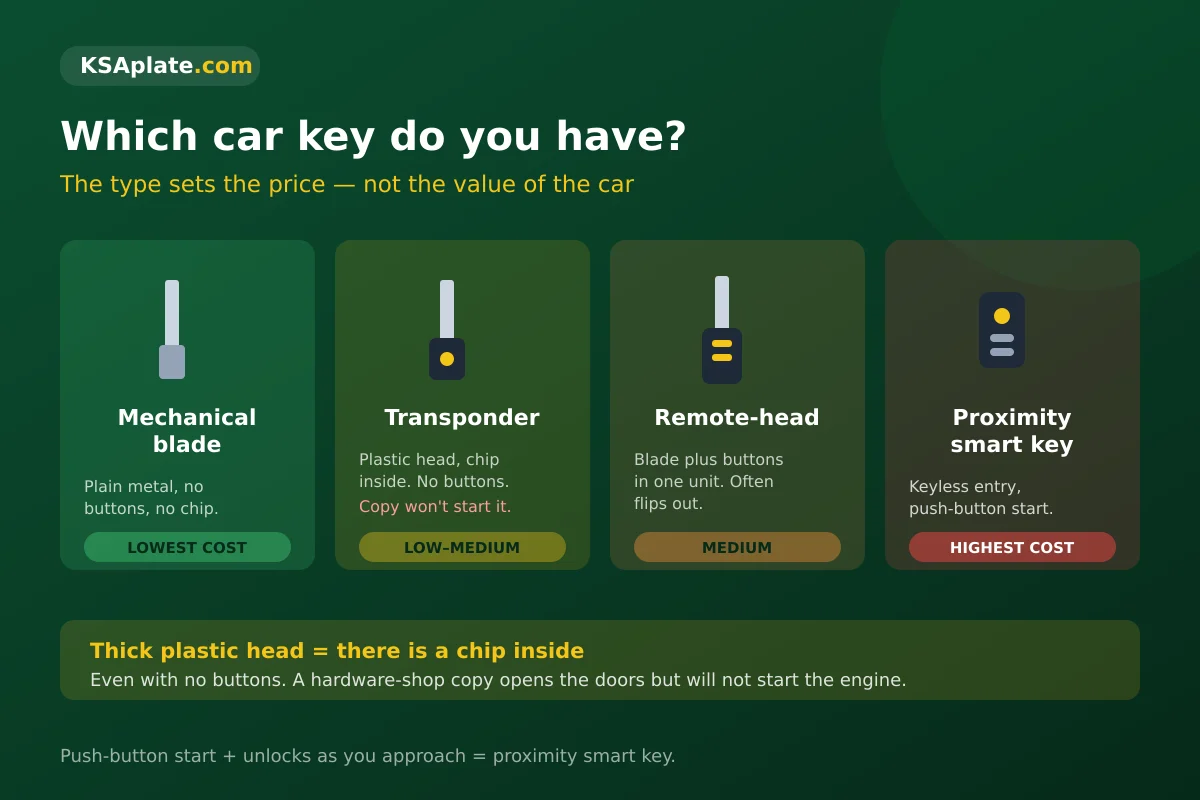
Key takeaway: identify the type first. A hardware shop can copy a mechanical blade in minutes, but that same copy will not start a transponder car — it will open the doors and nothing more.
Why a chip key costs more than a blade
An immobilizer is an electronic anti-theft system that prevents the engine from starting unless it detects an authorised transponder chip. The chip sits inside your key, and the car interrogates it every time you try to start — which is why a perfectly cut copy of the metal blade turns in the lock but leaves the engine dead.
This is also why replacement is a programming job rather than a cutting job. The new chip has to be introduced to the car's immobilizer module using diagnostic equipment, and on many vehicles that requires a security code or authenticated access tied to the VIN. The labour and equipment behind that step, not the plastic and metal, are what you are paying for.
Immobilizers are the reason car theft shifted away from hot-wiring, and they work — which is precisely why the systems around them are guarded. Standards for automotive components and electronics sold in the Kingdom fall under the regime administered by the Saudi Standards, Metrology and Quality Organization.
Key takeaway: you are buying programming, not metal. Any quote that seems far below the market for a chip key probably does not include the immobilizer step.
Lost one key: what to do first
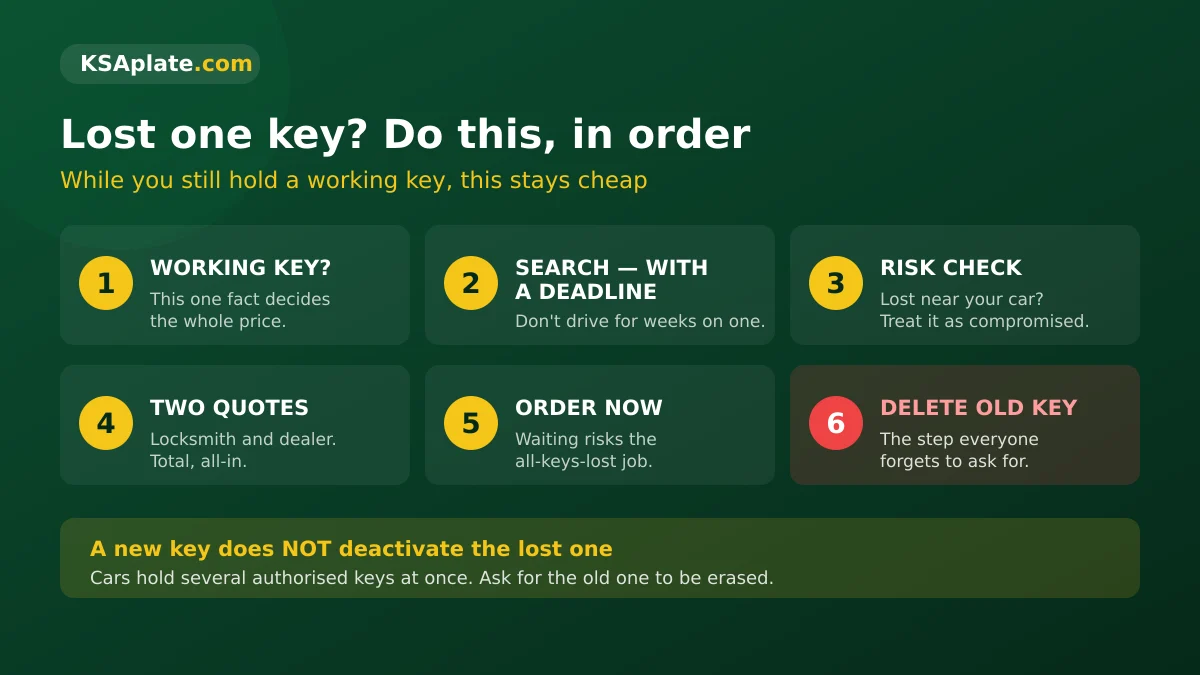
Losing one key while still holding a working spare is the cheap scenario, and acting quickly keeps it that way. The order below protects both your wallet and your car.
- Confirm you still have a working key. This single fact determines whether you are duplicating (routine) or originating from zero (expensive). Check before you make any call.
- Retrace and search properly before ordering. A found key saves the entire cost — but set yourself a deadline rather than driving for weeks on one key.
- Decide whether the lost key is a security risk. If it went missing somewhere your car was identifiable — a mall car park, a workplace — treat it as compromised and plan to delete it.
- Get a quote from an auto locksmith and from the dealer. Give them the make, model, year and key type. Ask both for the total including programming and deletion.
- Order the duplicate promptly. Driving on a single key is how a cheap duplication becomes an expensive all-keys-lost job later.
- Have the lost key erased from the immobilizer at the same appointment. It is far cheaper bundled than as a separate visit.
Driving on your last remaining key is a bet that you will never lose it. The spare costs a fraction of what losing that bet costs.
Key takeaway: a lost key is a deadline, not an inconvenience. Duplicate while you still have one working key.
What's your car worth?
Get a free instant estimate based on real Saudi market data — then sell it on KSAplate with direct WhatsApp contact.
Value My Car — FreeAll keys lost: the cost cliff
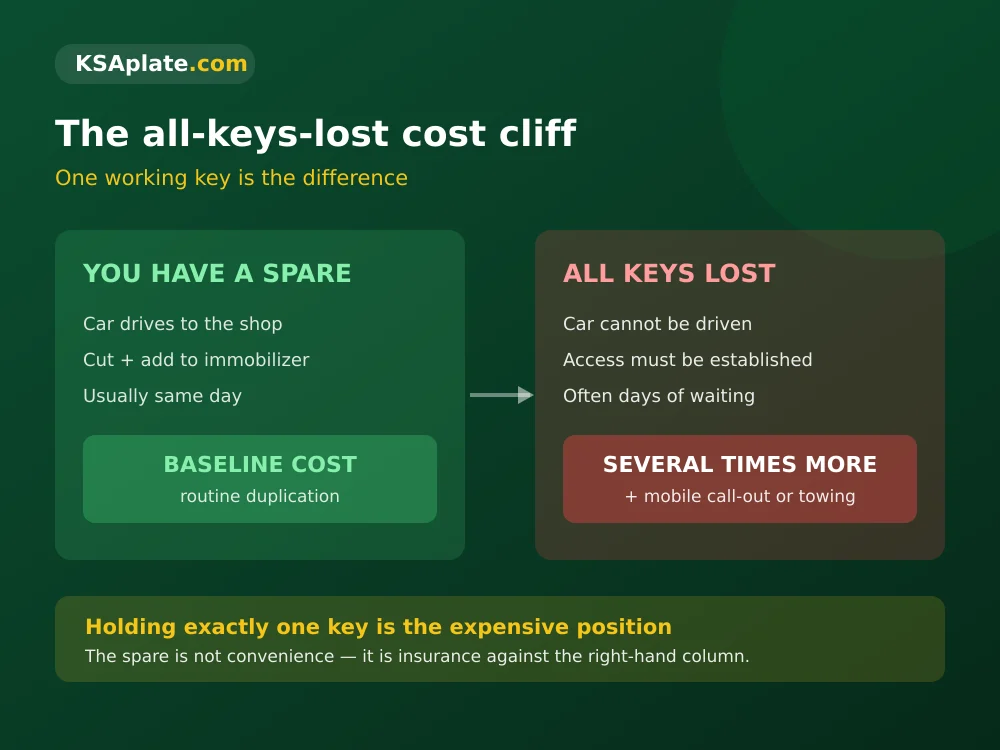
"All keys lost" is the industry term for replacing a key when no working key remains, and it is a fundamentally different procedure from copying a spare. With a working key, the car can be told to accept an additional one. With none, the technician has to establish authorised access from scratch.
That changes everything about the job. The car cannot be driven to a workshop, so it needs a mobile locksmith or recovery. The technician may need to read data directly from a module, retrieve a security code tied to the VIN, or in some cases replace the immobilizer component. Expect several times the cost of a simple duplicate, plus a longer wait while parts or codes are obtained.
| Duplicating a spare | All keys lost | |
|---|---|---|
| Working key available | Yes | No |
| Car drivable to workshop | Yes | No — mobile or towing |
| Typical procedure | Cut and add to immobilizer | Establish access, then originate |
| Relative cost | Baseline | Several times baseline |
| Typical wait | Same day | Often days |
The economics are unusually clear here, which is why this article keeps returning to the same advice: the spare key is not a convenience purchase, it is insurance against the cliff. If you currently hold exactly one key for your car, that is the most expensive position you can be in without knowing it.
Key takeaway: the gap between "I have a spare" and "I have nothing" is the single biggest cost variable in this entire topic.
The security step almost everyone skips
Deleting a lost key means erasing its code from the car's immobilizer so it can no longer start the engine, and it is a separate action from cutting a replacement. Adding a new key does not automatically revoke an old one — most systems simply hold several authorised keys at once.
The consequence is uncomfortable but worth stating plainly: if you lost a key with anything identifying your car nearby, and you only bought a replacement, a stranger may still hold a working key to your vehicle. Insurance and roadside services will not treat that as theft prevention, and the car will show no signs of forced entry if it is ever taken — which complicates any claim.
Ask for it explicitly when you book: "please delete all previously programmed keys and re-register only the ones I physically have." A competent locksmith or dealer will do this as a matter of course; the ones who do not mention it are the ones to question. Pair it with the wider measures in our guide to car theft prevention in Saudi Arabia, and check how your insurance policy treats theft where no forced entry occurred.
Key takeaway: replacement without deletion is not a security fix. Say the words out loud when you book the job.
Dealer or locksmith: how to choose
An auto locksmith and a dealership can both produce and programme a working key, but they differ sharply on price, speed and coverage. Indicative Saudi market figures put dealer pricing roughly a third to a half above an independent auto locksmith for the same key — so the dealer premium is real, and worth paying only in specific situations.
| Auto locksmith | Dealership | |
|---|---|---|
| Cost | Lower | Roughly a third to a half higher |
| Comes to the car | Usually yes | Rarely — you must get the car there |
| Speed | Often same day | Order and appointment |
| Newest / premium models | Sometimes limited | Full coverage |
| Warranty-sensitive work | Check first | Safest option |
Choose the locksmith for mainstream models, for all-keys-lost situations where the car cannot move, and whenever price matters and the vehicle is out of warranty. Choose the dealer for very new or premium vehicles whose security systems independents cannot yet access, when the immobilizer module itself may need replacing, and when the car is still covered — confirm against what your warranty includes before letting anyone connect diagnostic equipment.
Whichever you pick, ask three questions before agreeing: does the quote include programming, does it include deleting the lost key, and is there a warranty on the key itself. Vague answers on any of the three are a reason to call the next provider.
Key takeaway: locksmith by default, dealer for new, premium or warranty-sensitive cars. The premium buys coverage, not better keys.
Paperwork you must bring
Proof of ownership is mandatory for legitimate car key replacement in Saudi Arabia, and any provider willing to skip it is a provider you should not use. The requirement exists for an obvious reason: the ability to produce a working key for any car is the ability to steal it.
Bring your istimara (the vehicle registration) showing you as the registered owner, plus your national ID or Iqama. Have the VIN available, since programming is often tied to it. If the registration is not in your name — a company car, or a vehicle bought recently — bring the authorisation or transfer documentation that connects you to it.
Two situations catch people out. If your istimara has expired, sort that first through the normal istimara renewal process, because an expired document may not be accepted as proof. And if you have just bought the car, make sure ownership transfer is complete — vehicle records and services are handled through the Ministry of Interior's Absher platform, and a car still registered to the seller creates exactly the ownership gap a locksmith is required to check.
Key takeaway: if nobody asks for your istimara and ID, that is not convenience — it is a warning about who else they will cut keys for.
Key turns but the car will not start
A car that cranks or clicks but refuses to start with the correct key usually has an immobilizer communication problem rather than a mechanical fault. The engine is being actively prevented from running because the car cannot confirm the key is authorised.
Work through the cheap causes first. A dead key-fob battery is the most common and the easiest to fix; most proximity keys have a documented backup method, such as holding the fob against a marked spot on the steering column or placing it in a specific slot, which lets the car read the chip without battery power. Interference from another transponder on the same keyring, or from a phone pressed against the fob, can also block the signal — try the key on its own.
If the immobilizer warning light stays on and a fresh battery changes nothing, the fault is in the key's chip, the receiver antenna, or the module, and it needs diagnosis. Do not confuse this with a flat starter battery, which produces slow cranking or dashboard dimming instead — that is covered in our guide to Saudi maintenance, and a genuine no-start away from home falls under roadside breakdown procedure.
Key takeaway: try a fresh fob battery and the backup start method before paying for diagnosis. It resolves a large share of "my key stopped working" cases.
Two keys and what your car is worth
"How many keys does it come with?" is one of the standard questions in a Saudi used-car negotiation, and arriving with one key hands the buyer a ready-made reason to reduce their offer. The buyer is not guessing at the cost — they are pricing in the replacement they now have to arrange.
The effect is asymmetric in the way that matters. Two keys rarely earn a premium, but one key reliably triggers a deduction, and that deduction is typically larger than the spare would have cost you to cut beforehand. Producing both keys also signals a car that was looked after, which is the same reputational effect that protects a price against ordinary depreciation and supports a stronger valuation.
Buyers should turn the question around. Ask for every key, test each one — including the physical blade hidden inside a smart key — and treat "the second key is lost" as a reason to negotiate, because you will be paying for the replacement and the deletion. If the seller cannot produce all keys, you cannot know who else holds one, which belongs on the same checklist as a used-car inspection and the warning signs in our guide to used-car scams. Expats timing a final exit sale should sort the spare well before the last month, when time pressure works against them.
Key takeaway: cut the spare before you list, and hand over both keys at the sale. It is a small, predictable cost that removes an easy discount, and it belongs in your running-cost budget rather than your selling costs.
Both keys in hand? List it properly
Sell on the only Saudi marketplace that is also a plate market — and see what your distinctive plate is worth before it leaves with the car.
List my car Value my plateFrequently asked questions
How much does a replacement car key cost in Saudi Arabia?
Can a normal key cutter copy my car key?
Does a new key stop the lost one from working?
What if I have lost every key to the car?
What documents do I need to get a car key made?
My key fob stopped working — is it broken?
Is a locksmith or the dealership better?
Can I programme a spare key myself?
Does car insurance cover key replacement?
Should I buy a used car that only has one key?
Reviewed by Khalid Al-Rashid, Saudi Car & License Plate Market Expert. Prices are indicative market ranges observed in 2026, not quotes — confirm the total in writing, including programming and deletion of lost keys, before authorising work.
Sources: Absher (absher.sa), the Ministry of Interior platform handling vehicle registration and ownership records; Saudi Standards, Metrology and Quality Organization (saso.gov.sa) for the standards regime covering automotive components; indicative Saudi auto-locksmith and dealership pricing observed in 2026; KSAplate listing observations.