TL;DR:
- A first car has one job: to forgive. It absorbs the parking dings, the curb kisses and the learning mistakes of your first 5,000 km — so pick it for light steering, good visibility, a small footprint, real safety kit (ABS, ESC, airbags) and cheap parts, not for power or badge.
- Buy nearly-new, not new: on our real Saudi market curves a two-year Hyundai Accent trades at ≈SAR 39,500 against a new-car price far above it — the first owner pays the showroom premium, you enter where the curve flattens to ≈SAR 390 a month.
- The five forgiving picks by the data: Nissan Sunny (≈SAR 29,600 at two years — the cheapest nearly-new gateway), Hyundai Accent (the rational default), Toyota Yaris (easiest to park), Hyundai Elantra (the grow-into compact) and Toyota Corolla (the keep-forever pick).
- Budget the first year, not just the car: insurance with a new-license loading, ≈SAR 1,570 of fuel, transfer fees, maintenance and an honest ding-repair buffer put the true first year at roughly SAR 4,500–6,700 on top of the purchase.
- What not to buy first: big engines, aging luxury (cheap to buy, brutal to repair), modified cars, and anything without a clean history check — the classic first-car traps that turn a starter budget into a lesson.
Quick answer: The best first cars for new drivers in Saudi Arabia are the Nissan Sunny (≈SAR 29,600), Hyundai Accent, Toyota Yaris, Hyundai Elantra and Toyota Corolla — small, forgiving sedans with light steering, real safety kit and cheap parts, bought two to three years old so the first owner absorbs the steep depreciation. Budget ≈SAR 4,500–6,700 for year one beyond the purchase.
Why the first car decides your first decade
Nobody remembers their fifth car. Everybody remembers their first — because the first car is where driving stops being a license and becomes a habit. It is the car you learn parking geometry on, the car that teaches you what a service schedule is, the car whose insurance papers you actually read. Get it right and driving becomes a calm, affordable routine. Get it wrong — too much power, too much size, too much repair bill — and the first year becomes expensive chaos that shapes how you drive for a decade.
Saudi Arabia adds its own variables to the equation: summer heat that punishes weak air conditioning and old batteries, city traffic that makes visibility and parking agility worth more than horsepower, Saher cameras that price impatience by the frame, and a used market deep enough that a disciplined buyer genuinely can find a forgiving, safe, nearly-new starter car under SAR 40,000. This guide is that discipline, in order: the five traits that make a car forgiving, the honest first-year budget, the data-backed picks, the classic traps, and the first 5,000 km after the keys. Every price in it comes from the same real Saudi market curves that power our free car value calculator — medians from actual Kingdom listings, not showroom hopes. And if you are still one step earlier in the journey, the license process itself is covered in our Saudi driving license guide.
The forgiving five: what a first car must do
A first car is not a smaller version of a dream car. It is a different tool with a different job description — five traits, in priority order:
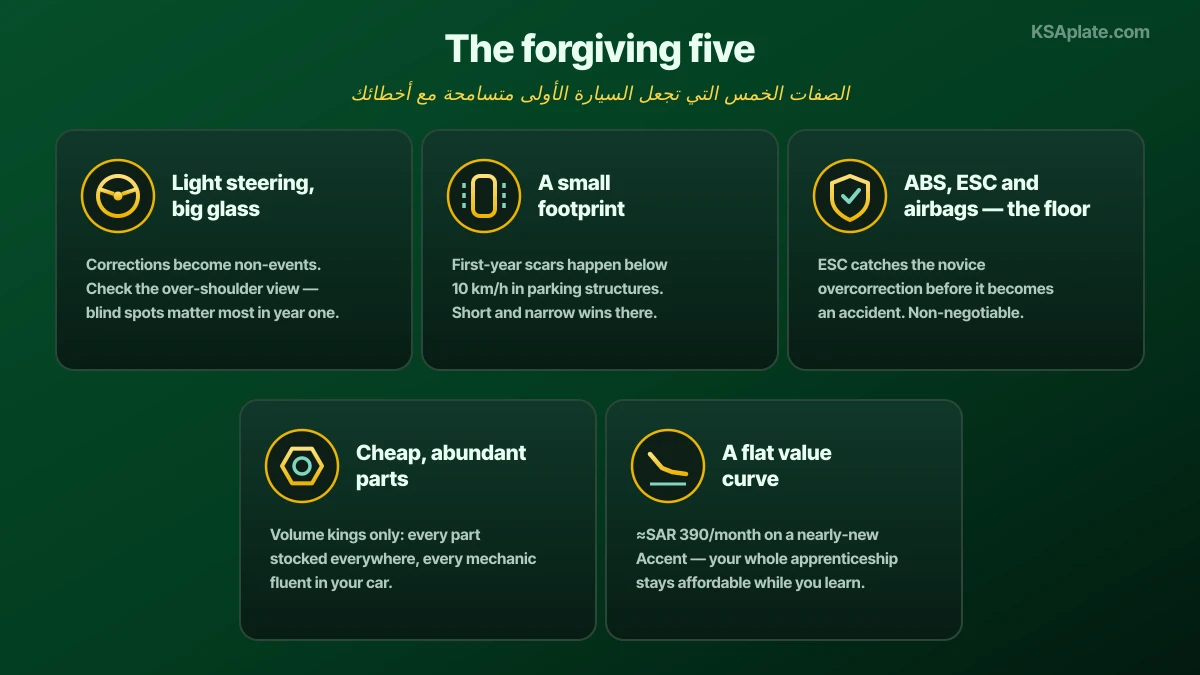
- It forgives your hands: light steering, big glass. New drivers correct constantly, and a car with light, honest steering and a large glass area turns those corrections into non-events. Sit in the driver's seat and check what you can see over your shoulder — blind-spot size matters more than any spec-sheet number in your first year.
- It forgives your judgment: small footprint. Almost every first-year scar — yours and the paint's — happens below 10 km/h in a parking structure. A short, narrow sedan turns tight Saudi mall parking from a stress event into a routine. This is the quiet reason the Yaris and Sunny dominate driving-school fleets.
- It protects you anyway: ABS, ESC, airbags. Forgiving does not mean fragile. Set a hard floor: anti-lock brakes, electronic stability control and at least two airbags — equipment that is standard on the nearly-new cars in this guide's price band. ESC in particular is the system that catches a novice's overcorrection on a wet roundabout before it becomes an accident.
- It forgives your wallet: cheap, abundant parts. First cars get consumables and small repairs, often. The picks below are the highest-volume cars in the Kingdom precisely so that every part is stocked everywhere and every mechanic has fitted a thousand of them — which is also your best negotiating position on labor.
- It forgives your exit: slow depreciation. Buy on the flat part of the value curve and your mistakes stay cheap: if the car loses ≈SAR 400 a month while you learn, the total cost of your entire apprenticeship is a fraction of what the same year costs in a new car. The curve data below shows exactly where that flat part starts.
The honest first-year budget
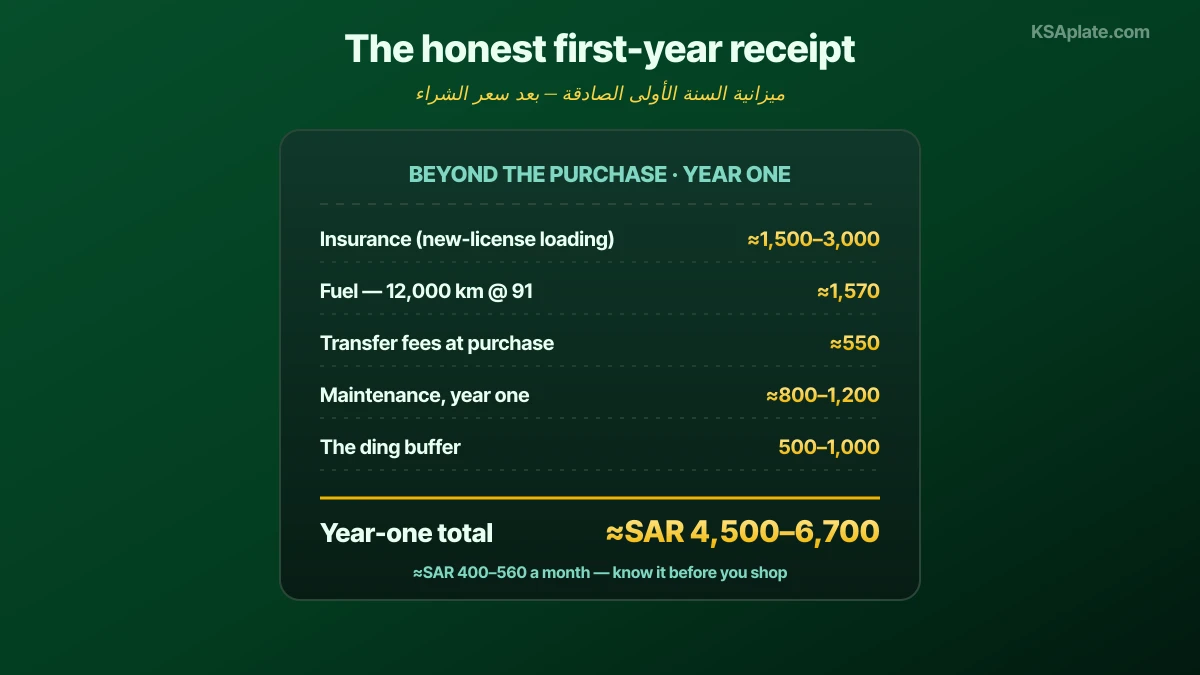
The purchase price is the headline, but the first year has five more line items — and the honest budget includes the one nobody puts in the spreadsheet: the ding buffer. Planning figures for a small sedan and a realistic 12,000 first-year kilometers:
| Line item | Planning figure (SAR) | The honest note |
|---|---|---|
| The car (nearly-new small sedan) | 29,000–52,000 once | Sunny to Elantra band from our curves — see the picks below |
| Insurance, year one | ≈1,500–3,000 comprehensive | New-license loading is real; third-party from a few hundred — full logic in the next section |
| Fuel, 12,000 km | ≈1,570 | ≈6 L/100 km at Octane 91's regulated SAR 2.18/liter |
| Transfer fees at purchase | ≈550 | Ownership transfer plus processing — paid once, on Absher |
| Maintenance, year one | ≈800–1,200 | Two oil services, filters, one battery risk in summer heat |
| The ding buffer | 500–1,000 | Parking is where first years happen; budgeting it removes the drama |
Running total beyond the purchase: ≈SAR 4,500–6,700 for the first year — roughly SAR 400–560 a month. Knowing that number before you shop does two things: it stops the "I can afford the car" miscalculation that ignores everything after the transfer, and it frames the picks below correctly — the difference between a SAR 30,000 and a SAR 50,000 first car is not just purchase price, it is also the insurance premium calculated on it. The full ownership-cost picture, beyond the first year, is in our cost of owning guide.
What's your car worth?
Get a free instant estimate based on real Saudi market data — then sell it on KSAplate with direct WhatsApp contact.
Value My Car — FreeInsurance with a brand-new license
Insurance is where a new license costs real money, and where first-car buyers make their first strategic decision:
- Expect the new-driver loading. Insurers price experience, and a first-year license — especially a young driver's — carries a visible premium loading. Comprehensive cover that costs an experienced driver roughly 3–5% of the car's value can run meaningfully higher on a fresh license. It falls with every clean year; your no-claims record starts building the day the policy starts.
- Third-party is the legal floor, not automatically the right choice. On a SAR 30,000 Sunny, the gap between third-party and comprehensive is a real annual saving — and some first buyers consciously self-insure the ding risk on a cheap car. On a SAR 50,000 Elantra, comprehensive usually earns its premium: one parking-structure misjudgment can cost more than the annual difference.
- The deductible is a first-driver's lever. A higher deductible cuts the premium and quietly teaches careful driving — you feel small mistakes, the insurer handles big ones. Pair it with the ding buffer from the budget table and the whole risk picture is covered without drama.
- Insure the truth. The policy must name the person actually driving. Insuring a new driver's car in an experienced relative's name to dodge the loading is the classic false economy — discovered at claim time, exactly when it matters. The full comprehensive-vs-third-party decision tree lives in our insurance guide.
The picks, priced by our market curves
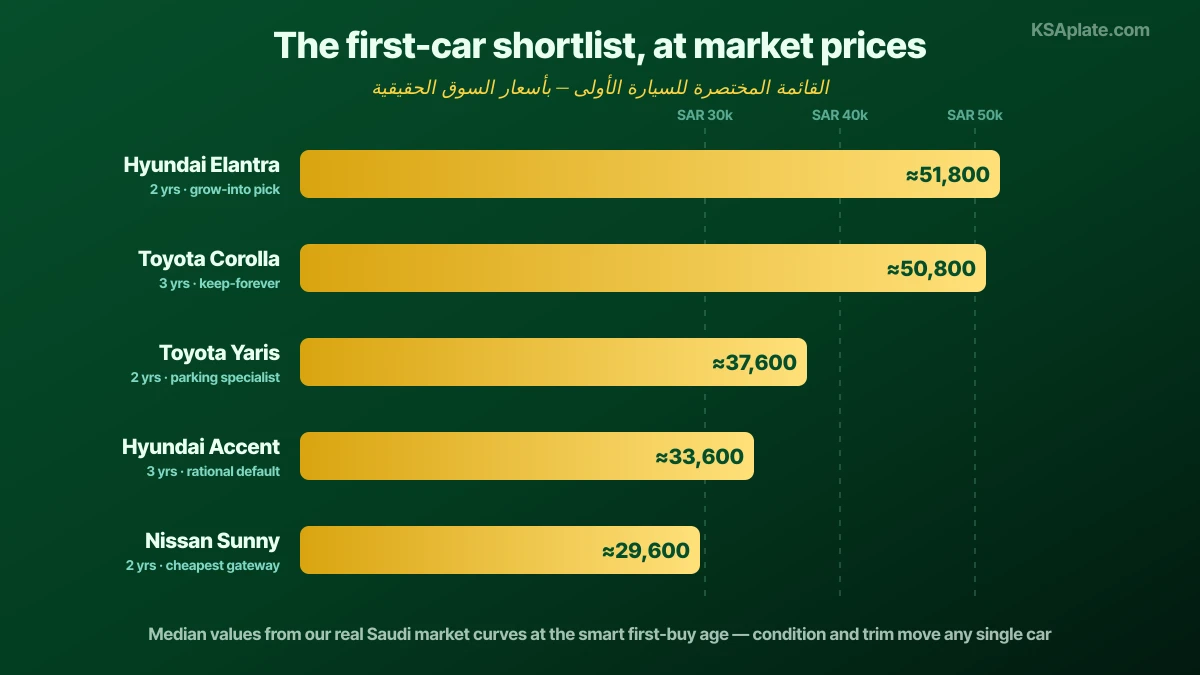
Five cars dominate the sensible end of the first-car market, and our curve data — medians from real Saudi listings, the same dataset behind the under-SAR-50,000 guide — prices each of them at the nearly-new ages that make first-car sense:
| Car | Smart first buy (age, ≈value) | Why it forgives |
|---|---|---|
| Nissan Sunny | 2 yrs, ≈SAR 29,600 | The cheapest nearly-new four-door in our dataset — light controls, tiny running costs, zero drama |
| Hyundai Accent | 3 yrs, ≈SAR 33,600 (2 yrs ≈39,500) | The rational default: the highest-volume small sedan in our data, parts everywhere, flat value curve |
| Toyota Yaris | 2 yrs, ≈SAR 37,600 | The smallest footprint here — the parking-structure specialist with Toyota running costs |
| Hyundai Elantra | 2 yrs, ≈SAR 51,800 | The grow-into compact: more space and refinement while keeping light, honest controls |
| Toyota Corolla | 3 yrs, ≈SAR 50,800 | The keep-forever pick — the car you buy first and still own at year eight, by reputation and by curve |
How to choose among them: if the budget is the constraint, the Sunny and three-year Accent do the entire first-car job for under SAR 34,000. If parking confidence is the worry, the Yaris is the specialist. If the car needs to survive into your second driving chapter — first job, longer commutes — the Elantra and Corolla carry you there without a second purchase. All five clear the safety floor from the traits section in their recent model years; verify the specific car's equipment list, because trim levels vary. Browse the current listings with this shortlist and the curve numbers in hand, and the negotiation starts from data instead of hope.
What not to buy first
The first-car traps are consistent enough to list — each one looks like a bargain and prices like a lesson:
- The powerful coupe at a tempting price. Power is the one trait a first car must not have. Insurance loads it, Saher prices it, and a new driver's skill ceiling meets a 300-horsepower floor in exactly one place: the fines system, or worse. Buy the boring car; the exciting one is a better fifth car anyway.
- The aging luxury sedan. A ten-year German flagship at Accent money is the market's favorite mirage. The purchase is cheap because the ownership is not: parts at multiples, specialist labor, and electronics with a decade of Saudi summers behind them. First budgets die here regularly.
- The modified car. Lowered, tinted beyond legal, remapped, loud — every modification is a question mark over how the car was driven, an insurance complication, and a re-inspection risk. A first car should be stock, boring and documented.
- Anything without a verifiable story. No service history, seller allergic to inspections, mileage that does not match the wear — walk away early. The full catalog of what dishonest listings look like is in our scams guide; as a first-time buyer you are the exact audience it was written for.
Nearly-new beats new: the depreciation argument
The showroom pitch to first buyers is warranty and peace of mind. The curve data tells a colder story: the first owner pays for the showroom smell, and the second owner gets the car. An Accent that left the dealership above SAR 60,000 trades at ≈SAR 39,500 two years later — the steepest depreciation of the car's life, paid entirely by someone else. From there the curve flattens: two-to-four years costs ≈SAR 9,400 total, roughly SAR 390 a month, for a car still young enough to feel new, still inside its mechanical prime, and already proven by its own history file.
This is also the honest answer to financing pressure: the less car-capital you need, the smaller the loan, and a nearly-new pick from the table above keeps the total obligation in starter territory. Timing is the final lever — the used market has seasonal soft windows where the same car costs meaningfully less, mapped in our timing guide.
Inspecting and verifying as a first-time buyer
First-time buyers are the market's softest target, which is exactly why the verification routine matters more for you than for anyone else. The condensed version, in order:
- Anchor the price before viewing. Run the exact model, year and mileage through the free calculator and write the fair range down. Every negotiation you will ever have starts stronger from a number.
- Pull the history first. A vehicle history check takes minutes and kills the two catastrophic outcomes — accident-salvage and odometer fraud — before you have emotional skin in the deal.
- Pay for a workshop inspection. A ≈SAR 300 pre-purchase inspection is the single best money a first-time buyer spends. You are not yet the person who hears a tired suspension bushing; the workshop is.
- Do the paperwork by the book. Ownership transfer on Absher, insurance active before you drive, registration in your name — the complete step-by-step, including the 14-point checklist, is in our how-to-buy guide.
Buying for your son or daughter
A large share of first cars in the Kingdom are bought by parents, and the parent's optimization differs from the new driver's in one honest way: the parent is buying a safety envelope, not a car. Three adjustments to the framework above:
- Weight safety above price inside the shortlist. Between a cheaper car with ABS only and a slightly costlier one with ESC and six airbags, the second is the correct parental purchase — the equipment gap matters most in exactly the first-year mistakes this guide plans for.
- Modest power is a feature, not a compromise. The small-engine picks in the table are not what a nineteen-year-old would choose — which is the point. The car's character teaches patience for the years when judgment is still catching up to confidence.
- Put the running costs in the driver's name, even if the car is not. Fuel, small maintenance, the deductible on any ding — ownership of consequences is how a first car teaches. The insurance itself must still honestly reflect who drives, per the insurance section above.
The first 5,000 kilometers
The car is bought; the apprenticeship starts. The habits formed in the first 5,000 km are the ones that stay:
- Practice parking before you need it. Twenty minutes in an empty lot on a Friday morning — forward bays, reverse bays, parallel — converts the most common first-year stress into a solved problem.
- Learn the car's paperwork rhythm early. Insurance renewal date, registration validity, the service intervals — put all three in your phone calendar the week you buy. Administrative surprises are the most avoidable category of first-car problems.
- Adopt the maintenance rhythm as a habit, not an event. Oil and filters on schedule, tire pressures monthly, AC checked before summer, battery tested after year two — the full Saudi-heat schedule is in our maintenance guide. A first car serviced on rhythm is also a car that sells well later.
- Drive like the cameras are certain, because they are. Saher does not negotiate with new drivers. Building the speed-limit habit in month one is cheaper than learning it by SMS.
- Keep every receipt. The service file you start today is the sales asset of your upgrade day — and when that day comes, listing the car on KSAplate costs free, with the documented history doing the selling.
Frequently asked questions
What is the best first car for a new driver in Saudi Arabia?
How much should I spend on a first car in Saudi Arabia?
Is it better to buy a new or used car as a first car?
How much is car insurance for a new driver in Saudi Arabia?
Should a first car have a small engine?
What safety features are essential in a first car?
Can an expat buy a first car in Saudi Arabia?
What should I avoid when buying my first car?
How many kilometers does a new driver do in the first year?
Should parents buy the car in their own name or the new driver's name?
When should I sell my first car and upgrade?
Conclusion
The perfect first car is an anticlimax on purpose: a small, honest, nearly-new sedan with light steering, real safety equipment, cheap parts and a flat depreciation curve — a machine engineered to make your mistakes affordable while your skills catch up. The data keeps the decision simple: Sunny or Accent for the tightest budgets, Yaris for parking confidence, Elantra or Corolla to grow into, all bought at two to three years old where someone else has already paid the steep part of the curve, all budgeted with the honest first-year number of SAR 4,500–6,700 beyond the purchase.
Run the first-timer's sequence in order: anchor your shortlist with the free value calculator, verify history and inspect before any money moves, buy from the current listings with the curve numbers in hand — and years from now, when the apprenticeship is complete and the upgrade day arrives, list it on KSAplate for free with a service file that tells the story of a first car chosen well. Somewhere in the Kingdom tonight a new driver is about to buy a tired luxury sedan because it looked like a bargain. You now know better — and it cost you one article instead of one year.