
Last updated: 22 August 2026
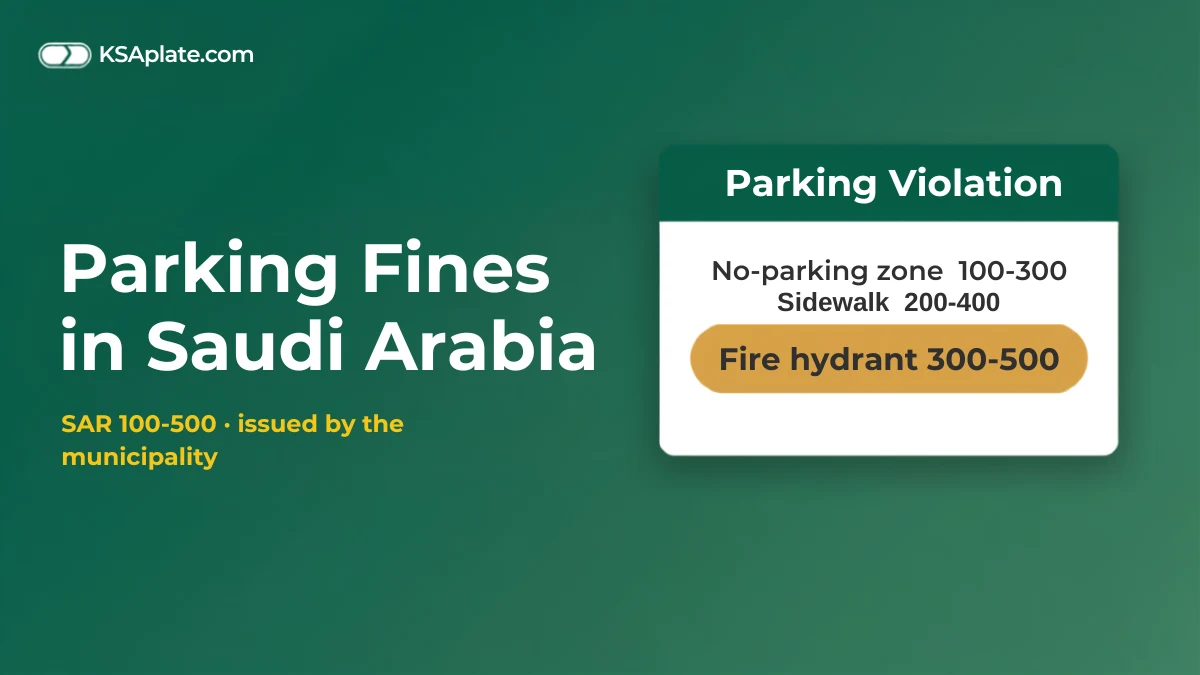
Parking fines in Saudi Arabia typically run from SAR 100 to SAR 500 and are issued by the municipality, not the traffic department. That single fact explains most of the confusion around them: a parking ticket often will not appear alongside your Saher and traffic violations, it does not add black points to your licence, and it follows a separate appeals route. Serious cases add towing and impoundment, where storage charges — not the fine — become the real cost.
The question to ask about any Saudi vehicle fine is not "how much?" but "who issued it?" The answer decides where it appears, how you pay it, and whether it touches your licence.
TL;DR
- Amounts: parking violations commonly fall in a SAR 100–500 band, scaling with how much the parked car obstructs others.
- Different authority: parking fines come from the municipality (Amanah), while speeding and red-light fines come from the traffic department (Moroor) — two separate systems.
- No black points: parking violations penalise your wallet, not your licence; traffic violations add points that can lead to suspension.
- Towing is the expensive part: where a car is towed and impounded, daily storage keeps accruing until you collect it.
- Appeals exist: a Parking Violations Appeals Committee is published as a national government service for objecting to a municipal parking fine.
Quick answer
A Saudi parking fine is a municipal penalty for parking somewhere prohibited or obstructive, usually between SAR 100 and SAR 500. Because the municipality issues it rather than Moroor, it sits in a different system from your traffic violations and carries no black points. Severe cases add towing and impoundment. Before you pay anything, confirm which authority issued the ticket — that determines where it lives.
What a parking fine is in Saudi Arabia
A parking fine is a monetary penalty issued when a vehicle is left in a place where parking is prohibited, restricted, or obstructive. It targets the stationary car rather than the way it was driven, which is why it is handled by city authorities rather than road-traffic enforcement.
The distinction matters more than it sounds. Traffic enforcement deals with driver behaviour — speed, signals, phone use. Parking enforcement deals with where a vehicle sits and who it inconveniences: blocked lanes, occupied sidewalks, obstructed emergency access. Different problem, different authority, different paperwork.
For example, a car photographed by a Saher camera for speeding and the same car ticketed an hour later for sitting on a sidewalk generate two penalties in two separate systems. Our guide to checking and paying traffic fines covers the Moroor side; this article covers the municipal side.
Key takeaway: parking fines penalise where a car is parked, not how it was driven — which is exactly why they sit outside the traffic-violation system.
What's your car worth?
Get a free instant estimate based on real Saudi market data — then sell it on KSAplate with direct WhatsApp contact.
Value My Car — FreeHow much parking fines cost
Saudi parking fines commonly fall between SAR 100 and SAR 500, with the amount scaling to how much the parked vehicle obstructs traffic, pedestrians, or emergency access. The least disruptive violations sit at the bottom of the band; anything that blocks people or emergency equipment sits at the top.
The table below shows the ranges most consistently reported for common violations. Treat them as indicative: municipalities set and update their own schedules, so the authoritative figure is the one on your notice.
| Violation | Indicative fine (SAR) | Why it is priced there | Towing risk |
|---|---|---|---|
| Parking in a no-parking zone | 100 – 300 | Prohibited spot, limited obstruction | Low |
| Parking on a sidewalk | 200 – 400 | Forces pedestrians into the road | Moderate |
| Blocking traffic | 300 – 500 | Obstructs moving vehicles directly | High |
| Parking near a fire hydrant | 300 – 500 | Blocks emergency access | High — towing common |
Notice the logic running through the band. A quiet no-parking bay costs you a couple of hundred riyals; a hydrant costs you up to five hundred plus the very real prospect of returning to an empty parking space. The fine rises with the harm, and so does the chance of the car being removed.
Key takeaway: the price is set by obstruction, not inconvenience — blocking people or emergency access is where fines peak and towing begins.
Why parking fines are not traffic fines
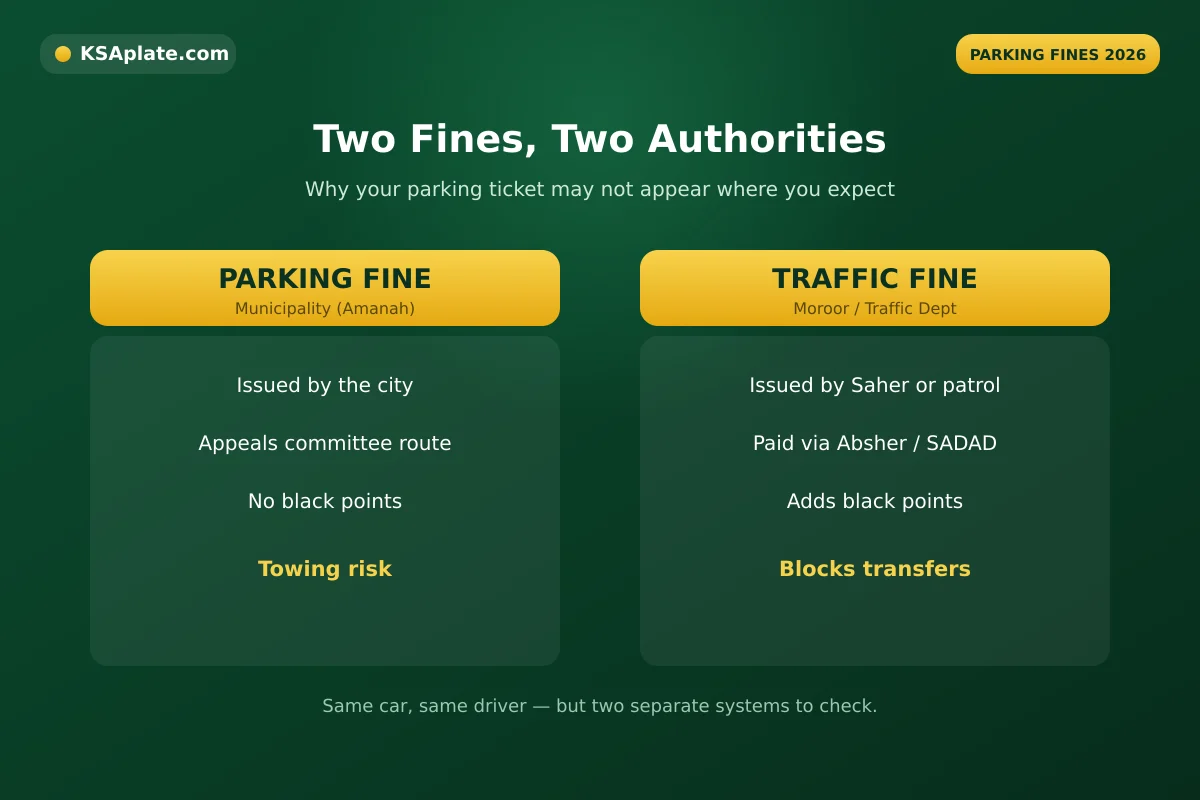
Parking fines in Saudi Arabia are issued by the municipality (Amanah), while traffic fines are issued by the General Directorate of Traffic, known as Moroor. They are two enforcement systems running over the same car, and they do not share a single screen.
This is the source of the most common complaint from drivers: a parking ticket that does not show up in the traffic violations list looks, at first glance, like a mistake or a scam. It usually is neither. It is simply filed with the city that issued it. Riyadh, for instance, publishes parking information and violation guidance through its own parking service rather than through the traffic platform.
A parking ticket missing from your traffic violations is not proof that it is fake. It is usually proof that you are looking in the wrong system.
Compare the two: a Saher speeding fine reaches you through the traffic system, is paid alongside other traffic violations, and carries points. A municipal parking fine reaches you from the city, is settled through the city's channel, and carries none. Our article on Saher and speed limits explains the automated traffic side in detail.
| Parking fine | Traffic fine | |
|---|---|---|
| Issued by | Municipality (Amanah) | Traffic department (Moroor) |
| Triggered by | Where the car is parked | How the car was driven |
| Where it appears | The issuing city's channel | Absher traffic violations |
| Black points | No | Yes |
| Worst case | Towing and impoundment | Licence suspension |
Key takeaway: one car can owe money to two different authorities, and checking only Absher will not show you the municipal half.
If you want the other side of that line, we keep the full list of Saudi traffic fines with current amounts and which ones carry black points.
Do parking fines add black points?
Parking fines do not add black points to your driving licence. Points are a traffic-violation penalty administered through the traffic system, and municipal parking penalties sit outside it.
The practical consequence is reassuring but easy to misread. Ten parking tickets will cost you money and possibly a towed car, but they will not move you toward the 24-point suspension threshold. Ten phone-use violations absolutely will. If you are tracking your exposure to a licence suspension, parking tickets are not part of that calculation.
That said, do not treat this as permission to ignore them. Unpaid municipal obligations create their own problems, and they tend to surface at the worst moment — usually when you are trying to complete a transaction on the vehicle. Our guide to traffic violation points and licence suspension covers what does count toward that threshold.
Key takeaway: parking fines threaten your wallet and your parked car, but not your licence — that risk belongs to traffic violations.
How to find and pay a parking fine
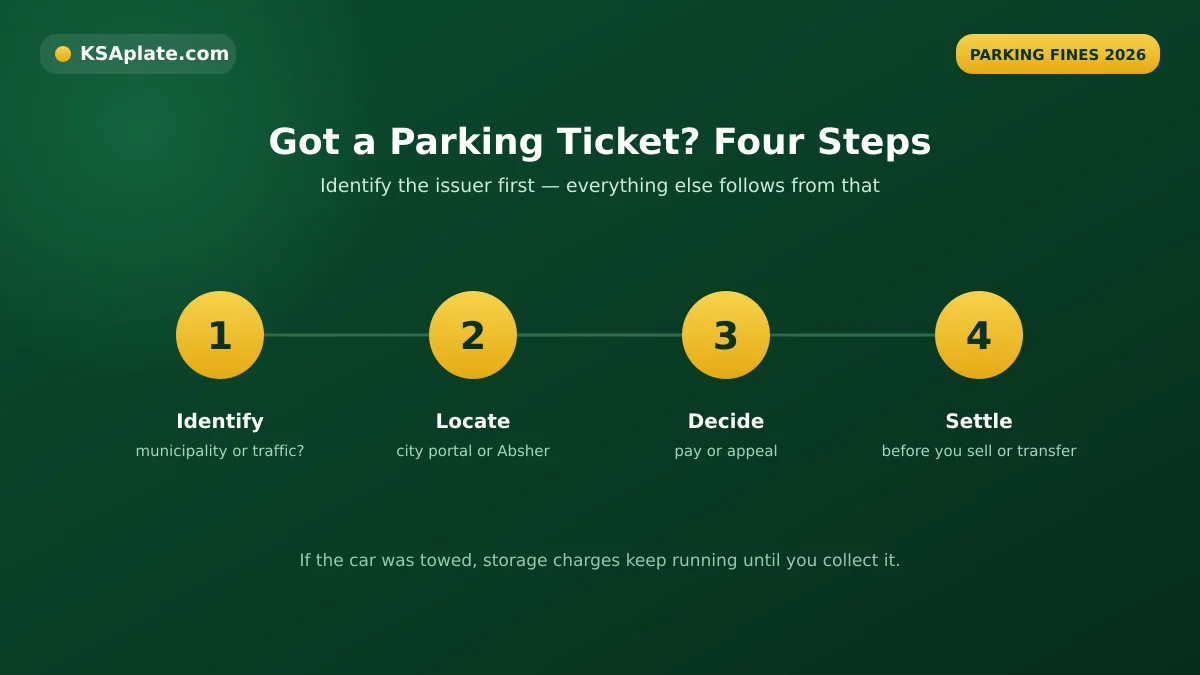
Finding a parking fine starts with identifying the issuing authority, because the ticket lives with whoever wrote it. Once you know that, the payment route follows directly.
Work through it in this order:
- Read the notice. Identify whether it names the municipality or the traffic department. This single step resolves most confusion.
- Check the traffic system first if it is a traffic violation. Absher lists Moroor violations and their fines.
- Check the city's parking service for municipal tickets. Riyadh publishes violation guidance through riyadhparking.sa; other cities operate their own channels.
- Pay through the channel that issued it, keeping the receipt or reference number.
- Re-check after payment to confirm the record cleared rather than assuming it did.
The national services portal at my.gov.sa is the reference point for government services, including the parking violations appeals service. For traffic-side fines, Absher remains the platform under the Ministry of Interior.
Key takeaway: identify the issuer first — searching the wrong system is why drivers conclude a legitimate ticket does not exist.
How to appeal a parking fine
An appeal is a formal objection asking the issuing authority to cancel or reduce a fine you believe was wrongly applied. Saudi Arabia publishes a Parking Violations Appeals Committee as a national government service, which reviews objections to municipal parking penalties.
Appeals work best when you can show a factual error rather than an inconvenience. Strong grounds include the vehicle not being yours at the time, the car having already been sold and transferred, unclear or missing signage, or a duplicate ticket for the same event. Weak grounds include being briefly away, or not having seen a sign that was clearly posted.
For example, a seller who transferred a car two weeks before the ticket date has a documentary case: the transfer record establishes that the vehicle was no longer theirs. That is precisely the situation our guide to a car not transferred after sale deals with, and it is one of the most common causes of tickets arriving for a car you no longer own.
Key takeaway: appeal with evidence of a factual error — ownership records and dates persuade; explanations of circumstances rarely do.
Towing and impoundment costs
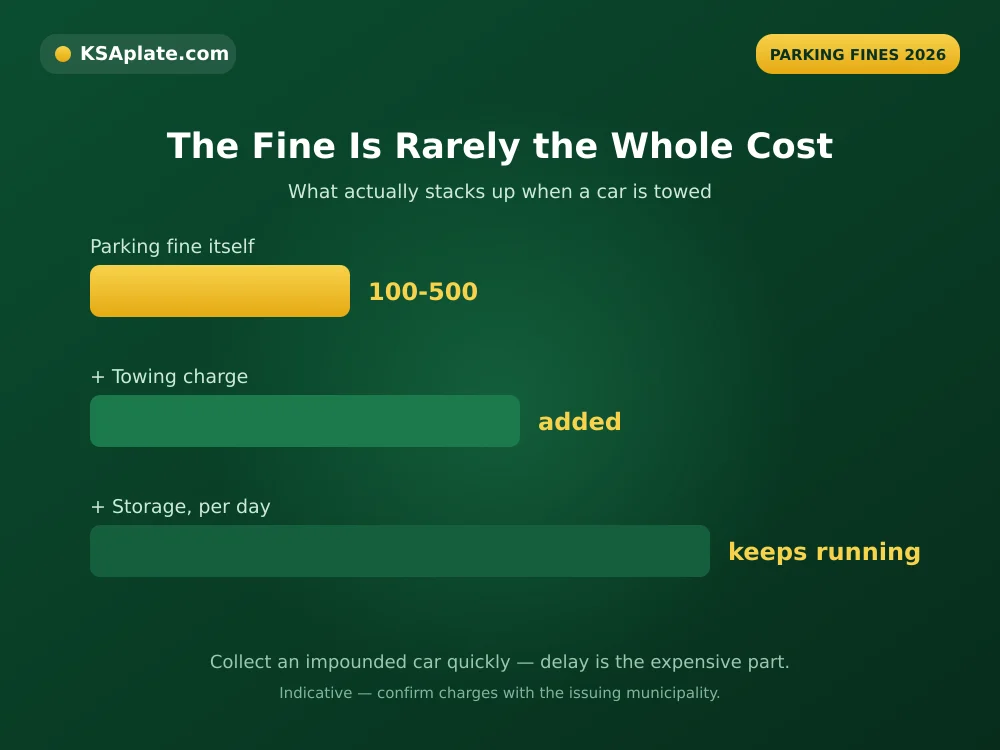
Towing is the removal of an illegally parked vehicle to an impound area, and it converts a modest fine into an open-ended cost. Where a car obstructs traffic or emergency access, removal and impoundment are explicitly part of the penalty framework.
The important shift is from a fixed cost to a running one. The parking fine is a known number. The towing charge is added on top. Storage then accrues for as long as the car sits in the impound area, which means the total depends on how quickly you act rather than on what you originally did wrong.
In practice, this reverses the usual advice about disputing charges. If your car has been towed, retrieving it promptly and appealing afterwards is almost always cheaper than leaving it in storage while you argue. Our guide to towing and vehicle recovery covers the retrieval process, and car theft prevention is worth reading if your car is missing and you are not yet certain it was towed rather than stolen.
A towed car is the one vehicle penalty where hesitation has a daily price. Collect first, dispute second.
Key takeaway: the fine is fixed but storage is not — with an impounded car, speed of collection matters more than the original violation.
What unsettled fines mean when you sell
Unsettled vehicle obligations can complicate the moment you try to transfer a distinctive plate, and they still surface when you sell a car. This is where an ignored ticket stops being an annoyance and starts costing you a sale.
Traffic violations are the best-known worry, but Saudi traffic police (Muroor) confirm that unpaid fines on the owner do not stop a car ownership transfer in Absher, provided the Istimara and periodic inspection (Fahas) are valid — the fines stay on your record and still need paying. Municipal parking tickets sit in a different system, so the safe approach is to clear both rather than assume the one you can see is the only one that exists. A buyer weighing your price does not care which authority issued a ticket.
In our experience running the KSAplate marketplace, deals that collapse late almost never collapse over price. They collapse over paperwork — an expired registration or inspection, a lapsed insurance policy, an unpaid violation on a plate move. Sellers who clear the file before listing close in days rather than weeks.
Before you list a car or a plate, run this check:
- Settle traffic violations in Absher — see the fines guide.
- Settle municipal parking tickets through the issuing city's channel.
- Confirm registration is current using our Istimara renewal guide.
- Confirm the transfer route in the ownership transfer guide or the plate transfer guide.
Key takeaway: clear both fine systems before listing — fines alone do not block a car transfer, but a buyer will not want surprises from a second system.
File clear? Find out what your plate is worth
With fines settled, a distinctive plate is an asset you can sell separately from the car. Value it free in seconds, then list it to active Saudi buyers for free — no commission.
Value my plate free List for freeHow to avoid parking fines
Avoiding parking fines is mostly a matter of recognising the four situations that generate almost all of them. None require local knowledge — they require noticing what your parked car is blocking.
The recurring causes are consistent: parking where signage prohibits it, resting a wheel on a sidewalk, stopping in a way that narrows a lane, and parking near emergency infrastructure such as hydrants. The last of these is the one drivers underestimate most, because a hydrant looks harmless in a way a blocked lane does not.
A useful test before walking away: ask whether a pedestrian with a pram, a delivery van, or a fire crew would be forced to go around your car. If the answer is yes for any of them, you are in the fine band — and possibly the towing band. Expat drivers new to Saudi cities should read our expat car ownership guide for how parking fits into the wider admin picture.
Key takeaway: if someone would have to go around your parked car, expect a fine — and if that someone is an emergency vehicle, expect a tow.
Frequently asked questions
How much is a parking fine in Saudi Arabia?
Why is my parking fine not showing in Absher?
Do parking fines affect my driving licence?
Can my car be towed for a parking violation?
How do I appeal a parking fine I think is wrong?
I sold the car — why am I still getting parking tickets?
Will an unpaid parking fine stop me selling my car?
Is there a discount for paying a parking fine early?
The bottom line
Parking fines are the quiet half of Saudi vehicle enforcement: SAR 100–500, issued by the municipality, invisible in the traffic system, and harmless to your licence — right up until a car is towed and storage starts running. Identify who issued any ticket before you look for it, appeal only where you can show a factual error, and clear both fine systems before you try to sell a car or move a plate. Fines alone will not block a car transfer while the Istimara and inspection are valid, but a forgotten SAR 200 ticket is still yours to pay.
Turn a plate you own into an offer
With your file clear, your distinctive plate can be sold on its own. Get a free valuation, then list it to active Saudi buyers for free — no commission when it sells.
Value my plate List my plateLast updated: 22 August 2026. Written and reviewed by Khalid Al-Rashid, Saudi License Plate Market Analyst, drawing on published municipal violation schedules, the national services portal, and transfer patterns observed on the KSAplate marketplace.
Sources: Saudi national services portal (my.gov.sa), Riyadh parking service (riyadhparking.sa), Ministry of Interior (moi.gov.sa). Methodology note: fine bands here are indicative figures consistent across current public reporting, not an official schedule. Parking penalties are set and updated by individual municipalities — confirm the amount, payment channel, and appeal window on your own notice or with the issuing city before acting.