
Last updated: 21 August 2026
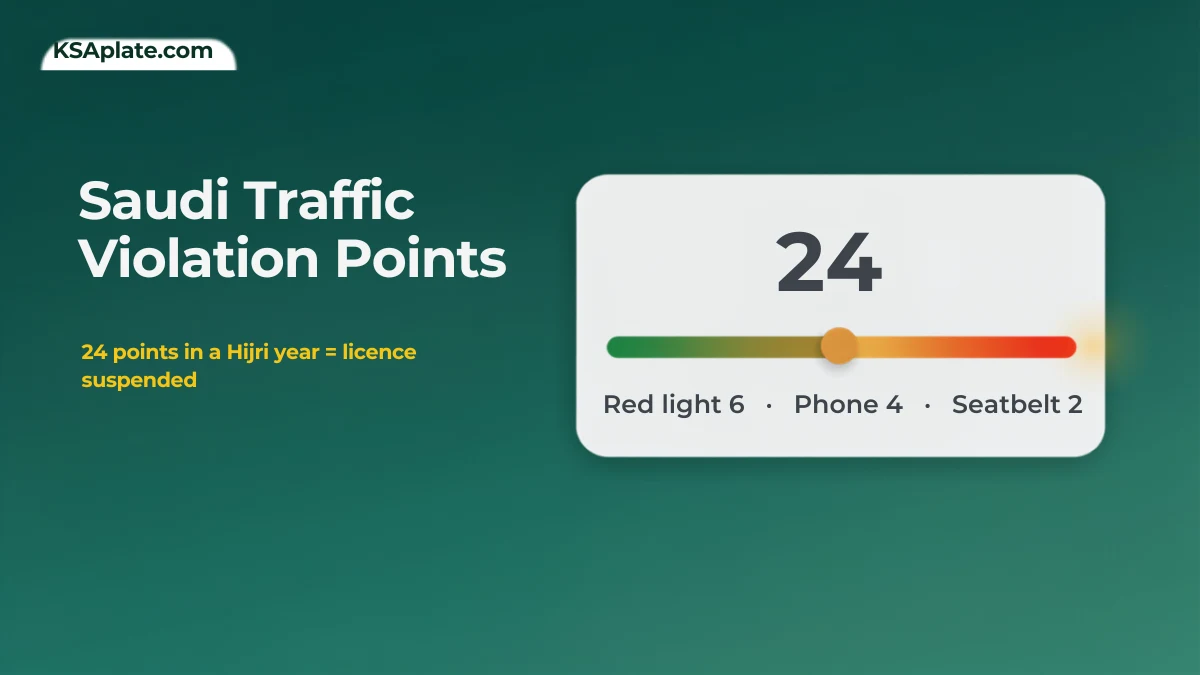
Saudi traffic violation points are penalty marks added to your driving record alongside a fine, and reaching 24 points within one Hijri year suspends your licence. The first suspension lasts three months, the second six months, the third a full year, and a fourth ends in permanent revocation. Points are tracked in Absher under the General Directorate of Traffic (Moroor), and a clean Hijri year with no new violation clears the balance back to zero.
One violation costs you twice. The fine takes your money. The points take your licence. Drivers who only watch the fine never see the suspension coming.
TL;DR
- The threshold: 24 points accumulated within a single Hijri year triggers licence suspension — the count is lunar, not calendar-based.
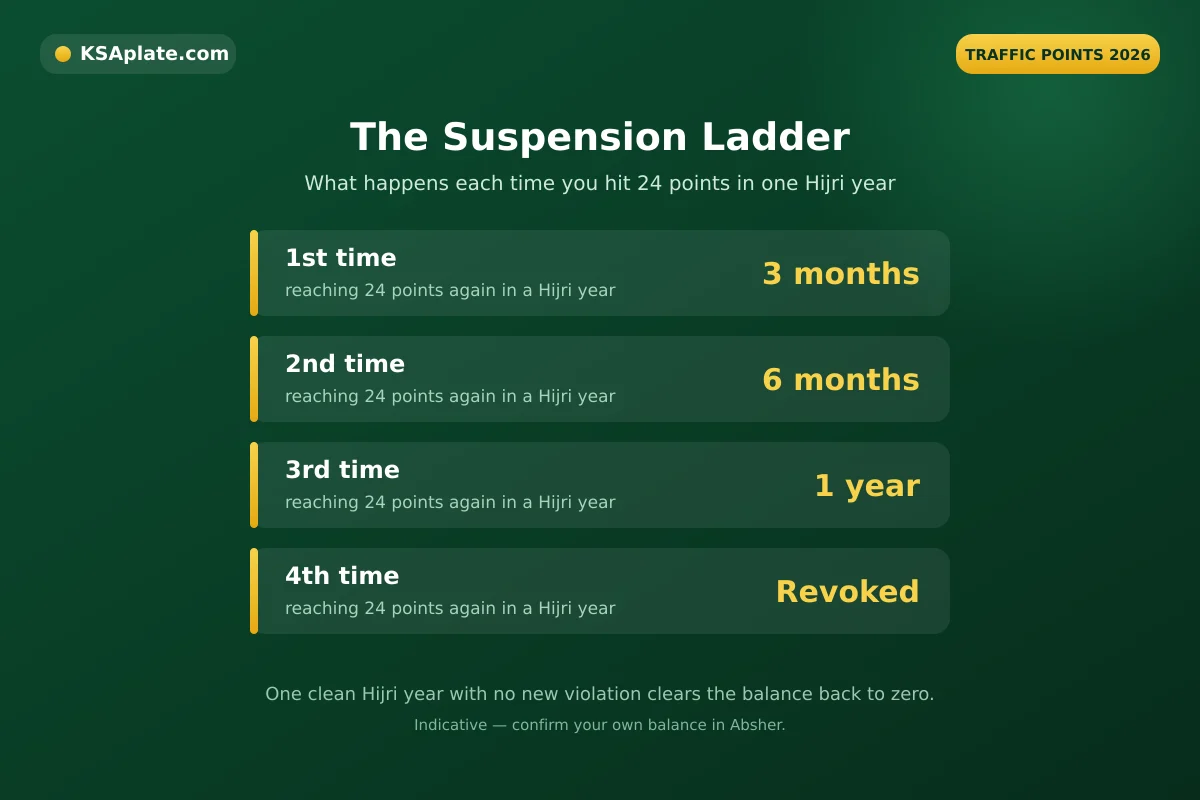
- The ladder: first suspension 3 months, second 6 months, third 1 year, fourth permanent revocation.
- Points reset: complete one full Hijri year without a new violation and the balance clears to zero on its own.
- Indicative values: running a red light around 6 points, handheld phone use around 4, no seatbelt around 2; drifting (tafheet) carries 24 points and immediate suspension.
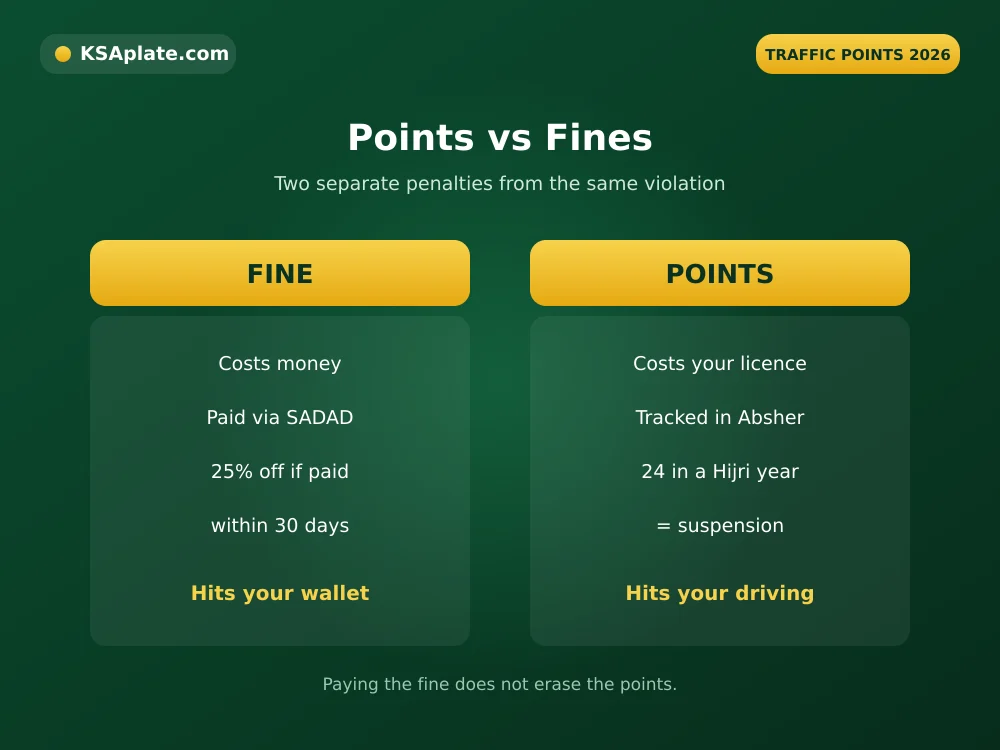
- Paying does not erase points: settling the fine — even at the 25% early-payment discount — clears the money, not the licence penalty.
Quick answer
Saudi Arabia runs a points-based traffic system on top of monetary fines. Each violation adds points to your record, most falling in a 2 to 8 point band. Hit 24 points inside one Hijri year and your licence is suspended for three months, with longer bans for repeat offences. You can see your current balance any time in Absher. The single most misunderstood part: paying the fine does not remove the points.
What traffic violation points are
A traffic violation point is a penalty mark recorded against your driving licence when you commit a road offence. Saudi Arabia adopted the points system to target repeat offenders — drivers who can absorb fines financially but keep driving dangerously.
The logic is behavioural rather than financial. A wealthy driver may treat a SAR 500 fine as a rounding error, but nobody can buy their way out of a suspended licence. Points make the consequence escalate with repetition instead of resetting every time a bill is paid.
For example, a driver caught on a handheld phone three separate times pays three fines — and quietly builds a points balance that a fourth or fifth offence can push into suspension territory. Our guide to checking and paying traffic fines covers the money side; this article covers the licence side.
Key takeaway: points exist to punish repetition, which is why they accumulate independently of whether you have paid the fine.
What's your plate worth?
Get an instant, free estimate with our plate value calculator.
Calculate My Plate's ValueThe 24-point threshold and the Hijri year
The suspension threshold in Saudi Arabia is 24 points accumulated within one Hijri year. Reaching that ceiling triggers an automatic suspension of your driving licence, regardless of which combination of violations got you there.
The detail most drivers miss is that the clock is lunar. A Hijri year runs roughly 354 days, about 11 days shorter than the Gregorian year, so your personal window shifts earlier each calendar year. Two violations that feel "months apart" on a phone calendar may still sit inside the same Hijri counting period.
Do not measure your risk in calendar months. The traffic system counts your points against the Hijri year, and that window closes 11 days sooner than the one on your phone.
For example, six red-light offences at roughly 6 points each would exhaust the entire 24-point allowance on their own. A mix of smaller offences — seatbelt, phone use, minor speeding — reaches the same ceiling more slowly but just as certainly.
Key takeaway: 24 points inside one Hijri year is the line, and the lunar calendar makes that window tighter than drivers expect.
The suspension ladder
The suspension ladder is the escalating scale of penalties applied each time a driver hits the 24-point ceiling. It exists so that a first mistake is recoverable while persistent offending removes the driver from the road entirely.
Each time you reach 24 points within a Hijri year, the penalty steps up:
- First time: licence suspended for 3 months.
- Second time: licence suspended for 6 months.
- Third time: licence suspended for 1 year.
- Fourth time: licence permanently revoked.
Compare that with the fine structure, which does not escalate the same way — a second red-light fine costs roughly what the first did. The ladder is where repetition genuinely changes the outcome. If your licence is approaching renewal, read our Saudi driving licence guide for how status affects renewal.
Key takeaway: fines repeat at the same price; suspensions get longer every time, ending in permanent revocation on the fourth.
How many points each violation carries
Point values are assigned per violation according to how dangerous the offence is, with most sitting in a 2 to 8 point range. The most severe offences carry the entire 24-point allowance at once.
The table below pairs commonly reported point values with their fine ranges. Treat the figures as indicative: schedules are updated periodically, and the authoritative number for your own case is the one shown in Absher.
| Violation | Indicative points | Indicative fine (SAR) | Effect |
|---|---|---|---|
| Drifting (tafheet) | 24 | 20,000 | Immediate suspension — the full allowance in one offence |
| Running a red light | 6 | 3,000 – 6,000 | Four offences exhaust the allowance |
| Handheld mobile phone use | 4 | 500 – 900 | Six offences exhaust the allowance |
| No seatbelt | 2 | Lower band | Small individually, adds up quickly |
Notice the asymmetry. A single drifting offence ends your driving immediately, while phone use needs roughly six repetitions to do the same damage. Speed-camera offences are their own category — our Saher speed limits guide explains how automated enforcement works.
Key takeaway: the gap between a 2-point and a 24-point offence is the difference between a warning and losing your licence in a single night.
Points vs fines: two separate penalties
A fine is a monetary penalty and a point is a licence penalty, and one violation usually triggers both. Confusing the two is the most expensive misunderstanding in the whole system, because drivers assume a paid fine means a closed case.
They run on different tracks. The fine is settled through SADAD and qualifies for a 25% discount if paid within 30 days of notification. The points sit on your record until a full clean Hijri year passes. Paying early saves money; it does not shorten the points clock by a single day.
| Fine | Points | |
|---|---|---|
| What it costs | Money | Your licence |
| Where it lives | Absher / SADAD billing | Your driving record |
| Can it be discounted? | Yes — 25% within 30 days | No |
| How it ends | You pay it | One clean Hijri year |
| Blocks vehicle services? | Yes, while unpaid | Not directly |
Key takeaway: paying the fine closes the invoice, not the points balance — they are two penalties from one violation.
How to check your points in Absher
Absher is the Ministry of Interior's digital services platform, and it is where your violation record and points balance are published. Checking takes under a minute and needs no visit to a traffic department.
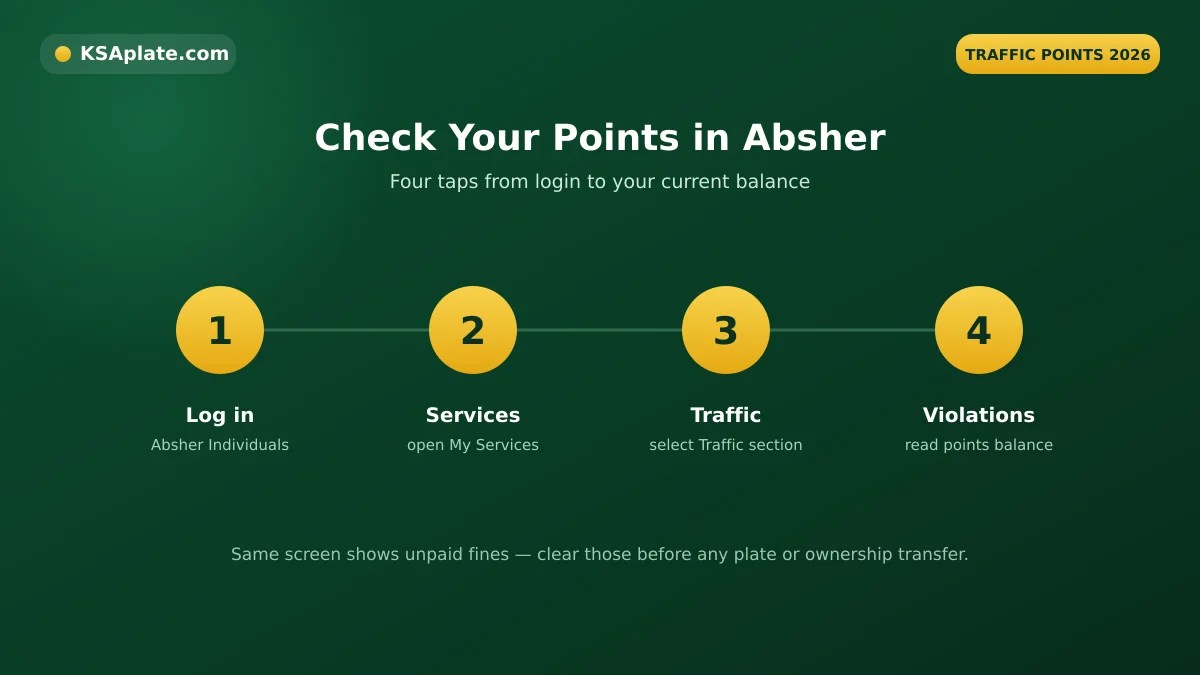
The route most drivers use:
- Log in to your Absher Individuals account with your ID or Iqama number.
- Open My Services.
- Select the Traffic section.
- Open Traffic Violations to see your violations, fines, and points balance.
The official platform is absher.sa, operated under the Ministry of Interior. The same screen shows unpaid fines — worth noting, because those can hold up some vehicle services in a way points do not.
Key takeaway: Absher → My Services → Traffic → Traffic Violations shows your live points balance and unpaid fines in one place.
How points clear
Points clear automatically after one full Hijri year without committing a new violation. There is no fee, no form, and no application — the balance simply resets once the clean period completes.
The catch is that the clean year must be genuinely clean. A new violation during the waiting period restarts your exposure and adds fresh points on top of the existing balance. This is why drivers close to the ceiling should treat the following months as a deliberate cooling-off period rather than business as usual.
For example, a driver sitting at 20 points who picks up a 4-point phone violation eleven months into the wait does not merely delay the reset — they reach 24 and trigger the suspension itself.
Key takeaway: the reset is free and automatic, but only a completely violation-free Hijri year earns it.
How violations affect a plate or car sale
Outstanding traffic violations can stop some vehicle transactions in Absher, such as moving a distinctive plate between vehicles. Selling the car itself is different: Saudi traffic police (Muroor) confirm that fines on the owner do not prevent an ownership transfer, provided the Istimara and periodic inspection (Fahas) are valid. This is where a traffic record stops being a personal matter and starts costing you a sale.
The mechanism is simple: Absher will not process a plate transfer while the file attached to the vehicle or the owner has unsettled obligations. A buyer ready to pay for your plate cannot receive it, and the deal stalls at the final step — usually after both sides have already agreed a price.
In our experience running the KSAplate marketplace, the transfers that stall at the last moment are almost never priced wrong. They are paperwork problems: an expired registration or periodic inspection, a lapsed insurance policy, or an unpaid violation holding up a plate move. Sellers who clear the file first close in days rather than weeks.
Before listing anything, run this short pre-sale check:
- Settle every unpaid violation in Absher — the most common snag on a plate move, and fines stay on your record until paid.
- Confirm insurance is valid; see our car insurance guide for what counts.
- Check the registration is current — our Istimara renewal guide covers the process.
- Confirm the transfer route in the Absher plate transfer guide or the car ownership transfer guide.
Key takeaway: points affect your licence; unpaid fines can stall a plate move but do not block a car sale while the Istimara and inspection are valid — clear them anyway before you list a plate or a car.
File clean? Find out what your plate is worth
Once your violations are settled, a distinctive plate can be sold separately from the car. Value it free in seconds, then list it to active Saudi buyers for free — no commission.
Value my plate free List for freeWhat suspension means for expats
Expatriate residents driving on a Saudi licence are subject to exactly the same points system and the same 24-point ceiling as Saudi nationals. There is no separate allowance and no leniency based on residency status.
The practical stakes are often higher for residents. A suspended licence can affect employment that depends on driving, and it complicates the vehicle admin that residency already ties together — registration, insurance, and eventually the sale or transfer of a car before leaving the Kingdom. Our expat car ownership guide covers those dependencies.
If someone else drives your car, remember that violations follow the driver at the wheel in most enforcement cases, but the registered owner is the one whose vehicle file carries the consequences. Our guide to authorising another driver explains how to document that properly, and if an incident occurs, the Najm accident reporting guide covers what to do next.
Key takeaway: residents face identical thresholds, with more downstream disruption because so much vehicle admin is tied to their Iqama.
Frequently asked questions
How many points suspend a licence in Saudi Arabia?
Does paying a traffic fine remove the points?
How long do traffic points stay on my record?
Where can I see how many points I have?
Which violation carries the most points?
What happens after a second or third suspension?
Do traffic points stop me selling my car or plate?
Do expats get the same points as Saudi nationals?
The bottom line
The points system is the part of Saudi traffic enforcement that a paid receipt cannot fix. Twenty-four points in a Hijri year costs you three months of driving, and each repeat costs more, ending in permanent revocation. Check your balance in Absher rather than guessing, treat a near-ceiling balance as a reason to drive conservatively for a full lunar year, and clear any unpaid violations before you move a plate or sell a car — they will not block a car transfer while the Istimara and inspection are valid, but they stay on your record until paid.
Turn a plate you own into an offer
With violations settled, your distinctive plate is a separate asset you can sell. Get a free valuation, then list it to active Saudi buyers for free — no commission when it sells.
Value my plate List my plateLast updated: 21 August 2026. Written and reviewed by Khalid Al-Rashid, Saudi License Plate Market Analyst, drawing on published Ministry of Interior traffic schedules, the Absher violations flow, and transfer patterns observed on the KSAplate marketplace.
Sources: Ministry of Interior (moi.gov.sa) and the General Directorate of Traffic via Absher (absher.sa). Methodology note: point values and fine bands in this article are indicative figures consistent across current public reporting, not a substitute for the official schedule. Traffic penalties are updated periodically — confirm your own balance and any specific violation in your Absher account before acting.