
Last updated: 8 August 2026 · 11 min read
Driving your Saudi-registered car across a GCC border is legal, but your Saudi car insurance usually does not travel with you. A Saudi-plated car can enter Bahrain over the King Fahd Causeway and the UAE through the Batha–Al Ghuwaifat crossing, provided you carry the right documents and, above all, insurance that is valid on the other side. The plate stays Saudi; what changes at the border is your cover, your authorization to drive that specific car, and a short list of papers the officer will ask to see. Get the insurance layer right before you leave and the rest of the crossing is quick.
The number on your car is Saudi; the insurance behind it is not. Nine out of ten delays at the causeway are an insurance problem, not a passport problem.
- Yes, you can drive your Saudi car across GCC borders. Bahrain via the King Fahd Causeway, the UAE via Batha–Al Ghuwaifat, Kuwait via Nuwaiseeb — all open to privately owned Saudi-plated cars.
- Insurance is the real gate. Standard Saudi third-party cover is not automatically valid abroad. You need a GCC extension (the "orange card") or destination cover before you cross.
- Carry the istimara in the driver's name. If the car is not yours, you need a notarized wakala (power of attorney); a financed car needs the bank's no-objection letter.
- Residents need an exit and re-entry visa. Complete it on Absher before you travel, and clear every Saher and Najm fine first — an unpaid fine can block your exit.
- Budget the toll. The King Fahd Causeway car toll is SAR 35 per crossing as of 18 February 2026; a round-trip package is SAR 60 for two crossings in a week.
Quick answer: Can you drive a Saudi-registered car to Bahrain or the UAE? Yes. A privately owned Saudi car may cross into any GCC state, but you must carry a valid vehicle registration (istimara) in the driver's name — or a notarized power of attorney if it is not yours — a driving licence, a passport with at least six months' validity, and motor insurance that is valid in the destination country. Saudi domestic cover rarely extends abroad on its own, so arrange a GCC "orange card" extension first.
Selling your car? List it on KSAplate for free
No commission on the sale, no account needed, and buyers contact you directly on WhatsApp. Keep or sell the plate separately.
List your car free Browse carsCan you drive a Saudi car across the border?
Driving a Saudi car across a GCC border is the act of taking a vehicle registered and plated in Saudi Arabia into a neighbouring Gulf state under a temporary, cross-border legal status. The car keeps its Saudi plate and Saudi registration; it is not exported, re-plated, or customs-cleared for permanent import. It enters as a visiting private vehicle, which is why the paperwork is lighter than an export but heavier than a domestic drive.
The six GCC states — Saudi Arabia, Bahrain, the UAE, Kuwait, Qatar and Oman — recognise each other's vehicle registrations for short visits, and a GCC driving licence is valid across all of them. What they do not automatically share is insurance. Each country requires that a visiting car carry third-party liability cover that is valid inside its own borders, and a Saudi policy issued for domestic use usually stops at the Saudi line unless you have extended it. That single gap is the reason most first-time crossers get turned back or delayed.
Key takeaway: the plate and registration are portable; the insurance is not. Treat cover as the first thing to fix, not the last.
The border document pack
The border document pack is the fixed set of papers a Saudi car and its driver must present to leave Saudi Arabia and enter a GCC neighbour. It is short, but every item is a hard stop — miss one and you do not cross. In our experience at the King Fahd Causeway, officers check them in the same order every time, so it pays to have them ready in one folder rather than searching the glovebox at the booth.
- Vehicle registration (istimara) — valid, and in the driver's name. If it is not your car, carry a notarized wakala (power of attorney) instead.
- Driving licence — a Saudi or GCC licence is accepted across the Gulf; you do not need an international permit for GCC states.
- Passport — valid for at least six months.
- Iqama and exit/re-entry visa — residents must hold a valid iqama and complete an exit and re-entry visa on Absher before travelling.
- Valid motor insurance for the destination — a GCC "orange card" extension or a policy the destination recognises (see below).
- A current Istimara that has not expired — an expired registration is treated the same as no registration.
Keep the pack together. The single biggest time-saver at any GCC crossing is handing over one folder that already answers every question the officer is about to ask.
Insurance: the orange card explained
The GCC orange card is a unified motor-insurance document that extends your third-party liability cover across Gulf borders, so a car insured in one GCC state is recognised as insured in another. It is the Gulf's version of the international "green card" system used in Europe, and it exists precisely because a domestic policy alone does not cross the border. Your Saudi insurer, or a licensed provider in the destination country, issues it as an add-on or a short-term policy.
Here is the part that trips people up: a standard Saudi third-party policy covers you inside Saudi Arabia only. To enter Bahrain, you extend that cover — many Saudi insurers sell a Bahrain or GCC add-on, or you buy a short Bahraini policy at the crossing. To enter the UAE, your Saudi cover is not valid at all, so you buy temporary UAE insurance at the Al Ghuwaifat border offices or arrange a GCC extension before you leave. If you already run a comprehensive policy, check whether a GCC clause is included; if you run basic cover, assume it is not and sort the extension before the trip.
Key takeaway: confirm in writing that your certificate names the destination country. If the paper does not say "Bahrain" or "UAE", officers treat you as uninsured — no exceptions at the booth.
What's your car worth?
Get a free instant estimate based on real Saudi market data — then sell it on KSAplate with direct WhatsApp contact.
Value My Car — FreeRoute 1 — King Fahd Causeway to Bahrain
The King Fahd Causeway is the 25-kilometre road-and-bridge link between Al Khobar in Saudi Arabia's Eastern Province and the island of Bahrain. It is the busiest GCC land crossing for private cars, carrying weekend traffic in the tens of thousands, and it is the route almost every Saudi resident means when they say "driving to Bahrain." The crossing runs day and night, with immigration and customs for both countries handled on the mid-causeway island.
For a Saudi car you need the full document pack plus insurance valid in Bahrain. The car toll is SAR 35 per crossing as of the 18 February 2026 increase; a round-trip package costs SAR 60 for two crossings within a week, and frequent travellers can buy 40 crossings for SAR 850. Pay the toll in advance through the official Causeway app to skip the cash lane. Expect the crossing itself to take anywhere from 30 minutes on a quiet weekday to several hours on a Thursday evening or a holiday eve.
On a normal weekday the causeway is a half-hour drive. On the eve of a long weekend, leave before dawn or after midnight — the queue, not the paperwork, is what costs you the day.
Route 2 — Batha to the UAE
The Batha crossing is the main land gateway between Saudi Arabia and the United Arab Emirates, known as Al Batha on the Saudi side and Al Ghuwaifat on the UAE side. It sits on the road toward Abu Dhabi, operates 24 hours a day, and is the standard route for anyone driving a Saudi car into the Emirates. The two checkpoints sit close together, with Saudi exit formalities first and UAE entry formalities immediately after.
The critical point for a Saudi car: your Saudi insurance is not valid in the UAE. You must buy temporary UAE cover — a short-term third-party policy — before you can enter, and the insurance offices at the Al Ghuwaifat border sell it on the spot, though arranging a GCC extension in advance saves a queue. Carry the istimara, your licence, and your passport with a valid Saudi exit stamp. Note the mirror rule for the return or for Emirati friends following you: a non-Saudi car entering Saudi Arabia needs a Manafith insurance policy, the system that covers foreign-plated vehicles inside the Kingdom.
Key takeaway: for the UAE, plan on buying fresh cover regardless of what your Saudi policy says. Treat the UAE leg as "uninsured until proven otherwise."
Route 3 — Nuwaiseeb to Kuwait
The Nuwaiseeb crossing (Al Nuwaiseeb on the Kuwaiti side, connected to the Saudi Khafji area) is the main land border between Saudi Arabia and Kuwait. It carries heavy private and commercial traffic and, like the others, requires the standard document pack plus insurance valid in Kuwait. The logic is identical to Bahrain and the UAE: extend or buy cover for the destination, carry the istimara or a wakala, and clear your exit on Absher.
Because Kuwait sits at the northern end of the Gulf, drivers heading there from Riyadh or the Eastern Province often treat it as a longer domestic-style haul; the same heat, fatigue and long-distance rules from a Saudi road trip apply before you even reach the border. The border formalities themselves are the familiar three: documents, insurance, exit stamp.
The three routes compared
Each GCC crossing follows the same template — documents, destination insurance, exit stamp — but the distances, the queues and the insurance mechanics differ. The table below sets the three most-used routes from Saudi Arabia side by side so you can plan the leg that matches your trip.
| Route | Crossing | Saudi insurance valid? | How to get cover | Typical car toll |
|---|---|---|---|---|
| To Bahrain | King Fahd Causeway (Al Khobar) | Not automatically | Saudi GCC/Bahrain add-on, or buy Bahraini cover | SAR 35 per crossing |
| To the UAE | Al Batha ↔ Al Ghuwaifat | No | Temporary UAE policy at Ghuwaifat, or GCC extension | No causeway toll (fuel + distance) |
| To Kuwait | Nuwaiseeb (Khafji) | Not automatically | GCC extension or Kuwaiti cover | No causeway toll (fuel + distance) |
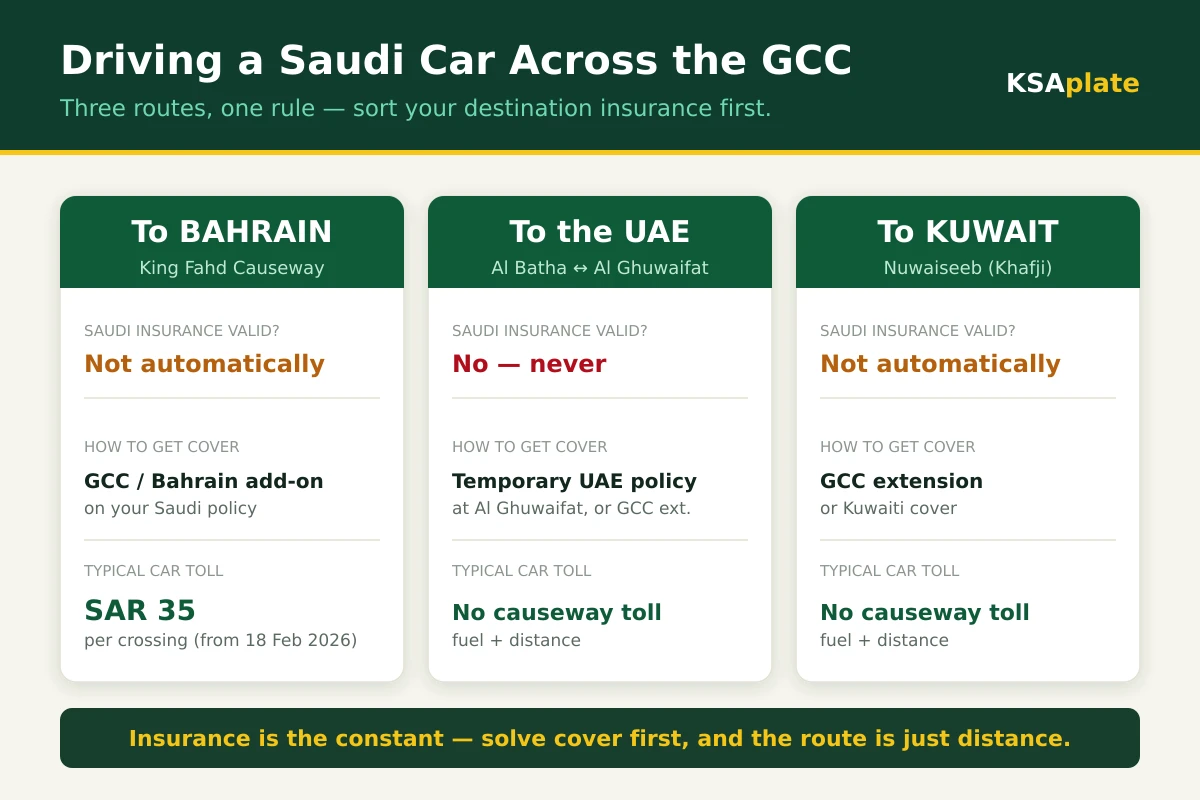
Key takeaway: the constant across all three is insurance. Solve cover first, and the route choice becomes a question of distance and queue, not paperwork.
Who is allowed to drive the car?
The right to take a specific car across a GCC border depends on who owns it, and each ownership type needs a different piece of paper. The officer is not only checking that the car is insured — they are checking that you are entitled to drive this particular vehicle out of the country. Work out which case you fall into before you reach the booth.
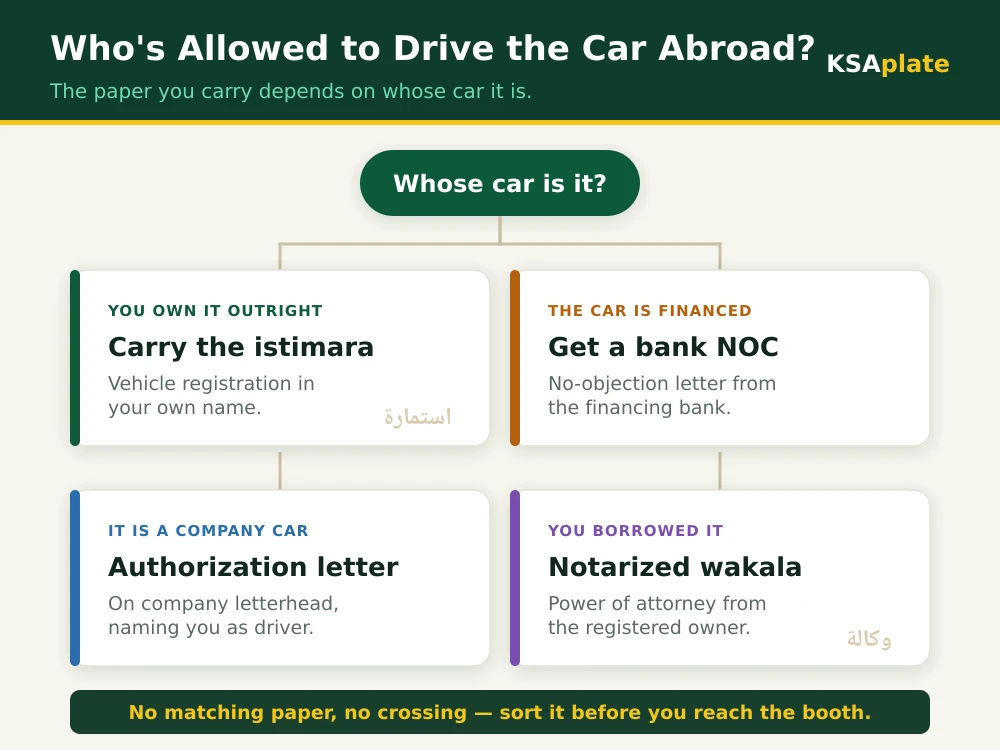
- You own it outright. The istimara is in your name — carry it, and you are set.
- The car is financed. The bank may still hold a lien, so you need a no-objection letter (NOC) from the financing bank permitting cross-border travel.
- It is a company car. Carry an authorization letter from the company, on letterhead, naming you as the permitted driver, plus the entity's registration.
- You borrowed it. Carry a notarized wakala (power of attorney) from the registered owner authorising you to drive it abroad.
The plate can be worth more than the car. If you are borrowing a car with a distinctive number, make sure the wakala is specific and notarized — a vague note will not clear the border.
Clear fines and complete your Absher exit
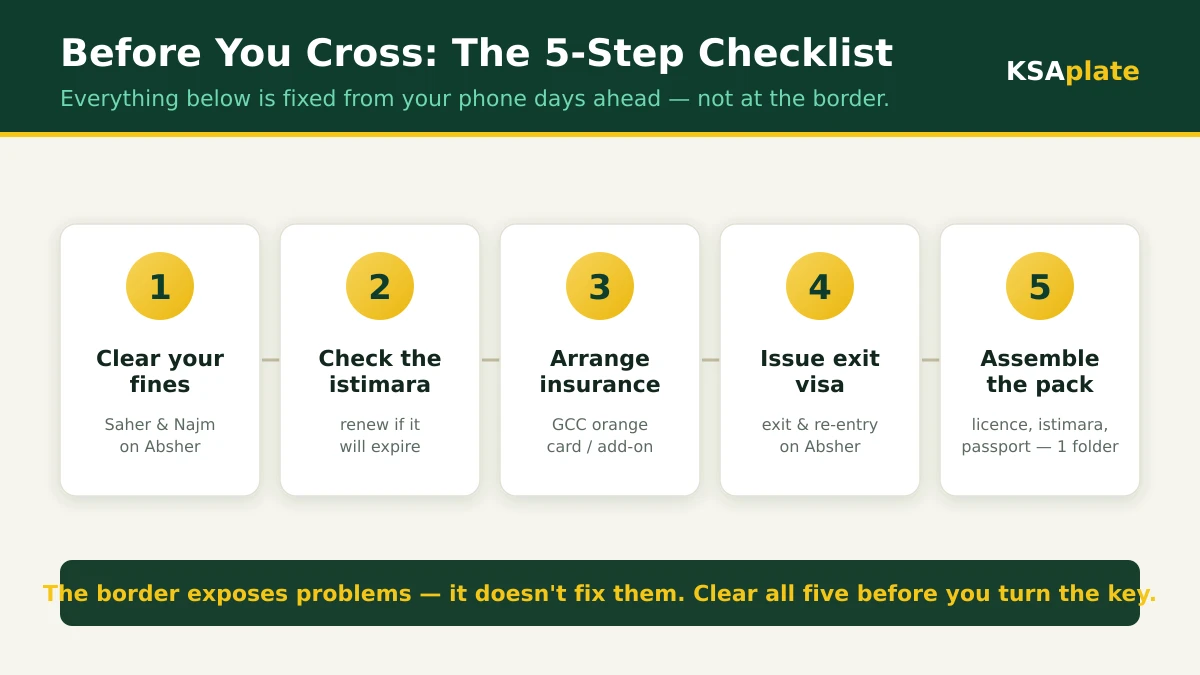
An Absher exit is the digital clearance every Saudi resident completes before leaving the country, and it is where a forgotten traffic fine quietly becomes a cancelled trip. Absher is the Ministry of Interior's e-services platform; it issues your exit and re-entry visa and it is where outstanding Saher and Najm penalties surface. Unpaid fines can block your exit, so treat this as a pre-trip checklist, not a border afterthought.
- Clear your fines. Settle any Saher and traffic fines on Absher or the bank app first — this is the step most people skip.
- Check the istimara date. Renew it if it expires before or during your trip; an expired registration fails at the border.
- Arrange destination insurance. Buy the GCC extension or destination policy and confirm the certificate names the country.
- Issue the exit/re-entry visa. Residents complete this on Absher; make sure its validity covers your whole trip.
- Assemble the document pack. Istimara or wakala, licence, passport, insurance certificate, iqama — one folder.
Key takeaway: the border is not where you fix problems; it is where they are exposed. Every item above is solved from your phone days earlier.
What it costs
The cost of driving a Saudi car across a GCC border is the sum of the toll, the temporary insurance, and the fuel for the distance — not a customs or export fee, because the car is only visiting. For a Bahrain weekend the numbers are modest and predictable; the causeway car toll is SAR 35 per crossing after the 18 February 2026 increase, with a SAR 60 round-trip package covering two crossings in a week and a SAR 850 package covering 40 crossings for regular commuters. Minibuses and buses pay more (SAR 55 and SAR 70 respectively), and students, people with disabilities and daily commuters are exempt from the latest increase.
Insurance is the variable line. A GCC extension or short destination policy is typically a small fraction of your annual premium, priced by the number of days and the country. Budget for it deliberately, because skipping it is what turns a SAR 35 crossing into a wasted day. There is no fee to keep your Saudi plate while the car travels — the plate is yours and it comes home on the car.
Common mistakes at the border
The most common border mistake is treating insurance as a formality you can settle at the booth, when it is the one thing that determines whether you cross at all. In our testing across multiple crossings, the delays clustered into a short, avoidable list — and every one of them is fixed before you leave home, not at the window.
- Assuming Saudi cover works abroad. It usually does not. Confirm the certificate names the destination.
- An expired istimara. Check the date; renew early.
- Driving someone else's car without a wakala. No power of attorney, no crossing.
- Unpaid fines. They can freeze your Absher exit — clear them days ahead.
- Travelling on a holiday eve without a time buffer. The queue, not the paperwork, is the real cost at the causeway.
Every avoidable delay we saw came down to one of five things — and all five are solved from your phone before you turn the key.
Thinking of selling the car instead of driving it out — say you are relocating across the Gulf for good? Reach Saudi buyers before you go: list your car free on KSAplate, or check what it is worth first. And if you are moving abroad permanently rather than visiting, that is a different process — see temporary export plates for taking a car out of the Kingdom long-term.
Can I drive my Saudi-registered car to Bahrain?
Does my Saudi car insurance cover me in the UAE?
What is the GCC orange card?
Do I need a power of attorney to drive someone else's car abroad?
How much is the King Fahd Causeway toll?
Can I drive a financed car out of Saudi Arabia?
Do unpaid traffic fines stop me leaving the country?
Does my Saudi license plate change when I drive abroad?
Is a Saudi driving licence valid across the GCC?
What insurance does a non-Saudi car need to enter Saudi Arabia?
Conclusion & next steps
Driving a Saudi car to Bahrain, the UAE or Kuwait is straightforward once you accept the one rule that governs every crossing: your registration travels, your insurance does not. Fix cover first — a GCC orange-card extension or a destination policy that names the country — then carry a valid istimara or wakala, clear your fines, and complete the Absher exit before you leave. Do that from your phone in the days before, and the border is a formality measured in minutes. Get it wrong and the same trip costs you a day, or the crossing itself.
If the trip is really the start of a move — a new car on the other side, or selling up before you relocate — reach real buyers at home first. List your car free on the KSAplate marketplace, with no commission on the sale, or value it in a couple of minutes before you decide. And whatever you drive across the causeway, remember the number on it is yours: it comes home on the car, every time.
Reviewed by Khalid Al-Rashid, Saudi vehicle and license-plate specialist. Last reviewed 8 August 2026.
Sources: Absher digital government platform (absher.sa) for exit/re-entry visas and vehicle e-services; the Ministry of Interior (moi.gov.sa) and its traffic department (Muroor) for registration and exit clearance; and Najm for Insurance Services (najm.sa) for motor-insurance and cross-border cover context. King Fahd Causeway toll figures reflect the increase effective 18 February 2026. Border documents, tolls, visa and insurance requirements change — confirm current rules through official Absher, destination-country and King Fahd Causeway Authority channels before you travel.