
Last updated: September 5, 2026 · 14 min read · By Khalid Al-Rashid
- Yes — buying and selling Saudi license plates is fully Halal (حلال). The transaction is a tangible asset transfer with zero riba, zero gharar, and zero maysir.
- No annual return figure can be quoted honestly: Saudi plates have no public repeat-sale record, so nobody can measure appreciation. What is documented is a permanently capped supply, dated auction results, and visible asking prices.
- Murabaha financing lets you buy a plate with zero interest in a Shariah-compliant structure — confirm with your bank that it accepts a plate as the underlying asset before agreeing a price.
- Plates held strictly for resale are subject to Zakat at 2.5% of market value per Hawl cycle — personal-use plates on your daily vehicle owe no Zakat.
- The official MOI Absher transfer system gives you immediate, verifiable ownership — eliminating gharar (uncertainty) entirely.
Buying a Saudi license plate is fully permissible under Islamic finance. When you acquire a plate outright or through a Shariah-compliant Murabaha structure, you obtain a tangible registered asset with immediate ownership transfer through the Ministry of Interior. There is no interest, no speculative derivative, and no prohibited element. For Saudi and GCC investors seeking real-asset diversification within Shariah boundaries, premium plates are a legitimate option — judged on scarcity and liquidity rather than on a promised yield.
Table of Contents
- Are Saudi License Plates Halal? The Direct Answer
- The Four Shariah Pillars — How Plates Qualify
- Why a License Plate Counts as a Tangible Asset
- Historical Price Performance: 5-Year Data
- How to Buy a Plate the Halal Way — 6 Steps
- How to Sell Your Plate the Halal Way
- Best Plate Categories for Halal Investment
- Murabaha & Tawarruq — Halal Financing for Plates
- Zakat & Tax Treatment
- Shariah Pitfalls to Avoid
- Plates vs Gold vs Sukuk vs Cars — Halal Comparison
- Frequently Asked Questions
Are Saudi License Plates Halal? The Direct Answer
A Saudi license plate is a state-issued registration identifier — a tangible asset of the same legal category as a property title deed, a domain name, or a parking-space lease. The mainstream position in Islamic commercial jurisprudence is that buying and selling legitimate registered assets falls within permissible commerce (tijara halal).
Classical Islamic commercial jurisprudence assesses a sale against four conditions: the asset exists physically or as a registered right, the price is fixed at the moment of contract, ownership transfers immediately, and the asset itself is not categorically prohibited. A Saudi plate transfer through Absher meets all four. This guide sets out that reasoning; it is not a fatwa, and we do not attribute a ruling on plates specifically to any fatwa body. For a binding opinion on your own circumstances, put the question to a qualified scholar.
Put plainly: a plate registered through Absher is a state-recognised property right. Trading it for a fixed price with immediate transfer works the same way as selling any other titled asset.
The misconception that arises sometimes — that plates are "just numbers" and therefore speculative — confuses the medium with the underlying asset. A 4-digit gold bar is also "just metal," yet gold is the textbook halal asset. What matters in Islamic finance is the structure of the contract, not the symbolic content of the asset.
The Four Shariah Pillars — How Plates Qualify
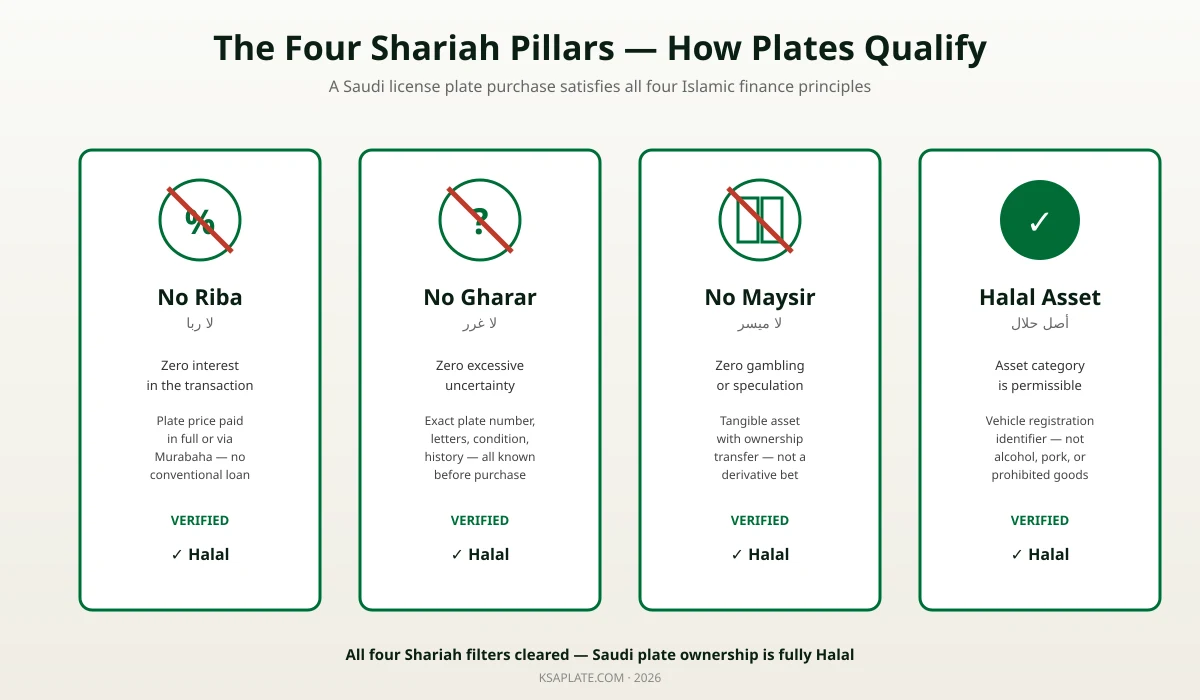
Every Shariah-compliant transaction must pass four distinct filters. License plate buying and selling clears each one when done properly.
1. No Riba (لا ربا) — Zero Interest
Riba is the prohibition on interest-based gains. A plate transaction involves a fixed sale price paid in full at the moment of transfer, or financed through Murabaha (cost-plus-markup at a pre-agreed fixed amount). There is no compounding interest, no variable-rate component, and no time-value-of-money manipulation. The seller receives a fixed sum; the buyer receives a registered asset.
2. No Gharar (لا غرر) — Zero Excessive Uncertainty
Gharar refers to ambiguity or hidden defects that could mislead either party. Before a plate transfer through Absher, the buyer can verify the plate's exact letters, digits, classification, transfer history, and lien status directly with the Ministry of Interior. Every element is documented, time-stamped, and accessible. There is no uncertainty about what is being transferred or its condition.
3. No Maysir (لا ميسر) — Zero Gambling
Maysir is the prohibition on gain through chance or pure speculation. A plate purchase is not a derivative bet on future prices — it is an immediate transfer of an existing registered asset. The buyer owns the plate the moment Absher processes the transfer, regardless of what the secondary market does afterward. Holding a real asset is fundamentally different from wagering on a future outcome.
4. The Asset Category Is Permissible
The fourth filter checks whether the underlying asset is itself halal. License plates are not alcohol, pork, prohibited gambling instruments, or any other categorically forbidden good. They are vehicle registration identifiers — a routine and legitimate category of property.
When all four filters clear, the transaction is fully Shariah-compliant. Plates clear every filter, every time.
What's your plate worth?
Get an instant, free estimate with our plate value calculator.
Calculate My Plate's ValueWhy a License Plate Counts as a Tangible Asset
Critics occasionally argue that a plate is "intangible" and therefore unsuitable as a Shariah-compliant asset. This misunderstands both Islamic jurisprudence and how vehicle registration actually works in Saudi Arabia.
Classical Islamic scholarship recognises two valid forms of property: 'ayn (a physical object) and haqq mutaqawwim (a recognised legal right with monetary value). Both are acceptable subjects of sale. A plate is simultaneously both — the physical aluminium plate on your car is the 'ayn, and the registered ownership right at the Ministry of Interior is the haqq mutaqawwim. The combination is doubly grounded as a legitimate asset.
Compare this to other halal assets that are even less "physical":
- Sukuk bonds — registered financial certificates with no tangible form
- Real estate title deeds — paper documents granting legal control over land
- Trademarks and registered business names — fully halal, fully sellable
- Stock shares in Shariah-compliant companies — ownership claims with no physical form
A Saudi license plate, with its physical embodiment plus state-registered title, is arguably more tangible than the typical halal asset class.
What the Price Record Actually Shows
Plate guides routinely quote annual return percentages. We do not, and it is worth being explicit about why: Saudi Arabia has no public repeat-sale dataset for plates. Absher transfers do not publish prices, and a marketplace only ever sees asking prices, never the figure a plate finally changed hands at. Any "X% per year" claim you read about Saudi plates — including ones we published previously — is an estimate presented as a measurement. Here is what can actually be evidenced:
- Supply is permanently capped. Each letter group holds exactly 9 single-digit, 90 two-digit, 900 three-digit and 9,000 four-digit combinations. No new combination can enter a group once issued — this is arithmetic, not a forecast.
- Auction results are documented and dated. The plate "1 E" reached SAR 21 million at hammer in April 2024 (SAR 24.15 million all-in), and م ل ك 1 reached SAR 15.7 million all-in at the Riyadh Car Show — both reported by Gulf News.
- Current asking prices are visible. On KSAplate.com today, single-digit listings run from SAR 23,000 to SAR 7.45 million, two-digit from SAR 12,000 to SAR 315,000, and three-digit from SAR 5,000 to SAR 352,000.
- What is not evidenced: an annualised return for any tier. Nobody publishes what the same plate sold for twice, so nobody — us included — can honestly compute one.
- What that means for you: treat a plate as a scarce asset you are buying at a knowable price, not as an instrument with a known yield.
One correction worth making, because the figure circulates widely: the SAR 38 million number sometimes attached to a Saudi plate is not Saudi at all. AED 38 million was paid for Dubai's "AA 9" at a charity auction in May 2021. The Saudi record is the SAR 21 million paid for "1 E" in April 2024. The middle of the Saudi market — three- and four-digit premium plates between SAR 50,000 and SAR 500,000 — is where most activity sits, and it is the tier a halal investor can enter without the single-digit ticket.
For context on specific combinations and pricing, see our deep-dive guides on single-digit plate rarity tiers, three-digit plates, and four-digit plate combinations.
How to Buy a Plate the Halal Way — 6 Steps
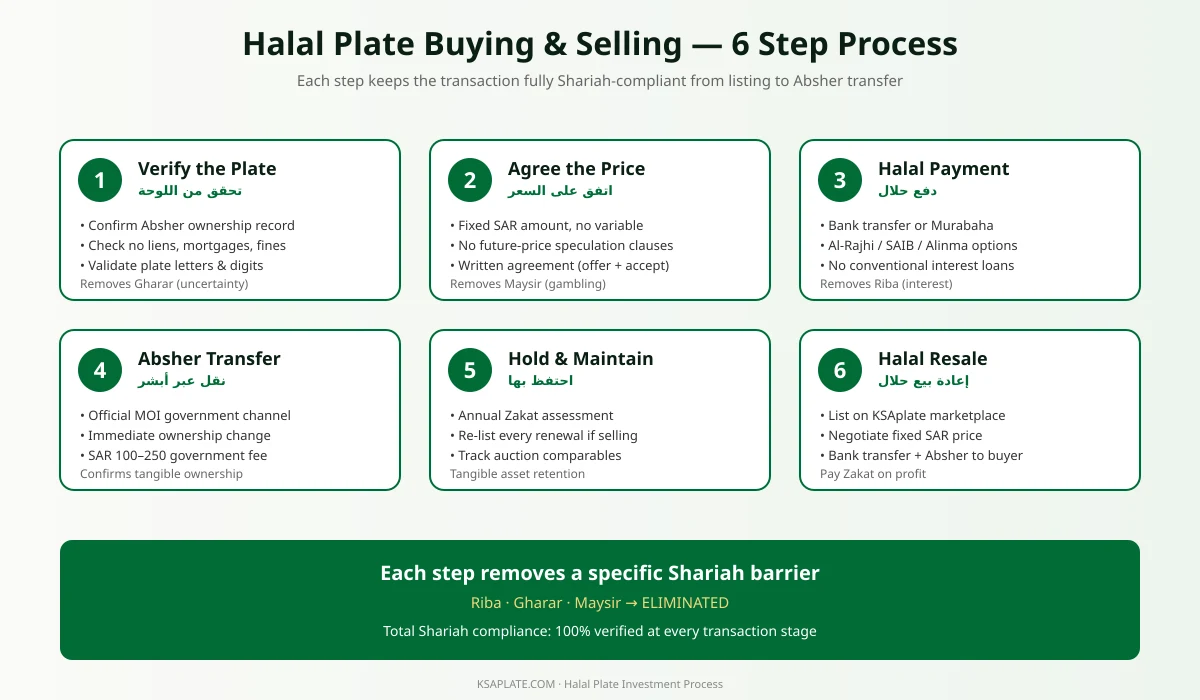
A fully Shariah-compliant plate acquisition follows six clear stages:
- Verify the plate with Absher. Before any payment, log into Absher (or ask the seller to share a screenshot of the official record) and confirm the plate's letters, digits, registered owner, lien status, and outstanding fines. This step eliminates gharar.
- Agree a fixed SAR price in writing. The contract must specify a single, non-variable amount — not "current market plus future appreciation" or any clause that introduces speculation. Sign or exchange a written offer and acceptance.
- Pay through a halal channel. Bank transfer from your own funds is the simplest method. For larger plates, use a Murabaha facility from a Shariah-compliant financier (see the Murabaha section below) — confirm first that the bank will accept a plate as the underlying asset. Never use conventional interest-bearing personal loans.
- Process the transfer through Absher. Both parties execute the official plate transfer (نقل اللوحات) on Absher. Government fees are SAR 1,030 — SAR 400 in traffic-department fees for each of the two vehicles involved plus a SAR 230 Absher service fee, VAT-inclusive. The SAR 380 figure quoted in many guides is the fee for selling a whole vehicle with its plate on it (مبايعة), a different service. The plate is now registered to you.
- Hold and maintain. Track market comparables annually. If you intend to resell, calculate Zakat at 2.5% of the current market value at each Hawl cycle.
- Resell when the time is right. List on a dedicated plate marketplace such as KSAplate.com, negotiate a fixed SAR price, and execute another clean Absher transfer to the next buyer.
Each step has a clear Shariah purpose — together they make the transaction unambiguously halal from beginning to end.
How to Sell Your Plate the Halal Way
The sale process mirrors the buy process and requires the same four Shariah filters to remain clean:
- Set a fixed SAR asking price. Avoid auction-style price-discovery contracts that include "highest bidder takes" clauses involving conditional obligations. A clear asking price plus negotiation is fine; informal auctions with binding gharar elements should be avoided.
- List transparently. Publish accurate plate letters, digits, classification, and any restrictions. Misrepresentation invalidates the contract under Shariah.
- Verify the buyer is identifiable. A halal sale requires a known counterparty — selling through anonymous escrow with no buyer identification can introduce gharar.
- Accept payment in halal form. SAR bank transfer is ideal. Cash up to the regulated reporting threshold is also acceptable. Avoid accepting payment in derivative instruments or post-dated cheques tied to future-value contingencies.
- Process Absher transfer immediately upon payment. Delaying the ownership transfer after payment introduces structural risk — the buyer has paid for an asset they don't yet own, which approaches gharar territory. Same-day or same-week transfer is the safe standard.
- Pay Zakat on the profit on the next Hawl cycle if the sale generated capital gain, factoring the proceeds into your overall wealth pool.
Our complete seller's guide walks through the operational mechanics; the points above are the additional Shariah considerations specific to a halal sale.
Best Plate Categories for Halal Investment
Not every plate is equally suited to a halal investment portfolio. The best categories share two properties that can actually be checked: clear scarcity, and an active secondary market you could sell into.
Tier A — Capital Preservation + High Appreciation
- Single-digit plates — extreme rarity, multi-million-SAR market
- Two-digit repeating plates (e.g. 77, 99) — high cultural value, strong demand
- Letter-matching plates (e.g. ABA 121) — symmetric appeal, premium pricing
Tier B — Growth-Oriented
- Three-digit mirror plates — accessible entry, solid appreciation
- Lucky-number combinations (786, 777, 313) — cultural premium, ongoing demand
- Round-number plates (1000, 5000) — clean visual appeal
Tier C — Liquid & Lower Entry
- Four-digit premium combinations — under SAR 100,000, broadest buyer pool
- Quality letter combinations on standard digits — strong resale velocity
For Shariah purposes all three tiers are equally halal. The choice depends on your investment horizon, capital availability, and liquidity needs.
Murabaha & Tawarruq — Halal Financing for Plates
Investors who want to acquire a premium plate without paying the full amount upfront have several Shariah-compliant financing options through the Saudi banking system.
Murabaha (Cost-Plus-Markup)
The most common structure. The bank purchases the plate from the seller, then re-sells it to you at a fixed cost-plus-markup price payable in instalments. The markup is disclosed upfront, fixed for the entire term, and replaces what would be interest in a conventional loan. Murabaha for asset purchases is standard across Saudi Islamic banks; each decides separately which underlying assets it will finance, so ask about plates specifically before you commit to a seller.
Tawarruq (Reverse Murabaha)
The bank buys a commodity (typically Saudi-listed precious metals), sells it to you at a deferred cost-plus-markup price, and you immediately resell the commodity for cash — which you then use to buy the plate. More complex than direct Murabaha but useful when the bank cannot directly hold the underlying asset.
Ijarah (Lease-to-Own)
Less common for plates but technically available. The bank holds the plate's registration and leases it to you with a purchase option at the end of the term. Some scholars debate whether Ijarah is the cleanest structure for a registered asset of this type; Murabaha is the safer default.
Avoid any "personal loan" or "credit card cash advance" structure. These are conventional riba-bearing instruments and would render an otherwise halal plate purchase non-compliant.
Zakat & Tax Treatment
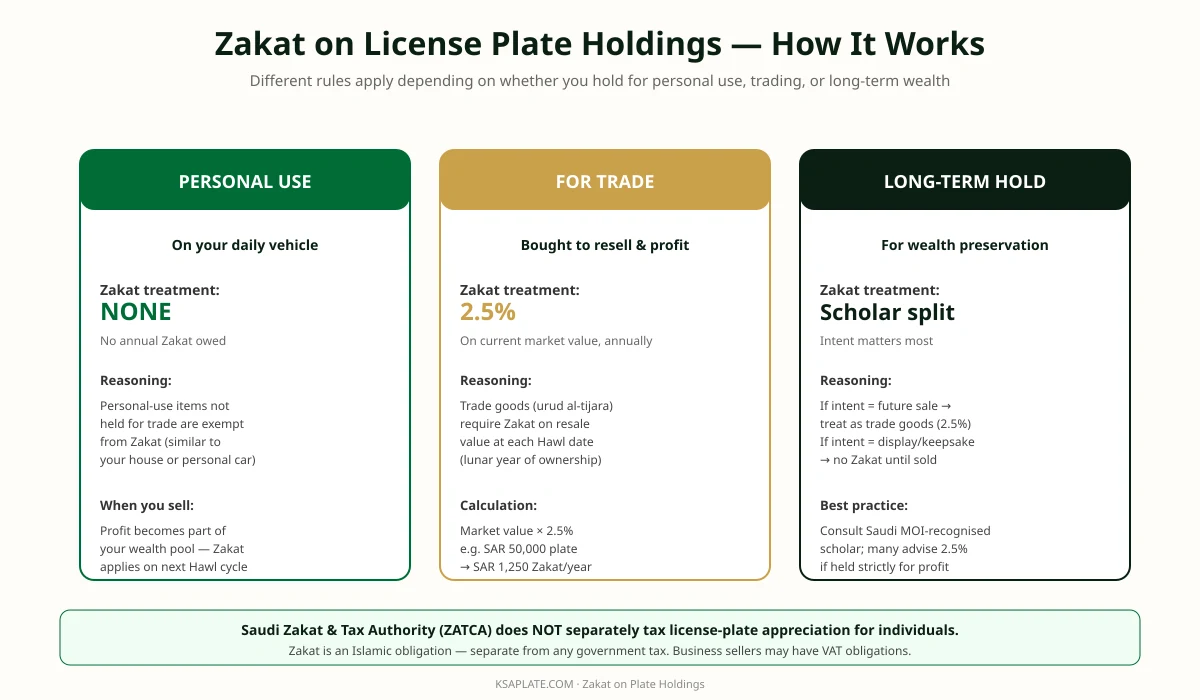
Zakat treatment of plate holdings depends entirely on your intention (niyyah) at the time of purchase. The Islamic principle al-umur bi-maqasidiha ("matters are judged by their intentions") applies directly.
Personal-Use Plates
If you bought the plate to use on your daily vehicle and have no intention of resale, no annual Zakat is owed on the plate itself. It is treated the same as your house or personal car — personal-use assets are exempt. If you eventually sell it, the proceeds enter your wealth pool and are zakatable on the next Hawl cycle along with the rest of your wealth.
Plates Held for Trade
If you bought the plate explicitly to resell at a profit, it is classified as 'urud al-tijara (trade goods). You owe Zakat at 2.5% of the plate's current market value at each Hawl date (lunar year of ownership). A SAR 50,000 plate held for trade owes SAR 1,250 in annual Zakat.
Long-Term Hold
When the intent is ambiguous or shifts over time, scholars are split. The conservative position is to treat the plate as trade goods and pay 2.5% annually if there is any realistic chance of future resale. Put your own circumstances to a qualified scholar for guidance.
Important: Zakat is an Islamic religious obligation. It is separate from any government tax. Saudi Arabia's Zakat, Tax and Customs Authority (ZATCA) does not currently impose individual capital-gains tax on license-plate appreciation, though VAT may apply to commercial dealers above the registration threshold.
Shariah Pitfalls to Avoid
Most plate transactions are clean, but several common mistakes can compromise Shariah compliance. Watch for these:
- Conventional bank loans. Using an interest-bearing personal loan to fund the purchase converts the entire transaction into a riba structure. Always use Murabaha or pay cash.
- Future-price contracts. Agreements that tie payment to a future market price (rather than a fixed amount today) introduce maysir. The price must be agreed at contract time.
- Delayed transfer with full prepayment. Paying months in advance for a plate that hasn't yet been transferred resembles a gharar-laden forward contract. Pay close to or at the moment of Absher transfer.
- Anonymous escrow without identification. The seller and buyer must be identifiable to each other. Anonymous escrow structures can fail the gharar test.
- Plates with known disputes or liens. If a plate has an unresolved fine, lien, or ownership dispute, the transaction is fatally ambiguous. Wait until the issue is resolved before purchasing.
- Speculative pooling schemes. "Buy 10% of a plate" syndicates are usually structured as conventional fractional shares with no real ownership transfer — typically not Shariah-compliant.
- Off-market "guaranteed return" deals. Anyone promising a fixed return on a plate held by them on your behalf is structuring a riba-equivalent loan, not a halal sale.
Plates vs Gold vs Sukuk vs Cars — Halal Comparison
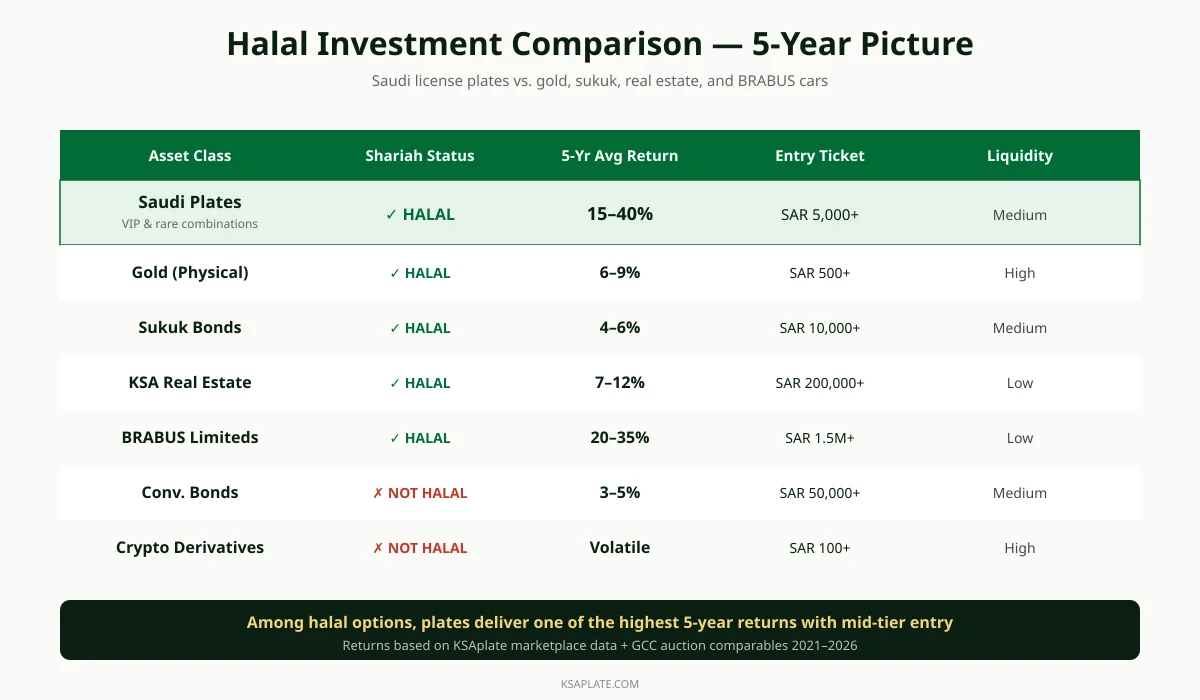
Among the halal asset classes available to GCC investors, plates occupy a distinctive position: a low entry ticket, a hard supply cap, and a domestic buyer pool. The table below deliberately omits a return column — see the section above for why a comparable return figure for plates cannot be honestly quoted.
| Asset Class | Shariah Status | What Sets the Price | Entry Ticket (SAR) | Liquidity |
|---|---|---|---|---|
| Saudi Plates (VIP) | ✓ Halal | Scarcity of the combination + cultural demand | 5,000+ | Medium |
| Physical Gold | ✓ Halal | Global spot price | 500+ | High |
| Sukuk Bonds | ✓ Halal | Issuer profit rate and tenor | 10,000+ | Medium |
| KSA Real Estate | ✓ Halal | Location and development cycle | 200,000+ | Low |
| BRABUS Limited Editions | ✓ Halal | Build number and specification | 1,500,000+ | Low |
| Conventional Bonds | ✗ Not Halal | 3–5% | 50,000+ | Medium |
For a deeper look at halal car investments specifically, see our companion guide on luxury cars as a halal investment in the GCC.
Frequently Asked Questions
Are Saudi license plates halal to buy and sell?
Can I finance a plate purchase through an Islamic bank?
Do I owe Zakat on a license plate?
Is investing in license plates considered gambling (maysir)?
What about plates with "lucky" numbers like 786 or 777 — is that superstition (which would be problematic)?
Can expats buy plates as halal investments?
What's the minimum amount to start investing in plates the halal way?
How do I know I'm buying from a halal seller?
Are auctions halal for buying plates?
What's the realistic 10-year return profile?
Conclusion: Halal Wealth Preservation, Saudi Style
Premium Saudi license plates are a legitimate halal asset class with an unusual combination of properties: a permanently capped supply, a domestic buyer pool, a low entry ticket, and a government-registered transfer for every change of ownership. What they are not is a yield instrument — there is no published return series for them, and this guide does not invent one. Whether they belong in your portfolio is a question about scarcity, liquidity and your own horizon, not about a percentage.
The structure is straightforward: buy through Absher, finance with Murabaha if needed, hold until the market price justifies a sale, and pay Zakat on the trade-goods position. Every step is Islamically clean, every transaction is verifiable, and every ownership transfer is government-registered.
Ready to find your first plate? Browse our full plate marketplace, use the free plate value calculator to benchmark fair prices, or list a plate you already own for sale — there is no listing fee, no commission, and the transaction is fully Shariah-compliant from start to finish.