
Last updated: May 22, 2026 · 16 min read · By Khalid Al-Rashid
- The BRABUS BODO is BRABUS's first standalone supercar in 50 years — not a tuned Mercedes, AMG, or other manufacturer's car. Its chassis, body, and powertrain were designed independently by BRABUS in Bottrop, Germany.
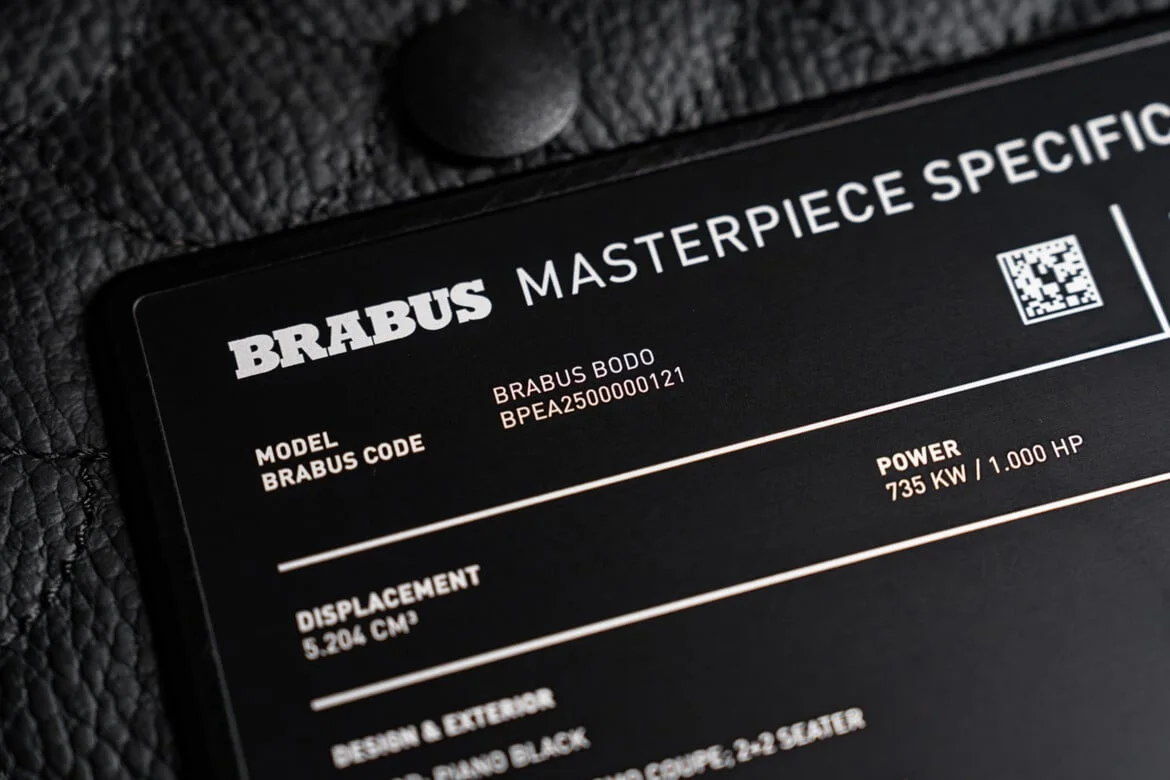
- Limited to exactly 77 units worldwide. Named in memory of co-founder Bodo Buschmann (1955–2018). The build code on each car (BPEA2500000121 series) marks it as a BRABUS Masterpiece.
- Powered by a hand-assembled 5.2-litre V12 biturbo producing 1,000 HP (735 kW) at 6,400 rpm and 1,200 Nm of torque. 0–100 km/h in 3.0 seconds, top speed 360 km/h.
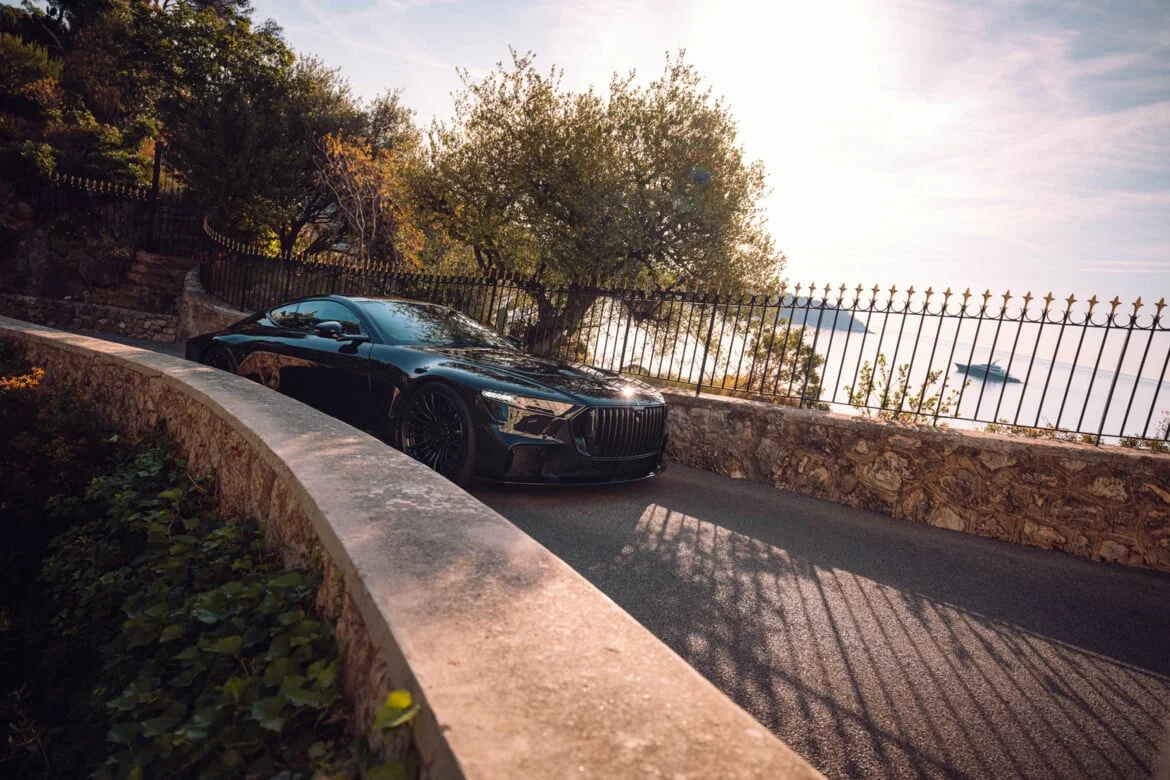
- Full carbon-fibre body finished in signature Piano Black. 2+2 Gran Turismo coupe, rear-wheel drive, Alcantara and quilted leather "scale-pattern" cabin signed as a BRABUS Masterpiece.
- GCC allocation is concentrated in Saudi Arabia and the UAE. Price on request — BRABUS publishes no list price, and resale prices are not published either, so no secondary-market premium is quoted on this page.
The BRABUS BODO is the most historically significant car the company has built in five decades. After half a century of refining other manufacturers' platforms — Mercedes-Benz G-Wagons, S-Classes, AMG GTs, EQS sedans — BRABUS has finally built its own. Independent chassis. Original body. Bespoke powertrain. Limited to 77 units. The result is a Gran Turismo coupe that doesn't share a single structural component with any car currently in production anywhere in the world.
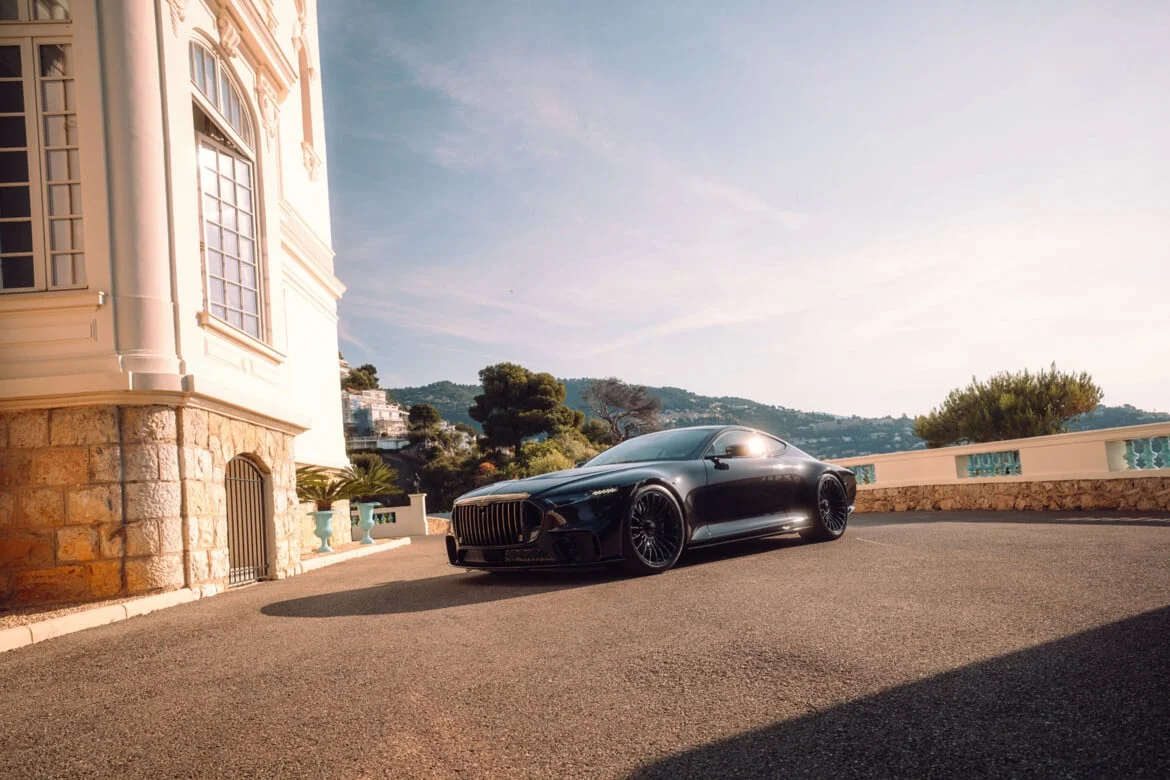
Table of Contents
- What Is the BRABUS BODO?
- Why "BODO"? — The Story of Bodo Buschmann
- The First Standalone BRABUS — 50 Years in the Making
- Full Technical Specifications
- Design & Exterior — Every Carbon Panel Explained
- Interior — The Masterpiece Cabin
- Performance — 1,000 HP V12 in Detail
- Production — 77 Units, Bottrop Hand-Build
- Pricing & Secondary Market
- GCC Allocation — Saudi Arabia, UAE & Beyond
- How to Acquire a BODO Through KSAplate
- BODO vs Pagani Utopia, Bugatti Tourbillon, Koenigsegg Jesko
- The Collector Case — and Its Limits
- Frequently Asked Questions
What Is the BRABUS BODO?
The BRABUS BODO is a 2+2 Gran Turismo coupe — a 1,000-horsepower mid-front-engined supercar with a hand-built 5.2-litre V12 biturbo, a full carbon-fibre body, and a production run capped at 77 examples worldwide. Each unit carries a BRABUS Masterpiece designation, the highest classification in the company's catalogue.
Where a tuned Mercedes G63 or AMG GT63 starts from a serial-production platform and receives BRABUS upgrades, the BODO starts from a clean sheet. There is no donor car. The chassis was engineered in-house, the bodywork was sculpted by BRABUS's design team, and the powertrain — while drawing on V12 know-how the company has refined over decades — is assembled to specification entirely at BRABUS's Bottrop workshop. The closest historical parallel is the original Mercedes-McLaren SLR Stirling Moss: a coachbuilt grand tourer built outside the constraints of mass production.
"After 50 years of taking the world's finest production cars and making them extraordinary, BRABUS has applied that accumulated expertise to a vehicle entirely of its own creation."
Why "BODO"? — The Story of Bodo Buschmann
Bodo Buschmann (1955–2018) was the co-founder and driving force behind BRABUS from its earliest days in Bottrop. He started the company in 1977 with Klaus Brackmann — the name BRABUS is built from the first syllables of BRAckmann and BUSchmann, and over four decades he built it from a small Mercedes-tuning workshop into the world's largest official AMG and Mercedes-Benz upgrade house.
Bodo's vision was always more ambitious than tuning. He spoke for years about BRABUS one day building a complete vehicle of its own — a car whose every line and every component reflected the company's identity rather than reinterpreting another manufacturer's blueprint. He passed away in October 2018, before that car was finished. Seven years later his son Constantin Buschmann, now CEO, completed the project his father started and named it in his honour.
The number 77 is not arbitrary. It marks the year BRABUS was founded — 1977. Each of the 77 cars carries an individual Masterpiece plaque, a unique BRABUS Code identifier, and a signature plate referencing the founder's vision.
What's your car worth?
Get a free instant estimate based on real Saudi market data — then sell it on KSAplate with direct WhatsApp contact.
Value My Car — FreeThe First Standalone BRABUS — 50 Years in the Making
This single distinction reframes the BODO entirely. Up to this car, every BRABUS vehicle has been a reinterpretation of an existing platform — the world's most aggressive G-Wagons, the most extreme S-Classes, the fastest EQS sedans. Brilliant cars, all of them. But every one started life as a Mercedes-Benz.
The BODO does not. Its monocoque was designed in-house by BRABUS engineers. The body panels — every fender, hood line, and roof rail — are original BRABUS sculptures, not modified Mercedes panels. The aerodynamic package was developed in dedicated wind-tunnel sessions for this car. The 5.2-litre V12 displaces 5,204 cubic centimetres, a figure that does not match the displacement of any current Mercedes-AMG V12 (the M275 was 5,980 cc; the M285 is 5,980 cc; AMG's most recent V12s are all 6.0-litre). The BODO's V12 is its own configuration.
This puts the BODO in the same conceptual category as the Pagani Utopia, the Koenigsegg Jesko, and the Bugatti Tourbillon — coachbuilt supercars produced by independent specialists, built in tiny numbers, and engineered without inheriting a mainstream manufacturer's platform constraints. It is BRABUS's coming-of-age statement.
Full Technical Specifications
| Category | Specification |
|---|---|
| Model | BRABUS BODO Gran Turismo |
| BRABUS Code | BPEA2500000121 (series) |
| Designation | BRABUS Masterpiece |
| Production | 77 units worldwide, hand-built in Bottrop, Germany |
| Body Style | 2-door Gran Turismo coupe, 2+2 seating |
| Body Material | Full carbon-fibre, Piano Black finish |
| Engine | 5.2-litre (5,204 cc) V12 biturbo, hand-assembled |
| Cylinders | 12, configured as 60° V |
| Power | 735 kW / 1,000 HP @ 6,400 rpm |
| Torque | 1,200 Nm |
| Transmission | Automatic, performance-tuned |
| Drivetrain | Rear-wheel drive (RWD) |
| 0–100 km/h | 3.0 seconds |
| Top Speed | 360 km/h (224 mph) |
| Fuel | Petrol |
| GCC Specification | Yes — climate-prepared for GCC region |
| Condition | New, accident-free, full service history |
| Year | 2026 |
Design & Exterior — Every Carbon Panel Explained
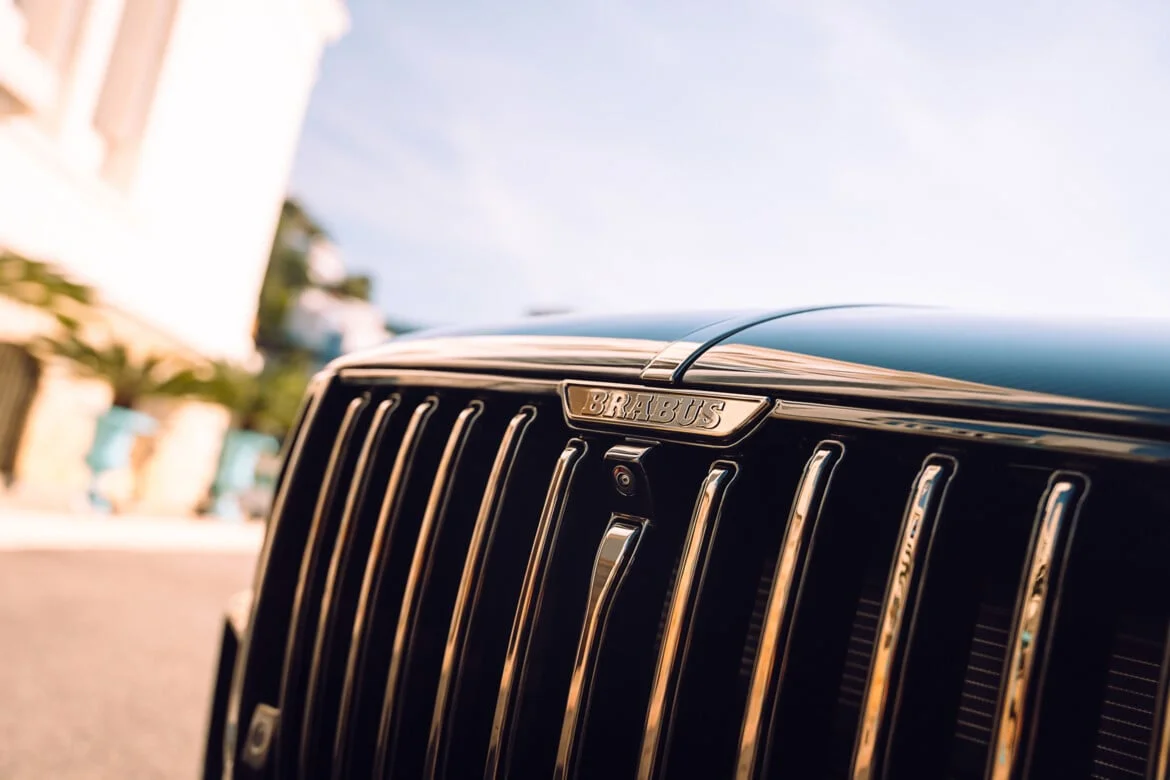
The BODO's exterior is a deliberate reinterpretation of the long-bonnet, short-deck Gran Turismo template that defined cars like the Ferrari 365 GTB/4 Daytona and the Lamborghini Espada. From the front, the signature BRABUS vertical-bar grille dominates — a sculpted chrome and gloss-black structure with the BRABUS wordmark centred between two grille leaves, illuminated by hidden front cameras and recessed quad LED units. There are no shared parts with any Mercedes-Benz front fascia.
In profile the BODO measures roughly 4.8 metres in length with an extreme dash-to-axle ratio that pushes the cabin rearwards over the rear axle line — a proportion possible only with a clean-sheet chassis. The roofline arcs into a fastback rear with an integrated ducktail spoiler, framed by gloss-black aerodynamic intakes ahead of each rear wheel arch.
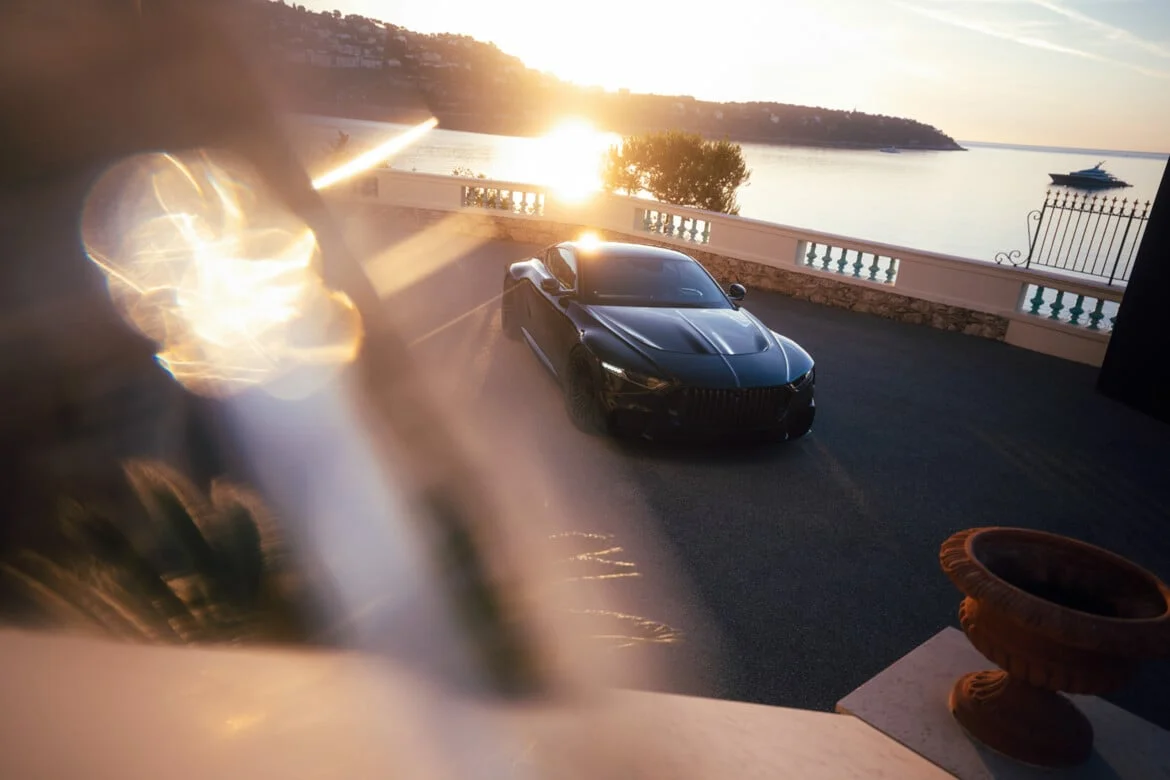
The rear three-quarter view reveals a horizontal LED light bar spanning the full width of the tail — currently among the cleanest light signatures in supercar design — flanked by quad oval exhaust outlets routed directly from the V12's manifold collectors. The full carbon-fibre underbody integrates a rear diffuser sculpted in the same wind-tunnel programme that shaped the front splitter.
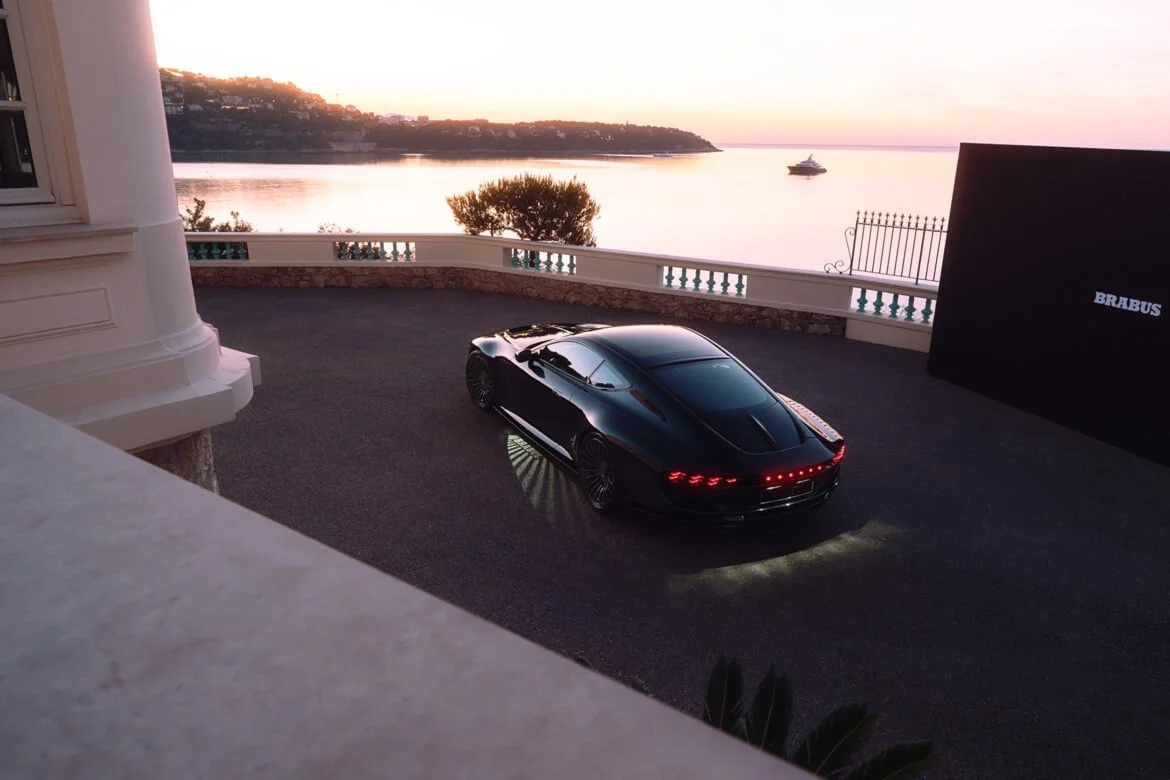
Every visible panel is carbon-fibre layered in a Piano Black gloss finish — a paint depth that requires more than 60 hours of polishing per car. The BRABUS Monoblock M Platinum Edition forged wheels measure 21 inches at the front and 22 at the rear, shod with Michelin Pilot Sport 5 tyres developed in cooperation with BRABUS.
Interior — The Masterpiece Cabin
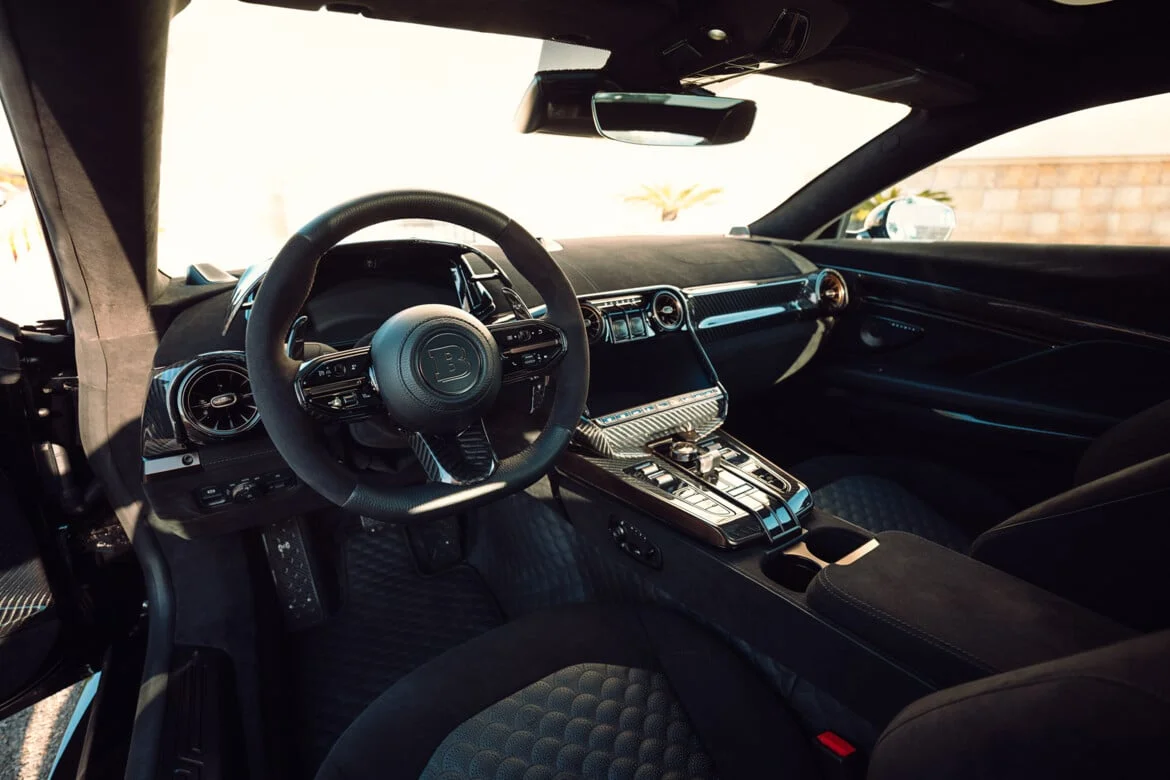
Step inside and the BODO declares its hand-built credentials immediately. The dashboard is a flowing single sculpture in alcantara and exposed carbon-fibre, with a steering wheel bearing the BRABUS "B" emblem in cast metal at its centre. The Centre console — finished in a chequered carbon weave — rises into a control plinth housing the gear selector, drive-mode controls, and a row of physical toggle switches that BRABUS has retained against the industry's drift toward all-screen interfaces.
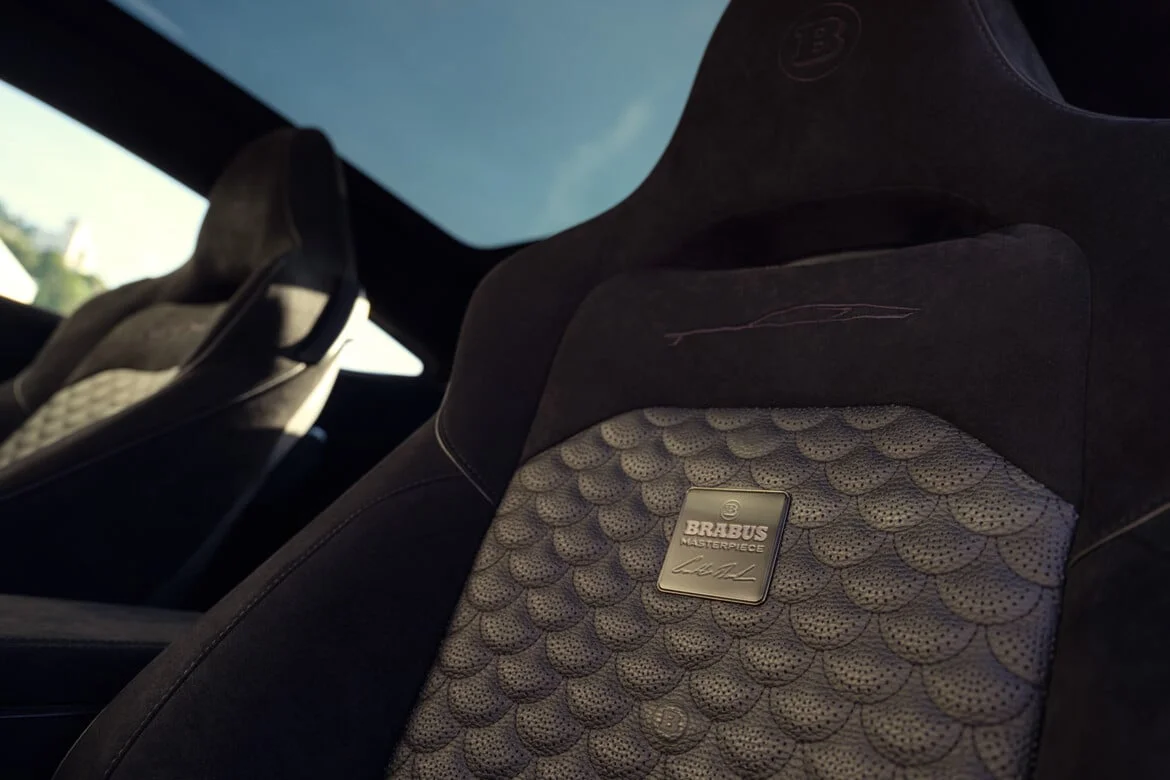
The seats are the standout interior feature. Each is upholstered in BRABUS's signature "fish-scale" quilted leather — a three-dimensional pattern of overlapping convex segments that takes a single artisan over 40 hours to stitch. Centred on each backrest is a polished steel plaque inscribed BRABUS MASTERPIECE with a hand-signed signature beneath, individually numbered for each of the 77 cars.
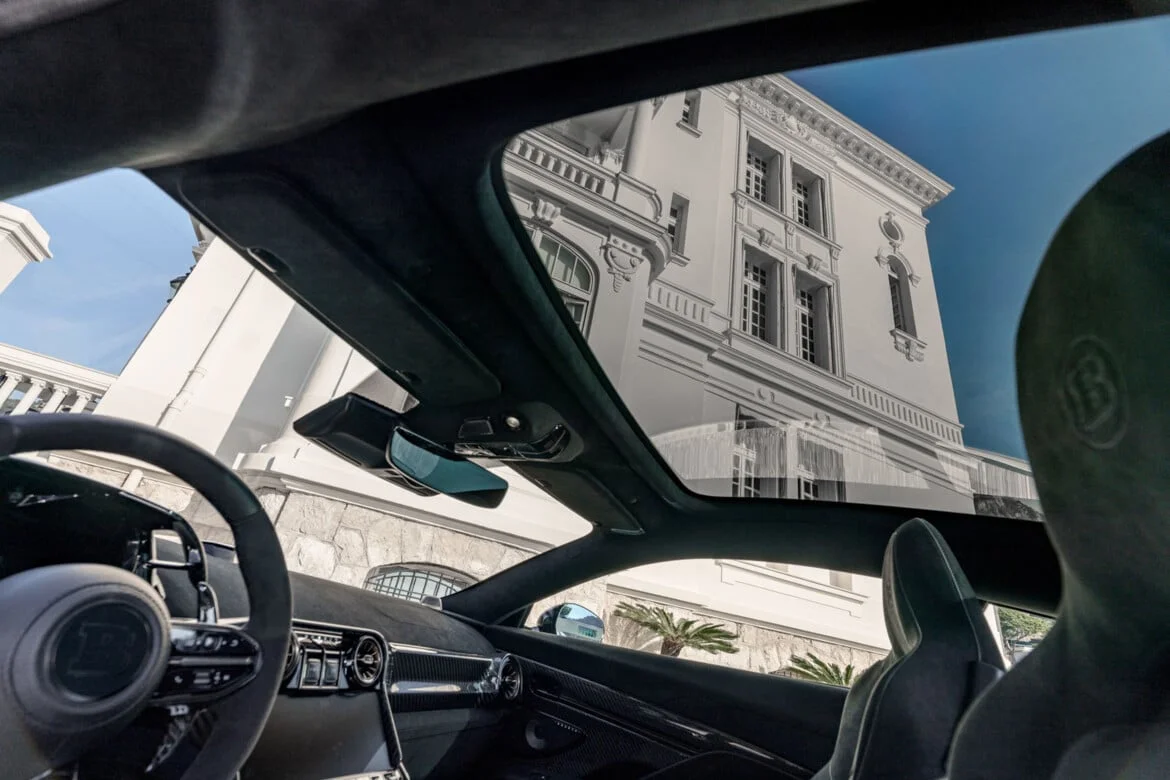
The 2+2 configuration adds two child or short-trip rear seats behind the main pair, in keeping with the Gran Turismo template. Headroom is generous for a coupe of this profile, aided by a panoramic glass roof that floods the cabin with light.
Performance — 1,000 HP V12 in Detail
The 5,204 cc V12 biturbo is the BODO's defining mechanical statement and the most ambitious internal-combustion engine BRABUS has ever signed. Each unit is hand-assembled by a single technician in a dedicated clean-room at Bottrop — a process that takes approximately three days and ends with the technician's signature engraved on the engine block. The technician's name is recorded on each car's build sheet.
The numbers in context
- 1,000 HP / 735 kW @ 6,400 rpm — more peak power than a Ferrari 812 Competizione (819 HP), a Bugatti Chiron Sport (1,479 HP — the only mainstream supercar that outguns it on peak), or a Lamborghini Revuelto (1,015 HP, hybrid). On a pure internal-combustion basis the BODO sits in the same conversation as the Pagani Utopia (864 HP), Aston Martin Valkyrie (1,001 HP combined), and Koenigsegg Jesko (1,280 HP on E85, ~1,000 HP on petrol).
- 1,200 Nm of torque — extraordinary for a rear-wheel-drive layout. Most cars producing this much torque deploy all-wheel drive to put it down (Bugatti, BMW M5, etc.). BRABUS has chosen RWD deliberately to preserve a classic Gran Turismo driving character.
- 3.0 seconds 0–100 km/h — the limiting factor here is rear-tyre grip, not engine output. Identical to the Pagani Utopia, slightly slower than AWD hyperhybrids like the Revuelto (2.5s) — but the driving experience is fundamentally different.
- 360 km/h top speed — limited by aero balance and gearing rather than power. Faster than a Ferrari 812 Competizione (340 km/h), comparable to a Lamborghini Revuelto (350 km/h).
The power curve is naturally aspirated in feel despite the twin turbos — peak torque arrives early but power continues to build linearly past 6,000 rpm to redline, an acoustic and dynamic experience that BRABUS engineers have spent months calibrating. The exhaust note has been tuned to emphasise the V12's natural 12-cylinder combustion frequency rather than the artificial bark of many modern turbo engines.
Production — 77 Units, Bottrop Hand-Build
All 77 cars are assembled at BRABUS's headquarters in Bottrop, North Rhine-Westphalia, Germany — a facility that has been the company's home since 1977. Each car spends approximately 14 weeks on the build floor, working through dedicated stations for chassis assembly, body fitment, paint, powertrain installation, interior trim, electronics, and final road testing.
Production began in late 2025 and is scheduled to complete by mid-2027. Buyers receive a documented build process — every major assembly stage is photographed, every technician who works on the car is named, and the final test report is bound into a leather-cased dossier that is delivered with the car along with a 1:8 scale model finished to match the customer's exact specification.
Each BODO carries an individual BRABUS Code in the format BPEA25000001XX, where the last two digits identify the unit number (01 to 77). The lower numbers — particularly 01, 07, 11, and 77 — have already been pre-allocated to long-standing BRABUS collectors and command an additional premium.
Pricing & Secondary Market
The BODO is sold on a price-on-request basis. BRABUS does not publish a list price, and allocation is by invitation through approved partners. Industry sources place the entry price in the €2.5–3.5 million range (SAR 10.4–14.6 million), with options, bespoke interior commissions, and individualised paint specifications pushing the final figure significantly higher. A fully personalised commission can exceed €4 million.
Talk of a secondary market has started, and so have the percentages. We are not going to quote one: BRABUS resales are private, prices are not published, and we do not see them. A figure like "30–60% above sticker" — which this page previously carried — is an estimate presented as a measurement. What is real is the supply position: 77 cars, no possibility of more. For context on BRABUS as a halal investment vehicle more broadly, see our guide to luxury cars as a Shariah-compliant investment.
The reason the secondary market is so active is simple supply economics: 77 cars across a global collector base of tens of thousands of serious BRABUS enthusiasts produces immediate scarcity. Each car that doesn't go to the GCC, the United States, China, or a handful of European collectors leaves multiple unfulfilled buyers willing to pay an aftermarket premium.
GCC Allocation — Saudi Arabia, UAE & Beyond
The GCC region is one of BRABUS's four largest global markets, alongside Germany, the United States, and China. Saudi Arabia and the United Arab Emirates are the principal demand centres, with significant pockets of activity in Kuwait, Qatar, and Bahrain.
Estimates from industry sources suggest 15–22 BODOs will be allocated to GCC customers — roughly a fifth of the total production. Among them:
- Saudi Arabia — long-standing BRABUS culture concentrated in Riyadh, Jeddah, and the Eastern Province. The Kingdom has historically taken the highest per-capita share of BRABUS limited editions in the GCC.
- United Arab Emirates — Dubai and Abu Dhabi remain the public face of GCC BRABUS ownership, with high visibility for limited-edition cars at events like the Abu Dhabi GP and Dubai Motor Festival.
- Kuwait, Qatar, Bahrain — smaller volumes but consistent demand from established collectors.
The cultural fit is real. BRABUS's aesthetic — gloss-black on chrome, V12 acoustics, hand-crafted leatherwork — aligns closely with GCC luxury preferences in a way that few other supercar marques achieve. The BODO's combination of historical pedigree and absolute scarcity will sit naturally alongside the most significant collections in the region.
How to Acquire a BODO Through KSAplate
KSAplate hosts the verified BRABUS Official dealer page, which is the first contact point for BODO allocations in the GCC. There is no public stock list — a BODO is an allocation, not a car on a forecourt, so availability is confirmed on inquiry. For the wider ordering route, see where to buy BRABUS in Saudi Arabia. The acquisition process runs through five clear stages:
- Initial enquiry. Send your enquiry from the BRABUS Official dealer page, which carries the desk's current WhatsApp and phone contact. The desk responds with allocation status, available specification windows, and indicative timing.
- Specification consultation. The build configuration window remains open during the chassis-assembly stage. Customers choose paint depth and undertone, interior leather grade and stitching pattern, the placement of personalised emblems, and any bespoke commissions such as monogramming, family-crest embroidery, or unique wheel finishes.
- Allocation confirmation. BRABUS confirms unit assignment with the BPEA-series code. A deposit is placed and the build slot is locked. Build progress is documented through the 14-week assembly cycle with photo updates at each stage.
- Payment & financing. Bank transfer or Shariah-compliant Murabaha financing through Al-Rajhi Bank, Saudi Investment Bank, or Alinma Bank — see our guide to Shariah-compliant car financing for full detail.
- Delivery & commissioning. The BODO is delivered to Saudi Arabia or the UAE with full GCC-spec documentation, TÜV-stamped build records, the bound leather-cased dossier, and the matching 1:8 scale model. Absher vehicle registration and matching premium plates can be sourced through KSAplate's plate marketplace.
For collectors who already own significant BRABUS cars, allocation priority is real. Mention prior BRABUS ownership in the initial enquiry and the team will route the request through the dedicated collector channel.
BODO vs Pagani Utopia, Bugatti Tourbillon, Koenigsegg Jesko
The BODO competes directly with the other coachbuilt supercars currently produced by independent specialists. Here is how it lines up:
| Model | BRABUS BODO | Pagani Utopia | Bugatti Tourbillon | Koenigsegg Jesko |
|---|---|---|---|---|
| Production | 77 units | 99 units | 250 units | 125 units |
| Power | 1,000 HP | 864 HP | 1,800 HP (hybrid) | 1,280 HP (E85) |
| Engine | 5.2L V12 BiT | 6.0L V12 BiT | 8.3L V16 + 3 EM | 5.0L V8 BiT |
| 0–100 km/h | 3.0s | 3.0s | ~2.0s | 2.5s |
| Top Speed | 360 km/h | 350 km/h | 445 km/h | 480 km/h |
| Price (entry) | €2.5–3.5M | €2.5M | €3.8M | €3.0M |
| Layout | FR / RWD | MR / RWD | MR / AWD | MR / RWD |
| First standalone? | YES (first ever) | No (4th gen) | No (5th gen) | No (3rd gen) |
Where the BODO uniquely positions itself: it is the only car on this list that marks the maker's first ever standalone vehicle. Pagani, Bugatti, and Koenigsegg have all been building from clean sheets for decades. The BODO is BRABUS's debut as an independent constructor — and historically, debut cars from now-iconic makers (the original Pagani Zonda, the first Koenigsegg CC8S) have proven to be the most collectible long-term.
The Collector Case — and Its Limits
Collector-grade supercars appreciate when three conditions converge: finite supply, historical significance, and a respected maker. The BODO scores at the maximum on all three.
- Finite supply — 77 units is fewer than the Pagani Utopia (99), the Bugatti Tourbillon (250), and the Koenigsegg Regera (80). Each delivery completes a fraction of permanent global availability.
- Historical significance — debut standalone vehicles from established marques have historically been the most collectible cars in those marques' catalogues. The first Pagani Zonda C12 today trades at multiples of its 1999 sticker. The pattern is consistent across coachbuilders.
- Respected maker — BRABUS has been building since 1977, and the BODO is presented by the company as its first standalone car in 50 years. The BODO carries the full weight of that reputation. There is no risk of the maker disappearing or losing relevance — this is a car backed by one of the most enduring names in performance engineering.
What a BODO will be worth in ten years is not something anyone can tell you, and this page will not pretend otherwise. Multiples that used to appear here — 2–4× for low-numbered cars, 1.5–2.5× for the rest — had no source behind them and have been removed. Low chassis numbers do command attention among collectors; how much is decided car by car, in private.
Frequently Asked Questions
What is the BRABUS BODO?
How many BRABUS BODO units will be made?
Why is the car called BODO?
What is the BRABUS BODO 0–100 km/h time and top speed?
How much does the BRABUS BODO cost?
Is the BRABUS BODO based on a Mercedes-Benz or AMG car?
Can I buy a BRABUS BODO in Saudi Arabia?
Is the BODO halal as an investment?
What engine does the BRABUS BODO use?
When does the BRABUS BODO deliver?
What makes the BRABUS BODO seats so distinctive?
Is the BRABUS BODO automatic or manual?
Conclusion — The Most Important BRABUS Ever Built
The BRABUS BODO is more than a fast and rare supercar. It is the first time in BRABUS's history since 1977 that the company has built a complete vehicle from the ground up, and the first vehicle to bear the founder's name. Both distinctions are permanent. There will never be a "second" first standalone BRABUS, and there will never be another car named in honour of Bodo Buschmann's original vision.
For GCC collectors, the BODO occupies a position no other recent supercar can claim — independently engineered, hand-built in Germany, finished in BRABUS's signature aesthetic, and limited to a quantity smaller than the Pagani Utopia, the Bugatti Tourbillon, or the Koenigsegg Jesko. It is, in every sense, an investment-grade automotive object.
Allocation enquiries go through our BRABUS desk. We do not publish how much of the GCC allocation remains — that is BRABUS's information, not ours, and it changes. Ask the desk and you will be told the current position for the specification you want.
Enquire about BODO Allocation — WhatsApp
Enquire about BODO availability through the BRABUS Official desk on KSAplate. For broader context on BRABUS as a collectible and halal-investment vehicle class, see our complete Shariah-compliant luxury car guide.